


API pentest cost depends on the API's access model, business workflows and agreed testing depth; use a scoped proposal rather than an endpoint-only estimate. Your budget also needs to cover internal remediation work and any separately scoped verification. For a 2026 engagement, compare what testers will attempt, what evidence they will deliver and what remains excluded.
- API pentest cost should reflect authorization testing, business workflows and validated findings—not endpoint count alone.
- Cyberhunter penetration testing is human-led and AI-assisted, with experts directing testing and validating findings.
- Vulnerability scanning identifies potential weaknesses; penetration testing investigates whether weaknesses are exploitable within an agreed scope.
- Specify reporting, remediation guidance and verification terms before accepting an API security testing proposal.
Why this matters
An API testing proposal can describe endpoint coverage without explaining whether testers will investigate access between customers, privileged actions or multi-step workflows. Those omissions matter: a reachable endpoint and a correctly enforced authorization boundary are different things.
Define the security questions before choosing among security assessment services. If your concern is whether a user can access another customer's records, the scope needs authenticated authorization testing—not just unauthenticated discovery.
Compare equivalent testing commitments before comparing proposals. A smaller engagement with explicit exclusions is easier to evaluate than a broad promise with no defined coverage.
How much does an API penetration test cost?
An API penetration test requires a scope-specific quote. The useful breakdown separates preparation, technical testing, findings validation, reporting and any agreed follow-up, rather than treating every API route as an identical unit of work.
For your 2026 procurement brief, ask providers to explain these components:
| Component | What the proposal should specify | What to clarify |
|---|---|---|
| Preparation | Documentation review, accounts, environment and access setup | Who supplies usable credentials and test data? |
| Technical testing | Authentication, authorization, inputs and business workflows | Which roles, tenants and API versions are included? |
| Findings validation | Controlled confirmation of suspected weaknesses | What evidence will demonstrate exploitability? |
| Reporting | Affected operations, reproduction steps, impact and remediation guidance | Can developers act without reconstructing the finding? |
| Follow-up | Debrief and any agreed remediation verification | What is included, excluded or separately scoped? |
Ask for assumptions alongside each component. A proposal based on complete documentation and working accounts is not equivalent to one that includes discovery and access troubleshooting.
Keep exclusions visible. If mobile APIs, administrative routes or partner integrations sit outside the engagement, record that boundary in the statement of work. The resulting report should not be interpreted as evidence about systems that were never tested.
Define the scope before requesting a quote
Give each provider the same scope brief. That makes differences in coverage visible and reduces ambiguity during testing.
Start with the API inventory
List the API environments, versions, hostnames and documented operations you want assessed. Identify deprecated routes that remain reachable, and distinguish production services from staging environments.
State whether documentation matches the deployed API. An OpenAPI specification helps describe intended behaviour, but the scope must also address how testers handle undocumented functionality they encounter.
Map roles and tenant boundaries
Describe what each account type should access. Include ordinary users, privileged users and service identities where they are relevant to the application.
For example, an authorization test can use 2 test tenants with separate records to check whether one tenant can access the other's data. This is a test-design example, not a universal minimum or a cost benchmark.
Name the business workflows
List actions whose misuse would have a meaningful business consequence: changing account permissions, exporting records, modifying transactions or accessing another organization's data.
Explain intended restrictions. Testers need to distinguish an authorized business action from an operation that succeeds only because the API fails to enforce a rule.
Agree operating boundaries
Identify permitted environments, testing windows, emergency contacts and prohibited actions. Require explicit agreement before destructive testing, high-volume requests or interaction with third-party systems.
A scope is complete when both parties understand the permitted activity and the security questions it must answer. An endpoint inventory alone does not accomplish that.
Why API pentest cost varies
The main effort drivers are features of the agreed work, not a generic label such as “small API” or “enterprise test.” Explain these factors consistently when requesting proposals:
- Authorization complexity. Testing access between users, roles and tenants requires accounts and expected-permission rules that represent those boundaries.
- Workflow depth. A sequence involving approval, payment or account changes requires different investigation from a standalone read operation.
- Authentication paths. User sessions, service credentials and token refresh flows create distinct behaviours to examine when included in scope.
- Documentation and readiness. Incomplete inventories, unavailable accounts and unusable test data create preparation work that the proposal must address.
- Environment restrictions. Production safeguards, excluded operations and third-party dependencies constrain what testers can demonstrate safely.
- Evidence and follow-up. Detailed reproduction steps, developer discussions and remediation verification require explicit delivery commitments.
A single shared weakness can affect many operations. Conversely, 1 API endpoint can support several sensitive actions with different authorization rules. Neither observation supports an endpoint-only purchasing decision.
For a 2026 comparison, keep the scope constant and ask each provider to identify assumptions that change the engagement. That produces a clearer decision than comparing headline descriptions of coverage.
Choose the testing approach that answers your question
Vulnerability scanning, penetration testing and broader security assessments serve different purposes. Specify the result you need before selecting the approach.
| Approach | Best for | Strength | Limitation |
|---|---|---|---|
| Vulnerability scanning | Identifying potential weaknesses across a defined inventory | Repeatable checks for detectable conditions | Does not by itself establish business-logic exploitability |
| API penetration testing | Investigating exploitable weaknesses in API behaviour | Human investigation of access controls and workflows | Conclusions remain bounded by scope, access and test conditions |
| Broader security assessment | Reviewing controls and security practices beyond exploitation | Connects technical observations with configuration and process | Does not replace exploitation testing unless that work is included |
Scanning can support penetration testing, but a list of scanner alerts is not equivalent to validated exploitation evidence. Ask how suspected findings are checked and how unconfirmed observations are distinguished from demonstrated weaknesses.
Cyberhunter is best for businesses seeking human-led, AI-assisted penetration testing with expert-validated findings. Cyberhunter experts direct testing and provide practical remediation guidance; define API coverage, access requirements and follow-up terms in the engagement rather than assuming them.
The limitation applies to every provider: a scoped penetration test does not establish that every possible weakness has been found, and it does not guarantee breach prevention or compliance.
What should happen during the engagement?
A clear testing sequence connects the agreed business risks to evidence your team can use. Require the provider to explain how work progresses through these stages:
- Scope confirmation. Confirm assets, accounts, permissions, prohibited actions and escalation contacts before active testing.
- Access preparation. Validate credentials, documentation and test records so that access problems do not masquerade as security controls.
- Controlled testing. Investigate authentication, authorization, inputs and agreed business workflows within the operating boundaries.
- Evidence validation. Confirm suspected issues safely and preserve enough detail to explain their impact.
- Remediation handoff. Deliver findings, discuss fixes and document any separately agreed verification work.
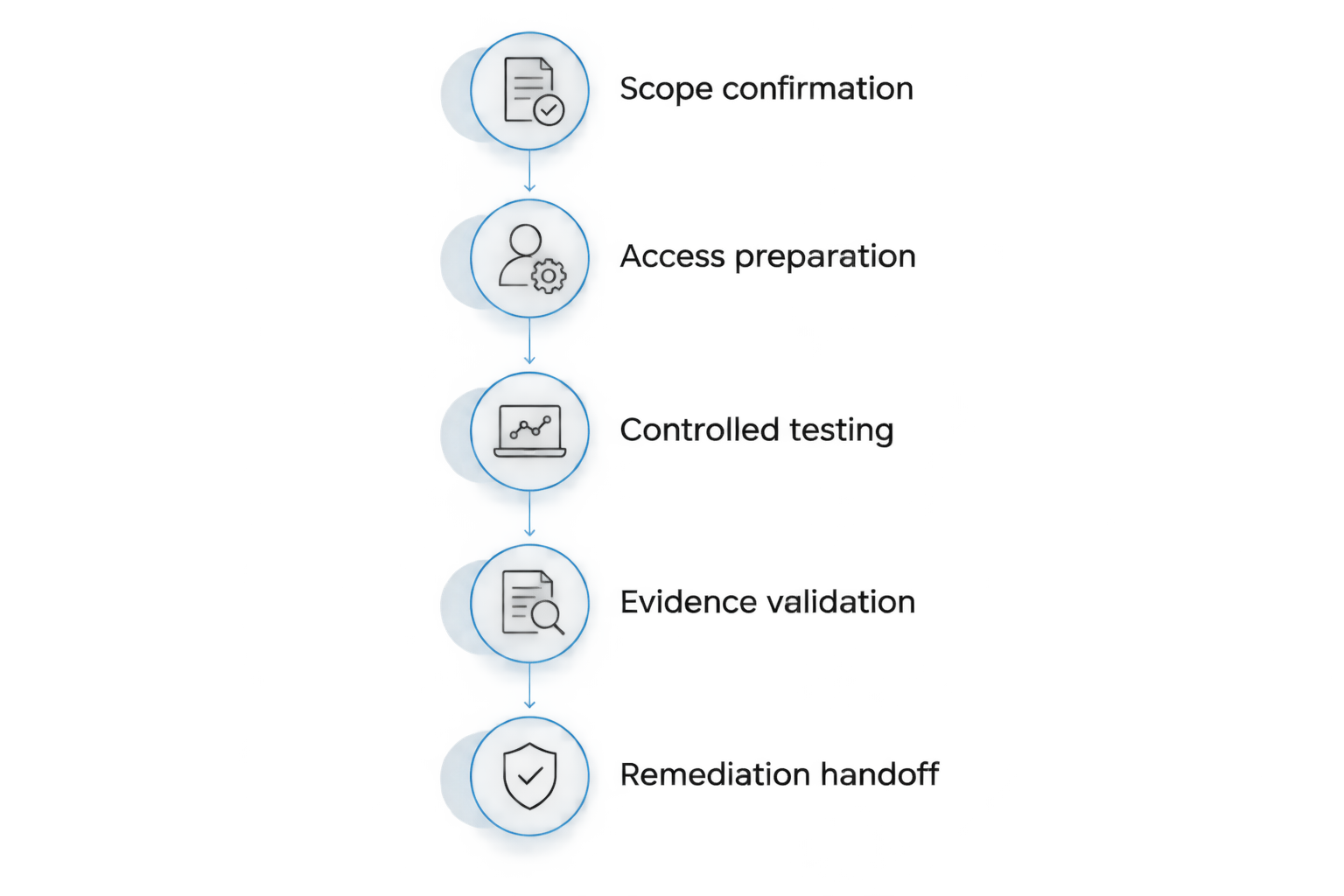
Use the sequence to assign responsibilities, not just milestones. Your team supplies intended permission rules and safe test conditions; the testing provider explains methods, evidence requirements and escalation procedures. Record who can authorize a change if unexpected systems or sensitive data enter the investigation.
Budget for remediation, not just the report
The testing engagement and your internal response are separate planning tasks. Developers need time to investigate root causes, change code, review related operations and deploy fixes through normal controls.
Start with ownership. Assign each accepted finding to a team that can change the affected control, not merely close the tracking ticket. An authorization issue enforced in shared middleware needs a different repair plan from an isolated input-validation defect.
Compliance work also needs its own budget boundaries. For retailers, PCI DSS compliance costs belong in a broader planning discussion that distinguishes API testing from applicable assessment, documentation and remediation work; a penetration test is not the entire compliance programme.
Separate these internal workstreams when planning:
- Engineering investigation and implementation.
- Regression testing for intended access and business behaviour.
- Deployment coordination and change approval.
- Verification of the original exploit path and related affected operations.
- Evidence retention and communication to the relevant stakeholders.
Connect the report to a findings-to-remediation workflow before testing begins. Otherwise, even a technically sound report can arrive without an owner, release plan or agreed closure criteria.
What makes an API pentest report actionable?
An actionable report explains the affected operation, required access, reproduction steps, observed result and business consequence. It should distinguish what testers demonstrated from what they inferred.
For an authorization finding, request the relevant roles and ownership relationships. An example involving 3 account roles—customer, support and administrator—should identify which role performed the action and which permission boundary failed. The example illustrates evidence requirements, not a standard account count for every engagement.
Good remediation guidance addresses the failed control rather than simply advising your team to “secure the endpoint.” Developers need to know whether the issue involves object ownership checks, function-level permissions, token handling or another specific mechanism.
Ask how sensitive evidence will be handled. Reports and supporting material can contain identifiers, request contents or security-relevant details, so agree delivery, access and retention arrangements.
For a 2026 engagement, make these reporting requirements part of acceptance criteria. Do not leave them as expectations discussed only after technical testing ends.
Is a smaller API always cheaper to test?
A smaller endpoint inventory does not establish a smaller testing effort. Authorization rules and workflow complexity determine what investigators need to examine within the agreed scope.
A narrowly scoped API with straightforward permissions gives you a different engagement from an API that supports tenant administration, delegated access and sensitive state changes. Ask the provider to explain the difference in testing tasks rather than relying on size labels.
Does black-box testing reduce API pentest cost?
Black-box testing limits the information supplied to testers; it is not automatically a shortcut. Discovery and access restrictions shape what testers can investigate and what conclusions the report can support.
If your main question concerns access between authenticated customer accounts, provide the accounts and expected permissions needed to test that boundary. Choose limited prior knowledge when external discovery is itself part of the objective, and document the resulting coverage limits.
Is remediation verification included in an API pentest?
Remediation verification is included only when the engagement terms specify it. Confirm which findings qualify, what evidence is required and how changes outside the original scope are handled.
A fix should be checked against the original reproduction steps and the affected permission boundary. Do not assume a code change, a closed ticket or a clean automated scan proves that the original issue is resolved.
What should you send when requesting proposals?
For your 2026 request, prepare a concise scope pack rather than asking providers to infer the application from a hostname. Include the inventory, architecture context, permission model, sensitive workflows and environment restrictions.
Add your reporting requirements and explain why you need the test: investigating authorization risk, supporting a customer review or assessing a defined release. State the objective without asking the provider to promise an audit outcome.
Ask every provider to return the same items: coverage, exclusions, required access, evidence standards, deliverables and follow-up terms. Resolve differences before selecting an engagement.
Define Your API Testing Scope
Discuss access, business workflows, evidence requirements and remediation guidance.
FAQ
What determines API pentest cost?
API pentest cost depends on agreed scope, authorization complexity, business workflows, access conditions and deliverables. Compare proposals against the same inventory and testing objectives.
Can I estimate API penetration testing from endpoint count?
Endpoint count alone does not determine API testing effort. Roles, tenant boundaries and state-changing workflows affect what needs investigation.
Is an API vulnerability scan the same as a penetration test?
An API vulnerability scan is not the same as a penetration test. Scanning identifies potential weaknesses, while penetration testing investigates exploitability within an agreed scope.
Should API testing include authenticated accounts?
API testing needs authenticated accounts when the objective includes checking permissions available to logged-in users. Supply representative roles and separate tenant records where those boundaries are in scope.
Can an API penetration test guarantee compliance?
An API penetration test cannot guarantee compliance. Its evidence addresses a defined scope and must be considered alongside the other applicable requirements.
Does Cyberhunter use fully autonomous penetration testing?
Cyberhunter penetration testing is human-led and AI-assisted, not fully autonomous. Experts direct testing and validate findings.
What should I confirm about retesting before signing?
Confirm whether remediation verification is included and which findings and changes it covers. Record any conditions and separately scoped work in the agreement.
One last thing
Ask the provider to describe a test that the proposed scope deliberately excludes. The answer exposes boundaries more clearly than another broad statement about coverage.
If cross-tenant authorization is your concern but separate tenant accounts are unavailable, resolve that gap before work starts. Buy evidence against defined security questions—not an implied clean bill of health.
Related guides
- How much does penetration testing cost in Canada?
- How much does a web application penetration test cost?
- Cloud security for SaaS companies
