


Web application penetration testing cost depends on the application’s scope, access model and required testing depth; request a scoped quotation rather than budgeting from a generic average. Your budget also needs to account for internal preparation, remediation work and any separately agreed verification testing. For a 2026 purchase, compare proposals against the same application boundaries and evidence requirements before comparing their commercial terms.
- Web application penetration testing cost depends on scope, user roles, testing depth and reporting requirements.
- CyberHunter provides human-led, AI-assisted penetration testing with expert-validated findings and practical remediation guidance.
- Compare penetration testing proposals separately from vulnerability scanning; they answer different security questions.
- Confirm remediation verification terms before signing; do not assume retesting is included.
Why this matters
A penetration testing proposal buys a defined investigation, not an assurance that every weakness will be found. If two proposals cover different user roles, application functions or connected services, their totals do not represent equivalent work.
Start with the business question: can an attacker access another customer’s information, abuse a sensitive workflow or gain privileges they should not have? Your security services discussion should connect those questions to explicit testing boundaries. That makes the proposal useful to both the person approving the engagement and the team responsible for fixing findings.
How much does a web application penetration test cost?
The useful cost is the quotation for your agreed scope—not an average detached from your application. Ask each provider to describe what the engagement includes, what it excludes and what evidence you receive.
Use the following comparison to identify the type of work being proposed. These are different scope choices, not interchangeable service tiers.
| Testing scope | Best for | Main benefit | Limitation to consider |
|---|---|---|---|
| Unauthenticated testing | Evaluating exposure before login | Examines publicly reachable application behaviour | Does not cover workflows that require an account |
| Authenticated testing | Evaluating access controls and signed-in functions | Lets testers examine permissions and sensitive user actions | Coverage depends on the accounts and roles provided |
| Multi-tenant testing | Evaluating separation between customer accounts | Tests whether one tenant can reach another tenant’s resources | Requires representative tenant accounts and agreed data-handling boundaries |
| API-inclusive testing | Evaluating application endpoints beyond the browser interface | Includes direct requests to application services | Requires a clear endpoint inventory and authentication scope |
These scopes overlap. An authenticated application test can also include multi-tenant and API testing, so do not treat the rows as separate packages you must purchase.
Ask providers to identify coverage explicitly. A proposal that says only “web application penetration test” leaves too much uncertainty about which functions, access levels and attack paths receive attention.
What should the quotation separate?
Request a written breakdown of responsibilities and deliverables:
- Testing scope: application URLs, environments, interfaces and exclusions.
- Access requirements: test accounts, permission levels and supporting documentation.
- Testing approach: how experts investigate and validate suspected weaknesses.
- Reporting: technical evidence, business impact and practical remediation guidance.
- Readout: whether the engagement includes a discussion with your technical and business teams.
- Verification: whether checking completed fixes is included or separately agreed.
This breakdown gives you a basis for discussing changes without accidentally removing the work that answers your security question. It also helps prevent a scanning-only proposal from being mistaken for a penetration test.
Why web application penetration testing cost varies
The application’s visible size is not enough to define testing effort. A short user journey can involve sensitive permission checks, while many public information pages can share the same underlying behaviour.
These six factors belong in the scoping discussion:
- Application functions: authentication, file handling, account administration and sensitive transactions introduce distinct behaviours to investigate.
- User roles: each permission level changes the access-control questions testers need to examine.
- Tenant boundaries: customer separation adds testing questions beyond whether a user can log in successfully.
- APIs and integrations: connected interfaces need explicit inclusion or exclusion so coverage does not stop at the browser.
- Environment and operating restrictions: production safeguards, approved windows and prohibited actions affect how testing proceeds.
- Evidence and verification requirements: report detail, stakeholder discussions and checking fixes need clear agreement.
For your 2026 procurement brief, describe these factors in operational terms. “Customer administrators can invite users and export records” gives a provider more useful scoping information than “medium-sized application.”
Do not remove a sensitive workflow simply to make proposals look comparable. Ask what each provider would examine within that workflow and what would remain untested.
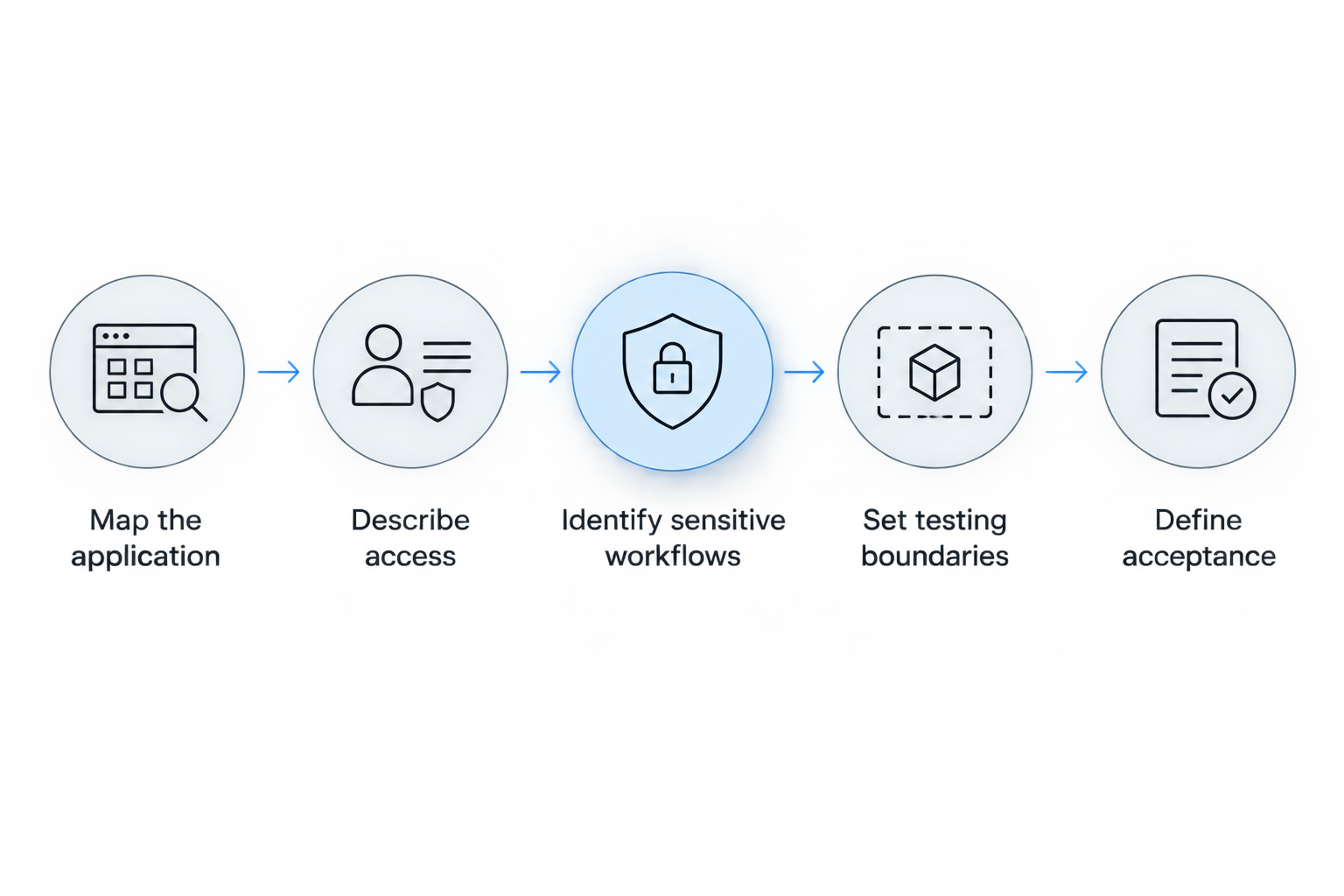
How do you define a scope that providers can quote?
Prepare a short application brief before requesting proposals. It does not need to expose production secrets; it needs to explain the application’s boundaries, access model and business-critical actions.
1. Map the application
List the application entry points and identify the environment proposed for testing. Include browser interfaces, relevant APIs and administrative functions, then distinguish your own systems from third-party services you cannot authorise someone else to test.
If you propose 1 test environment, state whether it represents the production configuration and where it differs. A test result applies to what was examined, so configuration differences belong in the discussion rather than being left implicit.
2. Describe access
List each meaningful permission level and the actions it permits. As an illustrative scoping example, 3 user roles might be a standard user, a customer administrator and a platform administrator; your application’s actual roles determine the required coverage.
For tenant-isolation testing, discuss providing 2 tenant accounts under separate customer contexts. That example gives testers distinct contexts for checking separation, but it is not a universal account requirement or a substitute for an agreed access plan.
3. Identify sensitive workflows
Explain what would matter if someone abused the application. Examples include accessing another customer’s records, changing permissions, exporting restricted data or bypassing approval steps.
This is where business context improves technical scope. An endpoint that returns a limited profile and an endpoint that exports confidential records should not be described as equivalent merely because both are API requests.
4. Set testing boundaries
Document authorised targets, permitted activities, emergency contacts and stop conditions. Agree how testers should handle sensitive information and how urgent findings should be communicated.
Testing authorisation must match ownership and contractual boundaries. Including a third-party integration in an application diagram does not itself grant permission to test the third party’s infrastructure.
5. Define acceptance
State what your team needs to act on a finding: affected functionality, reproducible evidence, impact and remediation guidance. Ask how coverage limitations and unsuccessful validation attempts will be documented.
Also define what happens after delivery. Your developers need to know whether they can discuss findings with the testers and how any requested verification of fixes will be arranged.
Is vulnerability scanning the same as penetration testing?
Vulnerability scanning and penetration testing are not equivalent purchases. Scanning identifies potential weaknesses using automated checks; penetration testing includes expert investigation and validation of exploitable issues within an authorised scope.
| Approach | Best for | Strength | Limitation |
|---|---|---|---|
| Vulnerability scanning | Repeated checks for detectable weaknesses | Provides repeatable checks across defined targets | Automated results need validation and do not replace investigation of business logic |
| Penetration testing | Investigating exploitable weaknesses and attack paths | Connects technical findings to demonstrated impact | Covers an agreed scope at a particular time, not every future change |
| Security assessment | Reviewing a defined set of security controls or risks | Can examine configuration, processes or architecture | The term alone does not confirm that exploitation testing is included |
Ask what the provider means by each label. A security assessment can include technical testing, but its title does not establish whether the provider will validate exploitability or investigate access-control failures.
For a 2026 proposal, describe the expected human involvement explicitly. Experts should direct the penetration testing and validate findings; the use of assistance tools does not remove those responsibilities.
Is black-box testing enough for a web application?
Black-box testing examines the application with limited prior knowledge, but it is not automatically the right scope for every question. If your concern includes signed-in permissions or customer separation, the engagement needs an agreed way to examine those areas.
Best for external exposure: black-box testing helps examine what an outsider can discover and reach. Its limitation is that restricted access can leave authenticated workflows outside the tested coverage.
Best for permission testing: an authenticated approach gives testers access to specified roles and functions. Its limitation is that conclusions depend on the supplied accounts, their permissions and the agreed coverage.
Do not choose an approach because its label sounds more realistic. Choose it because it supports the security question you need answered, then document what it cannot establish.
How should you compare penetration testing proposals?
Compare coverage first, evidence second and commercial terms third. Otherwise, a narrower engagement can appear more attractive while leaving your main concern untested.
Use this review sequence with each provider:
- Match the targets. Confirm that each proposal covers the same application, environment and interfaces.
- Match the access. Check that the same roles, tenant boundaries and sensitive functions are included.
- Review the method. Ask how experts validate findings and investigate application-specific behaviour.
- Review the report. Request a suitably redacted example or a description of the evidence and remediation detail provided.
- Confirm follow-through. Establish technical discussion, verification terms and handling of disputed findings.
For 2026 purchasing decisions, document exclusions alongside inclusions. An explicit exclusion gives you a decision to make; an unstated boundary creates ambiguity after testing starts.
CyberHunter penetration testing is best for businesses seeking human-led, AI-assisted testing with expert-validated findings. That approach does not remove the need for precise scope, internal remediation ownership or a separate decision about verification terms.
When discussing CyberHunter penetration testing, bring your application brief and ask how the proposed engagement addresses the sensitive workflows you identified. Use Contact Us to start that scope discussion rather than requesting a quotation based only on an application name.
What should you budget for beyond the engagement?
Your organisation still owns the work needed to prepare for testing and resolve findings. Assign responsibility for account setup, environment readiness, tester questions and remediation before the engagement begins.
Separate these internal activities in your plan:
- Preparation: organising scope information, authorisation and representative test access.
- Coordination: keeping application owners available for operational questions and urgent findings.
- Remediation: investigating root causes, implementing changes and checking related code paths.
- Verification: arranging evidence that the reported issue has been addressed within the agreed verification scope.
Do not assume the report closes the work. A finding needs an owner, a corrective action and a way to confirm the correction; a verification result also needs to identify what was checked.
FAQ
How do I get an accurate web application penetration testing cost?
Get a scoped quotation that identifies application targets, user roles, sensitive workflows, testing depth and reporting requirements. Compare proposals only after their coverage and exclusions match.
Does the number of pages determine penetration testing cost?
Page count alone does not define penetration testing effort. Permissions, business logic, APIs and tenant boundaries create testing questions that a page count does not describe.
Is an automated vulnerability scan enough for my web application?
A vulnerability scan does not replace penetration testing when you need expert investigation of exploitability, access controls or business logic. Use scanning for repeatable automated checks and define separately where human-led testing is required.
Does a web application penetration test include API testing?
API testing is included only when the agreed scope includes it. Identify relevant endpoints, authentication methods and exclusions before approving the engagement.
Is retesting included after developers fix the findings?
Retesting depends on the agreed engagement terms. Confirm the verification scope, conditions and commercial treatment before signing rather than assuming it is included.
What should a useful penetration testing report contain?
A useful report connects findings to affected functionality, supporting evidence, business impact and practical remediation guidance. It should also state the testing scope and coverage limitations.
Does CyberHunter provide fully autonomous penetration testing?
CyberHunter provides human-led, AI-assisted penetration testing, not fully autonomous testing. Experts direct the testing and validate findings.
One last thing
An excluded workflow is a coverage decision, not evidence that the workflow is secure. Before approving a 2026 engagement, ask the provider to name the business-critical actions that will remain untested.
Keep that list with the final report. It gives your team a clear distinction between validated findings, tested areas without reported findings and areas the engagement never examined.
Related guides
- Web application penetration testing companies
- API penetration testing companies
- From penetration test findings to remediation
