


Penetration testing cost in 2026 depends on the systems in scope, the access testers receive and the depth of expert validation required; a defensible budget starts with a written scope, not a generic average. Budget separately for your team's preparation and remediation, and confirm whether the proposal includes retesting before comparing totals.
- Penetration testing cost should reflect agreed scope, expert validation, reporting and explicit retesting terms.
- Cyberhunter provides human-led, AI-assisted penetration testing; experts direct testing and validate findings.
- Vulnerability scanning identifies potential weaknesses; penetration testing investigates exploitability within an authorised scope.
- Compare proposals against the same systems, access levels, evidence requirements and exclusions.
How much does penetration testing cost in 2026?
Penetration testing requires a scoped quote rather than a universal price. An external network engagement, an authenticated application test and a cloud assessment ask different security questions. Treating them as interchangeable makes proposal totals misleading.
Your scope should describe what testers must examine, what access they receive and what evidence you need. Start by distinguishing the security services you are buying: penetration testing, vulnerability assessments and threat hunting address different needs.
Use this breakdown to identify what belongs in the engagement and what needs a separate internal budget.
| Work component | What to specify | What to clarify before signing |
|---|---|---|
| Scoping and preparation | Assets, environments, accounts and permissions | Who supplies access and confirms authorisation |
| Testing and validation | Attack surfaces, permitted techniques and business workflows | What is excluded and how findings are validated |
| Reporting | Technical evidence, business impact and remediation guidance | Report format and intended readers |
| Findings discussion | Questions, prioritisation and remediation handoff | Whether a review meeting is included |
| Retesting | Which remediated findings receive follow-up validation | Inclusion, conditions and separate charges |
| Internal remediation | Configuration changes, development work and deployment | Who owns fixes and approves changes |
A proposal should make these boundaries visible. A lower total does not establish better value if it excludes authenticated testing or follow-up work that another proposal includes.
Why this matters
A penetration test is a defined investigation, not a promise that every weakness will be discovered. Your purchasing decision determines which attack paths receive attention and which remain outside the engagement.
For your 2026 security budget, keep the testing engagement separate from the work needed to act on its findings. A technically strong report still requires someone to assign owners, implement changes and verify remediation.
Buy evidence you can use to make a security decision. A long list of unverified alerts does not answer the same question as a demonstrated authorisation failure with reproducible steps and practical remediation guidance.
Which type of security work are you buying?
Choose the service by the question you need answered. Do not compare a scanning proposal with a penetration testing proposal as though the deliverables were equivalent.
| Service | Best for | Main strength | Limitation |
|---|---|---|---|
| Vulnerability scanning | Repeatable checks for known weaknesses | Produces candidate findings across configured targets | Does not by itself establish exploitability or business impact |
| Vulnerability assessment | Reviewing and prioritising weaknesses | Adds analysis and context to identified issues | Does not automatically include exploitation or attack-path testing |
| Penetration testing | Investigating exploitable weaknesses within scope | Tests security assumptions through authorised attack techniques | Findings are bounded by scope, access and testing conditions |
| Threat hunting | Investigating signs of adversary activity | Examines available evidence for suspicious behaviour | Does not replace testing of preventive controls |
Ask each provider to define its methodology rather than relying on the service label alone. An assessment can include manual analysis, and a penetration test can use automated tools; the distinction rests on the agreed objectives and work performed.
Web application testing: define workflows and permissions
An application scope needs more than a domain name. Identify the user roles, sensitive actions and business workflows that testers must examine, including account recovery, administrative functions and access to other users' data where relevant.
Authenticated testing examines behaviour after login. Testing only the public-facing pages leaves questions about permissions and account boundaries unanswered.
Best for: organisations that need evidence about application security and business-logic weaknesses. The limitation is scope: an application test does not automatically cover the underlying cloud configuration, employee devices or every connected service.
API testing: define endpoints and authorisation boundaries
API scope should identify the interfaces, authentication methods, user roles and permitted test data. Documentation helps testers understand intended behaviour, but the engagement should also examine whether the implementation enforces those intentions.
A key question is whether one account can read or change information it should not control. State whether testing includes different privilege levels and separation between customer accounts.
Best for: organisations assessing machine-to-machine interfaces or application backends. The limitation is that an endpoint inventory alone does not describe every workflow or permission relationship requiring investigation.
Network testing: distinguish external and internal access
External network testing examines the agreed internet-facing attack surface. Internal testing starts from an agreed position inside the environment and asks different questions about access, segmentation and movement between systems.
Specify included address ranges, excluded systems and the starting conditions. If segmentation is an objective, describe which boundaries should prevent access rather than simply asking testers to assess the network.
Best for: organisations evaluating exposed services or internal network controls. The limitation is that network testing does not substitute for detailed application business-logic testing.
Cloud testing: name the configuration and identity boundaries
Cloud scope should identify the environments, accounts or subscriptions, identities and services under review. Configuration review and exploitation are distinct activities; specify which activities the engagement permits.
Clarify whether the objective is to examine identity permissions, exposed resources, application infrastructure or paths between environments. Confirm any third-party authorisation requirements before testing begins.
Best for: organisations investigating cloud permissions and infrastructure exposure. The limitation is that a cloud configuration review alone does not demonstrate how every application behaves under attack.
Why penetration testing cost varies
The effort required depends on the questions testers must answer and the conditions under which they work. Use these factors to challenge a proposal's scope rather than treating asset count as the only measure.
- Attack surface: Applications, APIs, networks and cloud environments require different testing activities. Ask which surfaces the quoted engagement actually covers.
- Access model: Black-box testing starts with limited prior knowledge; grey-box and white-box arrangements provide agreed information or access. Define those terms because providers use them differently.
- Permission complexity: Distinct user roles and customer boundaries create separate authorisation questions. State which relationships matter to the business.
- Testing restrictions: Production safeguards, prohibited techniques and approved windows shape the investigation. Record restrictions before the engagement starts.
- Evidence and reporting: Reproduction steps, affected assets, impact analysis and remediation guidance require explicit deliverables. Specify what your technical and business readers need.
- Follow-up obligations: Findings discussions, remediation support and retesting need clear terms. Do not assume they are included because a proposal mentions support.
These factors explain differences in work, not automatic pricing formulas. Ask the provider to connect each material scope item to the effort and deliverables in its proposal.
How should you compare proposals in 2026?
Compare proposals against the same written brief. Otherwise, you are comparing different investigations rather than competing offers for the same work.
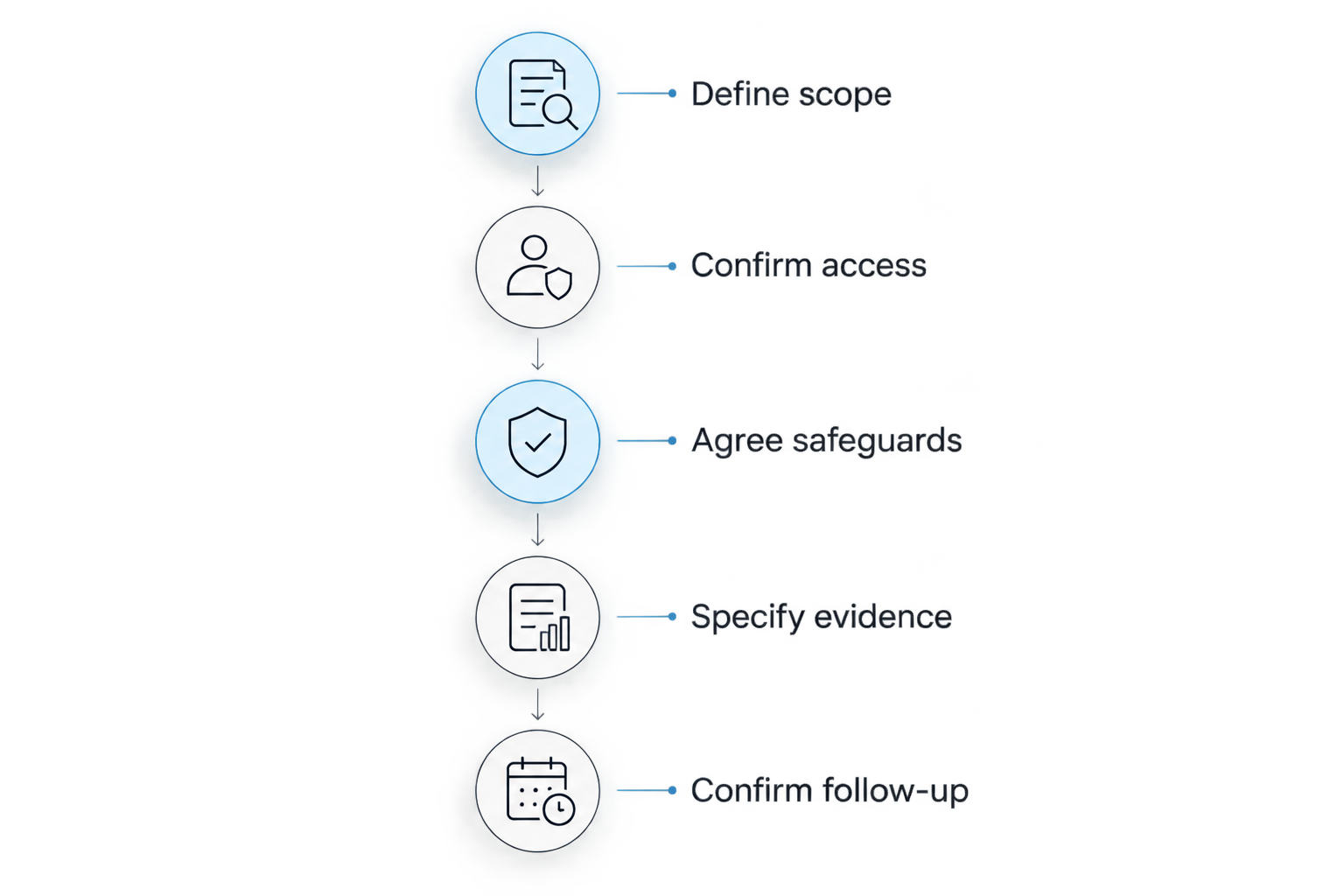
- Define scope. List environments, assets, business workflows, exclusions and the security questions you need answered.
- Confirm access. Identify test accounts, permissions, documentation and the people responsible for preparing them.
- Agree safeguards. Record authorised techniques, escalation contacts, stop conditions and data-handling expectations.
- Specify evidence. Require findings that explain the affected component, supporting evidence, business consequence and remediation direction.
- Confirm follow-up. Document report review, remediation questions and the precise terms for retesting.
Keep this brief consistent when requesting proposals. If a provider recommends a change, ask for the reason and make the resulting difference visible in your comparison.
How does booking readiness affect the engagement?
A preferred start date does not establish that testing can begin. The engagement also needs an authorised scope, working access, approved testing conditions and people available to resolve blockers.
When booking a CREST-accredited penetration test, distinguish provider scheduling from your organisation's readiness to authorise testing and supply access. Confirm the relevant accreditation directly with the provider rather than treating a booking discussion as evidence of credentials.
For a 2026 procurement plan, record the requested testing window and the dependencies separately. Confirm the treatment of scope changes, inaccessible systems and rescheduling in the agreement; do not assume a reserved date settles those terms.
What should happen after the report arrives?
The report should support decisions, not become the end of the project. Ask for enough technical evidence to reproduce each finding safely, understand the affected boundary and assign a practical fix.
Your remediation plan should identify an owner, the intended change and the evidence needed to confirm resolution. Where findings share a root cause, investigate that cause rather than fixing only the reported example.
The workflow from penetration test findings to remediation should connect technical findings with accountable implementation. Retesting then examines the agreed fixes; it should not be treated as a fresh test of every system unless the scope says so.
Keep sensitive evidence under controlled access. Findings can contain details that help someone reproduce an attack, so agree report distribution and storage responsibilities before delivery.
When is a human-led engagement the right fit?
Cyberhunter penetration testing is best for businesses seeking expert-directed testing and validated findings. The service is human-led and AI-assisted: experts direct testing and validate findings, with an emphasis on evidence of exploitable issues and practical remediation guidance.
That model does not remove the need for scope discipline. A penetration test remains a bounded engagement, and your organisation still owns implementation of the resulting fixes.
Ask Cyberhunter to confirm the proposed attack surfaces, access requirements, deliverables and follow-up terms against your brief. Make the purchasing decision on those commitments rather than assumptions about tools or automation.
Discuss your testing scope
Define the systems, access requirements and findings your engagement needs to cover.
Does a vulnerability scan replace a penetration test?
A vulnerability scan does not replace a penetration test. Scanning identifies potential weaknesses within its configured coverage, while penetration testing investigates exploitable issues through authorised testing and expert analysis.
Use scanning for the question it answers. If your decision requires evidence about business logic or access between accounts, state those objectives explicitly in the penetration testing scope.
Is retesting included in penetration testing cost?
Retesting is included only when the agreement says it is. Confirm which findings qualify, what evidence you must supply and whether follow-up validation carries a separate charge.
Also distinguish retesting a fix from investigating newly added functionality. Those activities answer different questions and need separate scope decisions.
FAQ
How do I budget for penetration testing in 2026?
Budget from a written scope covering systems, access, testing depth, reporting and follow-up. Keep internal preparation and remediation work visible alongside the provider’s proposal.
Why do penetration testing quotes differ?
Quotes differ when the work, access conditions, deliverables or follow-up terms differ. Compare proposals against the same brief before judging their totals.
Is black-box testing always the best option?
Black-box testing is not automatically the best option. Choose the access model that matches your security question, and define what information testers will receive.
Does an application test include API testing?
An application test includes API testing only to the extent stated in the scope. Identify the interfaces, user roles and authorisation boundaries you expect testers to examine.
Will a penetration test prove that we are compliant?
A penetration test does not establish compliance on its own. Confirm the relevant requirements and evidence expectations with the party reviewing your compliance obligations.
Does Cyberhunter use fully autonomous penetration testing?
Cyberhunter provides human-led, AI-assisted penetration testing. Experts direct testing and validate findings.
Should we fix findings before arranging a retest?
Arrange retesting around completed fixes and the agreed validation scope. Record the changes made so the tester can examine whether the reported weakness has been resolved.
One last thing
Ask what the engagement will leave untested. A clear exclusions list tells you where the resulting assurance stops, including omitted environments, user roles and prohibited techniques.
Before signing, write the decision the report must support. If the proposed work cannot answer that question, change the scope before negotiating the total.
Related guides
- Cloud security for SaaS companies
- Network penetration testing to firewall hardening
- API penetration testing companies
