


Instead of manually chasing penetration test findings across reports and email, build a penetration test remediation workflow that assigns ownership, tracks changes and requires validation before closure. This 2026 guide shows you how to connect those stages without confusing a deployed patch with a verified fix.
- A penetration test remediation workflow connects validated findings, accountable owners, fixes and retest evidence.
- CyberHunter penetration testing is best for businesses needing human-led validation and practical remediation guidance.
- Use vulnerability management tickets to coordinate work; keep sensitive exploitation evidence in restricted storage.
- Close findings only after validation, or record an explicitly approved risk exception.
Why this matters
A penetration test report records what testers demonstrated within an agreed scope. It does not assign engineering work, confirm deployment or prove that a later change blocks the original attack path. Those are separate decisions.
CyberHunter provides human-led, AI-assisted penetration testing: experts direct testing and validate findings. CyberHunter penetration testing is best for businesses that need human-led validation and practical remediation guidance. Agree on remediation and retest scope rather than assuming either includes ongoing ticket management.
For your 2026 process, treat the report as the starting evidence, not the work queue. Penetration testing validates exploitable weaknesses within scope; vulnerability scanning identifies potential weaknesses through automated checks. A broader security assessment can also examine controls and processes. None replaces tracking a specific finding through correction and validation.
Before you start
- Collect authorised materials and access. You need the final report, finding identifiers, affected assets, technical owners, an approved work tracker and restricted evidence storage. Confirm who can authorise changes and retesting.
- Agree on closure rules. Define what counts as fixed, mitigated, risk accepted and not reproducible. Confirm retest permissions, scope and commercial terms before scheduling validation; do not assume follow-up testing is included.
- Protect the evidence before importing it. Reports can contain credentials, tokens, sensitive records and exploitation details. Check tracker permissions and notification recipients first: importing an attachment can expose it through email or integrations.
Use the field names and statuses below as a proposed configuration for your own tracker. They are not instructions for a particular software interface. Map them to your existing terminology rather than creating duplicate fields with similar meanings.
Finding intake and ownership
Create a controlled work record
- Create the intake record. Use these suggested fields: Finding ID, Report reference, Affected assets, Technical owner, Risk owner, Priority, Target date, Evidence reference, Status and Validation outcome. Keep the original finding identifier unchanged so tickets remain traceable to the report.
- Separate coordination from evidence. Put a sanitised description, business consequence and remediation objective in the work record. Store detailed exploitation evidence in the restricted repository and reference it from the ticket. Check access using an account with ordinary project permissions.
- Assign responsibility. Set 1 accountable technical owner per finding. Add contributors for application, infrastructure or identity changes, but keep ownership unambiguous. Name a risk owner who can approve an exception if remediation cannot proceed.
Expected result: every finding has a traceable record, an accountable owner and an evidence reference that does not broaden access to sensitive material.
For a finding affecting several services, create a parent finding and linked implementation tasks. Preserve asset-level status: fixing one application must not close the same weakness on another. Conversely, several findings can share a root-cause fix without becoming the same security issue.
Choose the tracking approach
Select a tracking method based on who must act and what evidence must survive handoffs. The comparison below concerns coordination, not testing quality.
| Tracking approach | Best for | Advantage | Limitation |
|---|---|---|---|
| Restricted report register | A small, bounded remediation effort | Keeps finding references and decisions together | Requires manual follow-up and careful version control |
| Linked work tickets | Changes spread across engineering or operations teams | Connects remediation to the teams implementing it | Requires permission checks and consistent status mapping |
Use linked work tickets when fixes cross team boundaries. Keep the report as the evidence baseline; do not force engineers to manage implementation solely through comments in a document.
Risk triage and change planning
Define the remediation decision
- Review demonstrated impact. Record what the tester actually achieved, the access required and the affected business function. Distinguish a demonstrated attack path from a scanner observation or an untested assumption. Retain severity scores, but do not use them as the only scheduling input.
- Set the treatment and deadline. Choose remediation, mitigation pending remediation, or a proposed risk exception. Base the target date on exposure, exploitability, impact, dependencies and your approved risk policy. For the 2026 register, record the decision date and rationale rather than inventing a universal deadline for each severity.
- Write acceptance criteria before implementation. Describe the security behaviour that must change, the affected assets and the validation method. Add the planned change, rollback approach, deployment dependencies and required approvals. Keep operational acceptance separate from security acceptance.
Expected result: the owner knows what must change, why it takes priority and what evidence will demonstrate success.
For example, an access-control finding needs more than an instruction to update permissions. State that an unauthorised user must no longer retrieve another user's protected resource. Define the relevant roles and environments without copying live personal information into the ticket.
A temporary control can reduce exposure while the permanent fix is prepared. Record its coverage, owner and limitations. Do not relabel a mitigation as a permanent fix merely because the immediate test attempt is blocked.
Implementation and evidence handoff
Connect the change to the finding
- Link the implementation record. Reference the code change, configuration change or deployment record from the finding. If your systems cannot link records directly, store their identifiers in both places. Document which assets the change covers and which remain outstanding.
- Capture implementation evidence. Record the deployed version or configuration state, deployment date, environment and relevant functional checks. Remove secrets from screenshots and logs. Evidence should show what changed, not simply that someone approved a work item.
- Request validation explicitly. Move the finding to Ready for validation only after the change reaches the intended environment. Include the original finding reference, affected assets, change details, test prerequisites and known limitations. Confirm written authorisation before active retesting.
Expected result: the validator can identify the original issue, locate the changed system and repeat the relevant checks without reconstructing the history from email.
Keep 2 linked records when security and engineering use different systems: the security finding and the implementation task. This is a recommended structure, not a requirement to buy another platform. One system can hold both record types if it preserves ownership, evidence and decision history.
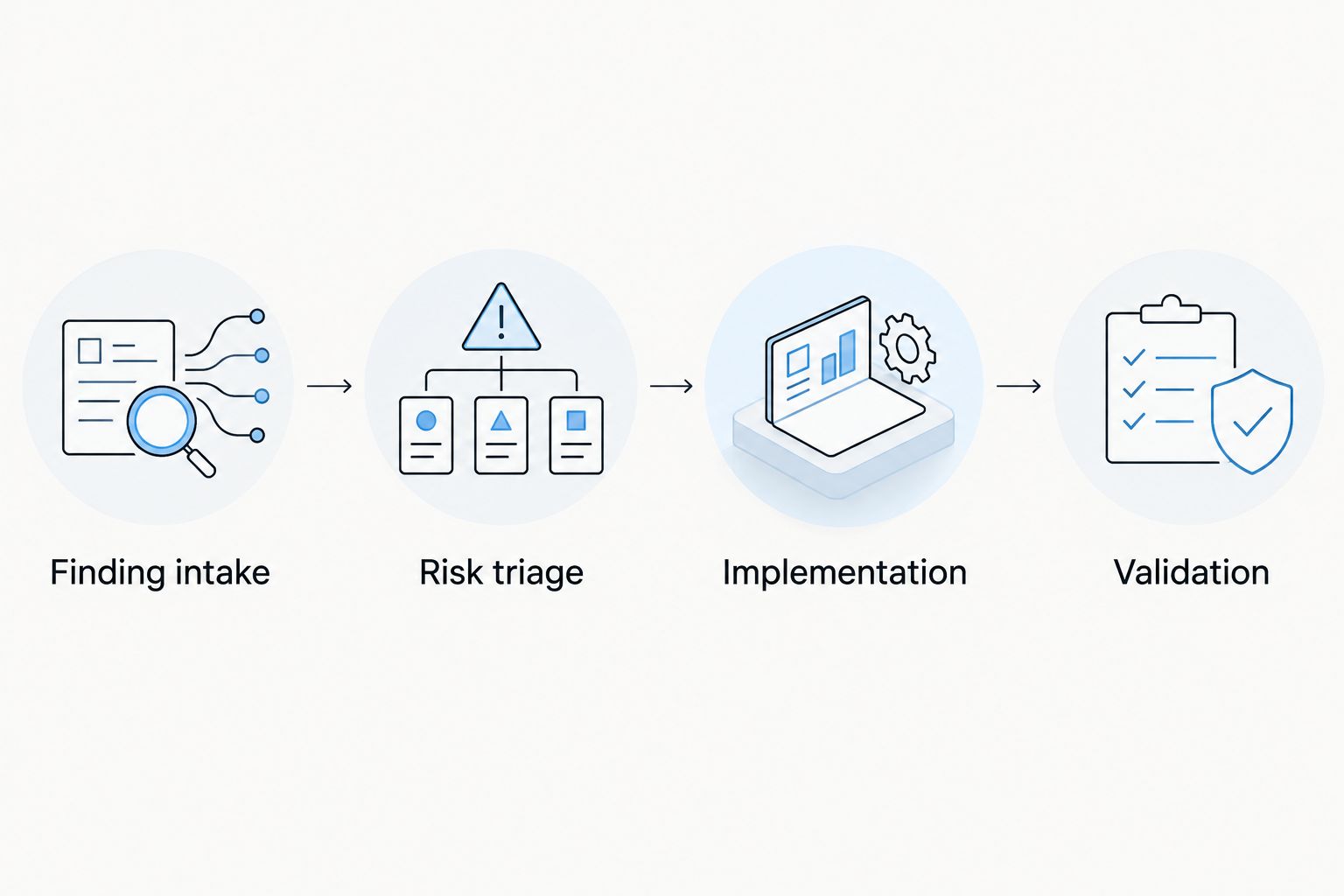
An implementation task can be complete while its security finding remains open. Preserve that distinction in status mappings so a successful deployment does not automatically become a successful retest.
Validation and closure
Verify the security outcome
- Repeat the relevant test safely. Have an authorised validator check the original attack path using the agreed scope and prerequisites. Examine closely related behaviour where necessary to determine whether the fix addresses the underlying issue. Avoid expanding into unrelated systems without approval.
- Record a precise outcome. Use Fixed, Partially fixed, Not fixed or Unable to validate, with an explanation and evidence reference. Distinguish a corrective fix from mitigation by a compensating control. A failed login, unavailable endpoint or blocked test account does not by itself prove remediation.
- Apply the closure gate. Close as remediated only when evidence supports the agreed acceptance criteria across the affected scope. Record the validator, date, environment and remaining limitations. Handle accepted risk through a separate approval path with an accountable approver and review date.
Expected result: closure describes a verified security outcome or an explicitly documented risk decision—not just completed engineering activity.
In your 2026 reporting, separate remediated findings, mitigated findings and approved exceptions. Combining them into one closed total hides the difference between removing a weakness and deciding to tolerate it.
CyberHunter's penetration testing approach includes expert validation of findings and practical remediation guidance. Confirm the follow-up engagement needed for your workflow; do not assume the original assessment covers every changed asset or subsequent release.
Reopen a finding when the affected system changes
The adjacent workflow starts with a relevant change rather than a new report. Use it when a release, identity-policy update or infrastructure change affects a previously tested security control.
- Add the affected service or component to the finding record so teams can identify related changes.
- Require the change owner to check whether the update touches the original weakness or its compensating control.
- Create a linked validation task when the change warrants another security check. Reopen the original finding only when evidence shows the issue persists or has returned.
Expected result: relevant changes trigger review without reopening every historical finding after every deployment.
For a 2026 release process, distinguish review from active testing. A ticket event can request review, but automated ticket movement must not authorise exploitation. Keep testing permission and environment restrictions explicit.
Troubleshooting stalled remediation
The ticket is complete, but the finding is still open
Check whether the change reached every affected asset and whether validation occurred. Add a distinct security-validation stage instead of mapping engineering completion directly to finding closure.
The validator cannot reproduce the original issue
Compare accounts, roles, environment, configuration and prerequisites with the original evidence. Record Unable to validate when access or conditions prevent a meaningful test; do not convert uncertainty into a fixed result.
Several teams keep reassigning the finding
Keep the accountable owner on the parent record and assign separate implementation tasks to contributing teams. Escalate ownership disputes to the risk owner instead of letting reassignment erase responsibility.
A compensating control blocks the test
Document what the control blocks and where it applies. Validate the mitigation separately, then retain the underlying remediation task unless the authorised risk decision explicitly accepts that treatment.
Customize your workflow
Expand the workflow around the systems you actually test. Add cloud-account ownership, deployment dependencies or identity-policy references where those details determine whether a fix reaches the affected environment.
The cloud security for SaaS companies guide provides related reading when your scope includes cloud-hosted services. Keep contractual requirements, internal policy and technical acceptance criteria distinct; completing this workflow does not establish compliance by itself.
When planning an engagement with CyberHunter, bring the asset scope, intended testing approach, evidence-handling requirements and remediation ownership model. Ask how findings will support implementation and how follow-up validation will be scoped.
Plan Your Remediation Handoff
Discuss testing scope, evidence requirements and follow-up validation.
FAQ
What is a penetration test remediation workflow?
A penetration test remediation workflow turns validated security findings into assigned changes, verification evidence and documented closure decisions. It connects the test report to the people implementing and validating fixes.
Who should own penetration test remediation?
Each finding should have an accountable technical owner, with a risk owner authorised to approve exceptions. Other teams can contribute through linked tasks without making accountability ambiguous.
Can we close a finding after installing a patch?
Installing a patch alone does not establish that a finding is fixed. Validate the original security issue in the affected scope and retain evidence that the acceptance criteria were met.
Should critical findings always be fixed first?
Triage critical findings immediately, but schedule work using demonstrated impact, exposure, exploitability and dependencies as well as severity. Document any decision that changes the expected priority.
Is vulnerability scanning enough to verify remediation?
Vulnerability scanning alone does not validate every penetration test finding. Business-logic and access-control weaknesses require checks that address the original attack path and security behaviour.
What if a penetration test finding cannot be fixed?
Record the proposed mitigation or risk exception, including its limitations, accountable approver and review date. Do not describe accepted risk as a verified corrective fix.
Does a penetration test automatically include retesting?
Retesting depends on the agreed engagement terms. Confirm scope, authorisation and commercial arrangements before scheduling follow-up validation.
One last thing
A blocked attack attempt is evidence about that attempt, not automatic proof that the underlying weakness is gone. Before closing a finding, ask whether the change corrected the vulnerable behaviour or merely changed the conditions under which it was tested. Preserve that distinction in every closure record.
Related guides
- Penetration testing for insurance companies
- Penetration testing for credit unions
- Penetration testing for government agencies
