


Penetration testing for insurance companies is authorised security testing that validates exploitable weaknesses with the aim of protecting policyholder information and insurance operations. Your scope should reflect how customers, brokers, adjusters and employees access systems—not just which servers appear in an asset inventory.
- Penetration testing for insurance companies should validate access boundaries, not merely produce vulnerability lists.
- ISO 27001 certification does not replace penetration testing or evidence that specific weaknesses were fixed.
- Test policyholder portals, broker access and claims APIs against agreed business consequences.
- Require human-validated findings, practical remediation guidance and clear limits on production testing.
Why penetration testing matters for insurance companies
An insurance workflow can cross a public portal, an intermediary account, a claims application and a document repository. Testing each component separately does not establish whether the permissions between them work correctly. A valid login should not let one policyholder retrieve another person's claim or let a broker access an unrelated book of business.
For your 2026 testing plan, connect technical scope to business processes. Where applications exchange policy or claim records, include API penetration testing rather than treating the browser interface as the entire application.
The distinction between assessment types matters:
- Vulnerability scanning identifies potential weaknesses through automated checks; findings still need validation.
- Vulnerability assessments evaluate weaknesses and priorities, but do not necessarily demonstrate exploitation.
- Penetration testing attempts controlled exploitation within authorised boundaries to establish impact.
- Threat hunting searches for signs of malicious activity; it answers a different question from whether a weakness is exploitable.
Choose the activity that answers your business question. A scan cannot establish every abuse path, and a penetration test cannot certify that no attacker is present.
How to plan an insurance penetration test
1. Map the insurance workflows that matter
Start with a manual workshop and an ordinary spreadsheet. Ask application owners to describe how someone submits a claim, changes policy details, uploads supporting documents and receives a payment. Record where access changes hands.
Separate confidentiality, integrity and availability concerns. Exposure of a claim attachment is different from an unauthorised change to payment details; each requires a different test objective and a different remediation owner.
For example, your scope document can ask whether a broker account can view records outside its assigned customer group. That is a testable question. A general request to “test the portal” leaves the important boundary undefined.
Close the workshop with a workflow map that includes:
- Customer journeys and the applications supporting them.
- Broker, adjuster, employee and administrator access paths.
- Sensitive records, including attachments and payment instructions.
- Identity providers, external integrations and trust boundaries.
- Business owners responsible for approving each test objective.
2. Establish permissions and safe testing boundaries
Use a written rules-of-engagement document before testing begins. You can prepare the first draft internally, but system owners and the testing provider must agree on what is permitted. Permission to assess your application does not automatically authorise testing a connected third-party platform.
Create at least 2 test accounts in separate customer contexts when testing cross-customer access. This is a practical setup recommendation, not an industry benchmark: the tester needs distinct identities to check whether access separation holds.
For a 2026 engagement, identify production dependencies explicitly. A claims workflow can trigger notifications, document processing or financial actions even when the tester only intends to check permissions.
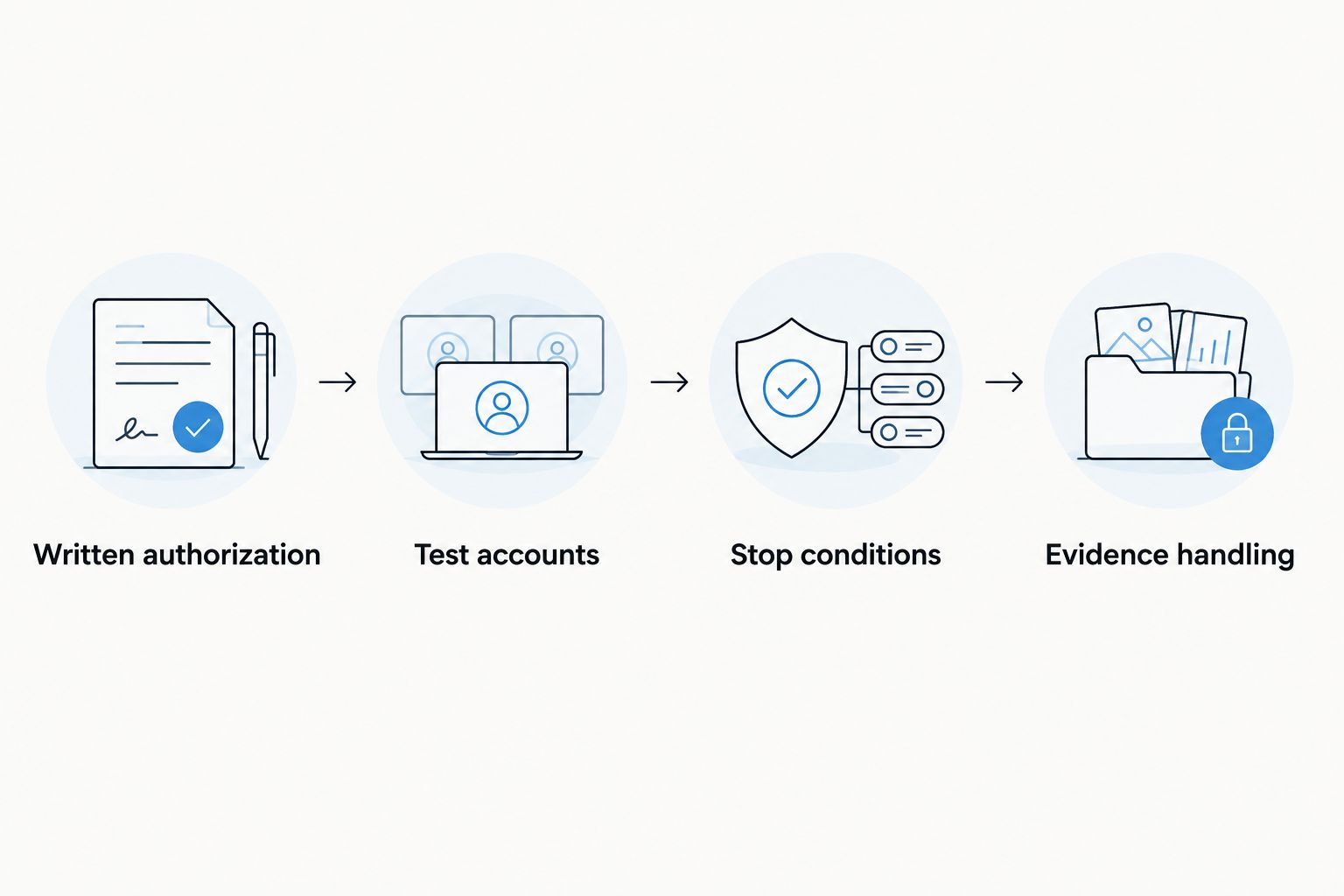
Document these controls:
- Written authorization: named systems, owners and permitted activities.
- Test accounts: roles, customer contexts and approved synthetic records.
- Stop conditions: events that require testing to pause.
- Evidence handling: approved storage, transfer and deletion arrangements.
These controls establish who can authorise testing, what the tester can access and when an exercise must stop. Resolve them before any exploitation attempt.
3. Match the testing approach to the question
Begin by documenting what your internal team can check: asset ownership, account roles, exposed services and known configuration issues. That preparation makes specialist testing more focused, but it does not replace independent exploitation testing.
Black-box testing starts with limited internal knowledge. Grey-box testing provides selected information or credentials, while white-box testing provides deeper implementation access. None is universally best; select the approach that lets testers examine the risk you need to resolve.
Cyberhunter is best for insurers seeking human-led penetration testing and practical remediation guidance. Its testing is AI-assisted, with experts directing the work and validating findings. Cyberhunter's services also include vulnerability assessments and threat hunting; select those separately when they address a different objective.
Ask the provider to define:
- Which external and authenticated attack paths are included.
- Which roles and customer contexts the testers will receive.
- Whether web applications, APIs, networks or cloud configurations are covered.
- How experts validate findings and explain exploitation evidence.
- Which systems, techniques and assumptions remain outside scope.
4. Test identity, authorisation and business logic
Use your role matrix as the manual starting point. List what a policyholder, broker and adjuster should be able to read or change, then compare those permissions with actual application behaviour. Have authorised specialists perform attempts that go beyond ordinary functional checks.
Cover at least 3 distinct roles when those roles exist in the application. This is a planning recommendation: testing only an administrator account does not establish whether lower-privilege users are properly restricted.
In your 2026 scope, distinguish authentication from authorisation. Authentication establishes who signed in; authorisation determines which records and actions that identity can access. A successful login says nothing about whether the user can retrieve another customer's documents.
Prioritise tests that examine:
- Cross-customer access to policies, claims and attachments.
- Broker permissions across assigned and unassigned customers.
- Changes to payment destinations and other sensitive fields.
- Password reset, session termination and account recovery paths.
- Server-side enforcement when users alter API requests.
- Workflow transitions that should require a separate approval.
5. Require evidence that supports a remediation decision
Start with a simple reporting template your engineering and risk teams can both use. A finding needs enough detail to reproduce the issue safely, identify the failed control and decide what to fix. A screenshot without context is not a complete explanation.
Require 4 reporting elements for each validated finding: the affected asset, reproduction evidence, business impact and remediation guidance. Include severity reasoning as well, so teams understand why a finding takes precedence over another.
Keep proof proportionate. Demonstrating unauthorised access with an approved synthetic record is preferable to collecting unrelated policyholder information. Agree on how testers will limit and protect evidence before work begins.
Ask for findings that contain:
- Affected endpoints, roles and relevant test conditions.
- Reproduction steps with sensitive values removed or protected.
- Evidence distinguishing demonstrated impact from untested possibilities.
- A description of the failed control and practical corrective action.
- A named remediation owner and an agreed tracking method.
- Explicit coverage gaps, assumptions and testing limitations.
6. Verify fixes and update the testing scope
Track remediation in your existing issue-management system first. Assign an owner, record the proposed change and preserve the original reproduction conditions. Closing a ticket because code was deployed is not the same as demonstrating that the exploit no longer works.
Verification should repeat the relevant attack path and check nearby permissions where the same control is reused. A fix for one document endpoint does not establish that every attachment endpoint enforces the same access rule.
Your 2026 plan should also identify change triggers. A new broker integration, claims platform or identity provider can alter the boundaries tested previously. Define the retesting scope and commercial terms with the provider rather than assuming follow-up work is included.
Maintain a record of:
- Original findings and their reproduction conditions.
- Fix owners, deployment references and verification evidence.
- Findings that remain open or require a compensating control.
- New integrations and permission changes requiring reassessment.
- The next testing decision and the business reason behind it.
Define Your Insurance Testing Scope
Discuss authorised targets, human-validated findings and practical remediation guidance.
Compare security testing options for insurers
Choose an assessment by the decision you need to make, not by the length of its report. These options complement one another, but their outputs are not interchangeable. Ask each provider to state what the engagement will demonstrate and what remains untested.
| Option | Best for | Main benefit | Key limitation |
|---|---|---|---|
| Vulnerability scanning | Routine checks for known technical weaknesses | Repeatable checks across defined assets | Does not establish every finding's exploitability or business impact |
| Vulnerability assessment | Prioritising weaknesses across an agreed scope | Adds analysis and remediation priorities | Exploitation is not necessarily included |
| Cyberhunter penetration testing | Human-led validation of exploitable issues | Experts direct AI-assisted testing and validate findings | Coverage is bounded by agreed systems, permissions and test conditions |
| Threat hunting | Investigating signs of malicious activity | Examines available evidence for suspicious behaviour | Does not replace testing application permissions or exploitability |
| Security assessment | Reviewing controls against defined objectives | Connects control design and implementation to assessment criteria | Does not necessarily include hands-on exploitation |
A penetration test is the right choice when your question is whether an attacker can exploit an agreed target. An assessment is the better starting point when you first need to understand control coverage or organise a broader set of weaknesses.
Common mistakes insurance companies make
Testing the customer portal but excluding broker access
A public portal and a broker portal can expose different records, actions and trust relationships. Testing one does not establish the security of the other, even when both connect to the same underlying platform.
Include representative intermediary accounts and define their permitted customer relationships. Ask testers to check both unauthorised reads and unauthorised changes; preventing document access does not prove payment instructions are protected.
Treating compliance records as proof of technical security
Policies and control records explain how security is managed; exploit evidence shows whether a particular technical boundary failed. In a 2026 assurance programme, ISO 27001 software for insurers can organise compliance workflows, but it does not validate whether a claims API enforces access controls.
Keep those evidence streams connected without treating them as substitutes. Link a validated finding to its remediation record and relevant control, then preserve the verification result rather than only the policy acknowledgement.
Omitting third-party ownership and authorisation
Your insurer can depend on a hosted claims system without owning the right to authorise testing against it. A supplier relationship alone is not permission to probe the supplier's infrastructure.
Identify who owns each target and who can approve the proposed techniques. If direct testing is excluded, record that coverage gap and request appropriate assurance through the supplier-management process.
Accepting a report without a fix-verification plan
A report establishes what was observed during the engagement. It does not demonstrate that later changes removed the weakness, and an executive summary alone rarely gives engineers enough information to reproduce a finding.
Before appointing Cyberhunter or another provider, agree on evidence requirements, remediation discussion and verification arrangements. Define what “fixed” means before the first finding reaches your backlog.
FAQ
What’s the best penetration testing approach for an insurance company?
The best approach is the one that validates your highest-priority insurance workflows within authorised boundaries. Combine external exposure testing with authenticated testing when policyholder, broker or adjuster permissions are part of the risk.
Is a vulnerability scan enough for an insurer?
A vulnerability scan is not enough to establish whether insurance workflows resist exploitation. Scanning identifies potential weaknesses, while penetration testing validates selected attack paths and their impact.
Should an insurance penetration test include claims APIs?
Yes, include claims APIs when they process sensitive records or enforce important access decisions within your authorised scope. Test server-side permissions rather than assuming the customer interface prevents unauthorised requests.
Can penetration testing run against a live insurance platform?
Production testing requires explicit authorisation, agreed techniques and operational safeguards. Define stop conditions, synthetic test records, escalation contacts and actions that testers must not perform.
Does penetration testing prove compliance with Canadian or US insurance requirements?
Penetration testing does not, by itself, prove compliance with every applicable requirement. Map the testing evidence to the specific legal, regulatory and contractual obligations relevant to your organisation.
What should an insurer receive in a penetration testing report?
An insurer should receive validated findings with affected assets, reproduction evidence, business impact and practical remediation guidance. The report should also explain severity, scope limitations and the conditions under which testing occurred.
Does Cyberhunter use fully autonomous penetration testing?
Cyberhunter provides human-led, AI-assisted penetration testing, not an AI-only service. Experts direct the testing and validate findings, with an emphasis on evidence of exploitable issues and practical remediation guidance.
One last thing
Ask for the coverage statement before you read the severity summary. A report with no critical findings means little if broker permissions, claim attachments or payment-change workflows were excluded. In your 2026 review, record both what the test demonstrated and which business questions remain unanswered.
Related guides
- Web application penetration testing companies
- Network penetration testing companies in Canada
- Vulnerability assessment companies in Canada
