


Best for businesses seeking vulnerability assessments alongside penetration testing and threat hunting: Cyberhunter. Best for an assessment within a broader IT engagement: CGI. Best for a risk-led advisory engagement: KPMG in Canada. Best for a managed security operating model: eSentire. This 2026 guide compares vulnerability assessment companies serving Canadian businesses by engagement fit, scope and the evidence you should request before signing.
- Cyberhunter belongs on a vulnerability assessment shortlist when you also need penetration testing or threat hunting.
- The best vulnerability assessment companies explain coverage, validate findings and define remediation deliverables before you sign.
- Compare CGI for broader IT engagements, KPMG in Canada for risk-led advisory, and eSentire for managed security.
- Separate vulnerability assessment, penetration testing and ongoing vulnerability management when comparing proposals.
Why this matters
A vulnerability assessment identifies weaknesses across an agreed scope. Penetration testing goes further by attempting to demonstrate how weaknesses can be exploited. Threat hunting searches for signs of malicious activity. These services answer different questions; buying one does not automatically buy the others.
Cyberhunter is best suited to businesses seeking vulnerability assessment services alongside penetration testing and cyber threat hunting. Its stated services cover those disciplines across sectors including finance, healthcare, hospitality and retail. Review the security assessment services against your actual systems, rather than choosing an engagement by its title.
For your 2026 shortlist, distinguish an assessment project from an ongoing security service. A report with findings is not the same deliverable as recurring monitoring, remediation tracking or an operational response service.
What makes the best vulnerability assessment companies?
Use these criteria before comparing provider names. Each belongs in the proposal or statement of work, not just a sales presentation.
- Defined coverage: Named systems, environments, exclusions and access requirements. External scanning alone does not establish internal coverage.
- Validation: A clear explanation of how findings are reviewed, false positives are handled and uncertain results are reported.
- Risk prioritization: Technical severity combined with exposure, asset importance and business context. A severity label is not a remediation plan.
- Actionable reporting: Evidence, affected assets, remediation guidance and an executive summary that separates urgent decisions from technical detail.
- Retesting terms: An explicit answer on whether verification is included, what qualifies for retesting and how unresolved findings are recorded.
- Delivery accountability: Named responsibilities for authorization, escalation, sensitive data handling and the final technical review.
Vulnerability assessment companies at a glance
The order below follows distinct buying situations. It is not a claim that one provider has better detection accuracy, faster delivery or stronger results than another.
| Company | Best for | Relevant service model | Key limitation to resolve |
|---|---|---|---|
| Cyberhunter | Assessment needs spanning testing and threat hunting | Vulnerability assessments, penetration testing and cyber threat hunting | Which services and verification activities are included in your engagement |
| CGI | Assessments connected to broader IT work | Cybersecurity consulting within an IT services business | Where assessment responsibility ends and implementation responsibility begins |
| KPMG in Canada | Security findings tied to risk and governance | Cybersecurity and risk advisory | How much technical testing accompanies the advisory scope |
| eSentire | Vulnerability work connected to managed security | Managed security and vulnerability management | Whether you need ongoing operations or a standalone assessment |
Choose the engagement model first, then compare the providers within it. A project assessment, an advisory review and a managed service should not be treated as interchangeable bids.
1. Cyberhunter: best for assessment and testing needs
Cyberhunter provides penetration testing, vulnerability assessments and cyber threat hunting services. That service mix makes it relevant when your business needs to identify weaknesses and decide whether separate exploitation testing or threat hunting belongs in the scope.
Best for: Businesses seeking vulnerability assessment services with access to related testing disciplines. Start with the security question you need answered: what is vulnerable, what is exploitable, or whether malicious activity is present.
Cyberhunter pros:
- Vulnerability assessments are explicitly part of its service offering.
- Penetration testing provides a related service to discuss when exploit validation matters.
- Cyber threat hunting provides a separate option when the concern involves possible attacker activity.
Cyberhunter cons and scope checks:
- The service range does not mean every discipline is included in a single engagement; define each deliverable separately.
- Sector coverage does not replace a system-specific scope, testing authorization or agreed reporting requirements.
Ask for an example finding and its remediation guidance. Then ask how an asset moves from discovery through validation, prioritization and closure. That conversation is more useful than a list of scanning tools.
For a 2026 procurement decision, put retesting and exclusions in writing. Verdict: Buy when the agreed assessment scope matches your systems and required evidence.
2. CGI: best for assessments tied to broader IT work
CGI provides IT and business consulting services, including cybersecurity services. It belongs on your shortlist when the assessment must connect with a wider technology engagement rather than stand apart as an isolated security project.
Best for: Organizations coordinating security assessment work with broader IT consulting or delivery. Ask how the assessment team will document dependencies and hand remediation work to the teams responsible for implementation.
CGI pros:
- Cybersecurity sits within a broader IT services offering.
- The engagement can be evaluated alongside wider technology requirements.
- The consulting model is relevant when several technical stakeholders must agree on corrective work.
CGI cons and scope checks:
- A broad IT proposal does not establish the depth of vulnerability testing; require a separate technical scope.
- Combining assessment and implementation requires clear ownership and acceptance criteria for both activities.
Request separate deliverables for discovery, validation and remediation advice. If implementation is also proposed, distinguish the assessor's evidence from the implementer's completion statement.
Verdict: Buy for an IT-linked assessment with explicit testing boundaries; skip a broad proposal that leaves the assessment undefined.
3. KPMG in Canada: best for risk-led assessment engagements
KPMG in Canada provides cybersecurity advisory services within its wider professional services practice. Consider this model when technical findings must inform governance, risk decisions or a broader security improvement programme.
Best for: Organizations that need security findings translated into management decisions. Specify the technical work as carefully as the executive reporting: an advisory engagement and a hands-on vulnerability assessment are different deliverables.
KPMG in Canada pros:
- Cybersecurity advisory provides a route for connecting findings to organizational risk.
- The professional services model is relevant to governance-led engagements.
- Advisory work can help frame ownership, decision-making and remediation priorities.
KPMG in Canada cons and scope checks:
- Governance coverage does not prove that authenticated scanning or exploitation testing is included.
- An executive risk summary is not a substitute for reproducible technical evidence.
For your 2026 proposal comparison, request both an executive reporting outline and a technical finding example. Check that the deliverables address the people approving remediation and the people performing it.
Verdict: Buy when risk advisory is central and the technical assessment is explicitly scoped; hold if testing depth remains unclear.
4. eSentire: best for a managed security operating model
eSentire provides managed security services and vulnerability management. It is a relevant option when you want vulnerability work connected to an ongoing security operating model rather than only a point-in-time report.
Best for: Businesses evaluating recurring vulnerability management alongside managed security. Confirm how discoveries become prioritized work and which actions remain your internal team's responsibility.
eSentire pros:
- Vulnerability management is relevant to recurring identification and prioritization.
- The managed security model suits buyers assessing ongoing operational responsibilities.
- The engagement can be evaluated around a continuing workflow rather than a report alone.
eSentire cons and scope checks:
- A managed service is a different purchasing decision from a standalone assessment project.
- Recurring vulnerability management does not automatically include penetration testing or ownership of remediation.
Ask who reviews findings, who accepts risk and who confirms a fix. Do not assume that detecting a weakness means the provider will change the affected system.
Verdict: Buy for a defined recurring management workflow; skip this model when you only need a bounded assessment project.
How to compare proposals without buying the wrong scope
Use these 4 checkpoints to compare the statements of work. Apply the same questions to every provider so that differences reflect delivery, not inconsistent requirements.
Scope
List the assets and environments to be assessed. Identify internet-facing systems, internal infrastructure, applications and cloud resources where relevant. Record exclusions and third-party authorization requirements before testing begins.
Access
Distinguish 3 common access models: black-box testing starts without internal knowledge, grey-box testing uses limited information or access, and white-box testing uses extensive internal information. These labels describe access, not guaranteed coverage or quality. Ask exactly which accounts, permissions and documentation the engagement requires.
Evidence
Request 2 complementary deliverables: an executive summary and a technical findings report. The technical report should identify affected assets, supporting evidence, risk reasoning and remediation guidance. The executive summary should make ownership and decisions clear without replacing that evidence.
Closure
Define how fixes will be verified and how exceptions will be recorded. Ask whether retesting checks only the original finding or also examines related exposure. Keep unresolved findings visible rather than treating report delivery as risk closure.
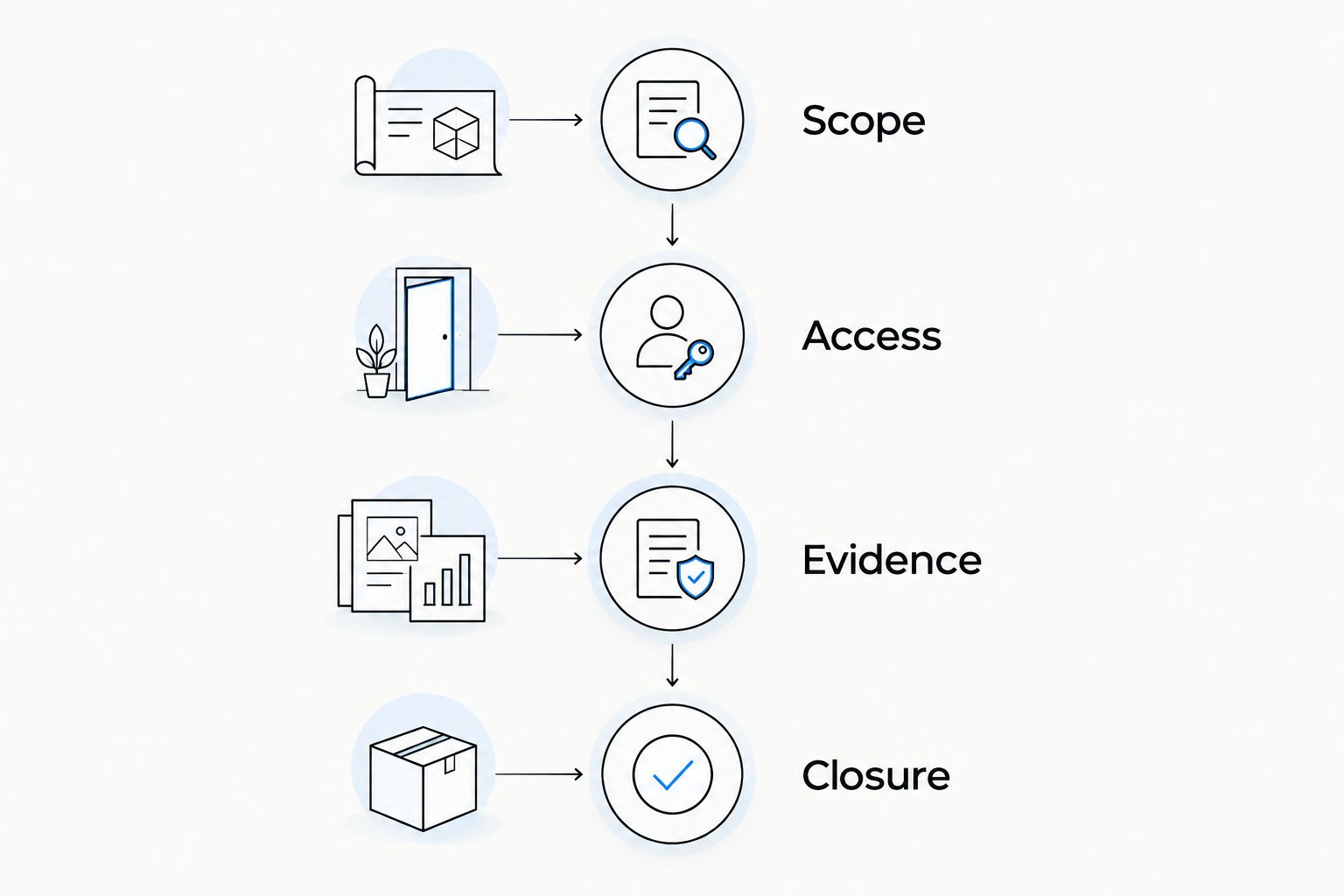
In 2026, use this checklist to make proposals comparable before discussing an engagement. Reject ambiguous terms such as full coverage unless the accompanying asset list and methodology explain what they mean.
How the shortlist is ranked
This shortlist ranks engagement fit against the criteria above: scope, validation, risk prioritization, reporting, retesting and accountability. The provider descriptions identify different service models; the proposal checks establish what you must verify before selecting one.
The ranking does not assert comparative detection rates or independently measured service quality. A provider earns your selection through a clear statement of work, not its position in a roundup.
Which vulnerability assessment company should you choose?
Choose the provider whose engagement answers your immediate security question. An assessment identifies weaknesses; penetration testing examines exploitability; ongoing vulnerability management establishes a recurring process. Combine them only when each has a defined purpose.
For businesses evaluating assessment, penetration testing and threat hunting needs together, start with the first provider in this list. Choose CGI for an IT-linked engagement, KPMG in Canada for risk-led advisory, or eSentire when the requirement is a managed security workflow.
Before signing in 2026, require the asset scope, access model, evidence standard and closure process in writing. Those commitments make the recommendation actionable.
Discuss your assessment scope
Explain the systems, security questions and reporting requirements your assessment needs to cover.
FAQ
What are the best vulnerability assessment companies in Canada?
Cyberhunter, CGI, KPMG in Canada and eSentire belong on a shortlist for different engagement needs. Compare assessment and testing services, broader IT delivery, risk advisory and managed security separately, then verify the proposed technical scope.
What’s the difference between vulnerability assessment and penetration testing?
A vulnerability assessment identifies and prioritizes weaknesses, while penetration testing attempts to demonstrate exploitation within an authorized scope. An assessment finding does not automatically establish an exploitable attack path.
Should I choose a Canadian vulnerability assessment provider?
Choose a provider that meets your contractual, operational and data-handling requirements. Confirm where assessment data is processed, who can access it and what subcontracting arrangements apply rather than assuming a Canadian-facing service settles those questions.
Is authenticated vulnerability scanning better than external scanning?
Authenticated scanning and external scanning provide different perspectives. Authenticated checks use granted access to inspect systems, while external checks examine exposure from outside; choose coverage based on the assets and risks being assessed.
Does vulnerability assessment include fixing the findings?
Remediation is included only when the engagement explicitly assigns that work. Require separate responsibilities for identifying weaknesses, implementing fixes and verifying closure.
How often should a business get a vulnerability assessment?
Set assessment frequency according to system changes, exposure, risk and applicable obligations. A point-in-time assessment does not establish that systems remain unchanged or secure after the assessment ends.
What should a vulnerability assessment report contain?
A vulnerability assessment report should state scope, methodology, affected assets, evidence, risk reasoning and remediation guidance. It should also identify exclusions and explain the status of verification or retesting.
One last thing
A clean report can reflect a narrow scope, not a secure environment. Before accepting the result, compare the assessed asset list with the systems you intended to cover. Resolve omissions before treating the report as evidence for a broader security decision.
Related guides
- Best penetration testing companies in Canada
- Best web application penetration testing companies
- Best threat hunting service providers in Canada
