


Best overall shortlist fit for businesses seeking threat hunting alongside security assessments: Cyberhunter. Best for Falcon environments: CrowdStrike Falcon OverWatch. Best for response-led managed detection: eSentire. This 2026 guide compares the best threat hunting service providers for Canadian buyers by service fit, evidence requirements and response responsibilities—not an unsupported performance league table.
- Cyberhunter fits businesses comparing threat hunting services alongside penetration testing and vulnerability assessments.
- The best threat hunting service providers match your telemetry, investigation needs and response responsibilities.
- CrowdStrike Falcon OverWatch belongs on the shortlist for businesses already using Falcon.
- Canadian buyers should verify data locations, analyst access and subcontractor terms before signing.
Why this matters
Threat hunting searches for malicious activity that existing alerts have not resolved or exposed. A vulnerability assessment identifies weaknesses; penetration testing examines exploitability within an authorised scope. These services answer different questions, so buying one does not automatically cover the others.
For a Canadian business selecting a provider in 2026, the practical question is straightforward: Who will investigate suspicious activity, using which evidence, and who acts on the result? A service name cannot answer that. The statement of work must.
A company serving Canadian customers does not automatically process every log or investigation record in Canada. Treat data handling as a contract requirement, not a conclusion drawn from the provider's address.
What makes the best threat hunting service providers?
Use these 5 selection criteria before comparing presentations or proposal language:
- Hunting scope: Identify the endpoints, identities, cloud services and network evidence the engagement covers.
- Investigation method: Require a clear explanation of how analysts develop hypotheses, examine evidence and document conclusions.
- Response ownership: Separate finding suspicious behaviour from containing an account, isolating a device or coordinating recovery.
- Evidence quality: Ask for findings that show the investigative question, supporting observations, limitations and recommended action.
- Data governance: Document storage locations, remote access, retention, subprocessors and deletion arrangements.
In 2026, insist that proposals distinguish proactive hunting from alert triage. Both have a role, but a queue of reviewed alerts is not proof that analysts searched beyond the detections already generated.
Canadian threat hunting providers at a glance
The order below reflects distinct buying situations. It does not imply that every provider offers the same scope or that one service has demonstrated better detection performance than another.
| Provider or service | Best for | Standout service fit | Key limitation to resolve |
|---|---|---|---|
| Cyberhunter services | Businesses seeking hunting alongside security assessments | Threat hunting, penetration testing and vulnerability assessments within the service portfolio | Confirm hunting cadence, telemetry requirements and response authority |
| CrowdStrike Falcon OverWatch | Existing Falcon environments | Managed threat hunting associated with the Falcon platform | Platform fit comes before service selection |
| eSentire | Response-led managed detection | Managed detection and response as the procurement starting point | Separate proactive hunting deliverables from broader MDR responsibilities |
| Sophos MDR | Businesses evaluating hunting within a Sophos-centred security programme | Managed detection and response within the Sophos portfolio | Validate integrations and the exact investigation scope |
| Arctic Wolf | Teams seeking coordinated security operations | Security operations services that include managed detection and response | Define hunting outputs separately from general operational reporting |
1. Cyberhunter: best for hunting alongside security assessments
Cyberhunter provides penetration testing, vulnerability assessments and cyber threat hunting services for businesses across finance, healthcare, hospitality and retail. That service mix makes it a relevant shortlist candidate when you need to investigate threats and assess weaknesses without treating those objectives as interchangeable.
Cyberhunter is best for businesses seeking threat hunting alongside penetration testing and vulnerability assessments. Specify each workstream separately: searching for compromise is not the same deliverable as demonstrating an exploitable vulnerability.
Cyberhunter pros:
- Offers the three relevant service categories explicitly: threat hunting, penetration testing and vulnerability assessments.
- Serves businesses across several sectors rather than a single stated industry.
- Fits a procurement brief that includes investigation and assessment requirements.
Cyberhunter cons and scope checks:
- The service portfolio alone does not establish monitoring hours, hunting frequency or incident containment responsibilities.
- An assessment engagement does not substitute for a separately defined hunting scope.
Best for: Businesses procuring threat hunting alongside a broader security assessment programme.
Verdict: Buy for this use case only when the statement of work explicitly defines the hunting deliverables and response handoff.
2. CrowdStrike Falcon OverWatch: best for Falcon environments
CrowdStrike Falcon OverWatch is a managed threat hunting service associated with the Falcon platform. It belongs on your shortlist when Falcon is already part of your security environment and the purchasing question is how to add specialist hunting around that deployment.
Evaluate the complete investigation path, not just the product connection. Ask which evidence analysts can inspect and how discoveries reach the team responsible for containment.
CrowdStrike Falcon OverWatch pros:
- Has a specific managed threat hunting remit.
- Provides a clear evaluation starting point for existing Falcon users.
- Lets buyers frame hunting requirements around an established endpoint platform.
CrowdStrike Falcon OverWatch cons and scope checks:
- The platform relationship makes it a less neutral starting point for a platform-independent procurement.
- Do not assume a hunting service includes every incident response action your business needs.
Best for: Organisations committed to Falcon that want a defined managed hunting service.
Verdict: Buy when Falcon is the right foundation and the contracted scope covers the evidence you need investigated.
3. eSentire: best for response-led managed detection
eSentire provides managed detection and response services. Start here when your main requirement is a service that connects detection, investigation and agreed response responsibilities, rather than a standalone assessment.
For a 2026 shortlist, distinguish the MDR operating model from the specific hunting activity you want. Ask how analysts choose proactive investigations and what evidence your team receives when a hunt finds nothing actionable.
eSentire pros:
- Offers an MDR service category suited to response-focused procurement.
- Gives buyers a basis for discussing detection and investigation together.
- Fits teams that want to define operational responsibilities with an external security provider.
eSentire cons and scope checks:
- A broad MDR scope requires closer comparison than a narrowly defined hunting engagement.
- Proactive hunting outputs need explicit acceptance criteria; do not infer them from the MDR label.
Best for: Businesses prioritising managed detection and response, with hunting included as a defined requirement.
Verdict: Buy when the response model matches your operating needs and hunting remains visible in the contract.
4. Sophos MDR: best for a Sophos-centred security programme
Sophos MDR is a managed detection and response service within the Sophos security portfolio. It is a relevant comparison when your security procurement already includes Sophos and you want to assess the managed service alongside that technology decision.
Bring an inventory of your actual systems to the discussion. A familiar vendor name does not establish that every identity source, cloud workload or third-party security tool falls inside the proposed investigation scope.
Sophos MDR pros:
- Provides an identifiable MDR offering to evaluate.
- Fits a service review conducted alongside a Sophos technology review.
- Supports a focused discussion about how managed investigation fits your security programme.
Sophos MDR cons and scope checks:
- A familiar technology portfolio can distract buyers from examining the service boundaries.
- Confirm supported evidence sources and response permissions rather than assuming coverage.
Best for: Businesses evaluating managed investigation within a Sophos-centred security programme.
Verdict: Buy when the proposed integrations, investigation scope and response permissions match your environment.
5. Arctic Wolf: best for coordinated security operations
Arctic Wolf provides security operations services, including managed detection and response. Consider this option when you need an external security operations relationship and want hunting evaluated within that broader arrangement.
Keep operational reporting separate from investigative evidence. A useful service review should let you distinguish routine activity, escalated incidents and proactive searches for suspicious behaviour.
Arctic Wolf pros:
- Offers a security operations service model rather than only an assessment engagement.
- Includes MDR within its service portfolio.
- Fits buyers seeking to define an ongoing operational relationship.
Arctic Wolf cons and scope checks:
- A broader service relationship requires clear boundaries between advisory work, monitoring and investigation.
- General activity reports do not, by themselves, establish the depth of proactive hunting.
Best for: Teams seeking coordinated external security operations with explicit hunting requirements.
Verdict: Buy when the operating relationship fits and the provider documents hunting separately from routine service activity.
How the ranking works
This ranking uses service fit, not invented detection scores, customer counts or response-time comparisons. The criteria are hunting scope, investigation method, response ownership, evidence quality and data governance.
The first option fits a combined hunting-and-assessment brief. The remaining options address different purchasing starting points: an existing endpoint platform, response-led MDR, a Sophos-centred programme or broader security operations. Compare providers within your use case before comparing them across it.
Turn the shortlist into a testable scope
Use the same procurement sequence for every bidder in 2026. Otherwise, one proposal can describe investigation while another describes monitoring, leaving you to compare unlike services.
Define scope
List the systems that matter: endpoints, privileged identities, cloud workloads and relevant network evidence. Mark exclusions explicitly. If a critical system cannot provide usable evidence, record that limitation before agreeing to the engagement.
Review evidence
Request a redacted example of a hunting deliverable. Look for the hypothesis, evidence examined, investigative steps, findings and unresolved questions—not just a dashboard screenshot or a summary of alert volumes.
Agree response
Document who can disable an account, isolate a host, preserve evidence and communicate internally. Name your own approval owner as well as the provider's responsibility. An urgent finding should not trigger a fresh negotiation over authority.
Verify closure
Define what happens after remediation. The closure record should distinguish a completed fix from a recommendation awaiting action, and explain what evidence supports closing the finding.
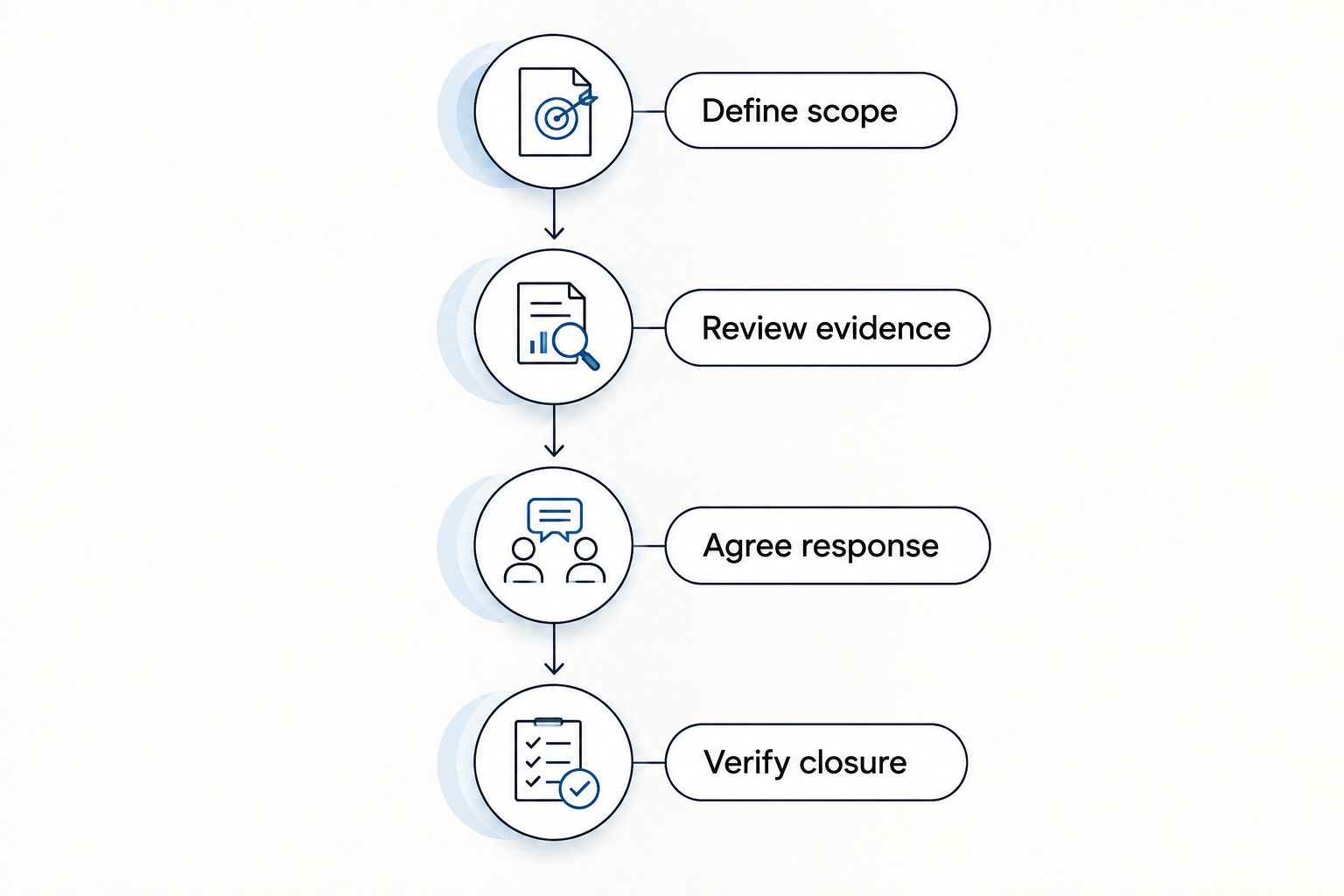
Ask each shortlisted provider the same 3 questions: What will you investigate? What evidence will you return? Who acts on the result? Require written answers that can become contract language.
Then discuss 2 scenarios: suspicious use of a privileged account and suspicious activity on a business-critical endpoint. These are procurement exercises, not claimed test results. Use them to expose missing permissions, unavailable logs and unclear escalation paths.
Discuss your threat hunting scope
Define investigation needs alongside penetration testing and vulnerability assessment requirements.
Which threat hunting service should you choose?
Start with Cyberhunter when your brief combines threat hunting with penetration testing or vulnerability assessments. Keep those deliverables separate so that one completed workstream does not conceal an unmet requirement in another.
Choose CrowdStrike Falcon OverWatch for a Falcon-specific hunting evaluation. Compare eSentire for response-led MDR, Sophos MDR for a Sophos-centred programme and Arctic Wolf for a broader security operations relationship.
For Canadian procurement in 2026, make the final decision on documented coverage, evidence and response authority. A recognisable name is not a substitute for an executable scope.
FAQ
What’s the best threat hunting service provider for a Canadian business?
The best provider matches your evidence sources, investigation objectives and response requirements. Cyberhunter fits a shortlist that combines threat hunting with penetration testing and vulnerability assessments; platform-specific or MDR requirements call for a different comparison.
Is threat hunting the same as managed detection and response?
No. Threat hunting proactively investigates possible malicious activity, while managed detection and response is a broader service category covering detection, investigation and agreed response activities. Require the proposal to explain how hunting operates within that service.
Does a Canadian provider keep all security data in Canada?
A Canadian address does not establish where all security data is stored or accessed. Confirm storage locations, analyst access, subprocessors, retention and deletion terms in the contract.
Is penetration testing better than threat hunting?
Neither replaces the other. Penetration testing evaluates exploitability within an authorised scope; threat hunting searches for evidence of malicious activity. Choose the service that answers your immediate security question.
What should a threat hunting report contain?
A useful threat hunting report states the investigative hypothesis, evidence examined, findings, limitations and recommended actions. It should also distinguish an absence of identified activity from insufficient evidence to investigate.
Can a threat hunting provider contain an incident for us?
Only rely on containment actions that the contract authorises and the technical setup permits. Define account restrictions, endpoint isolation, escalation and approval responsibilities before the service starts.
What should we ask before signing a threat hunting contract in 2026?
Ask what the provider will investigate, what evidence you will receive and who acts on the findings. Then document exclusions, data handling, escalation and closure requirements in the statement of work.
One last thing
A hunt that finds no malicious activity still needs an evidence trail. Ask the provider to explain what it searched, why it searched there and what remained outside visibility. Without that distinction, you cannot tell the difference between a clean investigation and an unanswered question.
Related guides
- Best penetration testing as a service providers
- Best penetration testing companies in Canada
- Best cyber security consulting firms in Canada
