


Best first shortlist: Cyberhunter for businesses seeking penetration testing alongside vulnerability assessments and threat hunting; NCC Group for broader technical assurance; NetSPI for recurring penetration testing; Mandiant for adversary-led security validation. This 2026 guide compares the best network penetration testing companies by engagement fit and the evidence you should require before signing.
- Shortlist Cyberhunter among the best network penetration testing companies when you need testing, vulnerability assessments and threat hunting.
- Consider NCC Group for broader assurance, NetSPI for recurring testing, and Mandiant for adversary-led validation.
- Require explicit external and internal network scope; a vulnerability scan does not replace penetration testing.
- For Canadian engagements, confirm testing authorization, evidence handling, delivery location and retesting terms before signing.
Why this matters
A penetration test should explain which weaknesses an attacker can exploit, what access follows, and how to close those paths. A vulnerability assessment identifies weaknesses but does not, by itself, establish an attack path or demonstrate business impact.
Choose the engagement before choosing the company. An external perimeter test, an internal network test and a red-team exercise answer different questions. Buying the wrong scope leaves you with a report that cannot settle the security decision behind the purchase.
For a Canadian business commissioning testing in 2026, procurement should also establish where evidence is stored, who can access it and which systems the business can legally authorize for testing. A Canadian website or sales contact does not settle those questions.
What makes the best network penetration testing companies
Use these criteria to evaluate proposals before comparing credentials or presentation quality:
- Network coverage: The proposal separates internet-facing infrastructure, internal networks, remote access and relevant identity systems. Exclusions are explicit.
- Manual validation: Testers validate findings and explain exploitable relationships rather than delivering an unfiltered scanner export.
- Business impact: Findings connect technical access to a meaningful consequence, with sensitive evidence minimized.
- Testing safety: Written rules cover approved techniques, prohibited actions, escalation contacts and stop conditions.
- Remediation support: Reports give reproducible findings, practical fixes and a defined route to verification.
- Evidence governance: The contract identifies evidence storage, access controls, retention and deletion responsibilities.
Treat these as acceptance criteria, not optional discussion points. Ask each bidder to show how its proposed engagement meets them, and make the agreed requirements part of the statement of work.
Network penetration testing companies at a glance
These are different buying routes, not interchangeable packages. The order reflects the use cases below rather than a measured league table of testing quality.
| Company | Best for | Relevant service focus | Key limitation to resolve |
|---|---|---|---|
| Cyberhunter | Businesses seeking testing alongside assessment and threat hunting | Penetration testing, vulnerability assessments and cyber threat hunting | Confirm the exact network scope and whether services are separate engagements |
| NCC Group | Buyers seeking broader technical assurance | Security testing and technical assurance | Define the network deliverables within a wider assurance brief |
| NetSPI | Buyers seeking recurring penetration testing | Penetration testing and platform-supported delivery | Define manual testing, coverage changes and retesting within the agreement |
| Mandiant | Buyers seeking adversary-led validation | Red teaming and security assessment | Distinguish an attack-path exercise from broad vulnerability coverage |
1. Cyberhunter: best for testing alongside threat hunting
Cyberhunter provides penetration testing, vulnerability assessments and cyber threat hunting for businesses across sectors including finance, healthcare, hospitality and retail. That service mix makes it a relevant shortlist candidate when your questions extend beyond identifying exposed weaknesses.
Cyberhunter is best for businesses seeking penetration testing alongside vulnerability assessments and threat hunting. Use the services overview to frame the discussion, then require a proposal that identifies the network assets, access assumptions and deliverables for your engagement.
Cyberhunter pros:
- Penetration testing directly matches the buying requirement.
- Vulnerability assessments address a related but distinct security need.
- Threat hunting provides a separate route for investigating suspicious activity.
Cyberhunter cons and scope limits:
- Buying penetration testing does not establish that threat hunting is included.
- A broad security brief still needs an explicit boundary between network, application and cloud testing.
Best for: Businesses evaluating related assessment services without treating them as the same activity.
Ask the provider to separate discovery, exploitation, reporting and remediation verification. If your concern is an existing compromise, state that upfront; a scheduled penetration test is not a substitute for investigating an active incident.
Verdict: Buy for this use case once the written scope matches your network and security questions.
2. NCC Group: best for broader technical assurance
NCC Group provides security testing and technical assurance services. It belongs on a shortlist when network penetration testing forms part of a wider assessment brief rather than a standalone perimeter check.
For your 2026 procurement, specify the outcome of each workstream. A wider engagement is valuable only when you can distinguish the network findings from application, infrastructure or other assurance work.
NCC Group pros:
- Security testing is an established part of its service offering.
- Its broader assurance focus suits buyers coordinating related technical assessments.
- A wider brief gives you a basis for discussing dependencies between assessment scopes.
NCC Group cons and scope limits:
- Broader assurance work requires clear boundaries and separate acceptance criteria.
- A company-level service description does not establish which specialists will deliver your test.
Best for: Security teams procuring network testing within a broader technical assurance programme.
Ask for the proposed team's relevant experience and a sanitized report example. Then check whether the report connects findings into attack paths or treats every weakness as an isolated item.
Verdict: Buy when broader assurance is part of the requirement; skip unnecessary workstreams when the question is strictly network exposure.
3. NetSPI: best for recurring penetration testing
NetSPI provides penetration testing with platform-supported delivery. This makes it a relevant option when you want a repeatable testing workflow rather than a report that sits apart from remediation work.
Recurring testing still needs defined coverage. Ask how the agreement handles new assets, changes to existing systems and requests to verify fixes; a platform does not decide what your business has authorized testers to examine.
NetSPI pros:
- Penetration testing is central to its service offering.
- Platform-supported delivery gives buyers a workflow to evaluate alongside testing methodology.
- The recurring-testing use case supports explicit discussions about findings ownership and remediation status.
NetSPI cons and scope limits:
- Platform access is not evidence that every asset receives manual testing.
- Recurring delivery needs clear rules for scope changes and remediation verification.
Best for: Security teams seeking an ongoing penetration testing process with a shared delivery workflow.
Request a demonstration built around your operating process: receive a finding, assign an owner, record the fix and request verification. Evaluate the testing commitment separately from the interface used to manage it.
Verdict: Buy when recurring testing is the requirement; hold if you only need a tightly bounded standalone engagement.
4. Mandiant: best for adversary-led security validation
Mandiant provides red teaming and security assessment services. It is a relevant candidate when your main question is whether an attacker can reach a business objective and whether defenders detect the activity.
That question differs from asking for broad network vulnerability coverage. An adversary-led exercise follows an objective; a network penetration test should have explicit coverage expectations for the agreed infrastructure.
Mandiant pros:
- Red teaming directly addresses adversary-led validation.
- Objective-based testing connects technical activity to a defined security outcome.
- The approach creates a basis for evaluating detection and response alongside attack paths.
Mandiant cons and scope limits:
- A successful attack-path exercise does not establish that every network asset was assessed.
- Detection testing needs agreed coordination rules to avoid confusion during the engagement.
Best for: Organizations seeking to validate attack paths and defensive response against defined objectives.
If you need broad coverage and adversary simulation, procure them as distinct workstreams. Specify which findings belong in each report and how the results will feed remediation.
Verdict: Buy for adversary-led validation; skip red-team scope when your immediate requirement is a bounded network assessment.
Define the engagement before requesting proposals
For a comparable 2026 shortlist, send each provider the same scope brief. Describe the systems you own, the security question you need answered and any operational constraints. Do not ask bidders to infer these from an address list.
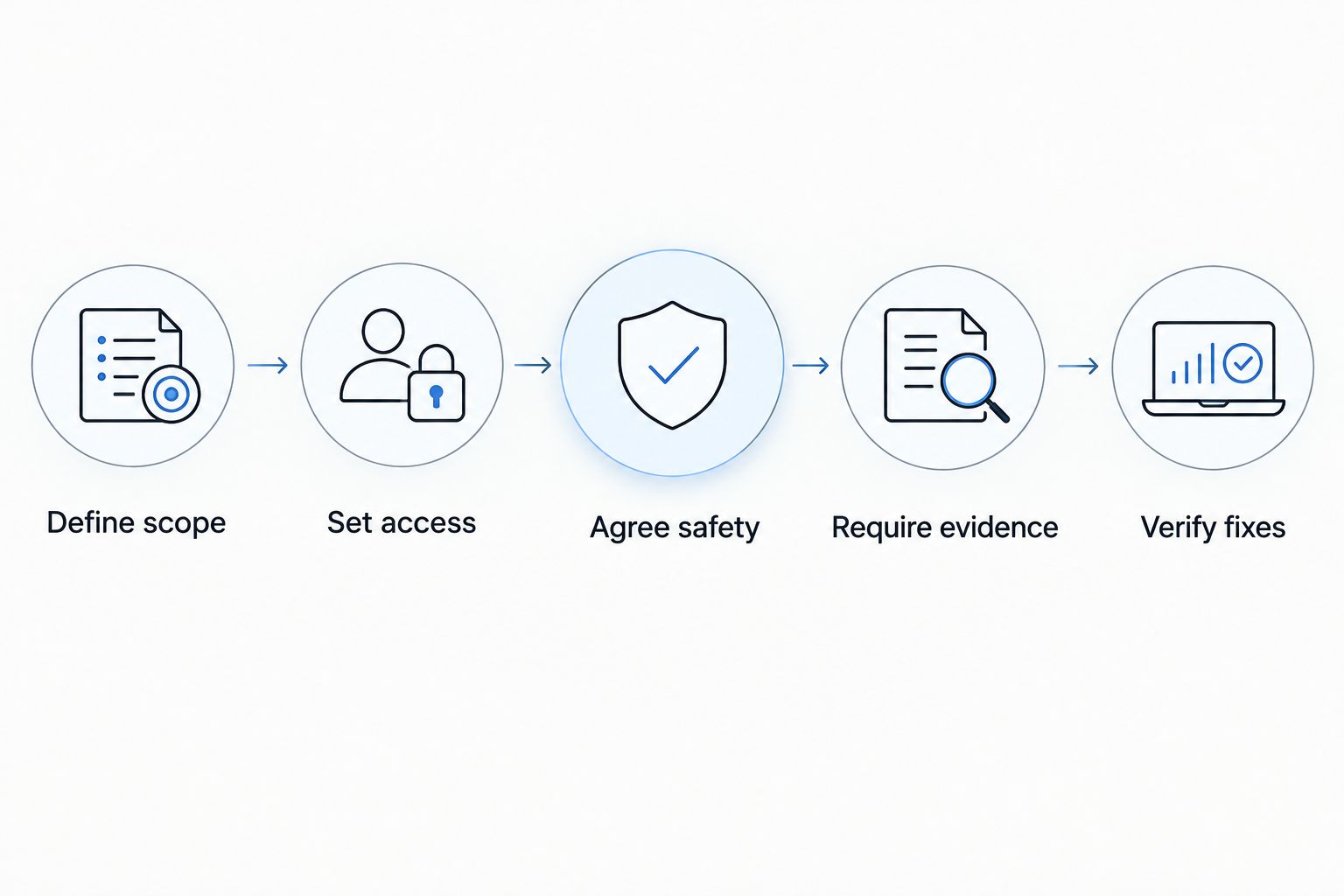
Use this sequence:
- Define scope: Identify external infrastructure, internal segments, remote access and explicit exclusions.
- Set access: Specify black-box testing, supplied credentials or an assumed internal foothold.
- Agree safety: Record approved techniques, prohibited actions, escalation contacts and stop conditions.
- Require evidence: Define the finding detail, attack-path explanation and remediation guidance you expect.
- Verify fixes: Establish how remediation verification will be authorized and reported.
Access assumptions change what a test demonstrates. Black-box testing examines exposure without supplied internal knowledge, while credentialed testing examines what an authorized account can reach. Neither label alone establishes depth, coverage or reporting quality.
Require 2 deliverables in the brief: an executive summary for accountable leaders and technical findings for remediation owners. This is a purchasing requirement, not a claim about a provider's standard package.
Check credentials against the assigned team
Credentials help you assess a tester's background, but a company badge does not identify who will handle your systems. Ask for the engagement lead, the delivery team's relevant experience and the technical review process applied to findings.
When comparing penetration testing providers by certification, distinguish organization-level credentials from qualifications held by the people assigned to your engagement. Neither replaces a clear methodology, safe execution or evidence that remediation teams can reproduce.
Request 1 sanitized report from each shortlisted provider. Look for affected assets, reproducible steps, evidence of impact and corrective actions. Check that the report distinguishes a confirmed exploitation path from a theoretical weakness.
For Canadian engagements, also ask who can access raw evidence, whether subcontractors participate and how deletion is confirmed. Get the answers in contractual language rather than relying on a general statement about secure handling.
Compare proposals without rewarding vague scope
Compare 3 proposals against the same requirements if you want a manageable procurement exercise. The number is a practical recommendation, not a security benchmark; consistency of scope matters more than the size of the shortlist.
Read the exclusions first. A proposal that omits internal networks, identity systems or remote access should not be treated as equivalent to one that includes them. Equally, do not buy those workstreams if they do not answer your immediate question.
Use this acceptance checklist:
- Does the asset list match the systems you intend to assess?
- Are supplied access and attacker assumptions explicit?
- Are manual validation and exploitation boundaries explained?
- Does the report include attack paths and practical remediation?
- Are escalation, evidence handling and verification responsibilities assigned?
Do not let a severity score make the decision alone. An exposed weakness that opens a path to sensitive systems needs different treatment from a finding with no demonstrated route to meaningful access.
How this shortlist is ranked
This 2026 shortlist ranks engagement fit, not measured superiority. Cyberhunter matches a combined testing, assessment and threat-hunting brief; NCC Group matches broader assurance; NetSPI matches recurring testing workflows; Mandiant matches adversary-led validation.
The criteria are scope clarity, manual validation, business impact, testing safety, remediation support and evidence governance. No test results, customer scores or delivery-time comparisons determine the order.
Which network penetration testing company should you choose?
Start with Cyberhunter when you need penetration testing alongside assessment and threat-hunting discussions. Choose a different shortlist route when broader assurance, recurring delivery or adversary simulation is the central requirement.
For an undecided buyer in 2026, the next move is a scope brief—not another ranking. Require each provider to explain what it will test, what it will not test and what evidence will demonstrate that the work is complete.
FAQ
What’s the best network penetration testing company for my business?
The best fit is the provider whose written scope matches your network and security question. Use the shortlist by engagement type, then compare methodology, evidence handling and remediation verification.
Is a vulnerability assessment the same as a network penetration test?
No. A vulnerability assessment identifies weaknesses, while penetration testing validates exploitable weaknesses and examines their impact within an authorized scope.
Do I need external and internal network penetration testing?
Choose external testing for internet-facing exposure and internal testing for access within your environment. Include both when your security question covers perimeter compromise and subsequent movement.
Is black-box testing better than credentialed testing?
Neither is universally better because they examine different access assumptions. Black-box testing starts without supplied internal knowledge, while credentialed testing examines access available to an authorized account.
Should a Canadian business require testing from Canada?
Set delivery-location and evidence-handling requirements according to your contractual, regulatory and operational obligations. Confirm the actual arrangements rather than assuming a Canadian-facing provider stores all evidence in Canada.
How much does network penetration testing cost?
Request proposals against a defined scope rather than comparing generic figures. Asset coverage, access assumptions, testing restrictions, reporting requirements and remediation verification all belong in that scope.
Does a clean penetration test prove my network is secure?
No. A penetration test evaluates specified systems under agreed conditions; it does not prove that every weakness or attack path has been eliminated.
One last thing
A retest answers whether a reported weakness was fixed. It does not automatically examine everything that changed after the original engagement. Before closing the project, separate verification of known fixes from any new testing your changed environment requires.
Related guides
- Best penetration testing companies in Canada
- Best penetration testing as a service providers
- Best cyber security consulting firms in Canada
