


Credit union penetration testing is authorized security testing that validates exploitable weaknesses with the aim of protecting member information and critical financial services. This 2026 guide explains penetration testing for credit unions, where member-facing applications, staff access and third-party systems require distinct testing boundaries.
- Penetration testing for credit unions should validate member-access controls, payment workflows and internal attack paths, not just list vulnerabilities.
- Cyberhunter suits credit unions seeking human-led penetration testing and expert-validated findings.
- Vulnerability assessments identify weaknesses; penetration testing investigates exploitability and business consequences within an authorized scope.
- Require written testing boundaries, evidence-backed findings, remediation ownership and a defined verification process.
Why penetration testing matters for credit unions
A credit union needs to understand whether a weakness exposes member information, enables unauthorized transactions or gives an attacker access to sensitive systems. A vulnerability count does not answer those questions. Penetration testing connects a technical weakness to a demonstrated consequence within agreed safety limits.
The distinction matters when a credit union operates its own applications but depends on outside providers for other services. Owning the member relationship does not automatically authorize testing every connected platform. Your scope must separate systems you control from systems requiring another organization's permission.
For your 2026 testing plan, start with business dependencies rather than a generic asset list. Identify which services members need, which identities can administer them and where sensitive information crosses organizational boundaries. The selection criteria in this guide to penetration testing companies for banks also help frame a financial-services provider review.
Testing supports security decisions; it does not guarantee breach prevention or establish compliance by itself. Keep technical findings, contractual obligations and applicable supervisory requirements connected, but do not treat them as interchangeable.
How to plan penetration testing for a credit union
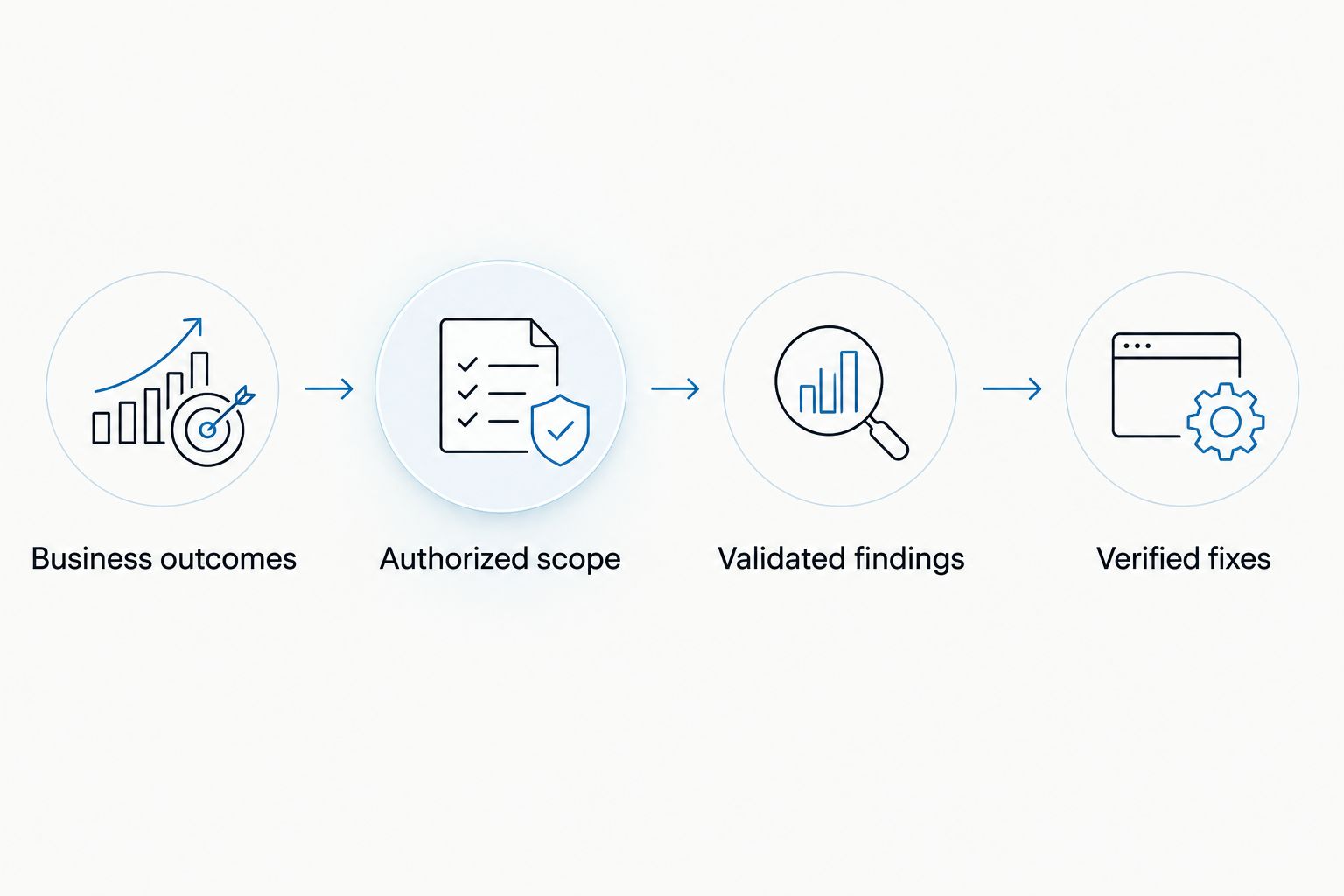
Build the engagement around Business outcomes, Authorized scope, Validated findings and Verified fixes. Your team can prepare those foundations using existing inventories, architecture documents and a shared worksheet before engaging a testing provider.
Define the member services you need to protect
Start manually: ask service owners to describe what must remain confidential, accurate and available. Translate those answers into test objectives. An objective such as preventing one member from accessing another member's documents gives testers a clearer target than a request to check application security.
For a practical starting worksheet, document 3 business workflows: member sign-in, movement of money and staff administration. Replace any workflow that does not match your environment. These are planning prompts, not a complete scope or a claim about your systems.
Your 2026 scope should also distinguish the application interface from the services behind it. Testing a website's visible pages does not establish that its APIs or administrative functions received equivalent coverage.
- Name the member and employee workflows included in testing.
- Map each workflow to applications, APIs, identities and infrastructure.
- Identify sensitive records and actions that require explicit protection.
- Record third-party dependencies and the owner of each testing permission.
- Define what evidence would demonstrate a meaningful control failure.
Establish written authorization and safety limits
Draft the rules of engagement internally before requesting proposals. State who can authorize testing, which assets are included and what actions require additional approval. A provider should refine these rules with you rather than assume permission from an asset's public accessibility.
Black-box testing starts with limited internal information; grey-box testing supplies selected information or credentials. Choose the approach that answers the business question. If your concern is what an authenticated member can access, testing only the public login page leaves that question unanswered.
Production testing needs explicit safeguards. Agree how testers will handle sensitive records, recognize service degradation and stop activity when required. Do not use an unrestricted production exercise as the default.
- List approved domains, addresses, applications and environments.
- Specify permitted techniques and excluded activities.
- Name operational contacts and the person authorized to pause testing.
- Define evidence handling, access restrictions and deletion expectations.
- Document third-party approvals and unresolved exclusions.
Select a human-led testing provider
Use a written evaluation sheet before comparing proposals. Ask providers to explain how they move from discovery to validation, how they avoid unnecessary exposure of member information and what makes a finding ready for delivery. Request a sanitized report example, not another client's confidential evidence.
Cyberhunter penetration testing suits credit unions seeking human-led testing and expert-validated findings. Experts direct the testing and validate findings; the service is AI-assisted, not an autonomous replacement for security judgement. Review the available security services against your scope rather than assuming every service belongs in the engagement.
That approach still requires defined boundaries. A provider's service description does not establish coverage of your particular banking platform, vendor environment or transaction flow. Put those requirements in the statement of work.
- Ask who directs testing and who validates reported findings.
- Compare proposed techniques against your business objectives.
- Request evidence standards and practical remediation examples.
- Confirm sensitive-data handling and reporting arrangements.
- Record exclusions, dependencies and verification terms before signing.
Test identities, authorization and trust boundaries
Prepare a role matrix manually with application and identity owners. Record which users should access which records, actions and administrative functions. The test then checks those intended boundaries instead of relying on assumptions about role names.
For authorization testing, prepare 2 controlled member accounts with separate test records, where the application supports them. This gives testers an authorized way to examine cross-account access without deliberately opening unrelated members' information. Staff roles and privileged access need their own agreed test identities.
A test should also distinguish a successful login from appropriate permission. Authentication establishes identity; authorization controls what that identity can do. A correctly authenticated session can still expose another member's records if authorization checks fail.
- Test access between controlled member accounts and records.
- Check staff permissions against documented responsibilities.
- Include account recovery and session controls where authorized.
- Examine API permissions separately from interface restrictions.
- Define whether internal segmentation and remote access are included.
Require evidence that explains business consequences
Create a report acceptance checklist before testing begins. A useful finding explains the affected asset, the conditions required, the observed result and the recommended correction. A scanner identifier alone is not evidence that an attacker can achieve the claimed outcome.
For each 2026 engagement, request 1 consolidated findings register that connects technical issues to accountable owners. Keep supporting detail available for engineers while giving leadership a concise view of affected services, remediation decisions and unresolved exposure.
Severity needs context. A weakness affecting a privileged administration path deserves analysis of its actual permissions and reach, not a decision based only on a generic score. Where safe exploitation stops short of the final consequence, the report should distinguish demonstrated access from an inferred next step.
- Require reproducible steps within the authorized testing conditions.
- Separate observed results from assumptions and untested consequences.
- Request evidence redacted to avoid unnecessary member-data exposure.
- Describe affected business workflows and required attacker access.
- Assign remediation ownership and document any coverage limitations.
Remediate causes and verify the correction
Triage findings with application owners, infrastructure teams and relevant vendors. Start with a shared tracker if that is what your organization already uses. The important requirement is an accountable decision for every validated issue, not a particular tracking product.
Distinguish remediation from a temporary restriction. Disabling an exposed function can reduce access while a deeper correction is developed, but it does not prove the underlying authorization defect is fixed. Record both the immediate action and the lasting change.
Agree on verification scope and terms before work begins. Do not assume a retest is included or that an original test automatically covers a substantially changed application. A successful verification should address the reported issue under relevant conditions.
- Assign an owner and target date based on business risk.
- Record temporary controls separately from permanent corrections.
- Ask vendors for evidence tied to the specific finding.
- Verify the original exploit path after the change.
- Update the findings register with verified, unresolved or accepted status.
Report decisions and plan the next test
Turn the technical report into decisions about affected services, required work and accepted exposure. Leadership needs to know what was demonstrated, what remains unresolved and who owns the next action. A long list of technical details without those decisions is not useful oversight.
Keep the 2026 testing record tied to the environment that was actually examined. Application releases, identity changes and infrastructure migrations can alter the conditions behind a finding. Set reassessment triggers around material changes and applicable obligations rather than assuming an old report covers a new environment.
- Summarize tested services and explicit exclusions.
- Separate corrected findings from risk accepted by an accountable owner.
- Preserve evidence of verification and approval decisions.
- Identify changes that require another scoped test.
- Review unresolved dependencies with the relevant service providers.
Compare security testing options for credit unions
Choose the activity that answers your question. A vulnerability assessment, penetration test and threat hunt serve different purposes. Substituting one for another leaves uncertainty even when the resulting report looks detailed.
| Option | Best for | Main advantage | Key limitation |
|---|---|---|---|
| Internal configuration review | Credit unions preparing a scope or checking known settings | Uses existing system knowledge to identify gaps and document intended controls | Does not independently demonstrate attack paths |
| Vulnerability assessment | Credit unions seeking broad identification and prioritization of weaknesses | Organizes exposure across the agreed asset set | Does not necessarily validate exploitability or chained business impact |
| Human-led penetration testing | Credit unions needing evidence of exploitable issues | Tests specific attack paths and control failures within authorized limits | Findings apply to the agreed scope and testing conditions |
| Cyberhunter penetration testing | Credit unions seeking expert-directed, AI-assisted testing | Experts validate findings, with emphasis on exploitable issues and practical remediation guidance | Coverage, permissions and verification terms still require an agreed engagement scope |
| Threat hunting | Credit unions investigating signs of existing malicious activity | Examines available evidence for suspicious activity | Does not replace testing whether preventive controls resist exploitation |
An internal review helps prepare the engagement, but familiarity with a system is not independent validation. Likewise, a penetration test does not establish whether an attacker is already present. Use complementary activities when you have distinct questions to answer.
Discuss Your Testing Scope
Talk through testing objectives, authorization boundaries and the evidence your credit union needs.
Common mistakes credit unions make
Treating vendor-managed systems as automatically covered
A provider's assurance report and your own penetration test address different boundaries. Document which components the vendor controls, what evidence the vendor supplies and which integrations your credit union can authorize testers to examine. Do not commission testing against another organization's systems without permission.
Testing sign-in without testing member isolation
A secure login does not establish that members can access only their own information. Include controlled cross-account checks and role-based access tests. Otherwise, the engagement can miss the business question that matters: whether an authenticated user can cross an authorization boundary.
Treating a clean report as proof of complete security
A report with no significant findings describes results within a specific scope and set of conditions. Read the exclusions, supplied access and testing constraints before drawing conclusions. Ask what remained untested instead of converting a limited result into a general assurance claim.
Closing findings when a vendor reports completion
A completion message records an action, not necessarily a verified outcome. Require evidence that the relevant exploit path no longer works, and record any residual exposure. Where verification is not possible, keep that limitation visible in the risk decision.
FAQ
What is penetration testing for credit unions?
Penetration testing for credit unions is authorized testing that validates exploitable weaknesses affecting agreed systems and workflows. It connects technical findings to consequences such as unauthorized member-data access or misuse of privileged functions.
Is a vulnerability scan enough for a credit union?
A vulnerability scan does not replace penetration testing when the objective is to validate exploitability and business consequences. Scanning identifies potential weaknesses; human-led testing investigates selected attack paths within authorized boundaries.
Should a credit union choose black-box or grey-box testing?
Choose black-box or grey-box testing according to the question the engagement must answer. Limited-information testing examines an outside perspective, while supplied credentials support deeper checks of member and staff permissions.
Can testers examine our third-party banking platform?
Testers can examine a third-party platform only within the permissions and boundaries authorized by its owner. Confirm vendor requirements before including hosted applications, integrations or infrastructure in your scope.
How often should a credit union arrange penetration testing?
Set testing frequency according to applicable obligations, business risk and material changes to the environment. Include reassessment triggers for significant application, identity and infrastructure changes rather than relying only on a calendar date.
What should a credit union receive after penetration testing?
A credit union should receive scope details, evidence-backed findings, business-impact explanations and practical remediation guidance. The report should distinguish demonstrated outcomes from assumptions and identify testing limitations.
Does Cyberhunter provide autonomous penetration testing?
Cyberhunter provides human-led, AI-assisted penetration testing, not an autonomous replacement for experts. Experts direct testing and validate findings; confirm the specific scope, reporting requirements and verification terms before the engagement.
One last thing
Read the exclusions before the executive summary. An untested member API or vendor-controlled integration can matter more to your decision than the report's headline finding count.
For your next 2026 engagement, write down the business question each excluded system leaves unanswered. Ask Cyberhunter to discuss those boundaries before testing starts, so the final report supports a decision rather than merely closing a procurement task.
Related guides
- API penetration testing companies
- Web application penetration testing companies
- Vulnerability assessment companies in Canada
