


Government agency penetration testing is authorized security testing that validates exploitable weaknesses with the aim of protecting public services and sensitive information. This 2026 guide explains how to scope testing around shared infrastructure, citizen-facing systems, procurement requirements and service continuity.
- Penetration testing for government agencies should produce validated attack evidence, clear remediation guidance and an agreed verification process.
- Cyberhunter penetration testing suits teams seeking human-led, AI-assisted testing with expert-validated findings.
- Vulnerability assessments identify weaknesses; penetration testing investigates exploitation and business consequences within an authorized scope.
- Confirm testing authority, data handling, operational limits and reporting requirements before selecting a provider.
Why penetration testing matters for government agencies
Government security testing needs to answer an operational question: can an attacker cross a boundary that protects a public service or sensitive record? A vulnerability inventory alone does not answer it. Penetration testing investigates whether identified weaknesses create a usable attack path within the agreed scope.
For your 2026 testing plan, distinguish systems your agency owns from systems operated by shared-service organizations, cloud providers or contractors. Permission from your agency does not replace authorization from another system owner. Public-service dependencies also belong in the scope discussion, not just the technical inventory.
Cyberhunter penetration testing is best for teams seeking human-led testing and expert-validated findings. Cyberhunter provides penetration testing, vulnerability assessments and threat hunting; selecting the right service starts with the question you need answered.
A useful engagement separates technical severity from operational consequence. An authorization flaw exposing another resident's records deserves a different discussion from an isolated configuration weakness, even when both appear in the same report.
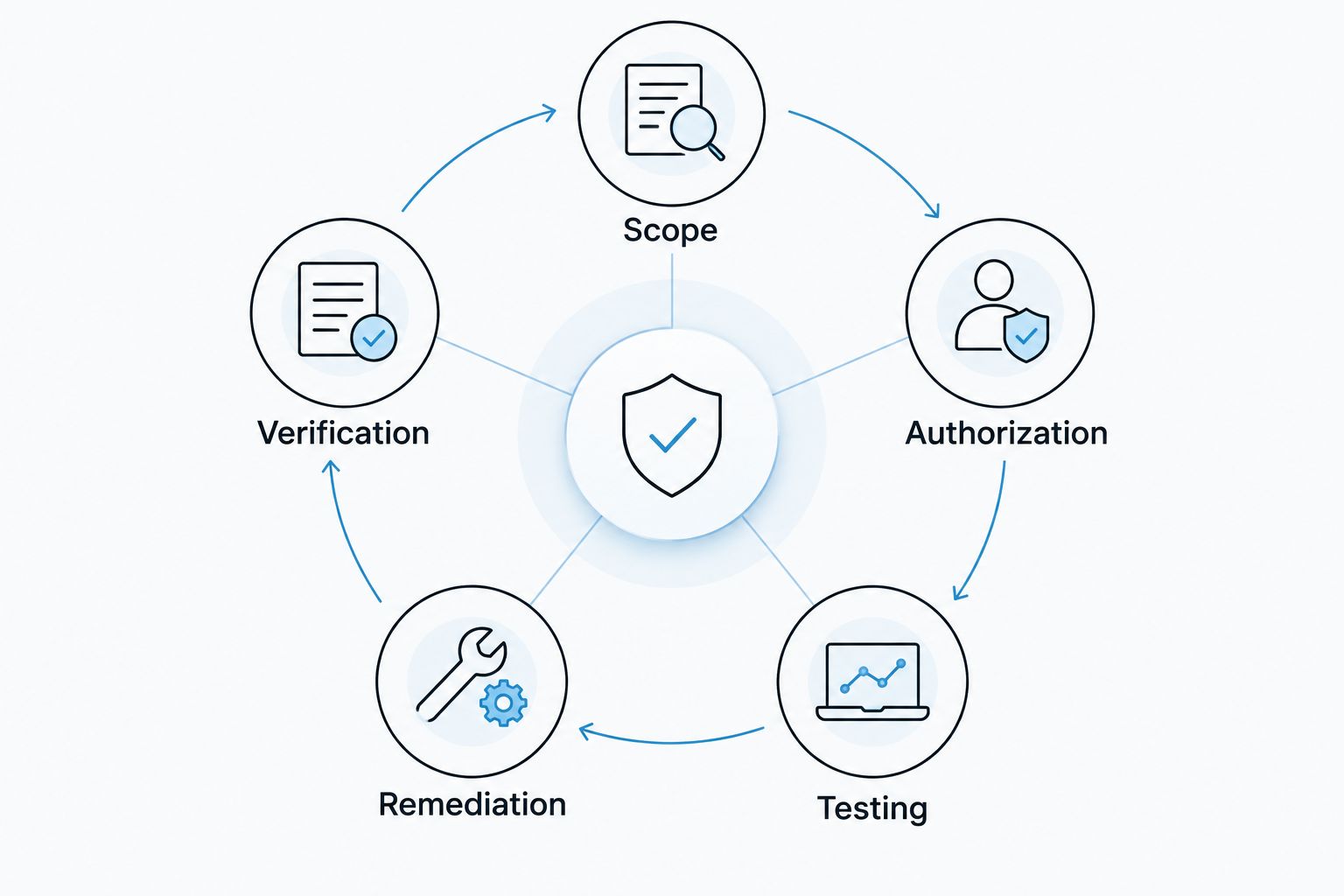
How to plan government penetration testing
Define the public service and security boundary
Start with a working session between the service owner, technical team and security lead. Use an existing asset register or a shared worksheet to connect each application, network range and identity system to the public service it supports. You do not need a new platform to establish scope.
Describe the decisions the test must support. These include whether an internet-facing application exposes restricted information, whether a contractor account reaches internal administration, or whether network segmentation separates unrelated services. These are testing objectives, not claims that a weakness exists.
Your 2026 scope should identify exclusions as carefully as inclusions. A shared authentication service or externally managed payment component needs explicit ownership and authorization review. Record dependencies even when testing them is prohibited, so the final report does not imply they were examined.
Close the scoping discussion with a document that procurement and technical owners can both interpret:
- List approved applications, API endpoints, network ranges and environments.
- Name the service owner and technical contact for each asset group.
- Describe the access boundary or security control to investigate.
- Mark shared infrastructure and third-party dependencies.
- Record exclusions and the resulting limits on assurance.
Establish authorization and operating limits
Draft the rules of engagement using your agency's existing approval process. Written authorization should define who can test, what they can test and which activities require separate approval. A signed agreement does not justify activity outside its technical boundaries.
Distinguish black-box testing from authenticated testing. Black-box testing starts without internal knowledge or supplied credentials; authenticated testing uses agreed accounts to examine access controls and other reachable functions. Neither approach answers every question, so select the approach against the objective rather than treating a label as a quality ranking.
Set operational limits before active testing begins. A stop condition is a required control, not an administrative detail. The rules should explain how testers respond to service instability, unexpected sensitive information or evidence of an unrelated intrusion.
Keep 2 escalation contacts available during the agreed testing window, with a defined backup route if the primary contact cannot respond.
- Document written authorization and the approved testing window.
- Specify permitted techniques and prohibited activities.
- Define stop conditions and authority to resume testing.
- Confirm emergency contacts and communication channels.
- Agree how testers handle unexpected sensitive data.
Evaluate providers against the actual scope
Build a requirements matrix before requesting proposals. Ask each provider to explain how its methodology addresses the same assets, access conditions, operational constraints and reporting requirements. Comparing service names alone hides important differences in coverage.
Evaluate the people directing the work, not just the scanning technology. Cyberhunter describes its approach as human-led and AI-assisted: experts direct penetration testing and validate findings. Its services also include vulnerability assessments and threat hunting, which answer different security questions.
For a 2026 procurement, request evidence of the proposed delivery approach and confirm all agency-specific conditions in writing. Do not infer security clearance, government purchasing eligibility, data residency or contractual acceptance from a provider's general service description.
A sample report can show whether findings connect evidence to remediation. Request a sanitized example rather than another customer's identifiable information, and assess whether your engineers could act on it without reconstructing the investigation.
- Request the proposed scope, methodology and explicit exclusions.
- Ask who directs testing and validates reported findings.
- Review a sanitized report for evidence and actionable remediation.
- Confirm personnel, subcontracting and information-handling requirements.
- Define deliverable acceptance criteria and verification terms.
Protect evidence throughout the engagement
Map the evidence workflow before testing starts. A simple process diagram should show where screenshots, request traces, logs and reports are collected, stored, transferred and deleted. Apply your agency's information-handling requirements to the workflow, not just the finished report.
Prefer synthetic records and dedicated test accounts where they answer the testing objective. Production testing requires its own authorization and operating controls; a realistic environment is not permission to copy unrestricted data. Agree what constitutes sufficient proof before testers encounter sensitive information.
Require 3 evidence elements for each validated finding: the affected asset, reproducible observations and the demonstrated impact. Evidence should establish the weakness without collecting unrelated records or spreading credentials through email and ticket attachments.
Separate executive reporting from restricted technical detail. Decision-makers need the service consequence and required action; engineers need enough protected evidence to reproduce and fix the issue.
- Approve evidence storage locations and access permissions.
- Specify secure transfer methods for reports and supporting files.
- Use synthetic records when they satisfy the test objective.
- Define redaction rules for identifiers, secrets and personal information.
- Agree retention, deletion and incident-escalation procedures.
Review attack paths and assign remediation
Review the report with the engineers and service owners who can authorize changes. Start with demonstrated access and affected services, then examine the individual weaknesses that enabled the result. A severity label is a prioritization input, not the entire decision.
Ask the tester to distinguish confirmed exploitation, observed weaknesses and untested hypotheses. These categories should not read as interchangeable findings. If operational limits prevented further validation, the report should state the limit rather than present an assumed outcome as demonstrated fact.
Assign 1 accountable owner to each accepted remediation action. Multiple teams can contribute, but shared participation should not leave responsibility undefined. Record dependencies such as supplier changes, application releases or identity-policy updates alongside the fix.
Close the exploitable path, not merely the scanner alert. For an access-control weakness, changing a visible interface is insufficient if the underlying request still permits unauthorized access.
- Map each finding to the affected service and responsible owner.
- Separate demonstrated impact from assumptions and untested scenarios.
- Prioritize using exposure, exploitability and operational consequence.
- Record the proposed fix and any temporary controls.
- Document accepted risks through your agency's approval process.
Verify fixes and preserve the testing record
Begin verification with the original evidence and the implemented change. Reproduce the previously successful attack under authorized conditions, then check closely related paths that the change was intended to protect. A ticket marked complete is not proof that exploitation has stopped.
Agree verification coverage, authorization and commercial terms with the provider rather than assuming follow-up testing is included. If another team performs verification, give that team the restricted technical evidence it needs through the approved channel.
Treat your 2026 report as a time-bounded record of the tested environment. Changes to authentication, public endpoints, network boundaries or supplier access can change the attack surface. Define reassessment triggers around those changes instead of treating an old report as permanent assurance.
The final record should make unresolved exposure visible to the person accepting it. Preserve scope limitations beside the findings so future readers understand what the engagement did not establish.
- Verify the original exploit path after remediation.
- Examine related paths within the authorized verification scope.
- Record unresolved findings, owners and accepted limitations.
- Retire temporary accounts and access after testing.
- Define changes that require a new testing decision.
Compare security testing options for government agencies
Choose the service by the question it answers. Vulnerability assessments, penetration testing and threat hunting are related activities, but their deliverables are not interchangeable. Internal testing also depends on the skills, access and independence of the assigned team.
The comparison below separates useful strengths from limits. Agency-specific eligibility and information-handling requirements still need confirmation before any external engagement.
| Option | Best for | Main strength | Key limitation |
|---|---|---|---|
| Internal manual testing | Teams with relevant testing skills and authorized access | Direct access to system context and engineering owners | Coverage and independence depend on the assigned team |
| Vulnerability assessment | Identifying and prioritizing potential weaknesses across an agreed scope | Produces a structured weakness inventory | Does not, by itself, establish a validated attack path |
| Cyberhunter human-led penetration testing | Teams seeking expert-directed testing and validated findings | Combines human direction with AI-assisted work and practical remediation guidance | Agency-specific eligibility, data handling and contract terms require confirmation |
| Threat hunting | Investigating signs of attacker activity in available telemetry | Examines evidence for suspicious activity within the hunting scope | Does not replace an authorized test of exploitable weaknesses |
When procurement requires independent validation, specify what independence means for the engagement. If your immediate concern is suspicious activity, route that concern to the appropriate investigation process rather than waiting for a penetration test to answer it.
Discuss Your Testing Scope
Talk through testing objectives, evidence requirements and operational constraints.
Common mistakes government agencies make
- Authorizing assets the agency does not control. A public-service contract does not automatically grant testing permission for a supplier's infrastructure. Identify the system owner and obtain the required authorization before including it.
- Accepting a scan as proof of exploitation. A list of possible weaknesses does not establish the attacker's access or the service consequence. Require findings to distinguish detection from validated impact.
- Leaving evidence handling until report delivery. Sensitive information can enter screenshots and working notes during testing. Agree collection limits, access controls and transfer methods before the engagement begins.
- Treating procurement completion as security closure. Receiving a report completes a deliverable, not remediation. Assign owners, approve residual risk and verify the agreed fixes.
FAQ
What’s the best penetration testing approach for a government agency?
The best approach matches the agency’s security objective, authorized assets and operational constraints. Choose black-box, authenticated or combined testing according to the access boundary you need examined, and require evidence-backed findings.
Is a vulnerability assessment the same as penetration testing?
No. A vulnerability assessment identifies and prioritizes potential weaknesses, while penetration testing investigates exploitation and impact within an agreed scope. Specify the required activity in procurement documents rather than relying on a service label.
Can a government agency authorize testing of a supplier’s systems?
An agency should not assume it can authorize testing of systems controlled by a supplier. Confirm ownership, contractual rights and the required permissions before those assets enter the testing scope.
Should government penetration testing use production systems?
Production testing requires explicit authorization and operating controls. Choose the environment against the objective, then define testing windows, prohibited actions, stop conditions and evidence-handling requirements.
Does passing a penetration test prove compliance?
No. A penetration test provides evidence about the tested scope under agreed conditions; it does not independently establish compliance with every applicable requirement. Map relevant findings and limitations to your agency’s assurance process.
How does Cyberhunter conduct penetration testing?
Cyberhunter provides human-led, AI-assisted penetration testing in which experts direct testing and validate findings. Confirm the proposed scope, evidence handling, reporting deliverables and agency-specific requirements before contracting.
When should a government agency repeat penetration testing?
Repeat testing when your assurance requirements or material system changes call for renewed validation. Changes to authentication, exposed applications, network boundaries and supplier access are useful triggers for a documented testing decision.
One last thing
Ask for the exclusions page before the executive summary. A reassuring summary cannot answer whether a critical identity service, administrative interface or supplier connection was outside scope.
For your next 2026 engagement, make every exclusion carry an owner and a stated assurance limitation. That small procurement requirement keeps an untested system from becoming an assumed success.
Related guides
- Best API penetration testing companies
- Best network penetration testing companies in Canada
- Best vulnerability assessment companies in Canada
