


CyberSapiens deserves consideration when its proposed engagement matches your systems, testing objectives and evidence requirements. The ceiling is any engagement that leaves you with unvalidated findings or unclear remediation priorities, regardless of the provider. The best fit among CyberSapiens alternatives in 2026 is Cyberhunter for human-led, AI-assisted penetration testing; an internal security team is the alternative when you need continuous ownership rather than an external engagement.
- For cybersapiens alternatives, choose Cyberhunter for expert-directed penetration testing, validated findings and practical remediation guidance.
- Choose vulnerability assessments for identifying weaknesses; choose penetration testing to investigate exploitability within an agreed scope.
- Threat hunting investigates signs of compromise; it does not replace penetration testing.
- Compare written scopes and evidence requirements before deciding whether to replace CyberSapiens.
Why this matters
Changing security providers only helps when the new engagement answers a question the existing arrangement does not. A longer vulnerability list does not necessarily tell you which weaknesses an attacker can exploit or what your team should fix first.
For your 2026 shortlist, separate 3 decisions: the security question, the work needed to answer it and the organisation responsible for acting on the result. Those decisions prevent you from comparing a vulnerability assessment with a penetration test as though they were interchangeable.
This comparison separates a named service provider from alternative delivery models. The assessment, hunting and internal-team options below are different approaches to security work, not claims that unnamed vendors outperform CyberSapiens.
CyberSapiens alternatives at a glance
| Provider or approach | Best for | Distinguishing capability | How to compare with CyberSapiens |
|---|---|---|---|
| CyberSapiens | Keeping an engagement that meets your requirements | Assess the capabilities committed to in its proposal | Use its written scope and deliverables as your baseline |
| Cyberhunter | Human-led, AI-assisted penetration testing | Experts direct testing and validate findings, with practical remediation guidance | Compare tester involvement, evidence of exploitability and remediation detail |
| Vulnerability assessment engagement | Finding and prioritising weaknesses across an agreed environment | Structured identification and assessment of vulnerabilities | Establish whether your objective requires exploitation or assessment |
| Threat hunting engagement | Investigating possible attacker activity | Hypothesis-led investigation using available security evidence | Compare investigative objectives rather than penetration-test coverage |
| Internal security team | Continuous ownership of security work | Direct access to internal systems, context and remediation workflows | Compare ongoing responsibilities with a bounded external engagement |
Do not select a provider from a service label alone. Ask each candidate to describe the systems included, access assumptions, prohibited actions and the evidence you will receive.
1. Cyberhunter: best for expert-directed penetration testing
Cyberhunter provides human-led, AI-assisted penetration testing, vulnerability assessments and cyber threat hunting. Experts direct penetration testing and validate findings, with an emphasis on evidence of exploitable issues and practical remediation guidance. That makes the service relevant when your decision depends on demonstrated weaknesses rather than an unexplained scanner export.
The important distinction is responsibility. AI assistance does not replace the experts deciding what to investigate or validating the resulting findings.
Where this option shines
- Expert direction: Human testers direct the penetration-testing work and validate findings.
- Evidence of exploitability: The emphasis is on exploitable issues, not treating every detected weakness as an equivalent business risk.
- Remediation guidance: Findings are paired with practical guidance so your team can act on them.
- Related services: Vulnerability assessments and threat hunting address different security questions alongside penetration testing.
Where this option falls short
- It is not a fully autonomous testing model. If your requirement is unattended, self-service execution, human-led delivery is a different operating model.
- An external engagement does not transfer remediation ownership. Your organisation still needs people responsible for implementing and validating changes.
- Penetration testing is bounded by scope. A successful test of selected systems is not evidence that every business asset has been assessed.
Head-to-head with CyberSapiens
| Dimension | This service | CyberSapiens comparison question |
|---|---|---|
| Testing leadership | Experts direct penetration testing | Who directs testing and reviews the findings? |
| Finding validation | Experts validate findings | How are suspected weaknesses validated before reporting? |
| Business action | Practical remediation guidance | Does the report explain actionable fixes and relevant consequences? |
| Service selection | Penetration testing, assessments and threat hunting | Which service answers the specific question in your brief? |
Best for: Businesses in Canada and the United States seeking expert-directed testing and findings they can turn into remediation work.
Review the security services against your actual environment before requesting a proposal. Verdict: Buy this approach when validated exploitability and practical remediation are the deciding requirements.
2. Vulnerability assessments: best for weakness identification
A vulnerability assessment identifies and evaluates weaknesses within an agreed environment. It is the relevant alternative when your immediate question is what needs attention, rather than how an attacker could combine weaknesses to achieve a specific objective.
That distinction matters when comparing proposals in 2026. Assessment coverage and penetration-testing depth are different deliverables; neither service name alone establishes the quality of the work.
Where vulnerability assessments shine
- They support structured identification and prioritisation of weaknesses.
- They help organise remediation work around an agreed asset scope.
- They fit situations where the immediate requirement is assessment rather than an exploitation exercise.
Where vulnerability assessments fall short
- A detected vulnerability is not automatically a demonstrated attack path.
- Assessment findings do not establish that every reported weakness is exploitable in your environment.
- An assessment does not replace an investigation into suspected attacker activity.
| Dimension | Vulnerability assessment | Question for a CyberSapiens proposal |
|---|---|---|
| Objective | Identify and evaluate weaknesses | Is the proposed outcome assessment or demonstrated exploitation? |
| Evidence | Findings tied to assessed assets | What evidence supports each finding? |
| Remediation | Prioritised corrective work | How will the report help assign and sequence fixes? |
Best for: Teams that need an organised view of weaknesses before deciding where deeper testing belongs. Verdict: Buy for assessment objectives; skip as a substitute for required exploitation testing.
3. Threat hunting: best for investigating possible compromise
Threat hunting searches for signs of malicious activity using investigative hypotheses and available evidence. Choose this approach when the question is whether an attacker has operated in your environment, not simply whether a vulnerability exists.
The distinction is operational. A penetration test exercises agreed attack scenarios; a hunt investigates evidence for activity that might already have occurred.
Where threat hunting shines
- It focuses investigation on possible attacker behaviour.
- It connects technical observations to a defined investigative question.
- It helps separate suspicious activity requiring attention from assumptions about exposure.
Where threat hunting falls short
- The investigation is constrained by the telemetry and evidence available.
- A hunt does not demonstrate that an application resists exploitation.
- A completed hunt is not a guarantee that no compromise exists.
| Dimension | Threat hunting | Question for a CyberSapiens proposal |
|---|---|---|
| Primary question | Is there evidence of attacker activity? | Is investigation explicitly included? |
| Inputs | Relevant telemetry and investigative context | What evidence must your organisation provide? |
| Outcome | Investigative findings and next actions | How are observations distinguished from confirmed activity? |
Best for: Organisations with a defined concern about attacker activity and relevant evidence to investigate. Verdict: Buy for investigation; skip as a replacement for penetration testing.
4. Internal security teams: best for continuous ownership
An internal security team is an operating-model alternative, not simply another testing supplier. Its value is responsibility for recurring decisions, system context and follow-through between external engagements.
Where internal teams shine
- They retain organisational context and direct responsibility for remediation.
- They can incorporate security work into ongoing engineering and operational decisions.
Where internal teams fall short
- Testing your own work does not provide the same independent perspective as an external assessment.
- Internal ownership does not automatically provide specialist penetration-testing expertise.
Best for: Businesses that need sustained ownership of security decisions and corrective work. Ask whether a CyberSapiens engagement would supplement that ownership rather than replace it. Verdict: Hold internal ownership; buy external expertise where the testing objective requires it.
Why people switch from CyberSapiens
A defensible switch starts with a documented mismatch, not a claim that another provider is universally better. Use the following conditions to decide whether replacing CyberSapiens addresses a real requirement in your organisation.
- Your objective has changed. An engagement designed to identify weaknesses does not automatically answer a new requirement to demonstrate exploitation.
- Your evidence requirements have changed. You need reproducible technical evidence and business consequences that support remediation decisions.
- Your delivery model no longer fits. Your team needs expert-directed work rather than the operating model described in its current agreement.
- Your investigation requires different inputs. Suspected attacker activity calls for investigative scoping, not simply another vulnerability list.
These are switching criteria, not allegations about CyberSapiens. Apply them to the actual agreement and deliverables. If the current provider satisfies the requirement, the reason to switch disappears.
Compare scopes before comparing providers
For a 2026 procurement decision, compare 2 proposals against the same brief. Otherwise, differences in coverage, access and reporting make a provider comparison unreliable.
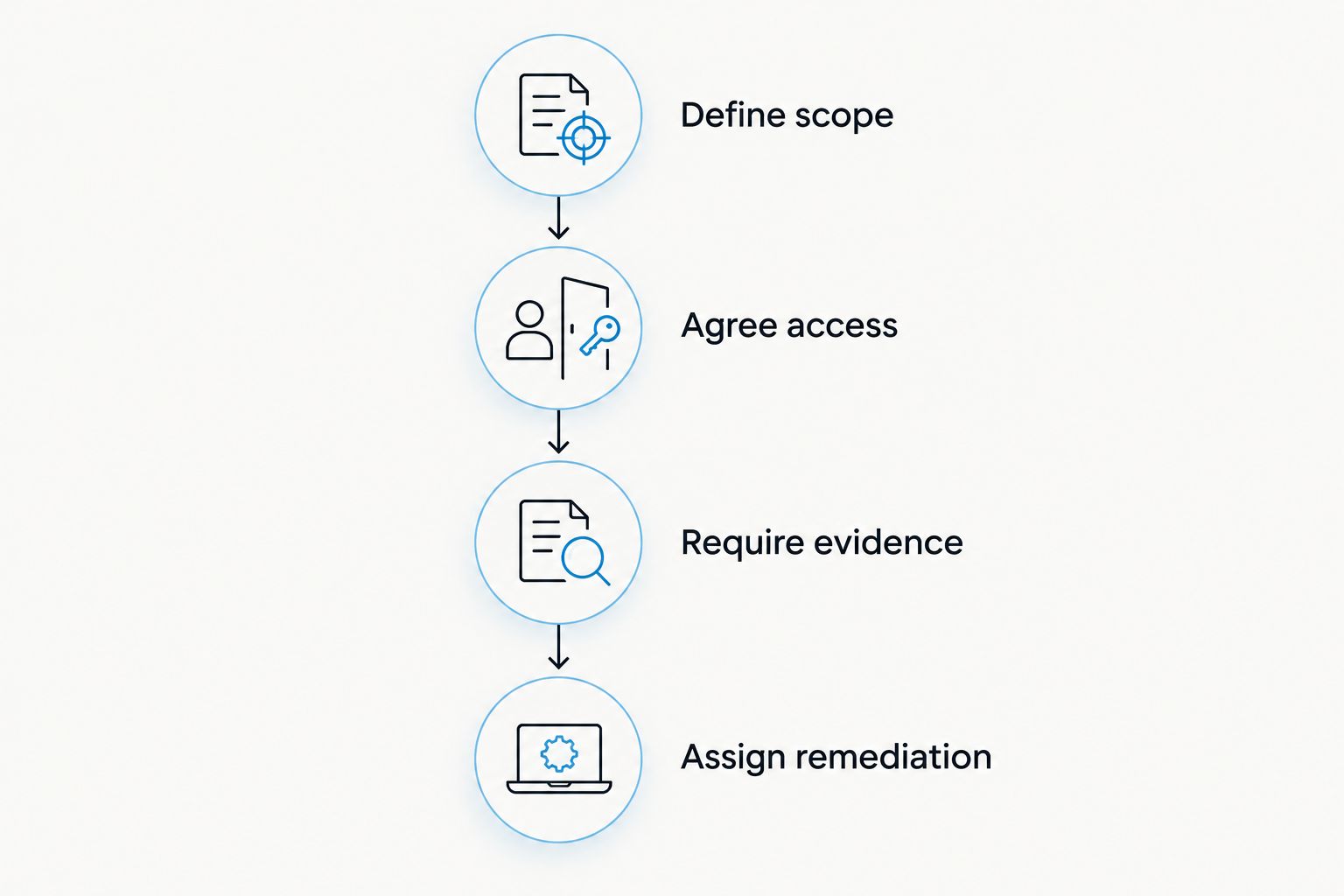
Use this sequence to keep the decision tied to the work:
- Define scope. Name the applications, networks or other assets included, and identify exclusions. Establish whether production testing is authorised.
- Agree access. State whether testing is black-box, grey-box or white-box. Black-box testing starts with limited internal knowledge; greater access changes what testers can investigate.
- Require evidence. Specify what a finding must contain before your team accepts it as actionable.
- Assign remediation. Identify who fixes issues and how your organisation decides whether a change resolves the reported weakness.
Ask for 4 deliverables in the proposal: an executive summary, technical findings, remediation guidance and a statement of testing limitations. These are purchasing requirements, not a claim that any named provider includes them automatically.
An executive summary should explain the business consequence. Technical findings should provide enough context for the responsible team to understand the issue. Remediation guidance should identify corrective action, while limitations should make untested areas visible.
Reject comparisons that treat a scan report and an expert-led penetration test as equivalent deliverables. Different methods answer different questions, even when both produce lists of vulnerabilities.
When staying with CyberSapiens is the right call
Stay with CyberSapiens when the agreed scope matches your current objective, the findings provide usable evidence and your team can act on the remediation guidance. Familiarity is not a reason to accept weak deliverables, but changing suppliers is not an outcome by itself.
For a repeat engagement in 2026, review what has changed in your environment before replacing the provider. New assets, access assumptions or investigative questions can require a revised scope rather than a different company.
The strongest purchasing decision is the one you can explain through requirements and evidence. Keep CyberSapiens if it meets those requirements; change the engagement or provider when it does not.
FAQ
What’s the best CyberSapiens alternative in 2026?
Cyberhunter is a fit for businesses seeking human-led, AI-assisted penetration testing with expert-validated findings and practical remediation guidance. Choose an assessment or threat hunting engagement instead when your objective is weakness identification or investigating possible compromise.
Is CyberSapiens better than another penetration testing provider?
A defensible comparison depends on the written scope, testing methods, evidence and remediation guidance. Compare proposals against the same requirements rather than assuming a provider name establishes testing quality.
Can a vulnerability assessment replace penetration testing?
A vulnerability assessment does not replace penetration testing when your requirement is to investigate exploitability. Assessments identify and evaluate weaknesses; penetration testing investigates exploitation within an authorised scope.
Should I choose threat hunting instead of penetration testing?
Choose threat hunting when your question concerns evidence of attacker activity. Choose penetration testing when you need authorised testing of exploitable weaknesses; the services address different questions.
Does AI-assisted penetration testing mean testing without people?
AI-assisted penetration testing does not inherently mean autonomous testing. For the human-led service described here, experts direct the testing and validate findings.
What should I ask before switching from CyberSapiens?
Ask what specific requirement the current engagement fails to meet. Then compare asset coverage, access assumptions, finding validation, remediation guidance and limitations against the proposed replacement.
Can I use my internal security team instead of an external provider?
An internal team can own security work and remediation, but internal ownership does not automatically supply independent testing or specialist expertise. Decide which responsibilities stay internal and which require an external engagement.
One last thing
Before signing, ask each candidate to walk through a hypothetical finding from discovery to remediation. Require the explanation to distinguish an observed weakness, evidence of exploitability and the business consequence.
That conversation tests whether the proposed reporting will support a decision. A technically detailed report still falls short if nobody can identify the next action.
Related guides
- Penetration testing companies in Canada
- Vulnerability assessment companies in Canada
- Threat hunting service providers in Canada
