


Penetration testing in Canada is priced against an agreed scope, so a useful 2026 budget starts with a written quote rather than an unsupported national average. Confirm whether the quote includes authenticated testing, reporting, remediation discussions and retesting; a headline fee alone does not establish what you are buying.
- Searching average cost of penetration test canada? Compare written scopes before comparing totals.
- CyberHunter penetration testing suits businesses seeking human-led, AI-assisted testing with expert-validated findings.
- Vulnerability scanning identifies potential weaknesses; penetration testing investigates exploitability within agreed boundaries.
- Confirm reporting, remediation guidance and retest terms before approving a penetration testing engagement.
How much does penetration testing cost in Canada in 2026?
There is no useful single price without a defined testing scope. A public-facing website, an authenticated application and an internal network present different testing tasks. Treating those engagements as interchangeable makes a national average a poor purchasing guide.
For your 2026 procurement process, ask providers to separate the work below. This is a quote-comparison framework, not a claim that every provider includes each component.
| Quote component | What to specify | What to clarify before approval |
|---|---|---|
| Scope and preparation | Systems, environments, permissions and exclusions | Who prepares access and authorizes testing? |
| Testing | Attack surfaces, user roles and agreed objectives | What receives manual investigation? |
| Evidence and reporting | Reproduction details, affected assets and business impact | What evidence supports each finding? |
| Remediation discussion | Technical handover and clarification of findings | Is discussion with your technical team included? |
| Retesting | Which fixes receive verification | Is verification included or separately quoted? |
Start with the penetration testing and security services that match your objective, then request a scope-specific proposal. Do not compare totals until the proposals describe equivalent work.
Why this matters
A cheaper engagement with narrower coverage is not automatically better value. Equally, a larger engagement is not automatically necessary: paying to test systems outside your immediate objective can divert resources from fixing known weaknesses.
Your purchasing decision should answer a practical question: what security decision will this work allow you to make? Examples include approving an application release, investigating whether exposed services are exploitable, or checking whether users can cross an authorization boundary.
A useful 2026 budget connects that decision to testing coverage and remediation capacity. The report is an input to corrective work, not the finish line.
Which type of security work should you budget for?
Choose the service that answers your actual question. Vulnerability assessments, penetration testing and threat hunting overlap in subject matter, but their objectives and evidence differ.
| Service | Best for | Main strength | Limitation to understand |
|---|---|---|---|
| Vulnerability assessment | Identifying and prioritizing potential weaknesses | Organizes weaknesses for investigation and remediation | Does not necessarily establish a validated attack path |
| Penetration testing | Investigating exploitability within an authorized scope | Connects technical weaknesses to demonstrated impact | Conclusions are limited by scope, access and testing conditions |
| Threat hunting | Investigating signs of adversary activity | Examines hypotheses using available security evidence | Depends on relevant telemetry and is not a substitute for penetration testing |
Do not purchase a vulnerability scan when your requirement is validated penetration testing. Scanners help identify potential issues, but automated output alone does not establish whether an attacker can exploit a finding in your environment.
The reverse also matters. If your immediate task is to inventory weaknesses across an environment, define that assessment objective rather than expecting a tightly scoped penetration test to answer every security question.
Why penetration testing quotes vary
The scope must explain the work behind the quote. These factors give you a practical basis for challenging differences between proposals:
- Attack surface: Identify whether the engagement covers external infrastructure, internal networks, applications, APIs or cloud resources. Each requires different access and testing activities.
- Application behaviour: Describe sensitive workflows, integrations and authorization boundaries. A list of hostnames alone does not capture business logic.
- Access and knowledge: State whether testers receive credentials, architecture information or neither. Access changes what the engagement can examine.
- Operating restrictions: Document prohibited actions, testing windows and escalation contacts. Restrictions define which attack paths can be investigated safely.
- Evidence and reporting: Specify the proof, reproduction instructions and remediation detail you need. A finding title and severity label are not a technical handover.
- Follow-up work: Confirm remediation discussions, retest coverage and the process for addressing findings that remain unresolved. Do not assume these activities are included.
Ask providers to explain these differences in plain language. If a proposal does not identify the boundaries, request clarification before treating its total as comparable.
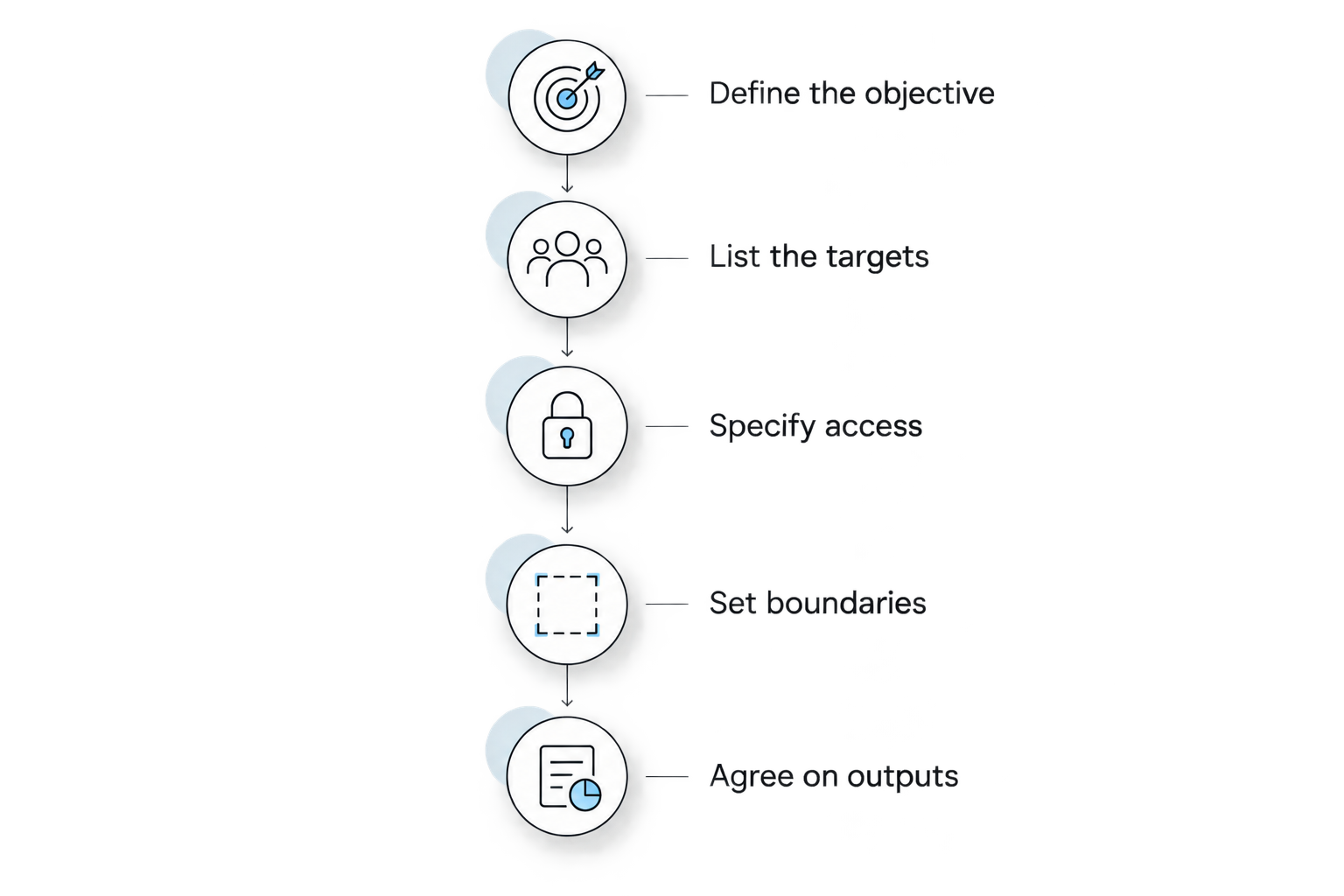
How do you build a scope that providers can quote?
Give each provider the same brief. For 2026 planning, a shared scope document is more useful than asking several firms for their usual penetration testing package.
Define the objective
State what you need to learn. For example, ask whether an authenticated user can access another user's records, rather than requesting a generic application security check.
Identify the business process behind the objective. That context helps testers distinguish an inconvenient defect from a weakness affecting sensitive information or administrative control.
List the targets
Name the applications, APIs, network ranges or cloud environments you authorize the provider to test. Separate production from non-production assets and identify third-party systems that require additional permission.
Document dependencies without assuming they are included. An application integration is not automatically authorization to test the external service behind it.
Specify access
Describe available accounts, permission levels and technical documentation. If authorization testing matters, provide accounts representing the relevant access boundaries.
Explain how testers will receive credentials securely and who can resolve access problems. Preparation gaps consume effort without advancing the testing objective.
Set boundaries
Agree on prohibited techniques, operational restrictions and emergency escalation. Explicitly address activities that could disrupt service or alter data.
The rules of engagement should also define when testing must pause. Your operational contact needs authority to act, not just a name on a distribution list.
Agree on outputs
Request evidence, practical remediation guidance and a technical discussion of findings. State who needs to read the report and what decisions the report must support.
Separate requested deliverables from assumptions. Retesting, additional environments and follow-up work need written treatment before approval.
Does black-box testing cost less than authenticated testing?
Black-box testing is a testing approach, not a discount category. Testers begin with limited knowledge or access, which changes the question the engagement answers.
Authenticated testing examines behaviour available after sign-in, including permissions and role boundaries. Neither approach is inherently the right choice for every application.
| Approach | Best for | Useful perspective | Trade-off |
|---|---|---|---|
| Black-box testing | Examining exposure with limited prior knowledge | Shows what testers can discover from the agreed starting position | Limited access can leave authenticated functionality outside meaningful coverage |
| Authenticated testing | Examining signed-in functionality and permissions | Supports investigation of user workflows and authorization boundaries | Requires suitable accounts and access preparation |
Choose the starting conditions that match the threat scenario. If a provider proposes black-box testing for a business application, ask how the engagement will address signed-in functionality before accepting the scope.
What should you require in the final report?
Request 3 deliverables: an executive summary, technical findings and remediation guidance. These serve different readers; combining them into an unstructured export makes corrective work harder.
- Executive summary: Explain the tested scope, important limitations and business consequences without overstating coverage.
- Technical findings: Identify affected assets, evidence, reproduction steps and the reasoning behind prioritization.
- Remediation guidance: Describe practical corrective actions and any conditions that influence the proposed fix.
For an exploitable issue, request enough evidence for your team to understand what happened without unnecessarily exposing sensitive data. Evidence handling belongs in the engagement agreement.
Also ask how unresolved questions are handled after delivery. A report should enable action, but its existence does not prove your team has implemented the recommended changes.
How should you budget for remediation and retesting?
Keep 2 workstreams visible in your plan: discovering weaknesses and correcting them. The testing provider's quote addresses agreed services; your developers, administrators or other suppliers still need to implement fixes.
Assign an owner to each accepted finding. Record the corrective action and the evidence required to close it, rather than treating a changed configuration or completed ticket as proof by itself.
Retesting verifies specified fixes against agreed criteria. Confirm its coverage and commercial terms in writing; do not assume it is included, unlimited or free.
For your 2026 budget, ask what happens when an issue is only partially resolved or a code change affects another workflow. Agree on the process before findings create an urgent purchasing decision.
How do you compare proposals without buying less coverage?
Create 1 shared scope document and require each provider to identify deviations. That makes exclusions visible before procurement reduces the decision to a total.
Use this approval checklist:
- Do the proposals cover the same assets, environments and user roles?
- Do they explain expert involvement and finding validation?
- Do they identify restrictions that limit testing?
- Do they specify evidence and remediation deliverables?
- Do they describe technical handover and retesting terms?
- Do they explain how scope changes receive approval?
CyberHunter penetration testing is human-led and AI-assisted: experts direct testing and validate findings. CyberHunter suits businesses seeking expert-validated evidence of exploitable issues and practical remediation guidance.
That service model does not remove the need for a defined scope. Confirm the systems, testing approach, deliverables and follow-up terms in the proposal rather than assuming every activity is included.
Discuss Your Testing Scope
Define your targets, testing objectives and reporting requirements before requesting a proposal.
FAQ
What’s the average cost of a penetration test in Canada?
A useful Canadian penetration testing budget requires a scope-specific quote, not an unsupported national average. Compare the same targets, access levels, reporting requirements and retest terms before comparing totals.
Is vulnerability scanning the same as penetration testing?
Vulnerability scanning is not the same as penetration testing. Scanning identifies potential weaknesses, while penetration testing investigates exploitability within an authorized scope and uses validated evidence to explain findings.
Does a penetration testing quote include retesting?
Retesting is included only when the proposal explicitly includes it. Confirm which findings qualify, what verification covers and how unresolved issues are handled.
Should I request black-box or authenticated penetration testing?
Choose the approach that matches your testing objective. Black-box testing begins with limited knowledge or access, while authenticated testing examines signed-in functionality and permission boundaries.
What should I send a provider to get an accurate quote?
Send a written scope describing targets, environments, user roles, testing objectives, restrictions and required outputs. Ask the provider to document assumptions and exclusions in the proposal.
Does a penetration test guarantee compliance or prevent a breach?
A penetration test does not guarantee compliance or prevent a breach. Its findings describe the evidence established within the authorized scope and testing conditions; remediation and other security controls remain necessary.
Does CyberHunter use human penetration testers?
CyberHunter provides human-led, AI-assisted penetration testing. Experts direct the testing and validate findings, with an emphasis on evidence of exploitable issues and practical remediation guidance.
One last thing
Treat exclusions as part of the purchasing decision, not administrative fine print. An untested authorization boundary or excluded environment can matter more to your objective than an additional page of findings elsewhere.
Before approving your 2026 engagement, read the exclusions aloud with the technical owner. If a critical workflow is outside scope, change the scope or explicitly accept that unanswered question.
Related guides
- Cloud security for SaaS companies
- From penetration test findings to remediation
- Network penetration testing to firewall hardening
