


Network penetration testing cost depends on the agreed scope: the networks covered, the tester’s starting access, the permitted techniques and the evidence required in the final report. For your 2026 budget, request a scope-specific quote and confirm whether remediation support, retesting and additional environments are included or charged separately.
- Compare network penetration testing cost against identical scope, access assumptions, evidence requirements and retesting terms.
- Cyberhunter provides human-led, AI-assisted penetration testing, with experts directing testing and validating findings.
- External testing examines internet-facing exposure; internal testing examines attack paths from inside an agreed network boundary.
- Vulnerability assessments identify weaknesses; penetration testing validates exploitable issues through authorised testing.
How much does network penetration testing cost?
Network penetration testing requires a defined scope before a quote becomes useful. An external assessment of selected public-facing systems is not equivalent to an internal engagement covering identity infrastructure, segmented networks and movement between systems. Compare the work promised, not just the total on the proposal.
Start by identifying the question you need the engagement to answer. If you are reviewing penetration testing services, specify whether you need evidence of internet-facing exposure, internal attack paths or both.
| Testing approach | Best for | What the scope must establish | Main limitation |
|---|---|---|---|
| External network testing | Examining exposure from the internet | Public IP addresses, domains, reachable services and permitted exploitation | Does not establish what an attacker can do from an internal foothold |
| Internal network testing | Examining attack paths inside a network | Starting location, credentials, identity systems and reachable segments | Does not establish how an attacker would first enter from the internet |
| Combined network testing | Examining external and internal attack paths | Both boundaries, starting assumptions and whether findings can be chained across them | Requires more coordination and explicit boundaries between activities |
A proposal should distinguish preparation, active testing, analysis and reporting. It should also state what happens after delivery: a findings discussion, remediation advice and technical retesting are different activities, not interchangeable labels.
Why this matters
An apparently simpler proposal can exclude the systems or techniques that answer your actual security question. A long list of scanned assets also does not establish that a tester investigated exploitable paths or validated business impact.
For a 2026 purchasing decision, require each bidder to respond to the same scope document. That makes differences in coverage visible before you commit resources, grant access or schedule testing against production systems.
External network testing: define the public boundary
External network penetration testing examines systems reachable from outside your organisation. Its value comes from investigating whether exposed services and configurations create exploitable paths within the authorised scope.
List the public IP addresses, domains and network services you control. Identify third-party hosting and managed infrastructure separately, because ownership of an application does not automatically grant permission to test every underlying system.
Ask whether discovery is limited to your supplied inventory or includes finding additional assets for approval. Neither approach is inherently wrong, but they answer different questions and require different boundaries.
Choose external testing when your immediate question concerns internet-facing exposure. Its limitation is equally important: a clean external result does not establish that internal network segmentation or access controls resist an attacker who already has access.
Internal network testing: define the starting foothold
Internal network penetration testing examines what an attacker can reach or accomplish from an agreed position inside your environment. That position might involve a network connection, a standard user account or another explicitly authorised starting point.
Specify which office networks, remote-access connections, identity systems and server segments are included. Tell the provider whether the objective is to investigate privilege escalation, movement between systems, access to sensitive resources or a defined combination.
Credentials change the test’s assumptions, not just its logistics. A test starting without credentials and a test starting with a valid user account provide different evidence, so proposals should explain the intended scenario.
Choose internal testing when you need to examine the consequences of an internal foothold. Its limitation is that the starting access is an assumption unless establishing that access is also part of the agreed engagement.
Combined testing: connect the scenarios explicitly
Combined external and internal testing covers both perspectives, but the proposal must explain how they relate. Separate workstreams do not automatically establish a continuous attack path from public exposure to an internal business system.
Ask whether testers can follow a validated external finding into an internal environment, subject to authorisation. If they cannot, the report should keep demonstrated outcomes separate from hypothetical next steps.
Combined testing suits organisations that need evidence across both boundaries. The trade-off is coordination: asset owners, access arrangements, safety restrictions and escalation contacts must support the broader engagement.
Do not assume that a combined network test includes web application logic, API authorisation, cloud configuration or social engineering. Name those requirements separately so their inclusion or exclusion is explicit.
Why network penetration testing cost varies
These scope factors explain why proposals for apparently similar networks can describe substantially different work:
- Asset coverage: Public services, internal hosts, network segments and identity infrastructure create different testing tasks. An IP address count alone does not describe complexity.
- Starting access: Black-box testing begins with limited prior knowledge; authenticated testing supplies agreed access. Each approach changes what testers can investigate within the engagement.
- Testing objectives: Finding exposed weaknesses differs from validating privilege escalation, segmentation bypass or access to a named business resource.
- Operational restrictions: Maintenance windows, prohibited techniques, fragile systems and third-party permissions affect how testing can proceed safely.
- Evidence and reporting: Reproduction steps, impact analysis, technical debriefs and remediation guidance require explicit deliverables rather than an undefined promise of a report.
- Follow-up requirements: Retesting, additional technical discussions and testing changed systems need written boundaries and commercial terms.
Your 2026 scope should connect each requirement to a business decision. For example, validating separation between network segments answers a different question from compiling an inventory of exposed services. Remove unrelated requirements, not the evidence needed to answer the question.
Build a comparable 2026 scope before requesting quotes
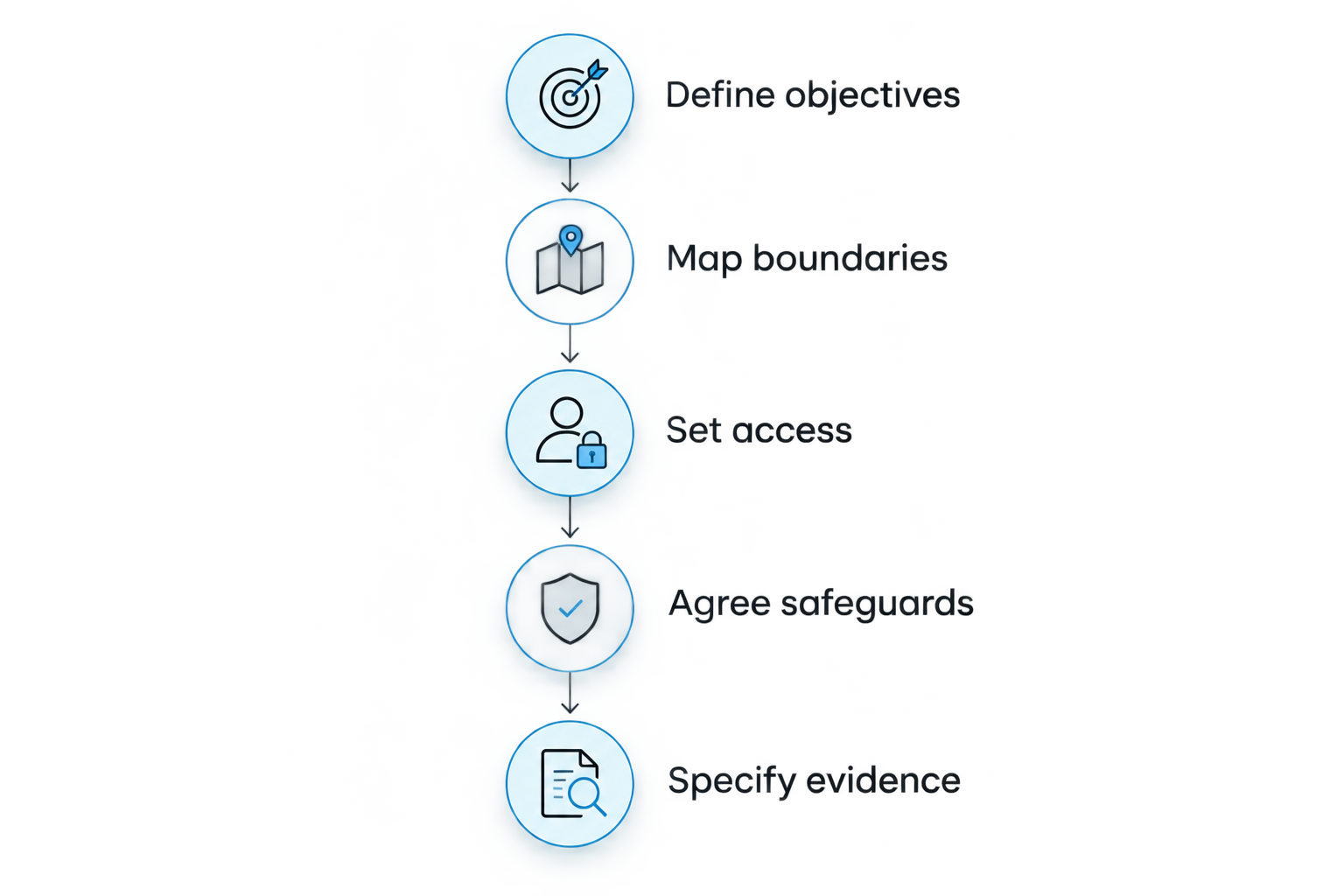
Use this sequence to prepare a brief that providers can estimate against. You do not need to prescribe every test technique, but you do need to define the objective, boundaries and expected output.
- Define objectives. State what you need to learn, such as whether an internal user can reach restricted systems. Avoid an objective as broad as testing everything.
- Map boundaries. List authorised assets, exclusions, third-party dependencies and relevant network segments. Identify who can approve changes when discovery reveals another system.
- Set access. Describe the tester’s starting location, supplied credentials and permitted connections. Keep external and internal assumptions distinct.
- Agree safeguards. Establish testing windows, emergency contacts, stop conditions and prohibited activities. Define how sensitive evidence will be collected and handled.
- Specify evidence. Require validated findings, reproduction information, impact explanations, remediation guidance and explicit retesting terms.
A written brief turns a broad request into a testable engagement. It also gives your internal team a basis for checking whether the final report answers the original question.
Include responsibility for firewall changes and remediation in the brief, even when those tasks remain with your own team. The network penetration testing to firewall hardening workflow connects testing findings to that follow-up work.
Separate testing fees from your internal delivery work
A testing proposal is not your entire project plan. Your organisation still needs to identify asset owners, arrange access, obtain approvals, review findings and assign remediation work.
Treat these as separate responsibilities in your 2026 budget planning:
- Before testing: Confirm inventory, authorisation, access arrangements and escalation contacts.
- During testing: Support approved access and respond to operational questions or stop requests.
- After testing: Triage findings, implement changes, preserve evidence and arrange any agreed verification.
Ask whether retesting checks only the original findings or also covers newly introduced functionality. Likewise, confirm whether a technical debrief includes advice on remediation priorities or hands-on implementation. Do not assume either service is included.
How do you compare penetration testing proposals fairly?
Compare each proposal against the same objectives, assets and access assumptions. Then check the promised evidence, exclusions and follow-up terms; a matching service label is not enough.
Request a redacted sample report or a clear description of its contents. Look for affected assets, evidence supporting the finding, business consequences, reproduction information and practical remediation guidance—not simply a list of scanner alerts.
For Cyberhunter network penetration testing, the stated approach is human-led and AI-assisted: experts direct testing and validate findings. Cyberhunter suits businesses seeking human-led network penetration testing with expert-validated findings. The engagement still needs an agreed scope; that approach does not make an excluded environment part of the test.
Discuss Your Testing Scope
Define network boundaries, testing objectives and expected evidence before requesting a proposal.
Is vulnerability scanning enough instead of penetration testing?
Vulnerability scanning is not a substitute when you need evidence that weaknesses can be exploited within an authorised scenario. Scanners help identify potential issues; penetration testing adds expert investigation and validation of exploitable conditions and attack paths.
A vulnerability assessment can be appropriate when your objective is to identify and prioritise weaknesses across a defined environment. Its limitation is that an identified weakness does not, by itself, demonstrate the business impact of a successful attack.
Choose the activity that answers your question. Do not purchase a scan expecting evidence of lateral movement, and do not commission a penetration test without specifying what systems and outcomes matter.
Does a penetration test include remediation and retesting?
A penetration test includes remediation implementation or retesting only when the agreement explicitly includes those activities. Remediation guidance explains what to change; implementation makes the change; retesting checks the agreed corrective work.
Ask what evidence the retest will produce and how unresolved findings will be recorded. Confirm the process for changes that affect systems outside the original scope rather than assuming the initial engagement covers them.
FAQ
What determines network penetration testing cost?
Network penetration testing cost depends on scope, starting access, testing objectives, operational restrictions and deliverables. Compare proposals using the same asset boundaries and confirm remediation support and retesting terms separately.
Does an external network penetration test cover internal systems?
An external network penetration test does not automatically cover internal systems. Internal access, network segments and permitted follow-on testing must be explicitly authorised in the scope.
Should I choose black-box or authenticated network testing?
Choose black-box testing to examine an agreed limited-knowledge scenario, and authenticated testing to examine what supplied access permits. Neither approach answers every security question; specify the attacker scenario before choosing.
Can a vulnerability assessment replace a network penetration test?
A vulnerability assessment does not replace penetration testing when your requirement is validated exploitation evidence. Assessments identify and prioritise weaknesses, while penetration testing investigates exploitable conditions within an authorised scope.
Does network penetration testing guarantee compliance?
Network penetration testing does not guarantee compliance. Match the engagement and its evidence to the applicable requirement, and confirm acceptance criteria with the party reviewing your compliance evidence.
How does Cyberhunter approach network penetration testing?
Cyberhunter network penetration testing is human-led and AI-assisted, with experts directing testing and validating findings. Agree on the network boundaries, objectives, evidence requirements and follow-up terms before the engagement begins.
What should I ask before approving a testing proposal?
Ask what is included, what is excluded and what evidence will demonstrate that the testing objective was addressed. Confirm authorisation, access assumptions, safety restrictions, reporting and retesting terms in writing.
One last thing
A report with no exploitable findings is not evidence that every network path was tested. Its meaning depends on the authorised scope, starting access, techniques and limitations documented in the report.
Before approving your 2026 engagement, write down the security question you expect the report to answer. Use that sentence to review the proposal, the findings discussion and the remediation plan. It is a stronger acceptance criterion than a document title or an asset count.
Related guides
- How much does penetration testing cost in Canada?
- From penetration test findings to remediation
- How to connect penetration test results to your SIEM
