


Best for human-led penetration testing: Cyberhunter. Best for managed security services: TELUS. Best for network security controls: Fortinet. This 2026 guide to the best cybersecurity companies in Vancouver also includes D3 Security for security orchestration and Absolute Security for endpoint resilience, with clear distinctions between hiring specialists and buying security technology.
- Cyberhunter leads this best cybersecurity companies in Vancouver shortlist for human-led, AI-assisted penetration testing and validated findings.
- TELUS fits managed security service requirements; confirm monitoring scope, escalation ownership and contractual responsibilities.
- Fortinet, D3 Security and Absolute Security address different technology needs, not interchangeable penetration testing engagements.
- Choose the service category first, then compare scope, evidence, remediation responsibilities and operating requirements.
Why this matters
A cybersecurity shortlist fails when it treats penetration testing, managed security and security software as interchangeable purchases. A penetration test investigates exploitable weaknesses within an agreed scope. Managed security supports ongoing security operations, while technology platforms provide controls or workflows that someone still needs to operate.
For Vancouver buyers in 2026, the first decision is therefore not which company has the broadest product catalogue. It is which security problem needs an accountable owner. An application launch, an overloaded security team and unreliable endpoint controls require different buying decisions.
This is a use-case ranking, not a claim that every company offers equivalent services or maintains a Vancouver office. Geographic fit belongs in procurement: confirm service coverage, delivery arrangements and any requirement for on-site work before signing.
What makes the best cybersecurity companies in Vancouver
Use these criteria before comparing names. They make a proposal easier to evaluate and expose gaps that a broad service description leaves unresolved.
- Problem fit: Specify whether you need exploitable weaknesses validated, alerts investigated, network traffic controlled or response workflows coordinated.
- Defined scope: Require named environments, exclusions, access assumptions and deliverables. A category label such as “cloud security” is not a scope.
- Human accountability: Identify who directs the work, reviews findings and owns escalation. Automation does not remove these responsibilities.
- Evidence quality: For testing, require reproducible findings and practical remediation guidance. For operations, define investigation records and escalation evidence.
- Operating requirements: Establish which staff, integrations and administrative access the engagement or platform requires from you.
- Delivery fit: For your 2026 procurement, confirm remote versus on-site work, data handling and the contractual division of responsibilities.
Cybersecurity companies at a glance
The order below reflects distinct buying needs. Read across the limitation column before treating any option as a substitute for another.
| Company | Best for | Standout capability | Key limitation |
|---|---|---|---|
| Cyberhunter | Human-led penetration testing | Experts direct AI-assisted testing and validate findings | A scoped test does not establish continuous monitoring |
| TELUS | Managed security services | Managed security service delivery | Monitoring and response responsibilities depend on the agreement |
| Fortinet | Network security controls | Network security technology, including firewalls | Technology requires configuration and ongoing operation |
| D3 Security | Security orchestration | Coordinating security workflows and automation | Workflows depend on integrations, inputs and response design |
| Absolute Security | Endpoint resilience | Maintaining visibility and resilience for supported endpoints | Endpoint coverage is not an assessment of the whole environment |
1. Cyberhunter: best for human-led penetration testing
Cyberhunter is the best fit here for businesses seeking human-led, AI-assisted penetration testing with expert-validated findings. Its services also include vulnerability assessments and cyber threat hunting. Experts direct penetration testing and validate findings, with an emphasis on evidence of exploitable issues and practical remediation guidance.
Choose this service category when you need to establish whether a weakness is exploitable, not simply whether a scanner identifies a possible vulnerability. Agree on the business question before the engagement: which application, network boundary or access path needs examination, and what evidence will support remediation decisions?
Pros:
- Human direction and expert validation are explicit parts of the testing approach.
- Exploitability evidence helps distinguish actionable findings from unvalidated alerts.
- Remediation guidance connects technical findings to corrective work.
Cons:
- Penetration testing remains bounded by the agreed scope and testing conditions.
- A completed assessment does not establish that ongoing monitoring or incident response is included.
- Retesting arrangements require confirmation rather than assumption.
Best for: Businesses that need validated penetration testing findings and a practical basis for remediation.
Verdict: Buy when exploitability validation is the immediate requirement; agree on scope and deliverables first.
2. TELUS: best for managed security services
TELUS belongs on the shortlist when your requirement is managed security rather than a standalone assessment. The buying question is operational: which security activities will the provider perform, and which decisions remain with your team?
A managed service agreement needs more precision than a promise to “monitor threats.” Define the systems supplying telemetry, the events requiring escalation and the authority to take containment actions. Those details determine how the service functions during an investigation.
TELUS pros:
- Managed security services address ongoing operational requirements.
- A service arrangement provides a way to assign recurring security responsibilities.
- The category fits buyers seeking external operational support rather than another tool alone.
TELUS cons:
- Service boundaries and escalation responsibilities require contractual definition.
- Managed security does not automatically include penetration testing.
- Internal staff still need ownership of business decisions and approved response actions.
Ask for an example escalation workflow that separates provider actions from customer approvals. Review the handoff, not just the alert format: an investigation stalls when neither party owns the next decision.
Best for: Organisations seeking managed security support with explicitly assigned operating responsibilities.
Verdict: Buy when the requirement is ongoing security operations and the agreement clearly defines responsibility.
3. Fortinet: best for network security controls
Fortinet is a security technology vendor whose portfolio includes network security and firewalls. It belongs in a Vancouver buying guide when the immediate requirement is to deploy or improve network controls, rather than commission an independent assessment.
A firewall purchase and a penetration testing engagement answer different questions. The firewall enforces configured policy; the assessment investigates weaknesses within its scope. Buying the control does not establish that the surrounding architecture or application is secure.
Fortinet pros:
- Network security technology directly addresses traffic-control requirements.
- Firewall policy provides an enforceable boundary between permitted and prohibited traffic.
- The technology category supports a defined network-control project.
Fortinet cons:
- Configuration, maintenance and monitoring still need accountable owners.
- A network control does not validate application business logic or every access path.
- Product selection alone does not establish a managed security service.
Before evaluating a proposal, document the traffic paths and administrative responsibilities. Ask who will review policy changes and maintain the deployment after implementation. Those operating decisions belong in the purchase discussion, not after installation.
Best for: Organisations with a defined network-control requirement and an identified operating team or service partner.
Verdict: Buy for network enforcement; skip it as a substitute for independent testing.
4. D3 Security: best for security orchestration
D3 Security provides security orchestration, automation and response technology. Its category addresses how security teams coordinate workflows across tools, rather than whether an application contains an exploitable weakness.
Consider orchestration when your investigation process requires repeated handoffs, enrichment steps or response actions. Start with the workflow you want to improve. Buying automation before defining decision ownership simply moves an unclear process into software.
D3 Security pros:
- Security orchestration addresses coordination across security workflows.
- Defined automation can reduce repetitive manual steps within a process.
- Playbooks make response procedures explicit and reviewable.
D3 Security cons:
- Integrations and input quality affect what a workflow can accomplish.
- Automated actions require permissions, safeguards and exception handling.
- Orchestration does not replace penetration testing or establish complete monitoring coverage.
Ask the evaluation team to demonstrate a workflow using your intended systems and approval requirements. Include an exception case: a process that works only when every input is complete is not ready for operational use.
Best for: Security teams with established tools and response processes that need better coordination.
Verdict: Buy when workflow coordination is the bottleneck; wait if ownership and procedures remain undefined.
5. Absolute Security: best for endpoint resilience
Absolute Security focuses on endpoint security and resilience. It belongs on this shortlist when your concern is maintaining visibility and security-control effectiveness across supported endpoints, rather than assessing an entire network or application estate.
The evaluation should start with your actual device environment. Confirm supported hardware, operating systems, required capabilities and administrative responsibilities against current documentation. A broad endpoint objective is not evidence that every device or required control fits.
Absolute Security pros:
- Endpoint resilience addresses the continued functioning of endpoint controls.
- Device-focused visibility supports investigation of endpoint security gaps.
- The category gives endpoint owners a more specific evaluation target than general cybersecurity software.
Absolute Security cons:
- Compatibility and capability coverage require environment-specific confirmation.
- Endpoint coverage does not establish application, cloud or network security.
- Deployment and exception handling still require internal ownership.
Separate the desired outcome from the purchasing label. If the problem is an exploitable web application, endpoint resilience is not the corresponding assessment. If the problem concerns endpoint controls, test the required behaviour on representative devices before deciding.
Best for: Organisations evaluating resilience and visibility requirements for supported endpoint environments.
Verdict: Buy for a confirmed endpoint requirement; skip it as an organisation-wide security assessment.
Turn the shortlist into a 2026 buying brief
Send candidates the same business requirement, but do not force different service categories into an identical checklist. A penetration testing proposal needs scope and evidence requirements; a managed service proposal needs operating boundaries; a platform evaluation needs compatibility and ownership requirements.
For ongoing operations, compare responsibilities before comparing commercial proposals. Discussions of managed security service provider costs belong alongside covered assets, monitoring duties, investigation responsibilities and response authority; an agreement that excludes containment assigns a different responsibility to your team than one that includes it.
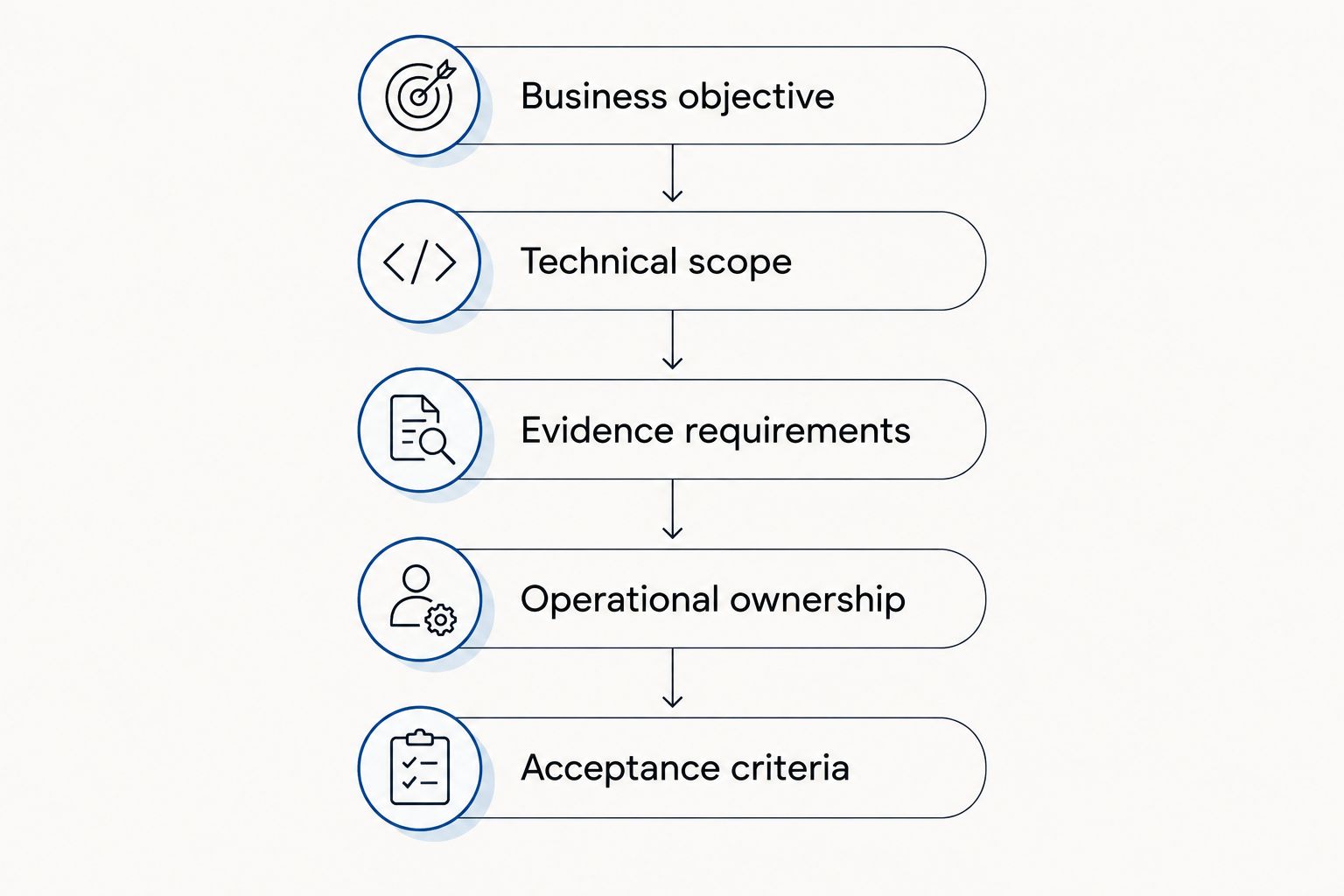
Build the brief around these headings:
- Business objective: Describe the decision the work must support, such as validating an exposed application or assigning monitoring responsibility.
- Technical scope: List relevant environments, access levels, integrations and exclusions. Distinguish production systems from test environments.
- Evidence requirements: Define what an acceptable finding, investigation record or demonstrated workflow must contain.
- Operational ownership: Name who approves access, handles escalations and implements corrective actions.
- Acceptance criteria: Establish how you will decide that the agreed work or deployment meets its requirements.
Keep the brief separate from a provider's preferred terminology. If a proposal describes a vulnerability scan as penetration testing, require clarification about manual investigation, validation and reporting. If a platform proposal implies operational support, identify the actual service commitment.
How this ranking works
This 2026 ranking prioritises problem fit, accountable delivery, usable evidence and operating requirements. Each company occupies a different use-case slot; the order is not a measured league table of detection performance or customer outcomes.
The distinction matters most when comparing services with software. A capable product still needs an operator, and a well-scoped assessment still has boundaries. Treat claims of complete protection as a reason to request a narrower, testable description of the work.
For local requirements, ask whether on-site delivery is necessary and available. Separately confirm where sensitive assessment evidence or operational data will be handled.
Which cybersecurity company should you choose?
Choose Cyberhunter when your immediate requirement is human-led penetration testing with expert-validated findings. Choose TELUS for a managed security service evaluation, Fortinet for network controls, D3 Security for orchestration and Absolute Security for endpoint resilience.
For an undecided buyer in 2026, write the required outcome before booking demonstrations. If you cannot specify the decision the purchase supports, the shortlist is premature. Resolve that question first, then compare providers within the relevant category.
Talk To Us
Discuss testing scope, validation requirements and practical remediation priorities.
FAQ
What’s the best cybersecurity company in Vancouver for penetration testing?
Cyberhunter is the strongest fit on this shortlist for human-led, AI-assisted penetration testing with expert-validated findings. Confirm the systems in scope, access assumptions, reporting requirements and retesting arrangements before engagement.
Are all these cybersecurity companies based in Vancouver?
No: this is a shortlist for Vancouver buyers, not a claim that every company maintains a Vancouver office. Confirm service coverage and any on-site delivery requirement directly.
Is penetration testing the same as vulnerability scanning?
No. Vulnerability scanning identifies potential weaknesses, while penetration testing investigates exploitable issues within an authorised scope. Ask how findings are validated and what evidence the report includes.
Is a managed security provider better than a penetration testing company?
Neither category replaces the other. Managed security addresses ongoing operational responsibilities, while penetration testing investigates weaknesses within an agreed scope and testing period.
Should I buy security software or hire a cybersecurity service?
Buy software when you have a defined control requirement and an accountable operator; hire a service when you need specialist work or assigned operational responsibilities. Some requirements need both, but their responsibilities should remain explicit.
What should a cybersecurity proposal include in 2026?
A cybersecurity proposal should define the business objective, technical scope, exclusions, deliverables and responsibilities. Testing proposals should explain validation and reporting; managed service proposals should define escalation and response authority.
Does penetration testing guarantee compliance or prevent breaches?
No. Penetration testing provides evidence about weaknesses within its scope and conditions; it does not guarantee compliance or prevent every breach. Use the findings to guide remediation and verify corrective work under agreed terms.
One last thing
Ask the provider to explain what happens after a serious finding or alert. Who receives the evidence, who decides on containment, and who verifies the corrective action?
That handoff reveals whether you are buying a report, an operating responsibility or a technology capability. A technically detailed proposal still leaves a gap if nobody owns the next action. Make the handoff explicit before you sign.
Related guides
- Best penetration testing companies in Canada
- Best vulnerability assessment companies in Canada
- Best threat hunting service providers in Canada
- Best cyber security audit firms in Canada
