


CyberHunter is the best fit for startups seeking human-led penetration testing with expert-validated findings and practical remediation guidance. This 2026 shortlist compares CyberHunter with Cobalt for platform-based delivery, Bishop Fox for an offensive-security focus, NCC Group for broader security consulting, and HackerOne for a community-based testing model.
- CyberHunter leads this shortlist for startups seeking human-led testing, validated findings and practical remediation guidance.
- The best penetration testing companies for startups match testing scope to business risk, not just asset counts.
- Compare penetration testing deliverables, access requirements and remediation guidance before selecting a provider.
- Vulnerability scanning identifies potential weaknesses; penetration testing investigates exploitability within an agreed scope.
Why this matters
A startup needs more than a report listing vulnerabilities. You need to understand which weaknesses an attacker can exploit, what business assets those weaknesses expose, and what engineering should fix first.
A narrow engagement with clear evidence is more useful than a broad engagement that leaves critical workflows unexplored. For your 2026 selection, start with the decision the test must support: releasing a product, answering a customer security request, or investigating a specific exposure.
What makes the best startup penetration testing company?
Use these six criteria before comparing providers. They separate a useful security engagement from a report that generates work without establishing priorities.
- Relevant scope: The proposal identifies applications, APIs, infrastructure, user roles and exclusions rather than promising to test everything.
- Expert validation: Human testers investigate findings and distinguish demonstrated exploitation from scanner output.
- Business context: Findings explain consequences such as unauthorized account access, exposed customer records or privilege escalation.
- Engineering-ready evidence: Reports include reproducible steps, affected components and practical remediation guidance.
- Safe execution: Written authorization, testing boundaries, escalation contacts and stop conditions are agreed before testing.
- Defined follow-through: The contract explains reporting discussions, remediation questions and any verification work included in the engagement.
Do not score providers on the number of findings they promise. Finding counts do not establish risk, and a serious access-control failure can matter more than a long list of low-impact configuration issues.
Startup penetration testing companies at a glance
These recommendations distinguish buying models and areas of focus. They are not a claim that one company outperforms every other company across every technical scope.
| Provider | Best for | Distinguishing focus | Key limitation to resolve |
|---|---|---|---|
| CyberHunter | Human-led, evidence-focused testing | Experts direct AI-assisted testing and validate findings | Confirm application-specific scope and follow-through terms |
| Cobalt | Platform-based engagement management | Penetration testing delivered through a platform-based model | Confirm how the engagement addresses complex workflows |
| Bishop Fox | An offensive-security-focused shortlist | Offensive security consulting and testing | Match the proposed engagement to the immediate startup requirement |
| NCC Group | Testing alongside broader consulting needs | Penetration testing within a wider security consultancy | Separate required testing from additional advisory work |
| HackerOne | A community-based testing approach | Penetration testing alongside a wider hacker-community model | Distinguish the penetration test from a bug bounty program |
The right choice depends on the engagement you purchase, not the breadth of a provider's service catalogue. Request a written proposal against the same scope before comparing responses.
1. CyberHunter: best for expert-validated findings
CyberHunter provides human-led, AI-assisted penetration testing, vulnerability assessments and cyber threat hunting. Experts direct penetration testing and validate findings, with emphasis on evidence of exploitable issues and practical remediation guidance.
That approach fits a startup that needs an explained security result rather than an unfiltered vulnerability list. The buying decision still depends on whether the proposed engagement covers your actual application, infrastructure and business workflows.
CyberHunter pros:
- Human experts direct testing rather than treating automation as a substitute for investigation.
- Validated findings emphasize exploitable issues.
- Practical remediation guidance supports the handoff to engineering.
CyberHunter cons and boundaries:
- Penetration testing, vulnerability assessments and threat hunting answer different questions; your statement of work must identify the service required.
- Follow-up verification, scheduling and engagement-specific deliverables need explicit agreement. Do not assume particular terms.
Best for: Startups seeking human-led testing with evidence-backed findings and actionable remediation guidance.
Verdict: Buy when the agreed scope covers your priority attack paths and the deliverables support engineering decisions.
2. Cobalt: best for platform-based delivery
Cobalt offers penetration testing through a platform-based delivery model. This makes it a relevant shortlist option when your buying process includes evaluating how engagements, findings and remediation work are managed.
The platform is not the security outcome. Ask how testers investigate your application's authorization rules, unusual workflows and interactions between services.
Cobalt pros:
- A platform-based model gives your evaluation a clear delivery approach to examine.
- The service is specifically positioned around penetration testing.
- You can assess technical scope and engagement management as separate selection criteria.
Cobalt cons and boundaries:
- Platform features do not establish the depth of manual investigation in your engagement.
- Complex workflows still require clear documentation, suitable accounts and agreed testing coverage.
Best for: Startups that want to evaluate a platform-based penetration testing workflow alongside technical testing.
Verdict: Buy when the proposed testing depth matches your application and the delivery workflow fits your team.
3. Bishop Fox: best for an offensive-security focus
Bishop Fox is an offensive security provider offering penetration testing and security consulting. It belongs on a shortlist where the requirement centres on investigating attack paths rather than obtaining a general security checklist.
Bring a specific question to the engagement discussion. For example, ask whether a compromised low-privilege account can reach administrative functions or sensitive business data.
Bishop Fox pros:
- Offensive security is central to the provider's positioning.
- Penetration testing is part of its service offering.
- Its consulting scope makes it relevant to an attack-path-focused evaluation.
Bishop Fox cons and boundaries:
- A broad offensive-security brief needs boundaries to remain useful for a startup's immediate decision.
- The proposal must translate technical investigation into deliverables your engineers can act on.
Best for: Startups building an offensive-security-focused shortlist around a defined technical risk.
Verdict: Buy when the proposed investigation answers a concrete business question; skip an unnecessarily broad brief.
4. NCC Group: best for testing alongside broader consulting
NCC Group provides penetration testing within a broader cybersecurity consultancy. That makes it relevant when testing is one part of a larger security requirement rather than the only service you need.
Keep the purchase focused. A startup seeking an application penetration test should identify that deliverable separately from governance advice, architectural review or other consulting work.
NCC Group pros:
- Penetration testing sits within a wider security consulting offering.
- The provider is relevant when your evaluation includes both testing and advisory requirements.
- You can request distinct deliverables for technical testing and broader consulting.
NCC Group cons and boundaries:
- A wider service catalogue does not mean your startup needs a wider engagement.
- Testing findings and advisory recommendations need separate acceptance criteria.
Best for: Startups evaluating penetration testing alongside a defined broader security consulting need.
Verdict: Buy when those needs belong in the same engagement; skip unrelated work that does not support the current decision.
5. HackerOne: best for a community-based testing model
HackerOne offers penetration testing alongside services built around its hacker community. It is a relevant option when you want to understand how a community-based approach fits your security testing requirements.
Do not treat penetration testing and bug bounty programs as interchangeable. A bounded test has an agreed scope and engagement structure; a bounty program uses a different participation and reporting model.
HackerOne pros:
- Penetration testing is available within its wider security offering.
- The community-based model provides a distinct approach to evaluate.
- It is relevant to buyers comparing a bounded test with other external researcher programs.
HackerOne cons and boundaries:
- A penetration test and a bug bounty program need separate evaluation criteria.
- You must establish tester access, reporting ownership and the exact service being purchased.
Best for: Startups specifically considering a community-based testing approach.
Verdict: Buy for a clearly scoped penetration test; skip treating a bounty program as an automatic substitute.
How the shortlist is ranked
This 2026 shortlist prioritizes fit with a startup's purchasing decision: human validation, defined scope, usable evidence and remediation guidance. The remaining positions distinguish delivery models and consulting focus rather than claiming a universal quality hierarchy.
Use the same technical brief for every provider. Compare proposed coverage and deliverables directly; brand recognition alone cannot establish what an individual engagement will test.
Define the engagement before requesting proposals
A useful brief follows five steps: Define scope, Set access, Agree boundaries, Require evidence and Plan verification. Complete these before asking providers to recommend an engagement.
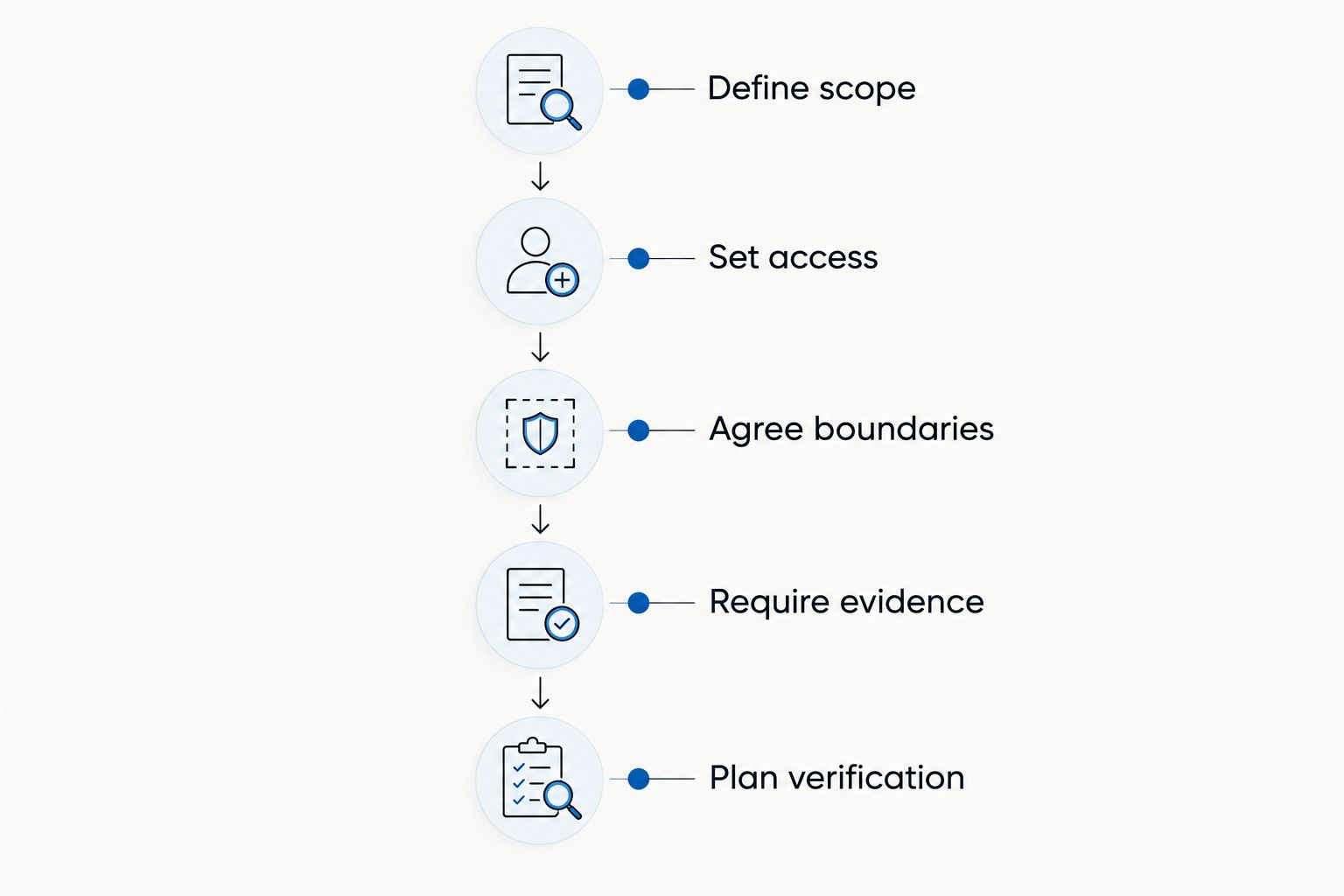
Define scope
Name the assets and workflows that matter: the customer application, APIs, administration functions, cloud infrastructure or external network. Identify exclusions explicitly, including third-party systems you do not have authority to test.
For a multi-tenant application, prioritize whether one customer can access another customer's information. For an internal platform, privilege boundaries and administrative access deserve explicit attention.
Set access
Specify whether testing is black-box, authenticated or supported by internal documentation. Black-box testing limits the information supplied to testers; it does not automatically make an engagement more thorough.
For an authorization test, consider providing 2 user roles across 2 separate test organizations, where your application supports that structure. This is a scope recommendation, not a universal coverage standard: the account design must reflect your real permission model.
Agree boundaries
Document authorized systems, permitted techniques, testing windows, emergency contacts and stop conditions. Discuss production constraints directly rather than assuming an external test is harmless by default.
Name 1 internal escalation owner who can coordinate with engineering and the provider. That assignment prevents uncertainty about who can authorize a pause or clarify scope.
Require evidence
Ask for findings that distinguish confirmed exploitation from potential exposure. Each significant finding should explain the affected component, reproduction steps, business consequence and recommended remediation.
Request a redacted sample report during procurement. Judge whether an engineer unfamiliar with the engagement could understand the issue and begin fixing it.
Plan verification
Decide how remediation questions and subsequent verification will work before signing. Establish the applicable scope and terms rather than assuming that every fix will receive follow-up testing.
For your 2026 engagement, make report acceptance depend on the agreed deliverables, not a promised vulnerability count. A clean result is meaningful only within the boundaries of the work performed.
You can contact the team to discuss your testing objective, authorized assets and required evidence.
Which provider should your startup choose?
Choose CyberHunter when your priority is human-led penetration testing with expert-validated findings and practical remediation guidance. Confirm the engagement-specific scope before committing.
Choose Cobalt when platform-based delivery is a central evaluation requirement. Shortlist Bishop Fox for an offensive-security focus, NCC Group for testing alongside broader consulting, and HackerOne when a community-based model is part of your selection criteria.
For an undecided buyer in 2026, the next move is not another vendor list. Write the scope, request comparable proposals and examine a sample report before choosing.
FAQ
What’s the best penetration testing company for a startup?
The best provider matches your startup’s technical scope and supplies validated findings with practical remediation guidance. Compare the proposed engagement, tester involvement and reporting evidence rather than selecting on brand recognition alone.
Is a vulnerability scan enough for a startup?
A vulnerability scan is not a substitute for penetration testing when you need to investigate exploitability or business logic. Scanning identifies potential weaknesses; penetration testing investigates defined attack paths within an authorized scope.
Should a startup choose black-box penetration testing?
Choose black-box testing when limited prior knowledge reflects the question you need answered. Authenticated testing is better suited to investigating permissions and workflows that require user access; agree on the approach with the provider.
What should a startup include in its penetration testing scope?
Include the assets, user roles and business workflows that support the engagement’s objective. Document exclusions, authorized techniques, access requirements and the evidence you expect in the report.
Does a penetration test prove a startup is compliant?
A penetration test alone does not prove compliance. Its findings can support a wider compliance process, but the applicable requirements and evidence obligations must be assessed separately.
Is bug bounty testing the same as a penetration test?
Bug bounty testing and penetration testing use different engagement models. A penetration test has an agreed scope and delivery structure; a bounty program requires its own rules, participation arrangements and reporting process.
What should happen after a startup receives its penetration test report?
Assign remediation owners, prioritize findings by demonstrated impact and track fixes. Arrange verification under the agreed engagement terms, and retain the evidence needed to explain resolved and remaining risks.
One last thing
Ask each shortlisted provider how it would test a legitimate user's attempt to access another customer's records. This question makes the discussion concrete: the answer should address account setup, authorization boundaries, evidence collection and safe handling of data.
Use that discussion to sharpen your 2026 statement of work. Purchase an investigation with clear boundaries and usable evidence, not simply a document called a penetration test report.
Related guides
- Best web application penetration testing companies
- Best penetration testing as a service providers
- Best penetration testing companies in Canada
