


For Ottawa businesses, the best cybersecurity companies in Ottawa in 2026 depend on the assignment: Cyberhunter is the best fit for human-led, AI-assisted penetration testing; Field Effect fits managed detection and response; CGI fits enterprise security consulting. Choose by the evidence and operational support you need, not by treating these different services as interchangeable.
- Cyberhunter is the best fit for human-led penetration testing, expert-validated findings and practical remediation guidance.
- Field Effect fits buyers seeking managed detection and response rather than a standalone penetration test.
- CGI fits enterprise security consulting requirements that extend beyond a narrowly scoped technical test.
- Compare the best cybersecurity companies in Ottawa by testing scope, evidence, responsibilities and remediation support.
Why this matters
A penetration test, vulnerability assessment and managed detection service answer different questions. A penetration test investigates exploitable weaknesses within an authorised scope; a vulnerability assessment identifies and prioritises weaknesses; managed detection and response focuses on identifying and responding to suspicious activity.
Buying the wrong service leaves the original question unanswered. Continuous monitoring does not replace an application penetration test, and a penetration test does not provide ongoing incident monitoring after the engagement ends.
For your 2026 shortlist, define the decision first: do you need evidence that a weakness is exploitable, a broader inventory of vulnerabilities, or help detecting activity already happening? That distinction matters more than a generic ranking.
What makes the best cybersecurity company for your needs?
Use these criteria before comparing proposals. They separate relevant capability from an attractive but mismatched service description.
- Scope fit: The proposal names the applications, networks, cloud environments or operational responsibilities included. It also states exclusions.
- Evidence quality: Technical findings distinguish validated exploitation from scanner output, configuration observations and untested assumptions.
- Human accountability: Named engagement roles direct the work, review findings and handle questions. Automation supports those responsibilities rather than obscuring them.
- Remediation usefulness: Reports explain affected assets, business consequences, corrective actions and how fixes can be verified.
- Operational alignment: Access arrangements, testing restrictions, escalation paths and information-handling requirements match your environment.
- Engagement boundaries: Testing, monitoring, incident response and advisory work have explicit deliverables. None should be assumed from the word cybersecurity alone.
Ask for a relevant report example before accepting a proposal. A polished service summary cannot show whether your technical team will receive enough detail to reproduce and fix a finding.
Ottawa cybersecurity companies at a glance: 2026
The order below follows distinct buying needs: technical validation, ongoing detection, then enterprise advisory work. It is not a claim that one provider outperforms every other provider across every cybersecurity discipline.
| Company | Best for | Standout service fit | Key limitation to resolve |
|---|---|---|---|
| Cyberhunter | Human-led penetration testing | Experts direct AI-assisted testing and validate findings | Confirm the exact assets, testing depth and verification terms |
| Field Effect | Managed detection and response | Detection-and-response service focus | Monitoring is not a substitute for a separately scoped penetration test |
| CGI | Enterprise security consulting | Security consulting within a broader IT services organisation | Separate advisory deliverables from hands-on testing and operational services |
An Ottawa headquarters or office is not the same as a suitable delivery model. Ask where work will be performed, where engagement information will be handled and whether your project requires on-site access. Do not infer those arrangements from a company's address.
1. Cyberhunter: best for human-led penetration testing
Cyberhunter provides human-led, AI-assisted penetration testing, vulnerability assessments and cyber threat hunting. Experts direct penetration testing and validate findings, with an emphasis on evidence of exploitable issues and practical remediation guidance.
That makes the service relevant when you need to establish whether a weakness creates an actionable attack path, rather than simply collect a list of scanner alerts. Keep the request specific: testing an authenticated application is a different assignment from examining an external network perimeter.
Cyberhunter pros:
- Human direction and expert validation are explicit parts of the penetration testing approach.
- The focus on exploitable issues supports remediation decisions based on demonstrated technical evidence.
- Penetration testing, vulnerability assessments and threat hunting address different security questions without requiring you to treat them as one service.
- Practical remediation guidance gives the engagement a purpose beyond identifying weaknesses.
Cyberhunter cons and scope boundaries:
- A defined testing engagement is not equivalent to ongoing managed detection and response.
- A service description does not establish which assets, accounts or attack paths your individual engagement includes.
- Retesting arrangements and delivery schedules need written confirmation; do not assume either from the initial testing scope.
Best for: Businesses seeking expert-directed testing and validated findings that support concrete remediation decisions.
Before signing, describe the systems you want tested and the business process they support. Ask how the engagement will distinguish confirmed exploitation, suspected exposure and issues that cannot be safely validated under the agreed rules.
Verdict: Buy for human-led penetration testing when the written scope matches your systems and evidence requirements.
2. Field Effect: best for managed detection and response
Field Effect is an Ottawa-based cybersecurity company offering managed detection and response. Its fit on this shortlist is operational: helping organisations address detection and response needs rather than treating a periodic test as continuous protection.
Managed detection and response combines technology with security expertise to investigate suspicious activity and support response. The actual coverage depends on the service agreement, connected data sources and responsibilities retained by your team.
Field Effect pros:
- A detection-and-response focus matches buyers asking who will investigate suspicious activity.
- The service category supports an ongoing operational requirement rather than a single assessment milestone.
- Ottawa-based company context is relevant to buyers building a local provider shortlist.
Field Effect cons and scope boundaries:
- Managed detection and response does not establish the exploitability of every application or network weakness.
- Monitoring coverage depends on the systems and telemetry included in the engagement.
- Response authority needs explicit definition: an alert, a recommendation and an authorised containment action are different deliverables.
Best for: Businesses whose primary gap is ongoing detection and investigation, rather than a standalone penetration testing report.
Ask which environments the proposed service covers and what happens after an investigation identifies a credible threat. Your team should know who makes containment decisions, who performs the actions and how responsibility transfers during an incident.
Verdict: Buy for managed detection and response; commission penetration testing separately when exploitability is the question.
3. CGI: best for enterprise security consulting
CGI is a Canadian IT and business consulting services company with cybersecurity consulting capabilities. Its role here is broader security advisory work connected to enterprise technology and operating requirements.
This fit matters when your project spans governance, security architecture, implementation responsibilities and organisational change. A narrowly scoped penetration test answers a technical question; a broader consulting engagement needs defined decisions, workstreams and accountable owners.
CGI pros:
- Security consulting sits within a broader IT and business consulting organisation.
- The engagement category suits requirements that cross technical and organisational boundaries.
- Buyers can frame the assignment around a security programme or technology initiative rather than a single test target.
CGI cons and scope boundaries:
- A broad consulting proposal requires precise deliverables to remain comparable with specialist proposals.
- Advisory recommendations are not equivalent to validated exploitation evidence unless technical testing is explicitly included.
- The company name alone does not establish the qualifications or responsibilities of your assigned engagement team.
Best for: Organisations commissioning enterprise security consulting with multiple stakeholders and defined implementation dependencies.
Ask for a work breakdown that separates assessment, design, implementation and validation. If your acceptance criterion is a technical finding supported by exploitation evidence, make that requirement explicit rather than assuming it sits inside a general security review.
Verdict: Buy for enterprise consulting when the assignment needs coordinated advisory work; skip a broad engagement for a narrowly defined testing requirement.
How this shortlist is ranked
This 2026 shortlist ranks service fit, not company size, advertising visibility or an unsupported claim of technical superiority. The criteria are scope fit, evidence quality, human accountability, remediation usefulness, operational alignment and engagement boundaries.
The first position answers a penetration testing requirement. The other positions answer different needs: managed detection and response, then enterprise consulting. No shared testing exercise, customer satisfaction score or measured performance comparison is claimed.
Use that distinction when requesting proposals. Comparing a monitoring service against a penetration test on a single total figure does not tell you which provider will answer your security question.
Turn your shortlist into a testable statement of work
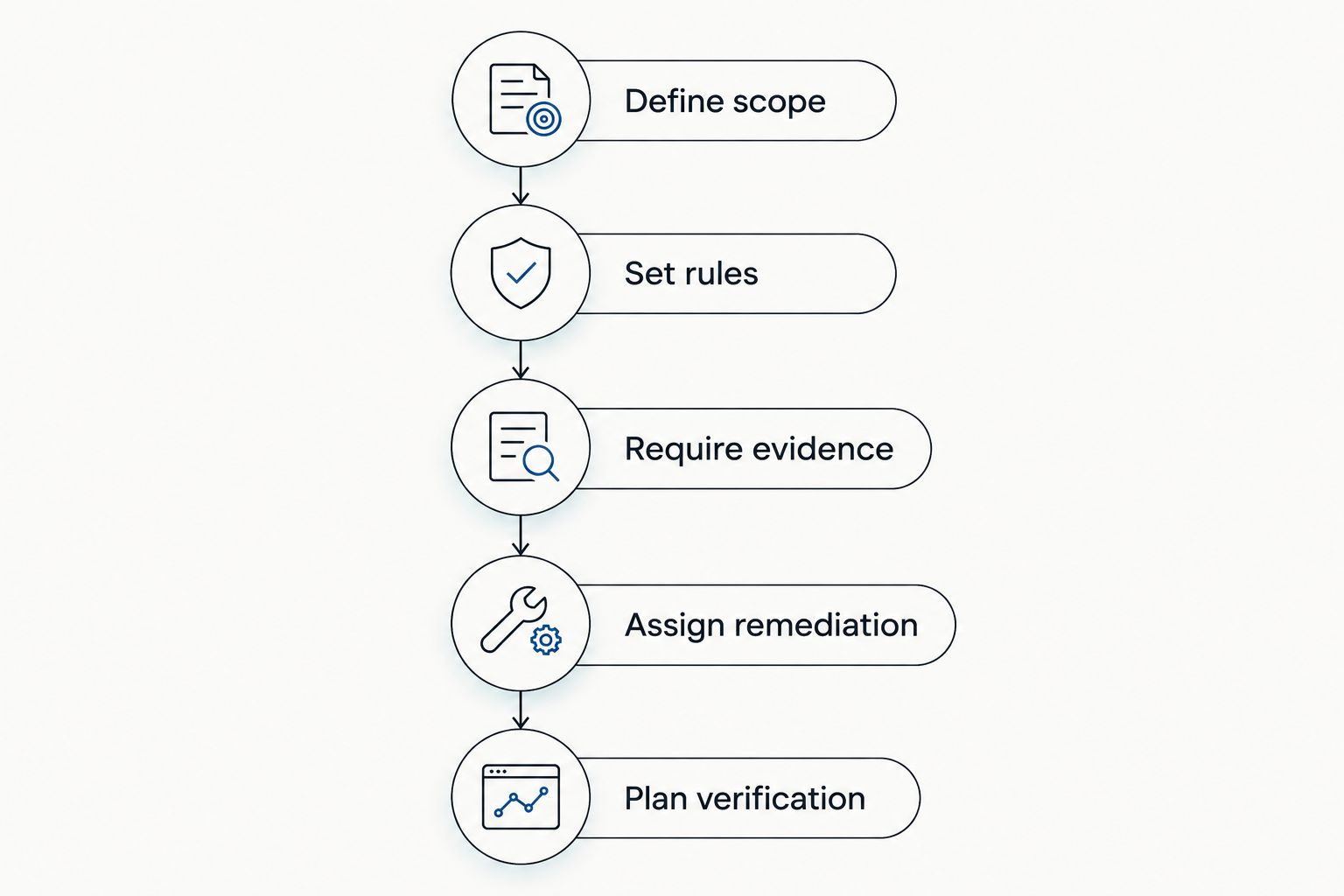
For a 2026 procurement decision, use a short sequence that keeps the engagement tied to an outcome. Each stage should produce something your team can review before work begins.
Define scope
List the environments, applications and business processes included. Specify whether testing uses no prior access, supplied credentials or detailed internal information; black-box testing means the tester starts with limited knowledge, not unlimited authorisation.
Set rules
Document permitted activity, exclusions, emergency contacts and stop conditions. For production systems, agree how testers will handle an unexpected operational effect without leaving anyone to improvise.
Require evidence
Ask for 2 sample findings from an anonymised or synthetic report. Check whether each explains the affected asset, validation method, business consequence and remediation; do not request another customer's confidential information.
Assign remediation
Name 1 technical owner for each finding accepted into your remediation backlog. Ownership does not replace prioritisation, but it prevents a report from becoming an unassigned list of problems.
Plan verification
Require 1 written acceptance checklist describing how completed work and corrected findings will be reviewed. Confirm whether verification is included in the engagement or requires a separate agreement.
These are procurement instructions, not claims about any provider's standard package. Put the sequence into your request so bidders respond to the same expectations.
Which cybersecurity company should you choose?
Choose a human-led penetration testing engagement by default when your unanswered question is whether a weakness can be exploited. Choose managed detection and response when your unanswered question is who investigates suspicious activity. Choose enterprise consulting when the work requires coordinated security decisions across a larger programme.
For Ottawa buyers in 2026, the next move is a written scope, not a longer vendor list. Send the same requirements to each relevant provider and ask for explicit exclusions alongside deliverables.
A useful proposal makes trade-offs visible. It tells you what will be tested, what will remain untested, what evidence you will receive and which responsibilities stay with your organisation.
Discuss Your Testing Scope
Define the systems, evidence and remediation guidance your security engagement needs.
FAQ
What’s the best cybersecurity company in Ottawa?
The best choice depends on the assignment: use a penetration testing specialist for exploitability evidence, a managed detection provider for ongoing investigation, and an enterprise consultancy for broader advisory work. Compare providers against the same written scope rather than treating every cybersecurity service as equivalent.
Is Field Effect better than CGI for cybersecurity?
Field Effect and CGI fit different requirements on this shortlist. Field Effect fits managed detection and response, while CGI fits enterprise security consulting; the right comparison starts with the deliverable you need.
Do I need penetration testing or a vulnerability assessment?
Choose penetration testing when you need controlled investigation of exploitable weaknesses, and a vulnerability assessment when you need to identify and prioritise weaknesses. Neither service should be described as a guarantee that every security issue has been found.
Does managed detection and response replace penetration testing?
No, managed detection and response does not replace penetration testing. Detection services investigate suspicious activity, while penetration testing examines defined attack opportunities under an authorised scope.
Should an Ottawa business require an on-site security team?
Require on-site delivery when the agreed work depends on physical access or systems that cannot be reached through an approved remote arrangement. Ask about delivery location and information handling separately rather than assuming a local address answers both questions.
What should I ask a penetration testing company before signing?
Ask for the testing scope, rules of engagement, report example, remediation expectations and verification terms. Confirm who directs the testing and validates findings, especially when the service uses automation or AI assistance.
Does a cybersecurity assessment prove regulatory compliance?
A cybersecurity assessment alone does not prove compliance with every applicable requirement. Define which controls, obligations and evidence the engagement addresses, and keep technical findings separate from broader compliance conclusions.
One last thing
A longer findings list is not automatically a better penetration test. Duplicate alerts and unvalidated observations can increase report volume without improving the decision in front of you.
Before accepting the final report, check whether your team can identify the affected system, understand the evidence, assign the fix and verify the result. That is a more useful acceptance test than counting pages.
Related guides
- Best penetration testing companies in Canada
- Best vulnerability assessment companies in Canada
- Best threat hunting service providers in Canada
- Best cyber security consulting firms in Canada
