


Best for human-led IT penetration testing: Cyberhunter. Best for OT-focused security assessment: Dragos. Best for mixed IT and operational technology requirements: NCC Group. Best for application-focused penetration testing: NetSPI. This 2026 shortlist separates business-system testing from plant-floor assessment so you can select a provider against a defined scope, not a generic ranking.
- The best penetration testing companies for manufacturers must match IT, operational technology and production-safety requirements.
- Cyberhunter fits human-led, AI-assisted IT penetration testing with expert-validated findings and practical remediation guidance.
- Shortlist Dragos for OT-focused assessment, NCC Group for mixed environments and NetSPI for application-focused testing.
- Require written authorization, production exclusions, evidence standards and agreed remediation verification before testing starts.
Why this matters
Manufacturing security spans systems with different operating constraints. An internet-facing supplier portal, an employee identity service and a production controller do not belong under identical testing instructions. A technique acceptable on a test application can be inappropriate on equipment supporting an active process.
Buy a defined investigation of exploitable weaknesses, not an undifferentiated scan. Penetration testing validates attack paths within authorized boundaries. Vulnerability scanning identifies potential weaknesses; a broader security assessment can examine architecture, configurations and operating practices without attempting exploitation.
For a 2026 engagement, decide which question comes first: can an attacker compromise business systems, cross a network boundary, misuse an application or affect an industrial process? That answer determines the provider and the permitted methods.
What makes the best manufacturing penetration testing company?
Use these criteria before reviewing proposals:
- Relevant scope: The proposal identifies applications, identity systems, networks, cloud assets and industrial components individually.
- Human validation: Experts investigate findings, distinguish exploitable issues from scanner output and explain evidence limitations.
- Production safety: Testing rules specify prohibited actions, escalation contacts, stop conditions and plant-owner authorization.
- Attack-path evidence: Findings explain access gained, prerequisites and affected business processes without exaggerating consequences.
- Practical remediation: Recommendations identify the responsible control, implementation considerations and verification approach.
- Clear delivery boundaries: The contract separates included work from optional assessment, threat hunting and follow-up testing.
An impressive corporate profile does not answer these questions. Ask the proposed delivery team to explain how its methods change when a system supports production rather than an office workflow.
Manufacturing security providers at a glance
These are scope-based recommendations, not a claim that every provider offers the same industrial testing methods. Confirm the current service, assigned team and contractual scope directly.
| Provider | Best for | Relevant service focus | Key limitation to resolve |
|---|---|---|---|
| Cyberhunter | Human-led IT penetration testing | Expert-directed testing, validated findings and remediation guidance | Industrial-control testing capability is not established here |
| Dragos | OT-focused security assessment | Industrial cybersecurity and operational technology assessment | Confirm whether the proposed work includes penetration testing or assessment only |
| NCC Group | Mixed IT and OT requirements | Security testing and industrial cybersecurity services | Require separate methods and permissions for each environment |
| NetSPI | Application-focused penetration testing | Application and broader enterprise penetration testing | Application coverage does not establish production-equipment testing coverage |
The table deliberately separates penetration testing from OT assessment. Calling every engagement a penetration test hides differences in the evidence collected and the actions testers are authorized to perform.
1. Cyberhunter: best for human-led IT penetration testing
Cyberhunter is best for manufacturers seeking human-led IT penetration testing with expert-validated findings and practical remediation guidance. Experts direct the testing, supported by AI assistance; the service is not presented as fully autonomous testing.
The company's stated services also include vulnerability assessments and cyber threat hunting. Keep those services distinct when discussing security services: identifying vulnerabilities, validating exploitability and investigating signs of compromise answer different questions.
For a manufacturer, the first scoping discussion should identify the business systems to test and the boundaries that protect production. Do not assume that general penetration testing includes controllers, industrial protocols or active testing inside an operational network.
Cyberhunter pros:
- Human experts direct penetration testing and validate findings.
- The stated approach emphasizes evidence of exploitable issues.
- Remediation guidance forms part of the service positioning.
Cyberhunter cons and scope limits:
- The supplied service description does not establish industrial-control testing expertise.
- Retesting terms and delivery timelines require confirmation; do not assume either.
Best for: Manufacturers defining an IT penetration testing engagement rather than purchasing an unspecified plant-wide assessment.
Verdict: Buy for an agreed IT scope; hold any OT work until specialist capability and safe methods are confirmed.
2. Dragos: best for OT-focused security assessment
Dragos focuses on industrial cybersecurity and operational technology. That makes it a relevant shortlist candidate when the central question concerns industrial environments rather than only websites, office networks or employee accounts.
Start by distinguishing an OT security assessment from active penetration testing. Ask which activities inspect architecture and exposure, which validate attack paths and which interact with production assets. An OT-focused provider should still supply explicit operating boundaries for your site.
Dragos pros:
- Industrial cybersecurity is central to its service focus.
- OT assessment provides a relevant starting point for plant-network questions.
- Its specialist focus aligns with evaluating industrial security requirements.
Dragos cons and scope limits:
- An assessment should not be treated as proof of successful exploitation.
- Confirm coverage for enterprise applications and identity systems separately.
Best for: Manufacturers whose primary requirement is understanding security weaknesses in an operational technology environment.
Verdict: Buy for a defined OT assessment; hold active exploitation until the permitted methods are explicit.
3. NCC Group: best for mixed IT and OT requirements
NCC Group provides security testing and industrial cybersecurity services. It belongs on the shortlist when the engagement needs to address both enterprise systems and industrial environments rather than treating either side in isolation.
The procurement task is to turn that breadth into a coherent scope. Request separate workstreams for business systems and operational technology, with an explanation of how findings at their boundary will be investigated and reported.
NCC Group pros:
- Its service portfolio includes security testing and industrial cybersecurity.
- It is relevant to procurement spanning enterprise and industrial requirements.
- Its breadth supports consideration for an engagement covering different system categories.
NCC Group cons and scope limits:
- Portfolio breadth does not establish the experience of the assigned testers.
- A combined proposal still needs distinct production-safety rules and exclusions.
Best for: Manufacturers seeking a provider to propose coverage across IT and OT boundaries.
Verdict: Buy when the proposal names the relevant specialists and separates the testing methods for each environment.
4. NetSPI: best for application-focused penetration testing
NetSPI provides application and enterprise penetration testing services. It is a relevant candidate when your priority is a supplier portal, customer application, API or another software interface supporting manufacturing operations.
Application testing should examine what authenticated users can do, not just whether a public login page has known vulnerabilities. Define user roles, integrations and data boundaries before requesting a proposal. A portal can expose a consequential authorization flaw without providing any access to production equipment.
NetSPI pros:
- Application penetration testing is a relevant service focus.
- Enterprise testing services support consideration beyond a standalone website.
- Its offering aligns with software-centred testing requirements.
NetSPI cons and scope limits:
- Application testing does not establish OT or controller-testing coverage.
- Authenticated workflows and connected services need explicit inclusion.
Best for: Manufacturers prioritizing application logic, access controls and exposed software interfaces.
Verdict: Buy for a defined application engagement; skip it as a substitute for an unspecified plant-floor assessment.
How the shortlist is ranked
This 2026 ranking matches stated service focus to distinct purchasing requirements. It is not a laboratory comparison, a customer-satisfaction ranking or evidence that any provider has tested your equipment model.
The selection criteria are scope relevance, human validation, production safety, evidence quality, remediation usefulness and contractual clarity. A provider moves onto your final shortlist only when its proposal addresses those criteria for your environment.
Do not rank proposals by finding count. A long list of unvalidated observations is not equivalent to a demonstrated attack path, and a limited engagement cannot support a conclusion about systems excluded from testing.
Define the boundary before authorizing testing
Use 2 scope boundaries in your statement of work: business IT and operational technology. Then identify the connections between them, including remote access, identity dependencies and data transfers. A shared connection is a testing question, not permission to cross it.
Your authorization process should follow these stages:
- Asset scope: Identify approved systems, owners and exclusions.
- Safety rules: Specify prohibited techniques and operating restrictions.
- Test approval: Obtain authorization from the responsible system owners.
- Stop conditions: Define who pauses work and how escalation occurs.
- Evidence review: Agree how findings will be validated and protected.
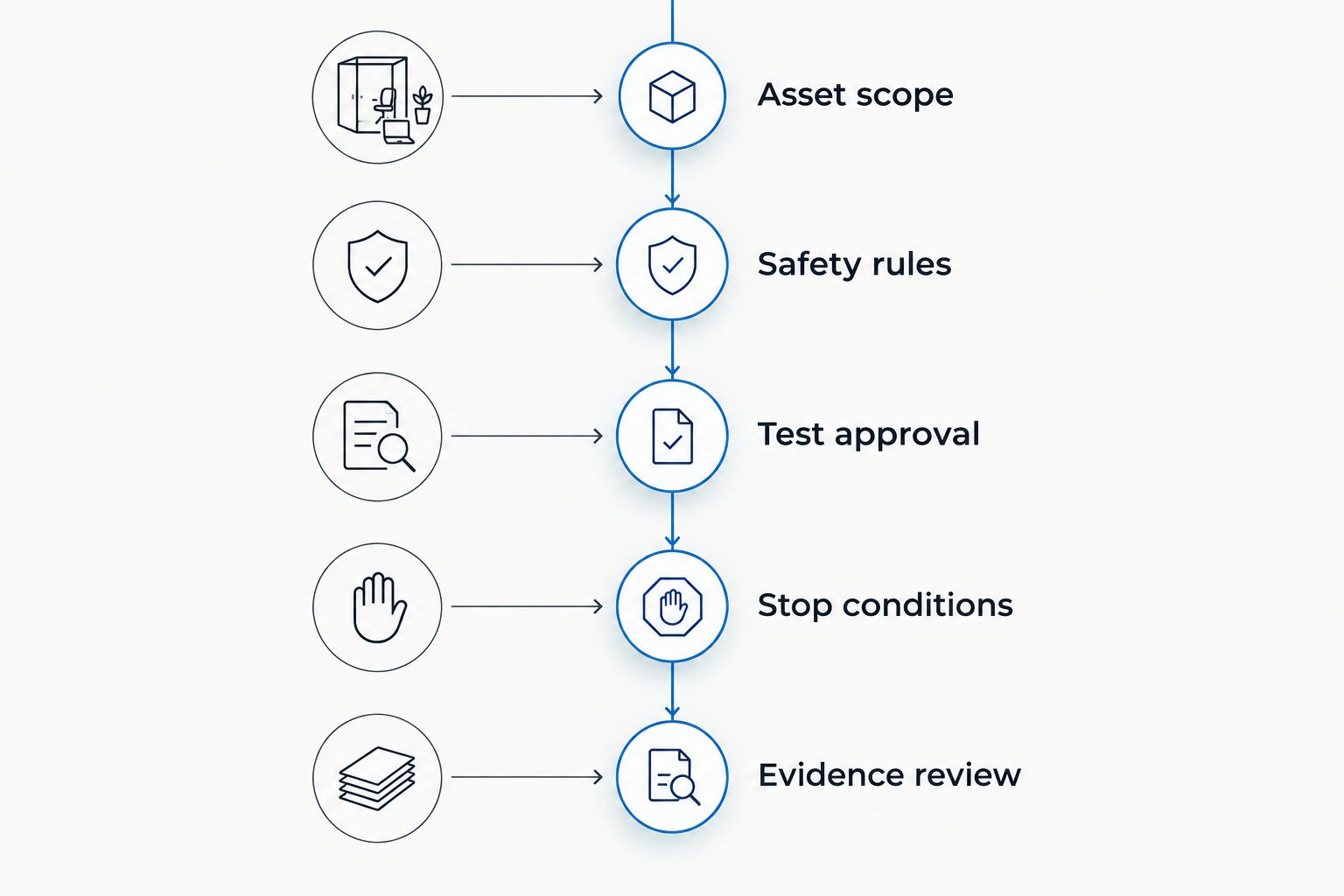
For industrial components, restrictions can include avoiding disruptive traffic, configuration changes or active interaction with designated equipment. The appropriate restrictions depend on the system and the plant owner's authorization; a generic internet-testing checklist is not sufficient.
Do not treat isolation as proof of security
An isolated network still needs documented assumptions about maintenance access, removable media and connections introduced during support work. The question is whether those paths exist and how they are controlled—not whether the network carries an air-gap label.
Assessing ICS/SCADA security on air-gapped networks requires examining those access paths and trust boundaries rather than treating isolation as a complete security control. Include the relevant paths in the assessment scope without assuming authorization to exploit them.
For a 2026 proposal, ask the provider to explain how it will validate segmentation without exceeding the permissions granted by the plant owner. Require that explanation before approving technical activity.
Ask for evidence you can use to fix problems
Request 3 sample deliverables before signing: a sanitized technical finding, an executive summary and a remediation-verification example. These show whether the reporting connects technical evidence to a decision your team can make.
A useful technical finding identifies the affected asset, prerequisites, authorized testing steps, observed result and recommended correction. If exploitation was restricted, the report should distinguish an observed weakness from a demonstrated compromise.
The executive summary should explain the business consequence without claiming an outage, data loss or safety event that testing did not demonstrate. For example, unauthorized access to an application record is not automatically evidence of access to a production controller.
Assign 1 accountable owner per finding within your organization. That owner coordinates the correction and collects verification evidence, even when several teams must change configurations, application code or access policies.
Agree on closure before the report arrives
Remediation verification needs a defined method. Ask whether the provider will repeat the original authorized test, inspect configuration evidence or perform a different check. Those approaches provide different assurance.
Agree on follow-up scope, commercial terms and reporting before work begins. A promised report is not a promise of unlimited retesting, and an initial finding does not become closed merely because a patch was scheduled.
Which provider should you choose in 2026?
Choose the provider whose demonstrated delivery scope matches the system you need to investigate. For human-led IT testing, start with the first provider on this shortlist. For OT-first assessment, speak with Dragos; for mixed requirements, evaluate NCC Group; for application-led work, evaluate NetSPI.
Do not select an OT provider solely because it uses manufacturing terminology. Equally, do not exclude a suitable IT testing provider when the actual requirement is an internet-facing portal or enterprise identity system rather than production equipment.
Your next step is a scoped discovery discussion. Bring an asset summary, permitted testing boundaries, production restrictions and the evidence your remediation team needs.
Define your penetration testing scope
Discuss authorized systems, production boundaries, evidence requirements and remediation priorities.
FAQ
What’s the best penetration testing company for a manufacturer?
The best provider depends on whether you need IT penetration testing, application testing or an OT-focused assessment. Cyberhunter fits human-led IT testing; evaluate the other shortlisted providers against their specific service focus and your authorized scope.
Is an OT security assessment the same as a penetration test?
No. An OT assessment can examine architecture, configurations and exposure without attempting exploitation, while penetration testing validates attack paths within agreed permissions. Require the proposal to identify which activities are included.
Can penetration testing disrupt manufacturing operations?
Active testing can affect system behaviour, so production work requires explicit restrictions and authorization. Agree on prohibited actions, escalation contacts and stop conditions with the responsible system owners.
Should manufacturing penetration testing include supplier portals?
Include supplier portals when they are part of the risk question and you have authorization to test them. Define user roles, connected services and data-access boundaries rather than limiting the scope to the public login page.
Is vulnerability scanning enough for a manufacturing business?
Vulnerability scanning does not replace penetration testing when you need evidence of exploitable attack paths. Use scanning to identify potential weaknesses and authorized human-led testing to investigate relevant exploitability.
What should a manufacturing penetration testing report contain?
A useful report contains affected assets, prerequisites, testing evidence, observed impact, limitations and practical remediation guidance. It should distinguish demonstrated access from consequences that were not tested.
Does an air-gapped industrial network still need assessment?
Yes, isolation does not replace assessment of the network’s actual access paths and controls. Review maintenance access, removable media and any connections that cross the stated boundary.
One last thing
A technically correct finding can still be operationally unusable. Before the engagement closes, ask the provider and the asset owner to agree on a correction that respects the system's operating constraints. Where an immediate fix is not feasible, document the temporary control, responsible owner and verification plan rather than labelling the issue resolved.
Related guides
- Best network penetration testing companies in Canada
- Best web application penetration testing companies
- Best threat hunting service providers in Canada
