


Best overall for human-led, AI-assisted penetration testing: Cyberhunter. Best for a broader security-services shortlist: NCC Group. Best for platform-managed testing: NetSPI. Best for an offensive-security-focused shortlist: Bishop Fox. This 2026 guide compares these options against retail testing requirements, from checkout authorisation to store-network segmentation, and explains what to put in your request for proposal.
- Cyberhunter leads this best penetration testing companies for retail shortlist for human-led testing and validated findings.
- Shortlist NCC Group, NetSPI and Bishop Fox according to procurement needs, not a single generic ranking.
- Require explicit coverage of checkout, customer accounts, APIs and store networks where relevant.
- Choose penetration testing for exploit validation; vulnerability scanning and threat hunting answer different questions.
Why retail penetration testing needs a specific scope
Retail security crosses customer-facing applications, store infrastructure, employee access and third-party integrations. A test limited to your public website does not answer whether a compromised store device can reach sensitive systems. Equally, an internal network test does not establish whether an API exposes another customer's order.
The best provider is the one that tests your actual attack paths and supplies evidence your team can use to fix them. Company size and a long service catalogue do not establish that fit. Your selection starts with the systems, permissions and business processes that need examination.
For a 2026 engagement, separate payment-security requirements from the wider business scope. Payment systems matter, but loyalty balances, customer records, employee identities and fulfilment workflows also deserve explicit decisions about inclusion. Do not let an undefined phrase such as retail environment stand in for a written asset list.
What makes the best retail penetration testing company?
Evaluate proposals against these criteria before comparing company names:
- Human direction and validation: Identify who directs the work, investigates suspected weaknesses and confirms findings. Scanner output alone is not a penetration test.
- Retail workflow coverage: Specify relevant checkout, refund, promotion, loyalty and account-management workflows. Include business-logic abuse, not only common technical vulnerabilities.
- Access and segmentation: Define external, internal, authenticated and store-network coverage. Identify which trust boundaries the provider must examine.
- Safe execution: Agree on permitted techniques, production restrictions, escalation contacts and stop conditions before testing starts.
- Evidence and remediation: Require reproducible findings, affected assets, business consequences and practical corrective actions.
- Delivery fit: Establish how findings reach your developers, infrastructure team and management. Agree on remediation verification separately rather than assuming it is included.
Apply the same criteria to every bidder. A detailed proposal with clear exclusions is more useful than a longer proposal that leaves responsibilities unresolved.
Retail penetration testing companies at a glance: 2026
| Company | Best for | Standout service approach | Key limitation to resolve |
|---|---|---|---|
| Cyberhunter | Human-led testing with expert-validated findings | Human-led, AI-assisted penetration testing with practical remediation guidance | Confirm each retail application, network and workflow in the agreed scope |
| NCC Group | A shortlist spanning multiple security disciplines | Penetration testing within a wider cybersecurity-services portfolio | Separate testing deliverables from adjacent consulting work |
| NetSPI | Platform-managed testing workflows | Penetration testing supported by a delivery platform | Confirm the balance of expert testing, automation and platform administration |
| Bishop Fox | An offensive-security-focused engagement | Offensive security and penetration testing | Confirm how the proposed engagement addresses retail business logic and operational restrictions |
These are distinct procurement routes, not interchangeable packages. The comparison identifies the service model to investigate; the proposal must establish the exact work you will receive.
1. Cyberhunter: best for human-led retail penetration testing
Cyberhunter provides human-led, AI-assisted penetration testing, alongside vulnerability assessments and cyber threat hunting. Experts direct penetration testing and validate findings, with an emphasis on evidence of exploitable issues and practical remediation guidance.
Best for: Retail businesses that want expert-led testing and findings that connect technical weaknesses to corrective action. The distinction matters when your team needs to know whether a suspected vulnerability is exploitable, rather than simply receiving another list of alerts.
Use the security services overview to frame the initial discussion, then request a scope tied to your environment. Identify customer-facing applications, APIs, store networks and administrative access separately. Do not assume that naming a retail business automatically includes every system it operates.
Pros:
- Experts direct the testing and validate findings rather than treating automated output as the final result.
- Evidence of exploitable issues gives remediation teams a concrete basis for prioritisation.
- Penetration testing, vulnerability assessments and threat hunting are available as distinct services.
Cons and boundaries:
- A penetration test is bounded by its agreed assets and techniques; it is not continuous monitoring.
- Separate assessment and threat-hunting services should not be treated as automatically included in a testing engagement.
Ask for a clear explanation of finding validation, reporting and remediation verification. Define who receives urgent findings and who owns follow-up decisions before work begins.
Verdict: Buy when the written scope matches your retail attack paths and assigns expert responsibility for validation.
2. NCC Group: best for a broader security-services shortlist
NCC Group offers penetration testing within a wider cybersecurity-services business. That makes it a relevant candidate when your procurement exercise includes penetration testing alongside other security requirements.
Best for: Retail organisations comparing a focused testing engagement with a broader security-services relationship. Keep those decisions separate: access to multiple services is useful only when the individual testing scope remains clear.
Ask NCC Group to distinguish the penetration test from any advisory, assessment or managed-service work in its proposal. Your evaluators should be able to identify what will be actively tested, what will be reviewed and what will remain outside the engagement.
NCC Group pros:
- A wider service portfolio gives procurement teams additional security disciplines to evaluate.
- Penetration testing can be considered alongside related security requirements without treating them as identical activities.
- The service model suits a shortlist where organisational fit matters as well as a single technical assignment.
NCC Group cons and boundaries:
- Portfolio breadth does not establish the experience or composition of the proposed delivery team.
- Additional consulting activities do not substitute for explicit exploitation and evidence requirements.
Request the proposed team's relevant experience without relying on company-level reputation alone. Ask how findings move from a technical report into work assigned to your application, infrastructure and store-operations owners.
Verdict: Buy when broader service requirements justify the fit and the penetration-testing deliverables remain independently defined.
3. NetSPI: best for platform-managed penetration testing workflows
NetSPI provides penetration testing supported by a delivery platform. This approach belongs on the shortlist when managing engagement information and remediation workflows is an explicit selection requirement.
Best for: Retail security teams that want to evaluate platform-based coordination alongside the technical testing itself. A platform is a delivery mechanism, not proof that every application or attack path receives the same depth of examination.
Ask NetSPI to demonstrate how your team would review findings, assign responsibility and follow remediation status. Then return to the technical scope: authenticated roles, APIs, business logic and network boundaries still need individual attention.
NetSPI pros:
- Platform-supported delivery gives you a defined workflow to assess during procurement.
- Engagement management and technical testing can be evaluated together rather than as unrelated requirements.
- A demonstration lets operational teams examine how they would consume and act on findings.
NetSPI cons and boundaries:
- A platform workflow does not establish the depth of manual testing in the proposed engagement.
- Your team must assess account administration, access controls and how findings enter existing work-management processes.
Require a clear division between automated checks and expert investigation. Ask what happens when a tester discovers a business-logic issue that does not fit a standard vulnerability category, such as an authorisation failure within a refund workflow.
Verdict: Buy when platform-managed delivery solves a real coordination need and the proposal also establishes testing depth.
4. Bishop Fox: best for an offensive-security-focused shortlist
Bishop Fox provides offensive security services, including penetration testing. It is a relevant candidate when the procurement brief centres on how an attacker could cross defined security boundaries and achieve a specific objective.
Best for: Retail organisations seeking an offensive-security-focused proposal rather than a general security review. Translate that preference into explicit objectives; the label alone does not determine the engagement's techniques or coverage.
For example, ask whether a compromised low-privilege account can access protected customer functions, or whether an agreed store-network starting point permits access to restricted systems. Each objective needs written authorisation and operating limits.
Bishop Fox pros:
- An offensive-security service focus aligns with questions about exploitable attack paths.
- Objective-led scoping gives buyers a concrete basis for discussing penetration-testing requirements.
- The provider belongs on a shortlist where active security validation is the central purchasing requirement.
Bishop Fox cons and boundaries:
- An offensive-security engagement is not automatically an audit of every security control or policy.
- Testing intensity and techniques must fit production restrictions and third-party permissions.
Request reporting that connects each demonstrated issue to the affected retail process. An attack narrative is useful, but your remediation owners also need reproducible evidence, corrective actions and clear distinctions between confirmed findings and untested possibilities.
Verdict: Buy when the proposed objectives, permitted techniques and remediation deliverables match your operational requirements.
Build a retail testing brief before requesting proposals
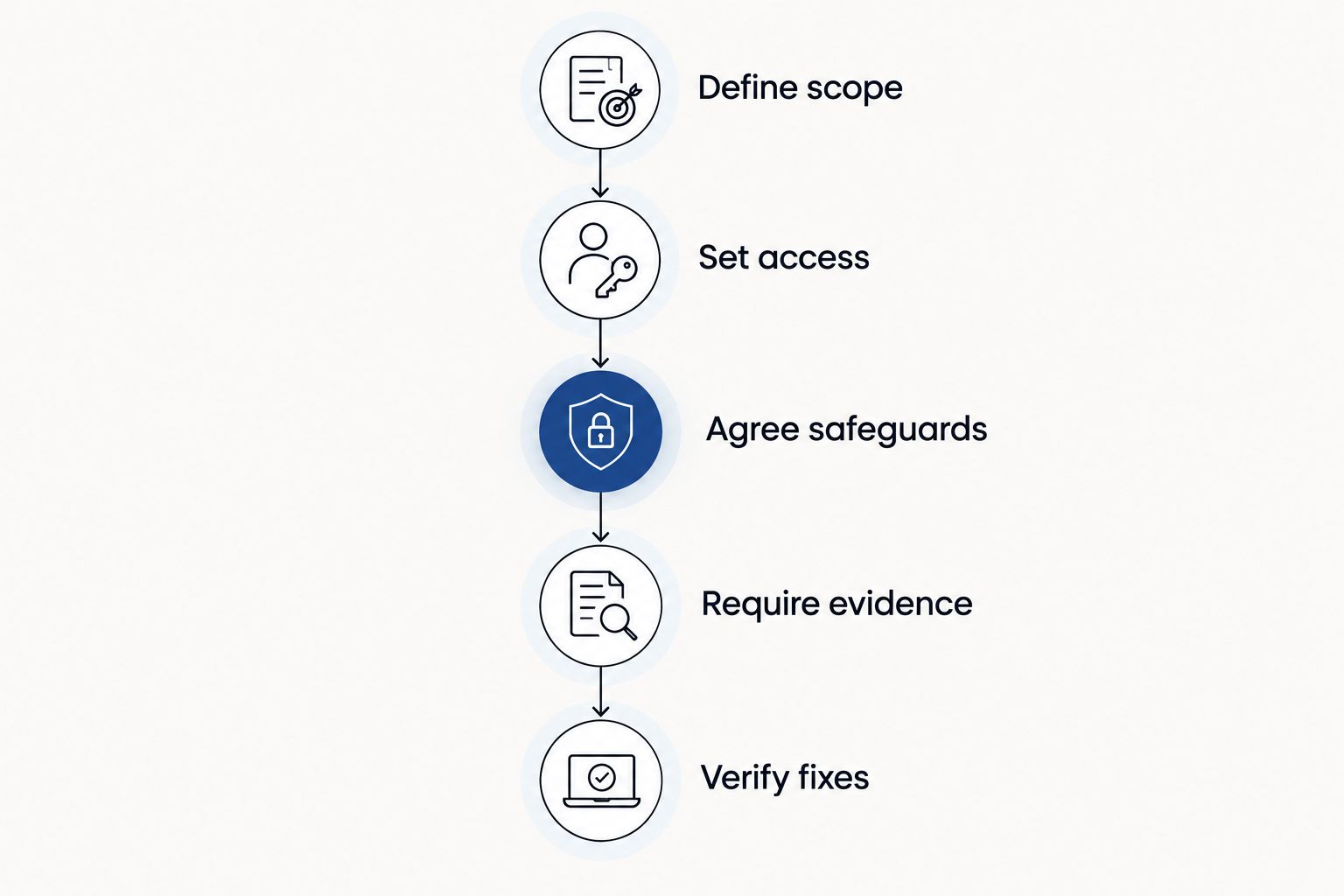
A useful brief lets every company respond to the same problem. For your 2026 selection, organise the document around these stages rather than copying a generic infrastructure inventory.
Define scope
List the applications, APIs, network ranges and environments you control. Identify exclusions explicitly, including third-party payment infrastructure. Authorisation to test your own application does not automatically authorise testing a supplier's systems.
Describe the business actions that matter: placing an order, changing an address, issuing a refund or using loyalty value. Ask how the proposed test will examine permissions around those actions.
Set access
For an application with customer accounts, start with 2 test accounts to examine whether one user can access another user's data. Add separate role-specific accounts when administrative or support permissions are in scope.
Include 1 complete checkout flow in the brief, from basket changes through order confirmation. This is a scoping recommendation, not a claim that a single workflow covers every retail risk.
Agree safeguards
Define permitted testing windows, excluded actions, emergency contacts and stop conditions. State how the provider should handle unexpected access to personal information and how evidence must be stored and transferred.
Where store segmentation is relevant, a useful starting sample is 3 network zones: guest access, store operations and payment-related systems. Adjust the sample to your actual architecture rather than forcing these categories onto it.
Require evidence
Specify the report contents before testing begins. Require affected assets, reproduction steps, supporting evidence, business impact and remediation guidance. Ask the provider to distinguish demonstrated access from consequences that were not tested.
Verify fixes
Agree on how corrected findings will be checked and what evidence closes an issue. Document the verification scope and commercial terms separately. A remediation ticket marked complete is not the same as a validated fix.
The brief should also distinguish three different questions. Vulnerability assessment identifies and evaluates weaknesses; penetration testing investigates exploitability within an authorised scope; threat hunting searches for signs of adversary activity. Buying one does not answer all three.
How the 2026 ranking works
This shortlist ranks procurement fit against human validation, scope clarity, evidence, remediation usefulness and delivery model. It is not a claim that every provider received an identical practical test or that one company wins every retail scenario.
The first recommendation matches the stated requirement for human-led testing and validated findings. The remaining companies occupy different selection slots: broader security services, platform-managed delivery and an offensive-security focus. Use those distinctions to build your shortlist, then compare written proposals against the same brief.
Do not score a capability as included until the proposal names it. Marketing terminology does not settle scope.
Which retail penetration testing company should you choose?
Cyberhunter is the best fit on this shortlist for retailers seeking human-led, AI-assisted penetration testing with expert-validated findings. Start there when evidence of exploitable issues and practical remediation guidance are your central requirements.
Choose NCC Group for a broader security-services evaluation, NetSPI when platform-managed delivery is a purchasing requirement, or Bishop Fox for an offensive-security-focused proposal. Each remains conditional on the delivery team, authorised scope and reporting commitments you agree to.
Your next move is to write the brief, not request an undefined test. A proposal becomes comparable only when it answers the same technical and operational questions as its alternatives.
Book a discovery meeting
Discuss your retail testing scope, evidence requirements and remediation priorities.
FAQ
What’s the best penetration testing company for retail in 2026?
Cyberhunter leads this shortlist for retailers seeking human-led, AI-assisted penetration testing with expert-validated findings. Confirm that the proposed engagement explicitly covers your applications, APIs, networks and relevant business workflows.
Is penetration testing the same as vulnerability scanning?
No. Vulnerability scanning identifies potential weaknesses, while penetration testing investigates exploitability within an authorised scope. Require expert validation and supporting evidence rather than treating scanner output as the final result.
Should retail penetration testing include checkout and loyalty systems?
Include checkout and loyalty systems when they are relevant to your risk and authorised testing scope. Specify the actions and permissions to examine, including account access, transaction changes and use of loyalty value.
What’s the difference between black-box and authenticated testing?
Black-box testing starts without supplied internal knowledge or credentials, while authenticated testing uses agreed accounts. The approaches answer different questions; authenticated testing can examine permissions and workflows that unauthenticated access cannot reach.
Does a retail penetration test guarantee PCI DSS compliance?
No. A penetration test can contribute evidence for applicable PCI DSS requirements, but compliance depends on the wider set of requirements and the relevant assessment process. Agree on the required scope and documentation with the responsible assessor.
How should a retailer compare penetration testing proposals?
Compare proposals against the same asset list, access assumptions, permitted techniques and evidence requirements. Check exclusions, reporting responsibilities and remediation verification separately so that different engagement boundaries do not distort the comparison.
Is threat hunting a replacement for penetration testing?
No. Threat hunting searches for signs of adversary activity, while penetration testing evaluates exploitable weaknesses through authorised testing. Select the service according to the question you need answered.
One last thing
Ask what the test will not establish. An external test does not establish internal segmentation, and a test using one customer role does not establish whether privileged administrative functions enforce the right permissions.
Before approving your 2026 engagement, write down the security conclusions you expect to draw from the report. Ask the provider to identify which conclusions the proposed scope can support. That short discussion prevents a technically sound but narrowly scoped test from becoming evidence for a much broader claim.
Related guides
- Best web application penetration testing companies
- Best network penetration testing companies in Canada
- Best penetration testing as a service providers
