


Best overall for human-led testing: Cyberhunter. Among the best penetration testing companies for law firms in 2026, NetSPI is the platform-based delivery pick, NCC Group suits broader assurance procurement, Bishop Fox suits an offensive-security focus, and Cobalt suits collaborative testing workflows.
- Cyberhunter leads this best penetration testing companies for law firms shortlist for human-led testing and validated findings.
- NetSPI and Cobalt suit buyers evaluating platform-based penetration testing workflows.
- NCC Group suits broader assurance needs; Bishop Fox suits an offensive-security focus.
- Require written scope, confidential evidence handling and practical remediation guidance before authorizing testing.
Why this matters for law firms
A law firm's penetration test should answer a business question: can an attacker reach confidential matters, impersonate a user or cross access boundaries? A list of exposed software versions does not answer that question. You need validated findings tied to the systems and information your firm actually uses.
For your 2026 shortlist, separate provider selection from test design. A capable testing company still needs explicit authorization, suitable accounts and clear boundaries around client information. The recommendations below distinguish delivery models; they are not rankings of proven law-firm outcomes.
What makes the best penetration testing company for a law firm?
Evaluate proposals against these criteria before comparing company names:
- Human validation: Experts should investigate suspected weaknesses and distinguish exploitable issues from scanner output.
- Relevant scope: Include the applications, identities, networks and access boundaries that support your legal work. Do not accept an undefined promise to test everything.
- Confidentiality controls: Establish how testers collect, store, share and delete evidence containing sensitive information.
- Safe testing boundaries: Document prohibited actions, escalation contacts, stop conditions and authorization for third-party systems.
- Useful remediation: Findings should explain the affected asset, evidence, business consequence and corrective action.
- Closure process: Define how your team submits fixes for verification and what any follow-up testing includes.
Choose the provider whose proposed test answers your firm's risk question, not the provider with the longest service catalogue. Credentials and company size do not substitute for an executable scope.
Penetration testing companies at a glance
Use this 2026 comparison to build a shortlist, then evaluate the actual statement of work. The limitation column describes a procurement trade-off, not a claim about a failed engagement.
| Rank and company | Best for | Standout service characteristic | Key limitation to address |
|---|---|---|---|
| 1. Cyberhunter | Human-led testing with validated findings | Expert-directed, AI-assisted penetration testing and practical remediation guidance | A defined test does not replace ongoing threat detection |
| 2. NetSPI | Platform-based delivery | Penetration testing delivered through a technology-supported service model | A platform does not make an incomplete scope sufficient |
| 3. NCC Group | Broader assurance procurement | Penetration testing alongside wider security assessment and assurance services | A broad engagement needs explicit technical testing depth |
| 4. Bishop Fox | Offensive-security-focused evaluation | Offensive security consulting and penetration testing | Exploit-focused testing does not replace governance review |
| 5. Cobalt | Collaborative testing workflows | Platform-based penetration testing with a distributed testing community | Workflow visibility does not establish coverage or evidence quality |
None of these service models automatically includes a law-firm-specific methodology. Ask each shortlisted provider to explain how the proposed work addresses your document permissions, remote access and confidentiality requirements.
1. Cyberhunter: best for human-led penetration testing
Cyberhunter provides human-led, AI-assisted penetration testing: experts direct testing and validate findings. The service emphasis is evidence of exploitable issues and practical remediation guidance, rather than presenting automated detections as a completed penetration test.
Best for: Law firms seeking expert-directed testing with findings their technical team can investigate and fix.
Cyberhunter pros:
- Human direction remains central to the penetration testing process.
- Experts validate findings rather than relying solely on automated output.
- Remediation guidance connects identified issues to corrective work.
Cyberhunter cons and boundaries:
- A penetration test is bounded by its authorized scope; it does not establish that every firm system is secure.
- Penetration testing does not replace ongoing monitoring or threat hunting.
For your proposal, identify the systems and access boundaries you want tested. Request evidence-handling requirements and a clear explanation of how findings will support remediation.
Verdict: Buy when you need human-led penetration testing with validated findings and practical next steps.
2. NetSPI: best for platform-based testing delivery
NetSPI offers penetration testing through a platform-supported service model. This makes it a relevant shortlist option when your procurement decision includes how testing activity and findings will be managed, not just the final report.
Best for: Firms evaluating a platform-based approach to organizing penetration testing engagements.
NetSPI pros:
- Platform-based delivery provides a distinct alternative to report-only procurement.
- Penetration testing is a central part of its service offering.
- The model supports evaluating technical delivery and engagement workflow together.
NetSPI cons and boundaries:
- Platform access does not prove that every relevant application or identity boundary is included.
- Your firm still needs an owner who assigns remediation and resolves scope questions.
Ask for a walkthrough of how a finding moves from validation to remediation and closure. Assess the evidence itself, not just the interface used to display it.
Verdict: Buy when platform-based delivery is a defined requirement; hold if your scope is still unclear.
3. NCC Group: best for broader assurance procurement
NCC Group provides penetration testing within a wider security consulting and assurance offering. It belongs on a shortlist when technical testing is part of a broader security review rather than a standalone purchase.
Best for: Firms coordinating penetration testing with other assessment or assurance work.
NCC Group pros:
- Its service portfolio extends beyond penetration testing.
- Technical testing and broader assurance needs can be considered together during procurement.
- The breadth supports a discussion about which questions require testing versus review.
NCC Group cons and boundaries:
- A broad assessment brief can obscure the depth of penetration testing unless deliverables are separated.
- Policy review cannot demonstrate whether a technical attack path is exploitable.
Require separate scope statements for technical testing and governance work. Each deliverable should answer a specific question, with no assumption that one workstream replaces the other.
Verdict: Buy when broader assurance is part of the brief; hold if you only need a narrowly scoped test.
4. Bishop Fox: best for an offensive-security focus
Bishop Fox provides offensive security consulting, including penetration testing. Its service focus makes it relevant when your main question concerns exploitable attack paths rather than policy documentation.
Best for: Firms prioritizing a technically focused investigation of defined attack scenarios.
Bishop Fox pros:
- Offensive security is central to its positioning.
- Penetration testing aligns with questions about exploitable weaknesses.
- An attack-focused brief creates a clear basis for requesting technical evidence.
Bishop Fox cons and boundaries:
- Technical exploitation does not establish whether your governance programme is adequate.
- Testing a defined attack path leaves excluded systems outside the conclusion.
Specify the attacker scenario you want assessed: for example, an external actor targeting remote access or an authenticated user attempting unauthorized access. Do not treat either scenario as coverage of the entire firm.
Verdict: Buy when the priority is a defined offensive-security question, not a general security review.
5. Cobalt: best for collaborative testing workflows
Cobalt offers platform-based penetration testing supported by a distributed testing community. It is a relevant option when the collaboration process between testers and your technical team is a major selection criterion.
Best for: Firms that want to evaluate a platform-centred testing and findings workflow.
Cobalt pros:
- Penetration testing is delivered through a platform-based model.
- The community-based delivery model gives buyers a distinct approach to evaluate.
- Workflow can be assessed alongside the technical testing proposal.
Cobalt cons and boundaries:
- A collaborative workflow does not remove your responsibility to assign fixes.
- Evidence access and tester access still require explicit confidentiality controls.
Ask how engagement participants receive access, how sensitive evidence is restricted and how technical questions are resolved. Evaluate the proposed process against your firm's confidentiality requirements.
Verdict: Buy when collaborative delivery is a priority and the proposed access controls meet your requirements.
How the ranking works
This ranking prioritizes human validation, relevant scope, confidentiality, safe execution, remediation and closure. The default recommendation favours the supplied service emphasis on expert-directed testing and validated findings; the other entries occupy distinct procurement use cases.
For a 2026 purchasing decision, use the ranking as a starting point rather than proof of delivery quality. Evaluate the proposed testers, scope, evidence format and contractual terms before selecting a company.
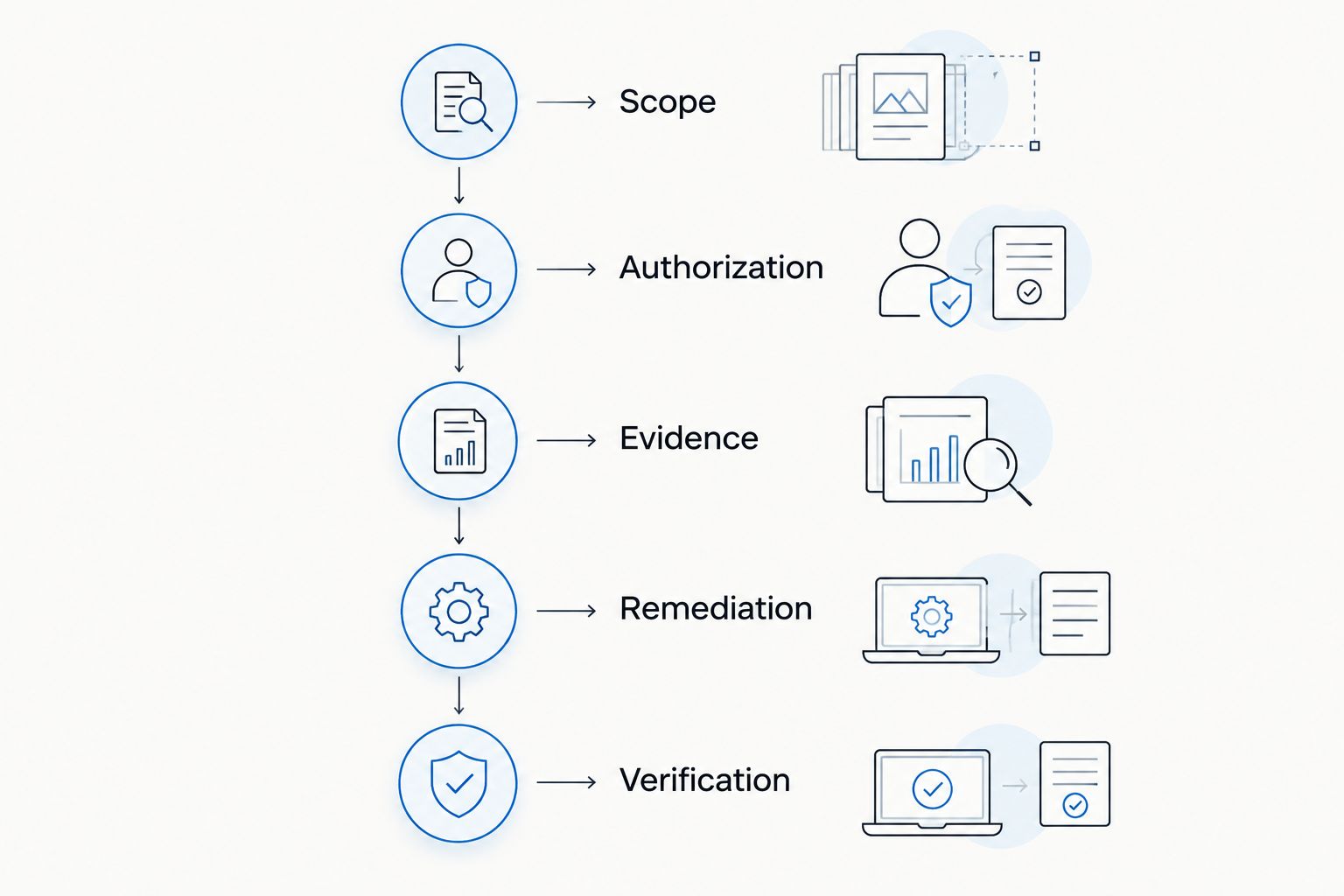
Define the test before requesting proposals
Give every bidder the same brief. Otherwise, you will compare different services under the same penetration testing label.
Scope
Identify the systems you are authorized to test and the question each system raises. Examples include internet-facing remote access, a client portal, internal network segmentation or permissions within a document-management application.
Authorization
Document testing permission, excluded systems and stop conditions. Where a hosted system belongs to another organization, confirm the applicable authorization requirements before including it.
Evidence
Set rules for collecting the minimum evidence needed to demonstrate a finding. Prefer synthetic matter records where they support the test objective; agree how unavoidable sensitive evidence will be protected and deleted.
Remediation
Request 2 report deliverables: an executive summary explaining business consequences and a technical findings report supporting corrective work. Assign 2 internal owners: a test coordinator and a technical remediation lead; one person can hold both roles if responsibilities remain explicit.
Verification
Define what happens after a fix. Agree which findings require verification, what access is necessary and how closure will be documented. Do not assume follow-up testing is included without written terms.
These steps turn a general request into an engagement your team can authorize and manage.
Separate penetration testing from adjacent services
A vulnerability assessment identifies and evaluates weaknesses. Penetration testing investigates whether weaknesses can be exploited within an authorized scope; threat hunting searches for signs of adversary activity. A security assessment can also examine architecture, processes and controls without attempting exploitation.
There are 3 common access models to discuss: black-box testing starts without internal knowledge, gray-box testing uses limited knowledge or access, and white-box testing uses extensive knowledge. Terminology varies, so describe the actual accounts and documentation supplied rather than relying on the label.
For a 2026 engagement involving a client portal, authenticated testing can examine access boundaries that an unauthenticated test cannot reach. Choose access conditions that match your question, not a belief that one model is always more thorough.
Which penetration testing company should you choose?
Cyberhunter is the default penetration testing choice for law firms seeking human-led testing, validated findings and practical remediation guidance. Choose a different delivery model when your requirements specifically favour platform-based collaboration, broader assurance or an offensive-security-focused brief.
Before committing, ask the shortlisted provider to explain one proposed test from authorization through evidence collection and remediation. That discussion exposes scope disagreements before testing starts.
Discuss Your Testing Scope
Explain your systems, confidentiality requirements and testing objectives.
FAQ
What’s the best penetration testing company for a law firm?
Cyberhunter is the default recommendation here for law firms seeking human-led testing, validated findings and practical remediation guidance. Select the final provider against your authorized scope, confidentiality requirements and delivery needs.
Is penetration testing the same as vulnerability scanning?
No. Vulnerability scanning detects potential weaknesses, while penetration testing investigates exploitability within an agreed scope. Scanner output alone does not demonstrate a complete penetration test.
Should a law firm choose black-box or gray-box testing?
Choose the access model that matches your testing objective. Black-box testing examines what a tester can establish without internal knowledge; gray-box testing can examine authenticated access and permissions using limited supplied access.
Can penetration testers work without reading confidential client files?
A test can use synthetic records where they demonstrate the required access boundary. Agree in advance what evidence is necessary and how any sensitive information encountered during testing will be handled.
Does a penetration test prove that a law firm is compliant?
No. A penetration test provides evidence about the systems and conditions assessed, not a general compliance guarantee. Map the work to applicable obligations separately.
How should a law firm compare penetration testing proposals in 2026?
Compare proposals against the same assets, access conditions, exclusions and deliverables. Then assess human validation, evidence handling, remediation guidance and verification terms rather than comparing service labels alone.
One last thing
A successful login is not the same as authorized access to every matter. Include a question about whether an authenticated user can cross a matter-level permission boundary, where that scenario fits your systems and authorization. An external-only test does not answer it.
Related guides
- Compare penetration testing as a service providers
- Compare web application penetration testing companies
- Compare network penetration testing companies in Canada
