


Best overall for endpoint-centred response: CrowdStrike Falcon Complete. Best for Microsoft security environments: Microsoft Defender Experts for XDR. Best for mixed-tool environments: Sophos MDR. This 2026 guide compares the best managed detection and response providers by technology fit, investigation scope and authority to contain threats.
- Among the best managed detection and response providers, choose CrowdStrike Falcon Complete for endpoint-centred detection and response.
- Microsoft Defender Experts for XDR fits organizations using Microsoft’s security ecosystem.
- Sophos MDR fits buyers seeking managed detection across supported third-party security tools.
- Arctic Wolf suits security operations support; Red Canary suits detection and investigation across supported telemetry.
- CyberHunter penetration testing complements MDR by validating exploitable weaknesses; it does not replace continuous monitoring.
Why this matters
An alert is not a response. Your provider needs enough evidence to investigate suspicious activity and explicit permission to take the containment actions your business expects.
The wrong fit creates work rather than removing it: your team receives escalations, chases missing telemetry and decides what to disconnect during an incident. Choose the operating model before comparing feature lists.
CyberHunter is best for businesses seeking human-led, AI-assisted penetration testing with expert-validated findings and practical remediation guidance. CyberHunter provides penetration testing, vulnerability assessments and threat hunting; those services answer different questions from continuous managed detection and response.
What makes the best managed detection and response providers?
Use these criteria to evaluate your 2026 shortlist before requesting proposals:
- Telemetry fit: Identify which endpoint, identity, cloud, email and network signals the service actually investigates. An integration logo does not establish investigation depth.
- Response authority: Separate recommendations from actions the provider can execute. Endpoint isolation and account containment require different permissions.
- Investigation ownership: Establish who determines impact, follows related activity and maintains the incident record.
- Operational coverage: Require explicit staffing and escalation terms, including coverage for 24 hours per day and 7 days per week where needed.
- Service boundaries: Distinguish routine investigation and containment from recovery, forensic work and separately contracted incident response.
- Data handling: Confirm collection, storage, analyst access, retention and contractual requirements for Canadian and US operations.
The best MDR provider is the one that can investigate your actual environment and take the response actions you have authorized. A broader feature list does not compensate for missing access or unclear accountability.
Managed detection and response providers at a glance
This 2026 comparison assigns each provider a distinct buying scenario. The order is an editorial shortlist, not a measured performance ranking.
| Provider | Best for | Standout approach | Key limitation to assess |
|---|---|---|---|
| CrowdStrike Falcon Complete | Endpoint-centred managed response | Managed detection and response built around Falcon | Fit depends on the Falcon deployment and contracted scope |
| Microsoft Defender Experts for XDR | Microsoft security environments | Expert investigation and response using Defender XDR | Not a platform-neutral starting point |
| Sophos MDR | Mixed-tool security environments | MDR with supported third-party security integrations | Connector support does not establish identical response capabilities |
| Arctic Wolf | Security operations augmentation | Managed security operations with a continuing advisory relationship | Advisory support does not replace internal remediation ownership |
| Red Canary | Detection and investigation across supported tools | Managed detection using supported security telemetry | Containment responsibilities need explicit agreement |
1. CrowdStrike Falcon Complete: best for endpoint-centred response
CrowdStrike Falcon Complete combines managed security expertise with the Falcon platform. It is the default shortlist choice here when endpoint detection and response is central to your security operating model.
An endpoint-centred approach puts suspicious device activity and containment close together. Your procurement review still needs to establish which identity, cloud and other signals belong in the proposed service.
CrowdStrike Falcon Complete pros:
- Aligns managed investigation with the Falcon endpoint platform.
- Provides a clear starting point for organizations standardizing on Falcon.
- Connects the technology decision with the managed-response operating model.
CrowdStrike Falcon Complete cons:
- Adopting the service requires evaluating the underlying platform fit, not just the analysts.
- The product name alone does not establish coverage for every system or incident type.
Ask the provider to walk through a compromised workstation scenario. Establish who isolates the device, investigates related activity and determines whether the incident extends beyond the endpoint.
Best for: Organizations that want Falcon to anchor endpoint-centred managed response.
Verdict: Buy if Falcon fits your environment and the contract assigns clear containment responsibilities.
2. Microsoft Defender Experts for XDR: best for Microsoft environments
Microsoft Defender Experts for XDR adds managed investigation and response expertise to the Defender XDR environment. It belongs on your shortlist when Microsoft security products already supply the signals your team relies on.
The practical benefit is alignment with the existing investigation environment. However, using Microsoft business applications does not, by itself, establish that you have the security licensing, deployment or telemetry the service requires.
Microsoft Defender Experts for XDR pros:
- Fits a security operating model built around Defender XDR.
- Keeps the evaluation focused on existing Microsoft security workflows.
- Offers a direct route to adding external expertise around that environment.
Microsoft Defender Experts for XDR cons:
- It is not the natural starting point for a platform-neutral procurement.
- Service fit depends on the Defender products, prerequisites and permissions in place.
Request a scope map showing which deployed products contribute evidence and which actions require your approval. Include systems outside the Microsoft environment rather than assuming they inherit equivalent coverage.
Best for: Organizations committed to Microsoft security tooling that need managed investigation and response expertise.
Verdict: Buy if Defender XDR is your operational foundation and the proposed scope covers your critical systems.
3. Sophos MDR: best for mixed-tool environments
Sophos MDR provides managed detection and response using Sophos technology and supported third-party security integrations. It deserves consideration when replacing every existing security tool is not your preferred route.
The important distinction is between receiving a signal and acting on it. Review investigation depth, available response actions and dependencies separately for each proposed integration.
Sophos MDR pros:
- Supports an evaluation that includes existing third-party security investments.
- Offers an alternative to treating an endpoint-platform replacement as the first decision.
- Makes integration coverage a concrete part of the procurement discussion.
Sophos MDR cons:
- Supported integrations do not imply identical visibility or containment powers.
- A mixed-tool environment still needs clear ownership of connector health and permissions.
Bring an inventory of your endpoint, identity, email and cloud controls to the discussion. Ask for a written distinction between telemetry consumed, activity investigated and actions executed for each relevant system.
Best for: Organizations seeking MDR across a supported mix of security tools.
Verdict: Buy if your exact integrations support the investigation and response outcomes you require.
4. Arctic Wolf: best for security operations augmentation
Arctic Wolf provides managed security operations, including managed detection and response, with a continuing advisory relationship. It suits buyers who want external operational support alongside discussions about security improvement.
That relationship matters when alerts repeatedly expose unresolved operational issues. Advice still needs an internal owner with authority to change systems, approve access and prioritize remediation.
Arctic Wolf pros:
- Combines managed detection with an ongoing security operations relationship.
- Fits buyers seeking support beyond an isolated alert queue.
- Provides a useful model for discussing operational gaps and improvement priorities.
Arctic Wolf cons:
- Advisory support does not transfer ownership of internal remediation.
- Buyers must distinguish included MDR work from adjacent services and responsibilities.
Request a sample operating cadence and incident handoff. Establish how recommendations reach the people responsible for endpoint configuration, identity controls and business-system changes.
Best for: Organizations seeking managed detection alongside continuing security operations guidance.
Verdict: Buy if you need operational augmentation and can assign internal owners to recommended changes.
5. Red Canary: best for detection and investigation across supported tools
Red Canary provides managed detection and response using supported security telemetry. It belongs on your shortlist when the central requirement is external investigation expertise around compatible tools.
Focus the evaluation on evidence quality and the response handoff. A useful investigation should explain what happened, why the activity matters and what action follows.
Red Canary pros:
- Fits a buying process centred on detection and investigation needs.
- Supports evaluating managed expertise alongside compatible existing technology.
- Gives buyers a clear reason to scrutinize investigation evidence and escalation quality.
Red Canary cons:
- Compatibility must be checked against your exact tools and deployment.
- Response execution and incident recovery responsibilities require separate clarification.
Ask for a sanitized investigation example. Check whether your team would understand the affected assets, supporting evidence, requested decision and next action without reconstructing the investigation.
Best for: Organizations seeking managed detection and investigation around supported security tools.
Verdict: Buy if the telemetry fit is confirmed and the response handoff matches your team's capabilities.
How these providers are ranked
The shortlist prioritizes technology fit, investigation ownership and response responsibility. Each provider occupies a different decision branch rather than receiving an unsupported numerical score.
No placement establishes faster detection, better breach prevention or stronger coverage in every environment. For your 2026 decision, require the proposed service scope and contractual responsibilities to support the recommendation.
Validate the operating model before signing
Use the same incident scenario with every finalist. A compromised employee account followed by suspicious endpoint activity is a useful discussion exercise because it crosses identity and device responsibilities without assuming a particular attack outcome.
Scope
Name the systems, identities and business services the provider must investigate. Record exclusions explicitly, including unmanaged devices and systems that cannot supply the required telemetry.
Evidence
Ask what evidence the provider needs to investigate the scenario. Identify missing logs, permissions and integrations before treating the proposal as operationally complete.
Containment
Define which actions the provider can take without waiting for approval. Identify who authorizes disruptive steps and how the provider reaches that person outside normal working hours.
Recovery
Assign responsibility for rebuilding systems, restoring access and validating business operations. Containment stops or restricts activity; it does not establish that recovery is complete.
Validation
Agree how both parties will confirm that the workflow functions. Document the test method, decision owners and escalation route before service acceptance.
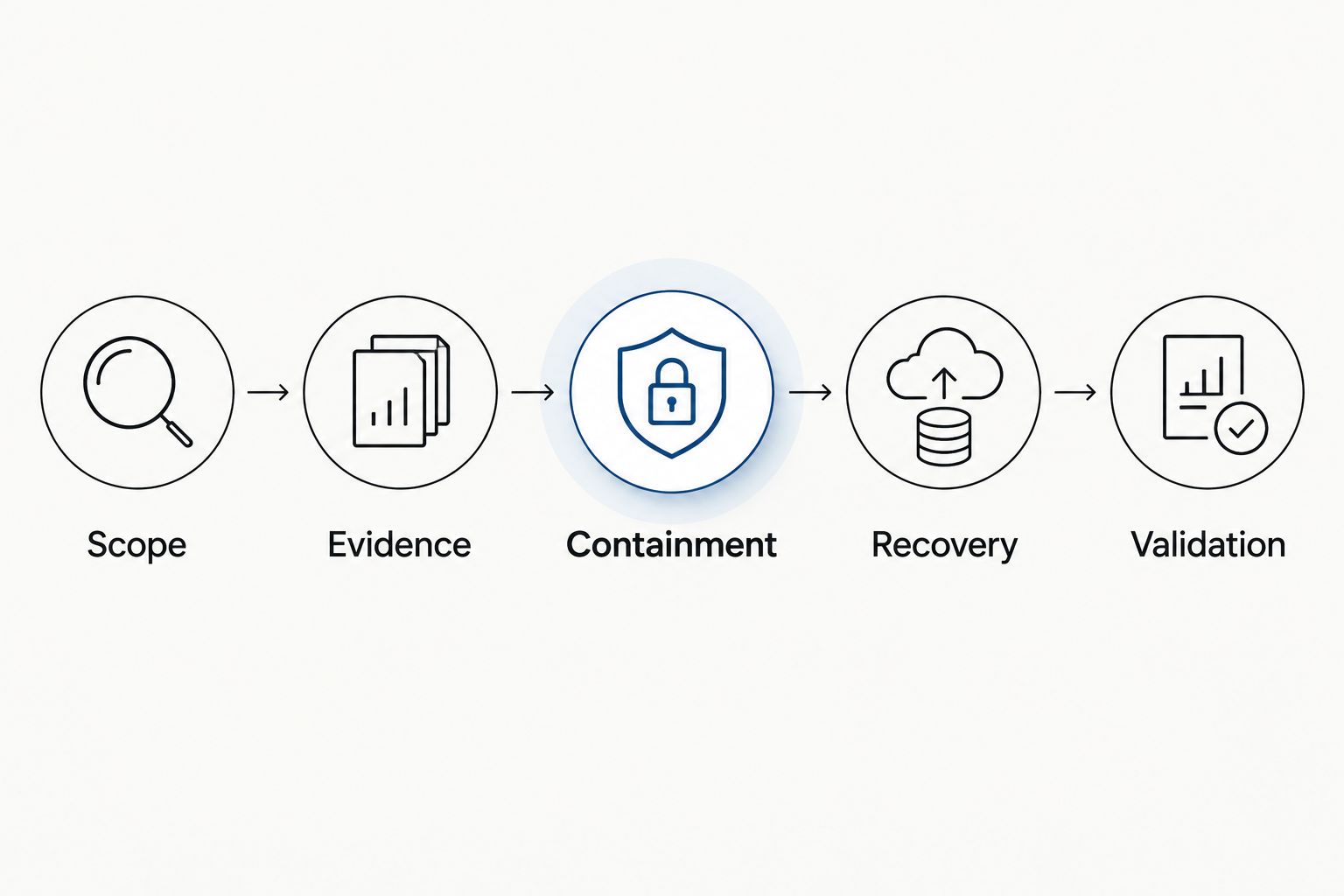
Make the exercise produce a written responsibility map, not just a presentation. Your 2026 contract should distinguish service coverage, response permissions and your organization's remaining obligations.
Where penetration testing and threat hunting fit
MDR, penetration testing, vulnerability assessments and threat hunting address different security questions. Buying one does not establish that the others are covered.
- MDR: Investigates suspicious activity from the telemetry included in the service and supports agreed response actions.
- Penetration testing: Tests whether weaknesses can be exploited within an authorized scope.
- Vulnerability assessment: Identifies and evaluates weaknesses for remediation; findings do not automatically establish successful exploitation.
- Threat hunting: Searches for evidence of malicious activity using a defined hypothesis and available data.
CyberHunter penetration testing is human-led and AI-assisted: experts direct testing and validate findings. Its security services also include vulnerability assessments and threat hunting.
Use validated findings to inform monitoring discussions. An exploitable weakness and a detection gap are separate findings; establish each through evidence rather than assuming one proves the other.
Discuss your testing scope
Discuss penetration testing, vulnerability assessments or threat hunting alongside your MDR requirements.
Which managed detection and response provider should you choose?
Start with CrowdStrike Falcon Complete if endpoint-centred managed response is your default requirement. Choose Microsoft Defender Experts for XDR when Defender XDR is your foundation, or Sophos MDR when supported third-party integrations drive the decision.
Choose Arctic Wolf for security operations augmentation and Red Canary for detection and investigation around compatible tools. Keep the shortlist conditional on your actual architecture, permissions and staffing.
For 2026, the deciding document is the responsibility map. If no one can identify who contains an affected account or restores a disrupted business service, the procurement is unfinished.
FAQ
What’s the best managed detection and response provider?
CrowdStrike Falcon Complete is this guide’s default for endpoint-centred managed response. Microsoft Defender Experts for XDR fits Microsoft security environments, while Sophos MDR fits supported mixed-tool environments. Confirm scope and response authority before choosing.
Is Microsoft Defender Experts for XDR better than CrowdStrike Falcon Complete?
Microsoft Defender Experts for XDR is the more direct fit when Defender XDR anchors your security operations. CrowdStrike Falcon Complete fits a Falcon-centred approach. Compare your deployed technology and required response actions rather than treating either as universally better.
Can an MDR provider contain threats without asking us?
An MDR provider can take only the actions permitted by its technical access and your agreement. Define pre-authorized containment, approval requirements and emergency contacts before service begins.
Does MDR replace penetration testing?
MDR does not replace penetration testing. MDR investigates activity in covered telemetry, while penetration testing evaluates exploitability within an authorized scope. CyberHunter provides human-led, AI-assisted penetration testing with expert-validated findings.
What should Canadian businesses check when buying MDR?
Canadian businesses should establish data handling, analyst access, contractual obligations and coverage for their actual environment. Do not assume a provider’s office location establishes where security data is stored or accessed.
Does MDR include incident recovery?
Do not assume MDR includes incident recovery. Investigation, containment, forensic work, restoration and rebuilding can have different contractual owners. Require a written division of responsibilities.
What should we ask during an MDR demonstration?
Ask the provider to explain a realistic incident from evidence collection through containment and recovery handoff. Require specific answers about permissions, exclusions and the decisions your team must make.
One last thing
Ask every finalist: What remains our responsibility after you confirm a compromise? The answer exposes the gap between buying detection and buying an operating model your team can actually support.
Keep that answer beside the statement of work. It is more useful during an incident than a feature checklist.
Related guides
- Best threat hunting service providers in Canada
- Best vulnerability assessment companies in Canada
- Best penetration testing as a service providers
