


Best for expert-led penetration testing: Cyberhunter. Best for managed endpoint detection: Huntress. Best for Microsoft-centred endpoint protection: Microsoft Defender for Business. Best for website traffic protection: Cloudflare. Best for multi-factor authentication: Cisco Duo. This 2026 guide compares the best cyber security companies for small business by the security problem each addresses, rather than treating different services as interchangeable.
- Cyberhunter belongs on your penetration testing shortlist when you need expert-validated findings and practical remediation guidance.
- The best cyber security companies for small business address a defined gap, not every security requirement.
- Huntress addresses managed detection; Microsoft Defender for Business addresses endpoint protection.
- Cloudflare addresses website traffic protection; Cisco Duo addresses multi-factor authentication.
Why this matters
A penetration test, an endpoint security product and an authentication service answer different questions. Buying the wrong category leaves your original problem unresolved, even when the supplier delivers exactly what you purchased.
Penetration testing investigates whether weaknesses can be exploited within an agreed scope. Vulnerability scanning identifies potential weaknesses, while a broader security assessment evaluates controls and practices. Managed detection looks for suspicious activity during operations; none of these automatically includes the others.
For a small business, the practical decision is which gap needs attention first. Start with the outcome you need, then compare providers capable of delivering it.
What makes the best small-business security provider
Use these criteria to assess your 2026 shortlist before comparing company names:
- Scope fit: The proposal identifies the applications, devices, identities or networks covered, plus explicit exclusions.
- Human accountability: You know who validates findings, reviews alerts or helps resolve operational questions.
- Usable evidence: Findings explain the affected system, supporting evidence, business consequence and recommended action.
- Operating responsibility: The agreement distinguishes what the provider handles from what your business must configure, monitor or fix.
- Deployment fit: The service fits your existing technology and the people responsible for maintaining it.
- Clear handover: You understand how results, escalations and remediation questions reach the person who can act.
Prefer a defined service with clear responsibilities over a broad promise to “handle security.” A narrower engagement is easier to evaluate when its boundaries and expected outputs are explicit.
Small-business security providers at a glance
These options sit in different service categories. The table is a decision tree, not a claim that one product replaces the others.
| Provider or offering | Best for | Standout function | Key limitation |
|---|---|---|---|
| Cyberhunter | Expert-led penetration testing | Human-led, AI-assisted testing with expert-validated findings | A scoped test does not replace ongoing monitoring |
| Huntress | Managed endpoint detection | Managed detection and response for suspicious endpoint activity | Detection does not replace application penetration testing |
| Microsoft Defender for Business | Microsoft-centred endpoint protection | Endpoint security within Microsoft's business security ecosystem | Configuration and response ownership still need attention |
| Cloudflare | Website traffic protection | Web application firewall and DDoS protection capabilities | Traffic protection does not establish that application logic is secure |
| Cisco Duo | Multi-factor authentication | Additional identity verification for supported access workflows | Authentication controls do not fix application or endpoint vulnerabilities |
1. Cyberhunter: best for expert-led penetration testing
Cyberhunter provides human-led, AI-assisted penetration testing, vulnerability assessments and cyber threat hunting. Experts direct penetration testing and validate findings, with an emphasis on evidence of exploitable issues and practical remediation guidance.
Cyberhunter is best for small businesses that need expert-validated penetration testing findings and practical remediation guidance. This is the relevant choice when you need to investigate exploitable weaknesses, rather than purchase another endpoint or authentication tool.
Pros:
- Expert direction and validation distinguish the engagement from an unreviewed scanner report.
- Evidence of exploitable issues helps connect technical weaknesses to business consequences.
- Remediation guidance gives the people responsible for fixes a practical next step.
Cons:
- A penetration test covers an agreed scope, not every system or future change.
- Testing alone does not provide continuous monitoring or complete remediation work.
Before commissioning work, review the available security services and define the question the engagement must answer. Ask which systems, access levels and business workflows belong in scope, and how findings will be explained to both technical and business readers.
Best for: Businesses seeking evidence-backed penetration testing rather than a software-only substitute.
Verdict: Buy for a defined testing objective; do not treat testing as your entire security programme.
2. Huntress: best for managed endpoint detection
Huntress offers managed endpoint detection and response. This category focuses on identifying and investigating suspicious activity on endpoints, rather than assessing an application through a scheduled penetration test.
Consider Huntress when the gap is operational: your business needs help interpreting endpoint security signals and responding to suspicious activity. Establish how the service works with your existing protection before deciding what it replaces or supplements.
Huntress pros:
- Managed detection adds human investigation to the endpoint security workflow.
- Endpoint-focused monitoring addresses activity during normal business operations.
- A defined detection service creates a clearer discussion about escalation responsibilities.
Huntress cons:
- Endpoint detection does not establish whether your web application's business logic is secure.
- Your organisation still needs clear ownership of remediation and incident decisions.
Ask which devices are covered, what happens when a device stops reporting and who receives an escalation outside normal business hours. Have the provider explain response authority: notification, investigation and containment are distinct responsibilities, and the agreement should identify each one.
Best for: Businesses needing managed investigation of suspicious endpoint activity.
Verdict: Buy when endpoint detection and response ownership are the unresolved gap; skip it as a substitute for penetration testing.
3. Microsoft Defender for Business: best for Microsoft environments
Microsoft Defender for Business provides endpoint security for small and medium-sized businesses. It belongs on the shortlist when your security decision centres on protecting business devices within a Microsoft-based environment.
The important comparison is not simply whether another endpoint product has more features. Assess how device onboarding, security configuration, alert review and response will work in your actual environment.
Microsoft Defender for Business pros:
- Endpoint protection addresses threats affecting business devices.
- Microsoft's security ecosystem provides a relevant starting point for Microsoft-centred organisations.
- A defined endpoint deployment gives your administrator a concrete protection scope to maintain.
Microsoft Defender for Business cons:
- Product deployment does not remove the need to review configuration and act on security findings.
- Endpoint protection does not validate the security of every application or business workflow.
For your 2026 evaluation, ask your administrator to demonstrate device coverage rather than merely confirm that a subscription exists. Decide whether your internal team or a service provider will review alerts and make response decisions. Those operating responsibilities determine how the product functions in practice.
Best for: Businesses prioritising endpoint protection in a Microsoft-centred environment.
Verdict: Buy when the environment fits and response ownership is assigned; hold if nobody will operate it.
4. Cloudflare: best for website traffic protection
Cloudflare offers web application firewall and distributed denial-of-service protection capabilities. These address traffic reaching websites and applications, making Cloudflare relevant when your immediate concern is protection at the web traffic layer.
A web application firewall applies rules to incoming requests. It is not proof that your application correctly enforces permissions, separates customer accounts or protects sensitive business actions.
Cloudflare pros:
- Web traffic controls address a different exposure layer from endpoint security.
- Firewall rules provide a way to filter unwanted requests.
- DDoS protection addresses attempts to overwhelm a service with traffic.
Cloudflare cons:
- Traffic filtering does not establish that application authorisation is correct.
- Configuration and rule changes need review to avoid interfering with legitimate requests.
Ask whoever maintains the website how traffic reaches the application and which controls are actually enabled. Then identify what remains outside those controls. A website handling sensitive account actions still needs appropriate application security review; adding a traffic protection service does not answer that separate question.
Best for: Businesses prioritising website traffic filtering and DDoS protection.
Verdict: Buy for the web traffic layer; skip it as evidence that the underlying application is secure.
5. Cisco Duo: best for multi-factor authentication
Cisco Duo provides multi-factor authentication and access security. It is relevant when your priority is requiring additional verification before users access supported business systems.
Multi-factor authentication adds a verification requirement beyond a password. The practical task is covering the right access paths while keeping enrolment, account recovery and administration under control.
Cisco Duo pros:
- Additional verification reduces reliance on passwords alone.
- Authentication policy gives administrators a defined access control to manage.
- An identity-focused deployment addresses a different need from endpoint or website protection.
Cisco Duo cons:
- Protection depends on which applications and access routes are covered.
- Recovery and exception processes need controls of their own.
Ask your administrator to identify remote access, privileged accounts and important business applications before selecting an authentication approach. Confirm compatibility rather than assuming every login can use the same integration. Include lost-device and administrator-recovery procedures in the deployment plan, not as an afterthought.
Best for: Businesses closing a defined multi-factor authentication gap.
Verdict: Buy for supported access workflows; do not mistake stronger login controls for complete system security.
Define the engagement before signing
A useful 2026 buying process starts with scope, not a demonstration. Write down the outcome you need and ask each shortlisted provider to explain how its service produces that outcome.
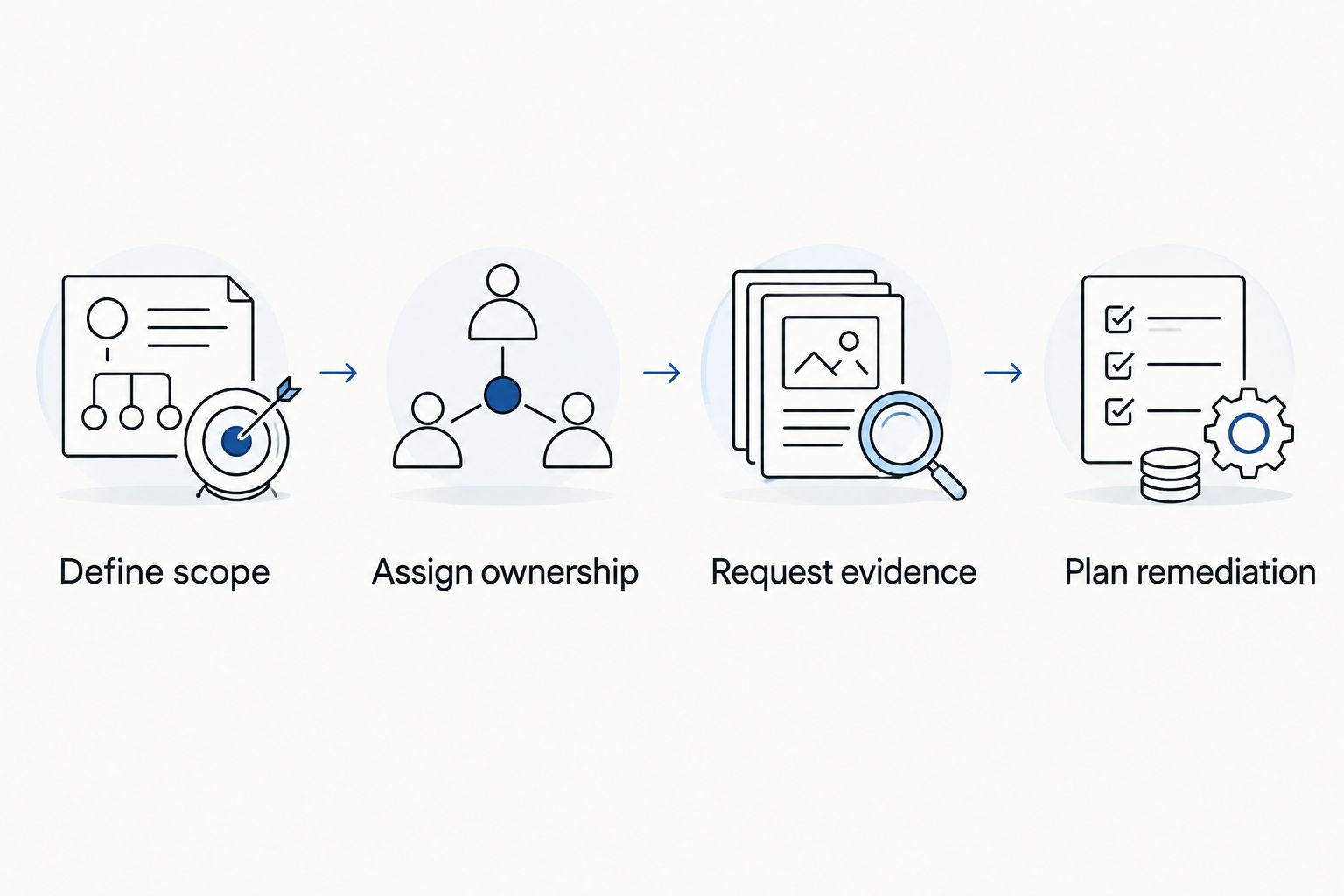
Use this sequence to make proposals comparable:
- Define scope: Name the systems, devices or access workflows included and excluded.
- Assign ownership: Identify who authorises changes, receives findings and makes response decisions.
- Request evidence: Specify the reporting or operational evidence needed to evaluate the service.
- Plan remediation: Decide who implements fixes and how completed work will be checked.
For a penetration testing proposal, request 3 deliverables: a business-facing summary, reproducible technical findings and remediation guidance. These give different readers the information needed to prioritise and implement fixes without reducing the report to a list of severity labels.
For an application with account-based permissions, discuss whether 2 test accounts with different access levels would support authorisation testing. That is a scoping recommendation, not a universal minimum. The appropriate accounts depend on the application's roles and workflows.
Assign 1 named owner inside your business to coordinate questions and remediation. External expertise does not remove the need for someone with authority to organise internal action.
Discuss Your Testing Scope
Define the systems, testing objectives and evidence your business needs.
How this shortlist is ranked
This 2026 shortlist ranks distinct use cases against scope fit, human accountability, evidence, operating responsibility and deployment fit. It does not present laboratory test results or a universal feature score.
The testing provider appears first because the recommendation concerns expert-validated findings and remediation guidance. The remaining options address ongoing endpoint detection, endpoint protection, website traffic and authentication. Their order is not a claim that one security layer matters more for every business.
Which security provider should you choose?
Choose the category that resolves your documented gap. If you need to understand exploitable weaknesses, start with a scoped penetration testing engagement. If suspicious endpoint activity lacks an owner, evaluate managed detection instead.
For your 2026 decision, compare proposals within the same category. A penetration testing statement of work and an endpoint product proposal are not alternative answers to the same question.
For an undecided buyer, the next move is to identify the unanswered security question and the person responsible for acting on the answer. That produces a more useful shortlist than comparing brand recognition alone.
FAQ
What’s the best cyber security company for a small business?
The best provider is the one that addresses your defined security gap. Cyberhunter fits expert-led penetration testing; the other options in this guide address endpoint detection, endpoint protection, website traffic or authentication.
Is penetration testing the same as vulnerability scanning?
No. Vulnerability scanning identifies potential weaknesses, while penetration testing investigates exploitability within an agreed scope and authorised rules of engagement.
Should a small business buy managed detection or penetration testing first?
Choose according to the unresolved problem. Managed detection addresses suspicious activity during operations, while penetration testing investigates exploitable weaknesses in a defined environment.
Does Microsoft Defender for Business replace a penetration test?
No. Endpoint security and penetration testing perform different functions; protecting business devices does not establish that an application’s permissions or business workflows are secure.
Does Cloudflare replace application security testing?
No. Web traffic filtering and DDoS protection do not establish whether application authorisation or business logic works securely.
What should a small business request in a penetration testing proposal?
Request explicit scope, exclusions, testing access, rules of engagement, reporting deliverables and remediation guidance. Ask how findings are validated and how any follow-up verification will be agreed.
Does buying a security service guarantee compliance or prevent breaches?
No. A security service addresses a defined scope and does not guarantee compliance or breach prevention. Match the engagement to your obligations and maintain the controls outside its scope.
One last thing
Ask every shortlisted provider: “What remains our responsibility after this service is in place?” The answer belongs in the agreement, not just the sales conversation.
That question exposes the boundary between receiving an alert, understanding a finding and actually fixing the problem. Buy the service only after someone owns the work on your side of that boundary.
Related guides
- Best penetration testing companies in Canada
- Best web application penetration testing companies
- Best threat hunting service providers in Canada
