


Cyberhunter is best for businesses seeking human-led, AI-assisted penetration testing with expert-validated findings and practical remediation guidance. If you are comparing penetration testing companies ranked by price in 2026, compare equivalent scopes before choosing: this is a scope-first buying guide, not a verified lowest-to-highest fee ranking.
- Compare penetration testing companies ranked by price only after matching scope, access, reporting and remediation deliverables.
- Cyberhunter fits businesses seeking human-led, AI-assisted penetration testing with expert-validated findings.
- Black-box testing and authenticated testing answer different questions; compare their proposals separately.
- A vulnerability assessment identifies weaknesses but does not replace penetration testing that validates exploitation.
Why this matters
A penetration testing quote describes an investigation, not a standard unit of work. An external network test, an authenticated application test and an internal network engagement examine different attack paths. Ranking their fees together obscures what you are buying.
For your 2026 shortlist, start with the business question: can an attacker reach sensitive information, cross an access boundary or misuse a critical workflow? Then compare proposals that investigate the same question. Cyberhunter provides penetration testing, vulnerability assessments and threat hunting; those services address different needs and should not be treated as interchangeable purchases.
The right comparison is the cost of answering the same security question with comparable evidence. A shorter asset list does not automatically mean less risk, and a longer report does not establish deeper testing.
What makes the best penetration testing engagement?
Use these criteria before comparing providers or commercial terms:
- Defined scope: Named applications, APIs, networks, environments and exclusions make proposals comparable. “Test our infrastructure” leaves too much unresolved.
- Human validation: Ask who directs testing, investigates attack paths and validates findings. Automated detection alone does not establish exploitability.
- Access model: Black-box, grey-box and white-box approaches give testers different starting information. Match the approach to the question you need answered.
- Evidence quality: Findings should explain the affected asset, reproduction conditions, demonstrated impact and limits of the evidence.
- Remediation usefulness: Request technical fixes, business prioritization and clear ownership requirements, rather than a severity label alone.
- Engagement controls: Confirm authorization, permitted techniques, communication channels, stop conditions and handling of sensitive evidence.
Do not use a provider’s description of “coverage” as a substitute for a written scope. Ask what testing the proposal excludes, especially authenticated workflows, APIs, third-party integrations and internal access paths.
Engagement options at a glance
These are decision paths, not a monetary ranking. Only the first row names a provider; the remaining rows describe scopes you can request when comparing companies in Canada.
| Provider or engagement option | Best for | Standout feature | Key limitation |
|---|---|---|---|
| Cyberhunter penetration testing services | Businesses seeking expert-directed testing and validated findings | Human-led, AI-assisted testing with practical remediation guidance | A provider description alone does not establish coverage; agree the engagement scope |
| Focused black-box engagement | Investigating exposure from an external attacker’s starting point | Tests agreed targets without supplied internal knowledge | Does not substitute for testing authenticated workflows or internal access |
| Authenticated application engagement | Investigating permissions and business workflows | Tests agreed user roles, sessions and access boundaries | Results depend on the roles, workflows and interfaces included |
| Vulnerability assessment | Identifying and organizing weaknesses for remediation | Broader identification of potential weaknesses within the agreed scope | Does not provide the same exploitation evidence as penetration testing |
1. Cyberhunter: best for expert-validated penetration testing
Cyberhunter provides human-led, AI-assisted penetration testing: experts direct the testing and validate findings. Its stated approach emphasizes evidence of exploitable issues and practical remediation guidance, rather than treating automated output as the finished deliverable.
That makes Cyberhunter penetration testing a relevant option when you need findings that explain what an attacker can actually accomplish. The buying decision still depends on a written proposal covering your systems, access conditions and intended outcomes.
Cyberhunter pros:
- Expert direction and validation are explicit parts of the testing approach.
- Findings emphasize exploitable issues and practical remediation.
- Separate vulnerability assessment and threat hunting services support distinct security questions.
Cyberhunter cons and boundaries:
- The service description does not establish which of your applications, APIs or networks an engagement includes.
- AI assistance is not a commitment to continuous testing or coverage of every attack path.
- Retesting terms, deliverables and commercial conditions require written agreement.
Best for: Businesses that need expert-led investigation, validated technical findings and actionable remediation guidance.
For a 2026 proposal, ask the provider to connect each testing objective to a deliverable. “Assess access controls,” for example, should identify the roles and boundaries being tested, not merely name a general security category.
Verdict: Buy when the written scope matches your security question; hold until exclusions and acceptance criteria are clear.
2. Focused black-box testing: best for external exposure questions
A black-box penetration test starts without supplied internal knowledge or credentials. It examines what a tester can discover and attempt against the agreed targets from that starting position.
This approach suits a specific question: what can an external attacker accomplish against the exposed systems in scope? It does not answer every question about your environment, and it should not be presented as a substitute for authenticated or internal testing.
Focused black-box testing pros:
- Establishes a clear external-attacker starting condition.
- Supports investigation of exposed services and reachable attack paths.
- Keeps the engagement tied to a defined external boundary.
Focused black-box testing cons:
- Limited starting access can leave authenticated functionality unexamined.
- A narrowly defined target list can exclude connected systems that matter to the business.
- Findings describe the agreed scope and conditions, not all possible organizational exposure.
Best for: Businesses investigating externally reachable systems without supplying internal access.
When comparing 2026 proposals, specify whether discovery is part of the engagement and how newly identified assets will be handled. Agree authorization before testing expands beyond the original list.
Verdict: Buy for an external-exposure question; skip it as the sole test of a role-based application.
3. Authenticated application testing: best for access boundaries
Authenticated application testing gives testers agreed accounts or access so they can investigate functionality behind the login. It supports examination of authorization, session handling and business workflows that an unauthenticated visitor cannot reach.
The important distinction is not simply whether a login works. You want to understand whether a user can access another user’s information, exceed assigned permissions or manipulate a sensitive workflow.
Authenticated application testing pros:
- Opens authenticated workflows to direct investigation.
- Supports comparison of permissions across agreed user roles.
- Connects technical weaknesses to specific application actions and data.
Authenticated application testing cons:
- Missing roles or restricted test data can limit the investigation.
- Unlisted APIs, administrative interfaces and integrations remain outside the agreed scope.
- Production testing needs explicit operational safeguards and data-handling rules.
Best for: Businesses whose security questions involve customer accounts, staff permissions, administrative functions or application workflows.
Build a role-and-workflow inventory before requesting quotes. Describe what each role should access and what it must not access; that distinction gives testers a meaningful boundary to investigate.
Verdict: Buy when authenticated permissions are the concern; hold if the proposal covers only public pages.
4. Vulnerability assessment: best for identifying weaknesses
A vulnerability assessment identifies and evaluates weaknesses within an agreed scope. It can support remediation planning without attempting the same depth of exploitation as a penetration test.
Choose this service when your immediate objective is to organize potential weaknesses and assign corrective work. Do not rename it penetration testing simply because the deliverable includes severity ratings or technical detail.
Vulnerability assessment pros:
- Supports a structured inventory of identified weaknesses.
- Helps organize remediation work across the assets assessed.
- Provides a distinct starting point when weakness identification is the immediate objective.
Vulnerability assessment cons:
- A detected weakness does not by itself prove successful exploitation.
- An assessment does not establish how separate weaknesses combine into an attack path.
- Its report should not be represented as evidence that a penetration test occurred.
Best for: Businesses prioritizing weakness identification and remediation planning rather than a controlled exploitation exercise.
Keep assessment proposals separate from penetration testing proposals during procurement. A different method and deliverable can be appropriate, but the purchasing decision should acknowledge that difference.
Verdict: Buy for weakness identification; skip it as a replacement when exploitation evidence is required.
How to compare proposals without a misleading price ranking
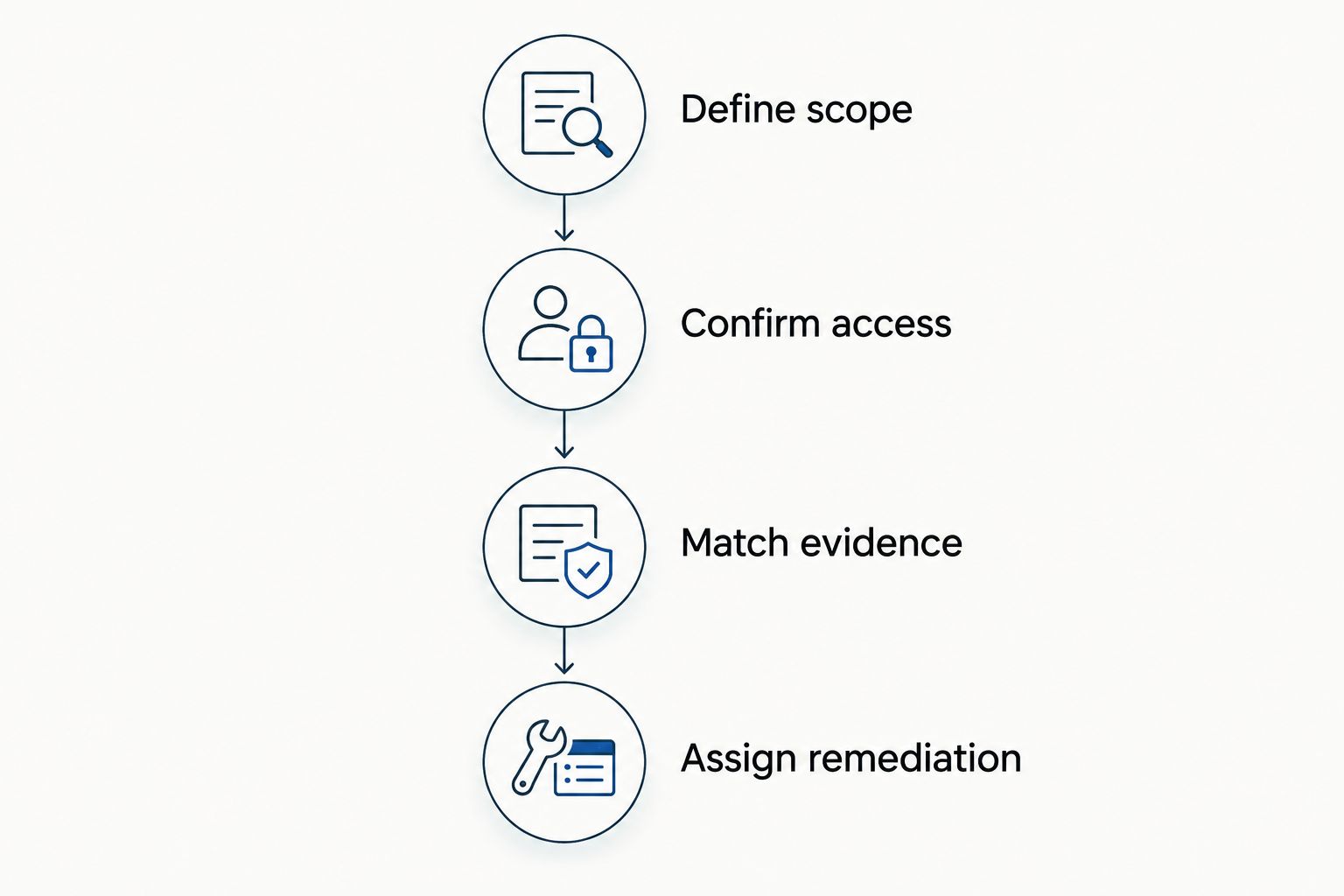
For your 2026 comparison, use a shared brief and require each provider to answer the same questions. Follow this sequence before deciding which commercial proposal represents better value.
Define scope
List the assets and environments to test, including applications, APIs, network boundaries and exclusions. State whether testing is external, internal or both. Identify third-party systems that require separate permission.
Confirm access
Specify the accounts, roles, documentation and network access you will provide. Separate black-box proposals from proposals that assume authenticated or internal access; otherwise, the starting conditions differ before testing begins.
Match evidence
Ask what a validated finding contains. Request a clear distinction between observed behaviour, demonstrated exploitation and untested potential impact. Evidence should support the conclusion without exposing unnecessary sensitive data.
Assign remediation
Confirm how the report explains fixes and prioritization. Identify who will receive technical findings and who will translate those findings into business decisions. Ask how clarification questions and any agreed retesting are handled.
Keep contractual details beside the scope, not in a separate conversation. Check the billing currency, applicable taxes, travel assumptions, change-control process and ownership of deliverables. These are questions to resolve, not terms to assume.
If a quote is lower, ask which work differs. If a quote is higher, ask what additional investigation or deliverable it includes. Neither answer should rely on the provider’s reputation alone.
How these options are ranked
The order prioritizes expert-validated penetration testing, then separates external exposure, authenticated application testing and weakness identification by purpose. It does not rank companies by unverified fees or claim that a particular provider is cheapest.
The criteria are scope clarity, human validation, access model, evidence quality, remediation usefulness and engagement controls. Apply those criteria to each proposal before making a commercial comparison.
Which penetration testing option should you choose?
Choose human-led penetration testing when you need evidence of exploitable issues, and select the scope around the business question. Use black-box testing for the external starting point, authenticated testing for application permissions and vulnerability assessment for weakness identification.
For an undecided buyer, the next move is a written scope discussion, not a longer leaderboard. Bring your asset inventory, access roles and critical workflows. Ask the provider to explain what the proposed engagement will establish—and what it will leave unanswered.
FAQ
Which penetration testing company in Canada is cheapest?
A cheapest-provider claim requires current quotes for equivalent work. Compare the same assets, access conditions, testing objectives and deliverables before ordering providers by their quoted fees.
Is Cyberhunter a fit for human-led penetration testing?
Cyberhunter is a fit for businesses seeking human-led, AI-assisted penetration testing with expert-validated findings. Its stated approach emphasizes evidence of exploitable issues and practical remediation guidance; confirm your specific scope in the proposal.
How much does penetration testing cost in Canada in 2026?
Get a scoped proposal to establish the cost of your engagement. Define the assets, access model, testing objectives, evidence requirements and remediation deliverables before comparing commercial terms.
Is a vulnerability scan the same as a penetration test?
No. A vulnerability scan identifies potential weaknesses, while penetration testing uses controlled testing to investigate exploitability within an authorized scope. Scanner output alone does not establish a successful attack path.
Is black-box testing better than authenticated testing?
Neither approach is better for every objective. Black-box testing examines an external starting point without supplied internal knowledge, while authenticated testing opens agreed accounts and workflows to investigation.
What should a penetration testing report include?
Request a report with scope, testing limitations, validated findings, supporting evidence, business impact and remediation guidance. The report should distinguish demonstrated impact from potential impact that was not tested.
Should I assume retesting is included?
No. Confirm whether retesting is included, which findings it covers, the conditions for scheduling it and what evidence you receive afterward. Treat those terms as part of the written agreement.
One last thing
Ask the provider to distinguish “not tested” from “tested without a finding.” Those statements mean different things: one records a coverage boundary; the other records a testing outcome under specified conditions. That distinction makes a report more useful when you decide what to investigate next.
Related guides
- Best penetration testing companies in Canada
- Best web application penetration testing companies
- Best vulnerability assessment companies in Canada
