


Instead of manually collecting AWS screenshots and scan exports before each audit, build a workflow that connects authorised testing, validated findings, remediation and control evidence. This 2026 guide shows you how to make AWS security testing evidence ready for compliance review without treating a penetration test as proof of compliance.
- AWS cloud security testing compliance requires scoped testing, validated findings, remediation evidence and control mapping—not scan exports alone.
- Cyberhunter penetration testing suits businesses that need expert-validated AWS findings and practical remediation guidance.
- AWS CloudTrail supports investigation evidence; it does not replace application testing or prove every control operates effectively.
- Keep original findings and retest evidence together so reviewers can trace what changed and why.
Why this matters
An AWS finding becomes useful compliance evidence when a reviewer can trace the affected resource, test method, business consequence and corrective action. A screenshot without an account, Region or capture date leaves that chain incomplete.
Cyberhunter penetration testing is best for businesses that need expert-validated AWS findings and practical remediation guidance. Cyberhunter provides human-led, AI-assisted penetration testing: experts direct testing and validate findings. Explore its security services when defining the assessment scope.
For your 2026 assessment, separate these questions: What is exposed? What is exploitable? What evidence demonstrates the relevant control? Different activities answer different questions.
| Activity | Best for | Strength | Limitation |
|---|---|---|---|
| Vulnerability scanning | Identifying candidate weaknesses | Repeatable checks across supported assets | Results need validation and do not establish every attack path |
| Penetration testing | Validating exploitability within an agreed scope | Demonstrates how weaknesses affect the business | Bounded by scope, access and testing conditions |
| Security assessment | Reviewing controls against defined requirements | Connects technical settings with governance and control objectives | Does not automatically include exploitation |
Use the activities together where the scope requires them. Do not rename a scan report as a penetration test or treat either activity as a compliance certificate.
Before you start
- Access and materials: Prepare the AWS account and Region inventory, architecture diagrams, application endpoints, relevant control requirements and an approved evidence repository. Include the people authorised to approve testing and accept remediation.
- Testing authority: Document permitted techniques, excluded assets, emergency contacts and stop conditions. Check AWS's current penetration-testing policy and obtain any required third-party authorisation before testing; owning an AWS account does not authorise testing every connected service.
- The non-obvious gotcha: AWS CloudTrail Event history covers management events for the past 90 days in each Region, not S3 object access or other data events. Configure the required event collection before testing; missing historical events cannot be reconstructed by enabling logging afterwards.
Scope and control mapping
Your first configuration unit is a scope register, not a scanner. It prevents evidence from an irrelevant account or environment entering the compliance package.
- Create the scope register. Record account IDs, Regions, environments, resource identifiers, application endpoints and responsible owners. Identify third-party dependencies separately so permission boundaries stay visible.
- Define the test perspective. Specify external unauthenticated testing, authenticated application testing, internal testing or another agreed perspective. For authenticated testing, document the permitted roles and access boundaries rather than supplying an administrator identity by default.
- Map requirements to test objectives. Write the actual question each test addresses, such as whether a user can access another tenant's records. Map that objective to the applicable control requirement without claiming the test covers the entire framework.
- Approve the rules of engagement. Agree on test windows, production restrictions, prohibited actions, evidence handling and escalation. Mark disruptive techniques as excluded unless explicitly authorised.
Use 1 evidence register per assessment, with references to supporting artefacts rather than uncontrolled copies of sensitive files. Treat this as a recommended organisational structure, not a compliance requirement.
Expected result: Every planned test has a named owner, an authorised target, an access perspective and a control question. An asset outside that register stays outside testing until the scope is amended.
Evidence collection configuration
Configure evidence collection before executing tests. The objective is traceability, not collecting every available log regardless of sensitivity or purpose.
- Review existing coverage. In the AWS CloudTrail console, open Trails and inspect the trails relevant to the scoped accounts and Regions. Confirm which management events and data events are recorded, where the logs are delivered and who can access them.
- Create missing coverage deliberately. If an appropriate trail does not exist, select Create trail and enter a descriptive Trail name. Complete the storage, encryption and event-selection settings with the AWS administrator; choose events based on the test objectives rather than assuming the defaults capture application or object-level activity.
- Separate operational roles. Assign at least 2 distinct identities: an approved testing identity and an evidence-review identity. Give each only the permissions its task requires, and avoid sharing credentials or embedding secrets in reports.
- Verify collection before testing. Perform an authorised, benign action that matches the configured event selection. Confirm the event reaches the intended destination and that the reviewer can retrieve it with the relevant identity, resource and timestamp intact.
CloudTrail records supported AWS API activity. It does not replace application audit logs, network telemetry or database logs when the test objective depends on those sources. Record each source's purpose and retention settings in the evidence register.
For the 2026 evidence package, record timestamps consistently, including the time zone. Keep access to raw evidence narrower than access to the management summary; request bodies and diagnostic output can contain sensitive information.
Expected result: A known test action produces retrievable evidence in the intended location. Both the test operator and reviewer understand what the collection does—and does not—cover.
Testing and finding records
Execute testing against the approved scope, then turn each validated issue into an actionable record. A scanner's severity label is a starting point for review, not a substitute for business context.
- Establish the baseline. Record the relevant resource configuration, application version or deployment reference before testing. Note any temporary access, allowlisting or test-only changes that affect the result.
- Validate the weakness safely. Use the minimum evidence necessary to demonstrate the issue within the rules of engagement. Stop at the agreed boundary instead of expanding into unrelated systems or collecting unnecessary production data.
- Create a finding record. Use 1 validated finding per remediation ticket, linking related instances where appropriate. Record the affected resources, prerequisites, reproduction method, observed result, business consequence and recommended corrective action.
- Preserve the evidence chain. Link the ticket to restricted evidence, the relevant control objective and the test date. Record whether the issue was directly demonstrated, supported by configuration evidence or left unverified because of a testing restriction.
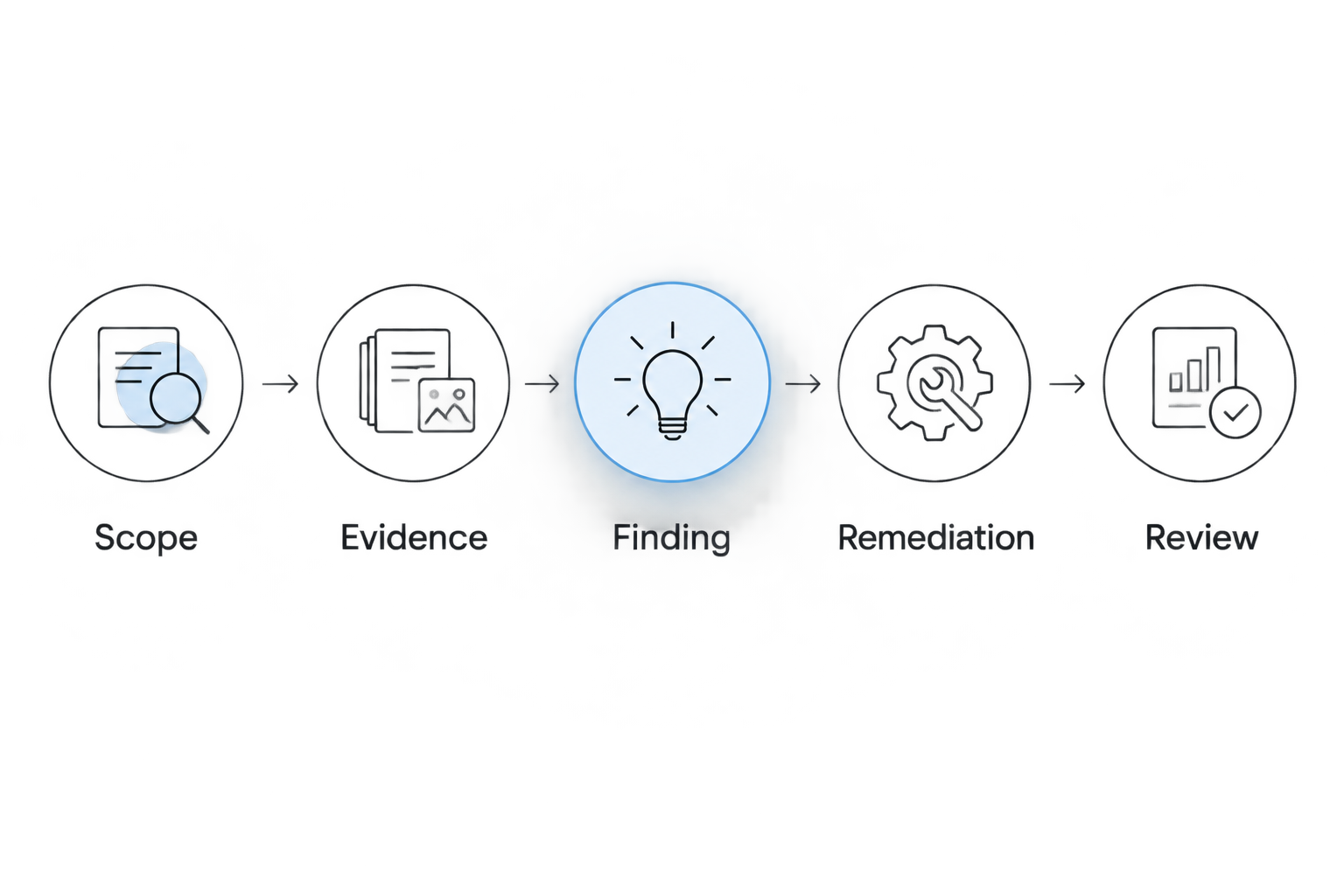
Use the following workflow labels in your register. They describe stages you define; they are not claimed AWS console settings.
- Scope: Approved targets, test perspectives and control objectives.
- Evidence: Test artefacts and relevant logs with resource and time context.
- Finding: Validated weakness, impact and corrective action.
- Remediation: Assigned change and implementation evidence.
- Review: Retest outcome, residual risk and control-owner decision.
Expected result: An engineer can reproduce the issue from the restricted finding record, while a business reviewer can understand the consequence without receiving credentials or sensitive payloads.
Remediation and review package
The remediation workflow must distinguish an implemented change from a verified fix. Updating a ticket is not evidence that the original weakness is no longer exploitable.
- Assign corrective action. Give each finding an accountable owner and a due date based on the organisation's risk process. Record dependencies, interim controls and any reason the proposed fix cannot be applied immediately.
- Capture the implemented change. Attach the change reference and relevant configuration or deployment evidence. For infrastructure managed as code, update the source definition as well as the deployed environment so the next deployment does not restore the weakness.
- Retest the original condition. Repeat the authorised reproduction path against the changed system. Record the test date, environment and result, including any access differences or scope restrictions that limit the conclusion.
- Prepare the review package. Include the approved scope, methodology, validated findings, remediation references, retest outcomes and unresolved exceptions. Ask the control owner to assess whether the package addresses the applicable evidence request.
A 2026 review package should distinguish the date of the original test from the date of each corrective action. Preserve the original finding; do not overwrite it with a clean screenshot that removes the history.
Expected result: A reviewer can follow each issue from discovery to closure or documented risk acceptance. The package supports a compliance assessment without claiming that technical testing alone establishes compliance.
Variant: refresh evidence whenever AWS resources change
A point-in-time assessment and change-triggered validation answer different questions. The first examines an agreed environment; the second checks whether a subsequent change invalidates the earlier conclusion.
Use deployment events and relevant AWS configuration changes as inputs to a review queue. AWS EventBridge can route supported events to downstream processing, but you still need rules that identify relevant changes and an authorised process for deciding what testing follows.
| Workflow | Best for | Advantage | Trade-off |
|---|---|---|---|
| Scheduled assessment | Reviewing an agreed scope at a defined point | Clear baseline and reporting boundary | Later changes require separate evaluation |
| Change-triggered validation | Checking changes to previously tested resources | Connects review to deployment and configuration activity | Event filtering and ownership need maintenance |
Configure the change workflow as follows:
- Define material changes, including identity-policy updates, new public endpoints and changes to tenant-authorisation logic.
- Route matching events or deployment notifications into an owned review queue. Include the resource identifier, account, Region and change reference.
- Decide whether the change needs configuration review, targeted testing or a broader reassessment. Do not launch intrusive tests automatically against production merely because an event occurred.
- Link the resulting evidence to the earlier finding or control record, preserving both dates and the changed scope.
For monitoring-derived evidence, a workflow built around continuous monitoring evidence still needs to connect each observation to a resource, time period and control question. An alert demonstrates that something was detected; it does not, by itself, establish that the response was effective or the weakness was corrected.
Expected result: Material changes receive an explicit review decision, and new evidence remains connected to the environment it describes.
Troubleshooting evidence and testing gaps
Expected test activity is missing from CloudTrail
Check the account, Region, event category and configured selectors before repeating the test. Management-event coverage does not include every data event; confirm that the expected action belongs in CloudTrail rather than application logs.
A test role cannot reach an approved target
Compare the approved permissions with the actual access path, including identity policies, resource policies and organisation-level restrictions. Correct only the access needed for the agreed test perspective; administrator access can hide the boundary you intended to assess.
A closed ticket still fails the original test
Confirm the fix reached the tested environment and was not reversed by a later deployment. Reopen the finding with the retest evidence rather than treating a merged change or completed deployment as proof of remediation.
A reviewer rejects the evidence package
Identify the missing requirement: scope, collection period, control mapping, ownership or operating evidence. A technically valid test result can still be insufficient for a request about how a control operated throughout a review period.
Customize your workflow
Extend the process according to the systems and decisions in scope. Application authorisation needs different evidence from AWS account configuration, and a control covering response activity needs more than a test report.
Use the findings-to-remediation workflow to define ticket handoffs, evidence ownership and closure criteria before increasing testing volume.
When discussing scope with Cyberhunter, identify the AWS accounts, application boundaries, test perspectives and intended compliance use. Ask how validated findings and practical remediation guidance will fit your existing engineering and review processes.
FAQ
What does AWS cloud security testing compliance actually require?
AWS cloud security testing compliance requires evidence that connects scoped testing to the applicable control requirements. Validated findings, remediation records and retest outcomes support that review; a test report alone does not establish compliance.
Is an AWS vulnerability scan the same as a penetration test?
No. A vulnerability scan identifies candidate weaknesses, while penetration testing validates exploitability within an agreed scope. Both have limits, and scan results need review before they become actionable findings.
Do I need permission before penetration testing AWS resources?
You need authorisation from the responsible asset owner and must follow AWS’s current penetration-testing policy. Check service restrictions, prohibited activities and any required approvals before beginning.
Can AWS CloudTrail provide all the evidence an auditor needs?
No. CloudTrail records supported AWS API activity, but an evidence request can also require application logs, configuration records, approvals and remediation evidence. Select sources according to the control objective.
Should every AWS deployment trigger a penetration test?
No. Use a defined change-review process to decide whether a deployment requires configuration review, targeted testing or broader reassessment. Material changes to exposure or authorisation deserve an explicit testing decision.
Does a successful retest mean the AWS environment is compliant?
No. A successful retest supports closure of the specific issue under the recorded conditions. Compliance review also considers scope, other requirements, operating periods and unresolved exceptions.
One last thing
Check the baseline before your next retest. Temporary credentials, allowlisting or debugging settings can make the tested environment differ from normal operations. Record those differences in your 2026 evidence package so a clean result does not imply broader coverage than the test delivered.
Related guides
- Cloud security for SaaS companies
- SOC 2 audit to penetration testing workflow
- Connect penetration test results to your SIEM
