


Automated penetration testing pricing depends on the assets, access, testing depth and human validation included in the agreement—not simply whether a provider uses automation. For your 2026 budget, assess the full engagement, including internal preparation, remediation work and any separately scoped verification of fixes.
- Automated penetration testing pricing should be compared against equivalent scope, validation, reporting and retesting terms.
- Cyberhunter suits businesses seeking human-led, AI-assisted penetration testing with expert-validated findings.
- Vulnerability scanning identifies potential weaknesses; penetration testing investigates exploitability within an agreed scope.
- Request written exclusions before comparing a platform subscription with an expert-led testing engagement.
How much does automated penetration testing cost?
Compare automated penetration testing proposals by what they prove, not by the automation label. A subscription, a vulnerability assessment and a human-led penetration test can describe different work. Treating them as interchangeable makes the commercial comparison unreliable.
Start by identifying the service being quoted. The following distinctions explain what each approach is suited to and what you must check before purchasing.
| Approach | Best for | Useful output | Limitation to account for |
|---|---|---|---|
| Vulnerability scanning | Repeatable checks for detectable weaknesses | Potential vulnerabilities requiring triage | A detected weakness does not, by itself, demonstrate a successful attack path |
| Automated penetration testing | Repeatable execution of supported attack checks | Results from the workflows and environments the system supports | Coverage depends on supported techniques, access and configuration; confirm human review |
| Human-led, AI-assisted penetration testing | Investigating exploitability and business-specific attack paths | Expert-validated findings and remediation guidance within scope | Requires an agreed engagement scope and coordination; it is not a guarantee of breach prevention |
Cyberhunter provides human-led, AI-assisted penetration testing: experts direct the testing and validate findings. Its services also include vulnerability assessments and cyber threat hunting, which address different security questions.
Why this matters
A proposal that covers only externally reachable systems does not answer the same questions as an engagement that includes authenticated application workflows. Likewise, a list of detected vulnerabilities is not equivalent to evidence showing how an attacker can misuse access.
For a useful 2026 comparison, require every bidder to respond to the same scope. Otherwise, you are comparing different deliverables under similar service names.
What should automated penetration testing pricing cover?
A useful proposal connects the commercial agreement to specific testing work. You should be able to identify what the provider will examine, what the provider will attempt and what evidence you will receive.
Ask for 3 documents before approving an engagement: a written scope, rules of engagement and a redacted sample report. These serve different purposes; a polished report cannot compensate for an unclear testing boundary.
Written scope
The scope should identify included applications, APIs, network ranges, cloud environments and relevant user roles. It should also state exclusions, dependencies and the assumptions behind the proposal.
Avoid accepting an asset count without its definition. An application containing separate administration functions and customer workflows needs a clearer description than a single inventory entry provides.
Rules of engagement
The rules of engagement should establish authorization, permitted techniques, testing windows, emergency contacts and stop conditions. They should also address sensitive data handling and restrictions on disruptive activity.
This document defines how testing proceeds safely. It does not promise that testing has no operational risk, and it should not substitute for coordination with the people responsible for the environment.
Reporting and validation
The sample report should show whether findings contain reproducible evidence, affected assets, business consequences and practical remediation guidance. Ask how the provider distinguishes a suspected issue from a validated finding.
If your team needs a findings review meeting, remediation discussion or verification of fixes, confirm those deliverables in writing. Do not assume that access to a reporting portal includes expert assistance.
Why automated penetration testing pricing varies
The useful question is not whether automation exists in the service. It is how the agreed scope changes the work required and the evidence delivered.
Use these factors to compare proposals:
- Asset boundaries: Specify which applications, APIs, networks and cloud environments are included. Record exclusions rather than relying on a broad description such as company infrastructure.
- Access model: Identify whether testing starts without credentials, with user accounts or with additional technical documentation. Each starting point answers different security questions.
- Workflow complexity: Describe role permissions, account recovery, administrative functions and other business processes that require examination. A hostname alone does not describe these workflows.
- Human validation: Establish who reviews results, investigates exploitability and removes unsupported findings. Do not infer expert involvement from the phrase automated penetration testing.
- Evidence and reporting: Define whether the deliverable includes reproduction steps, attack-path explanations and remediation guidance, rather than only a dashboard or exported results.
- Follow-up scope: Clarify findings discussions, remediation support and verification of fixes. Record whether subsequent changes to the environment require a revised scope.
Require a clear inclusion or exclusion for every factor that matters to your decision. An unanswered scope question is not a benefit; it is an unresolved purchasing decision.
How should you compare automated testing proposals?
Use a repeatable purchasing process for your 2026 security plan. First agree on the security question, then compare the work proposed to answer it.
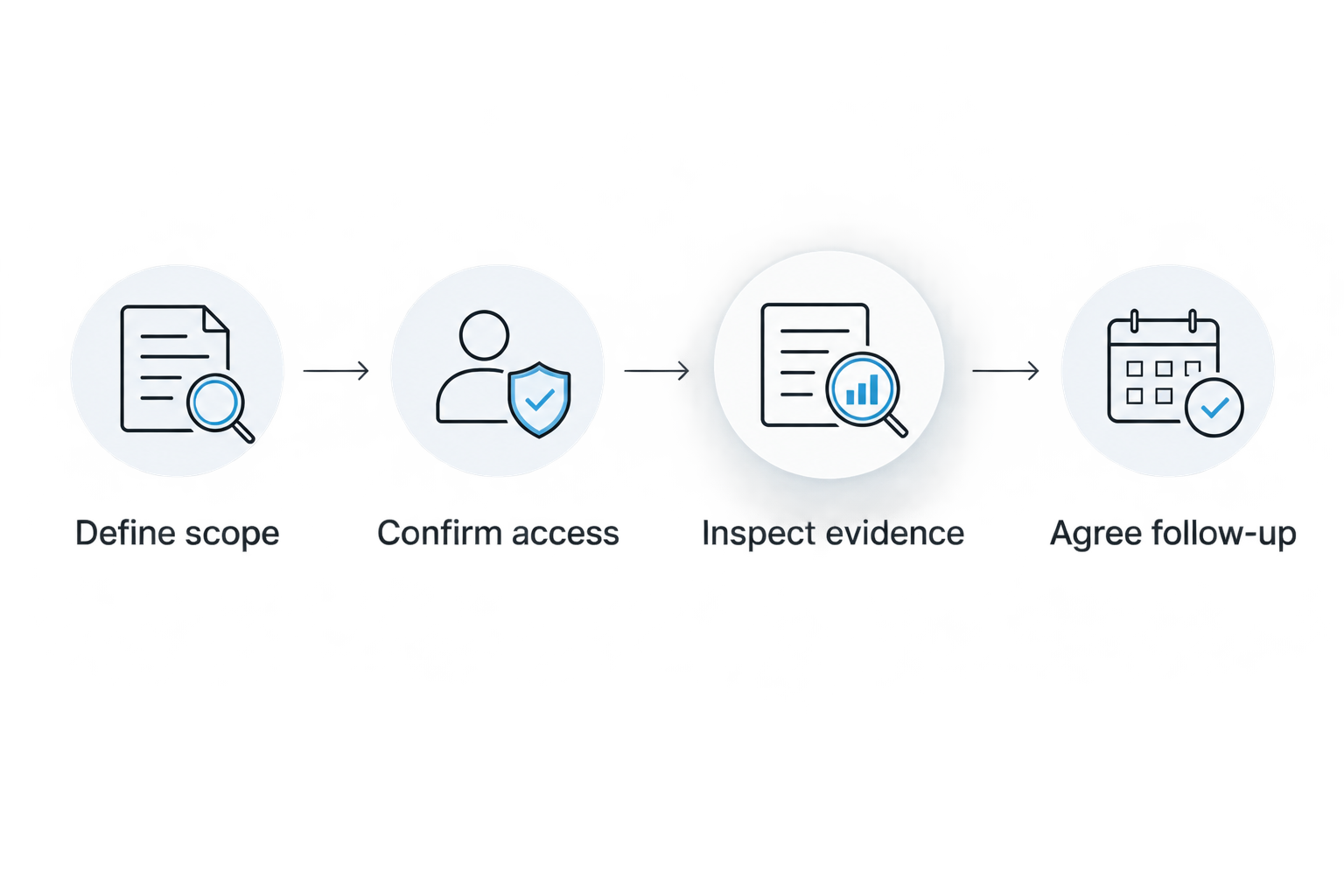
- Define scope. List the systems, user roles and workflows you need examined. Separate required coverage from optional work so bidders respond to the same request.
- Confirm access. State the starting access and required permissions. Identify who supplies accounts, documentation and authorization for systems operated by third parties.
- Inspect evidence. Review a redacted sample report and ask how findings are validated. Check whether technical staff can reproduce an issue and understand the recommended fix.
- Agree follow-up. Document how findings are discussed, how remediation questions are handled and what verification of fixes includes. Keep these terms with the approved scope.
Bring technical and purchasing stakeholders into the same review. Procurement needs clear contractual boundaries; technical teams need a test that examines the intended systems and produces usable evidence.
Compare 2 proposals against the same written scope before treating their commercial terms as equivalent. This is a purchasing discipline, not a claim that a particular number of bids guarantees the right provider.
Questions that expose an incomplete proposal
Ask the provider to explain what happens when automated checks cannot complete an authenticated workflow. Does the engagement include expert investigation, record a coverage limitation or stop at the failed check?
Then ask what a finding means. Does it identify a potentially affected component, demonstrate an exploitable condition or document a sequence of actions leading to unauthorized access? Those are different levels of evidence.
Finally, ask how coverage limitations appear in the final report. An untested workflow must not become an implied clean result simply because the report contains no finding for it.
What costs sit outside the testing agreement?
The provider's agreement is only part of the work your organization must plan. Your team still needs to prepare access, coordinate testing and act on validated findings.
For your 2026 budget, separate the provider's deliverables from your internal responsibilities. This avoids assigning work to a service that does not include it.
| Workstream | Confirm before approval | Business consequence if omitted |
|---|---|---|
| Preparation | Accounts, authorization, environment details and responsible contacts | Testing cannot examine the intended workflows without the required access |
| Coordination | Testing windows, escalation contacts and stop conditions | Operational teams lack a shared process for responding to testing activity |
| Remediation | Engineering ownership and a process for prioritizing findings | Validated issues remain unresolved without an accountable team |
| Verification | Which fixes are checked, under what conditions and with what evidence | Closing a ticket does not establish that the original exploit path is removed |
Assign 1 accountable owner to coordinate access and follow-up. Specialists can own individual fixes, but someone must track the engagement from authorization through remediation decisions.
Use a documented findings-to-remediation workflow to connect evidence with action. A report is an input to risk reduction, not the completed outcome.
Is automated penetration testing enough on its own?
Automated penetration testing is not a substitute for every form of security testing. Its suitability depends on whether supported checks cover the systems, permissions and attack paths you need examined.
Automation supports repeatable work. Its limitation is that supported workflows and configured access define what it can exercise; the service name alone does not establish coverage of application-specific business logic.
Human-led testing adds expert direction and investigation, but it also has boundaries. Time, authorization, access and agreed scope still constrain the engagement, and a clean report is not a guarantee that no weaknesses exist.
Cyberhunter is best for businesses seeking human-led, AI-assisted penetration testing with expert-validated findings. Buyers should still confirm the exact assets, techniques, deliverables and follow-up terms in their engagement agreement.
Choose based on the decision you need to make. Recurring identification of detectable weaknesses, investigation of an exploitable attack path and threat hunting for signs of attacker activity are distinct objectives.
Does automated testing replace a penetration test for compliance?
An automated testing label does not establish that an engagement satisfies a particular compliance requirement. Match the actual testing scope, methodology, independence requirements and evidence to the applicable obligation.
Ask the person responsible for your compliance programme to confirm acceptance criteria before purchasing. Where an auditor or assessor evaluates the evidence, resolve expectations before the engagement rather than after the report arrives.
For your 2026 review, keep compliance requirements separate from broader security objectives. A test can produce useful security findings without satisfying every documentation requirement, and documentation alone does not prove that every relevant attack path was examined.
What should you send a provider to get a useful proposal?
Send a concise scope brief instead of asking for a generic automated testing package. Describe the systems you want examined, their business purpose, the available access and the decision the results must support.
Include the following information where it applies:
- Application and API boundaries, including administrative interfaces.
- Relevant user roles and workflows that cross permission boundaries.
- Network or cloud environments included in the authorization.
- Restrictions on testing activity and handling sensitive information.
- Required reporting audiences and remediation discussions.
- Expectations for checking fixes after remediation.
State uncertainties directly in the request. If ownership of an environment or permission to test it is unresolved, settle authorization before including it in executable testing scope.
A useful discovery conversation should turn these details into explicit inclusions, exclusions and responsibilities. It should not require you to accept undefined coverage in exchange for a simple package name.
Discuss Your Testing Scope
Clarify testing objectives, access, evidence requirements and remediation expectations.
FAQ
What does automated penetration testing pricing depend on?
Automated penetration testing pricing depends on the agreed assets, access, testing depth, validation and deliverables. Compare equivalent scope and confirm exclusions before choosing a provider.
Is automated penetration testing the same as vulnerability scanning?
Automated penetration testing and vulnerability scanning are not interchangeable. Scanning identifies potential weaknesses; penetration testing investigates exploitability within an authorized scope, so inspect the methodology rather than relying on the label.
Does an automated testing subscription include human review?
A subscription label does not establish that human review is included. Ask who validates findings, investigates unsupported workflows and answers remediation questions.
Is checking fixes included after a penetration test?
Verification of fixes is included only when the engagement terms specify it. Confirm the covered findings, required access and evidence before approving the agreement.
What should a penetration testing report contain?
A useful penetration testing report should document scope, limitations, evidence, affected assets, business consequences and remediation guidance. Ask for a redacted sample to confirm that your technical team can act on the findings.
Does Cyberhunter provide fully autonomous penetration testing?
Cyberhunter provides human-led, AI-assisted penetration testing, not an AI-only service. Experts direct the testing and validate findings, with an emphasis on exploitable issues and practical remediation guidance.
Should I request black-box or authenticated testing?
Choose the access model that matches the security question you need answered. Black-box testing starts with limited supplied knowledge, while authenticated testing examines behaviour available through agreed user access; document the exact assumptions in either case.
One last thing
An empty findings list is meaningful only alongside documented coverage. Before signing, ask how the provider records blocked checks, inaccessible accounts, excluded workflows and other testing limitations.
That distinction helps you interpret the final report correctly. No finding recorded for a workflow is not the same as evidence that the workflow was tested successfully.
Related guides
- How much does penetration testing cost in Canada?
- How much does a web application penetration test cost?
- Cloud security for SaaS companies
