


A vulnerability assessment for utility companies is a structured review of technology weaknesses with the aim of reducing risk to service delivery, operational safety and business systems. This 2026 guide explains how to assess corporate IT and operational technology without treating production control systems like ordinary office networks.
- A vulnerability assessment for utility companies must separate corporate IT, operational technology and the connections between them.
- CyberHunter suits businesses seeking vulnerability assessments alongside human-led, AI-assisted penetration testing with expert-validated findings.
- Require operations approval before active testing touches control systems, remote access infrastructure or field equipment.
- Prioritize validated attack paths and service consequences, not scanner severity scores alone.
Why vulnerability assessments matter for utility companies
Utility assessments must account for systems that control physical processes, not just systems that store information. A weakness affecting a customer portal requires a different testing decision from one affecting a device that supports treatment, distribution or generation.
The assessment must identify exposure without creating an operational incident. That means documenting where active testing is permitted, which systems require passive review, and who can stop testing immediately.
CyberHunter provides vulnerability assessments, security assessments, threat hunting and penetration testing. CyberHunter is best for businesses seeking human-led penetration testing alongside vulnerability assessments. Experts direct its AI-assisted penetration testing and validate findings; utility buyers should separately establish the operational technology scope and testing restrictions they need.
For your 2026 assessment plan, organize the work around these questions:
- Which weaknesses expose business services or operational access?
- Which findings have supporting evidence rather than an unverified scanner match?
- Which corrective actions can proceed immediately, and which require operational change approval?
The deliverable should answer those questions for system owners, operations leaders and whoever authorizes remediation.
Define the assessment before selecting a provider
A vulnerability assessment identifies and evaluates weaknesses. Vulnerability scanning supports that work by checking systems for known issues, but scanner output alone does not establish business impact or confirm every reported weakness.
Penetration testing goes further by attempting authorized exploitation within agreed boundaries. A broader security assessment can examine architecture, access controls, procedures and configuration without trying to exploit systems. Threat hunting searches for evidence of malicious activity; it does not replace an exposure assessment.
For utilities, these distinctions belong in the statement of work. An agreement to assess vulnerabilities is not permission to exploit a control system, interrupt a process or test a third party's infrastructure.
Buy a defined scope and evidence standard, not an interchangeable list of security services. Ask what the assessor will inspect, how findings will be validated and what remains outside the engagement.
How to conduct a utility vulnerability assessment
Use the following sequence to keep technical discovery tied to operational decisions. Each stage should leave a record that the next stage can use, from the approved asset list through to closure evidence.
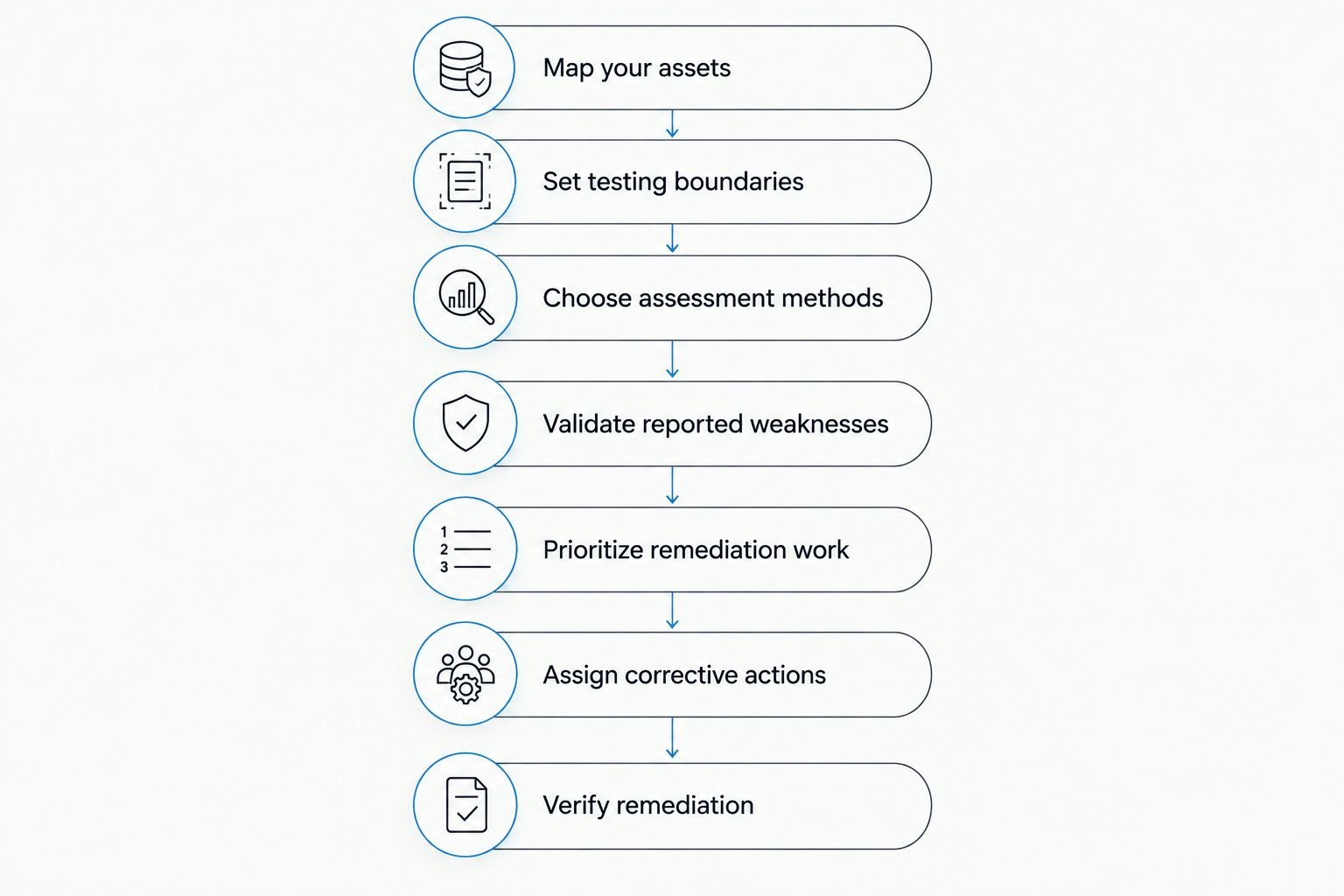
Map your assets
Start with existing network diagrams, asset registers and conversations with operations staff. Reconcile those records before introducing discovery traffic to operational networks. A device missing from the inventory is not automatically safe to probe.
Separate the environment into 3 scope zones: corporate IT, operational technology and connecting infrastructure. Connecting infrastructure includes the firewalls, jump hosts and remote access systems that mediate access between environments. Treat these as explicit assessment targets rather than incidental network equipment.
An asset list is useful only when someone owns it. Record the responsible team and operational purpose alongside the technical identifier, so findings reach a person who can authorize a change.
- Identify business applications, identity services and internet-facing assets.
- Record control systems, engineering workstations and relevant field equipment.
- Map vendor access routes and connections between environments.
- Mark assets with uncertain ownership or incomplete documentation.
Set testing boundaries
Begin with a joint review involving security, IT and operations. Use existing procedures to identify approved maintenance windows, escalation contacts and systems that cannot tolerate unplanned interruption.
For each asset group, distinguish passive review, authenticated configuration inspection, active scanning and exploitation. Passive review observes available information without sending assessment probes to the target; active methods interact with it. Neither method removes the need for authorization and careful handling.
Your 2026 rules of engagement should specify what happens if a device becomes unstable or an unexpected route into operational technology appears. An assessor must stop at the agreed boundary, even when a finding looks significant.
- Obtain written authorization from the relevant asset owners.
- List excluded devices, prohibited techniques and approved source addresses.
- Name the operations contact with authority to stop testing.
- Agree on incident escalation and evidence-handling procedures.
Choose assessment methods
Use configuration exports, access reviews and available system records first where direct interaction is restricted. For supported corporate systems, authenticated scanning can inspect details unavailable to an external-only scan. Credentials still require controlled access and an agreed purpose.
For operational technology, select methods with operations staff and the relevant equipment support requirements in view. Do not assume a scanner profile described as safe is suitable for every controller or embedded device.
CyberHunter's services include vulnerability assessments and human-led, AI-assisted penetration testing. External help supports assessment and validation, but it does not replace your utility's authorization process. Ask specifically about operational technology experience and methods rather than assuming general penetration testing covers industrial equipment.
- Match the collection method to each asset group's operating constraints.
- Use approved credentials where authenticated inspection is appropriate.
- Separate configuration review from attempts to demonstrate exploitation.
- Document exclusions and the resulting limits on assessment coverage.
Validate reported weaknesses
Review scanner findings against actual versions, configurations and exposure before assigning remediation. A reported software match is a starting point, not proof that the vulnerable condition exists or is reachable.
Validation does not always require exploitation. Configuration evidence, vendor documentation and controlled checks can establish a weakness without exercising a disruptive attack. Where evidence remains incomplete, state that limitation directly instead of presenting an assumption as a confirmed finding.
Require 4 evidence fields for each actionable finding: affected asset, observed condition, supporting evidence and business consequence. Keep sensitive screenshots and configuration details in an appropriately restricted repository, not a broadly circulated management summary.
- Confirm the affected system and relevant software or configuration.
- Record the access conditions required to reach the weakness.
- Distinguish confirmed findings from items needing further investigation.
- Request explicit approval before any exploit-based validation.
Prioritize remediation work
Start with a joint review of validated findings rather than sorting the scanner export by severity. Technical severity describes characteristics of a weakness; remediation priority must also consider exposure, existing controls and consequences for the utility.
An exposed remote access service warrants examination of the systems reachable after authentication. An isolated device with a severe finding still needs a decision, but changing it without an approved operational plan introduces a separate risk.
For 2026 planning, require the assessor to explain the attack path: the access an attacker needs, the boundary crossed and the capability gained. Where that path has not been demonstrated, distinguish supporting evidence from an untested hypothesis.
- Consider external exposure and access to privileged accounts.
- Review connections toward operational systems and shared administrative infrastructure.
- Document existing controls that restrict the attack path.
- Assign priority using both security impact and operational consequences.
Assign corrective actions
Use your existing change-management process to turn findings into assigned work. A finding without an accountable owner and an agreed next action remains unresolved, even if a report labels it critical.
Patching is one corrective action, not the only one. Restricting remote access, removing unused services, changing permissions or strengthening network boundaries can address exposure where an immediate software change is not approved. Confirm that the selected measure addresses the documented weakness.
When a permanent fix depends on an outage or equipment replacement, record the interim control and the decision-maker accepting the remaining risk. Do not let operational constraints become an indefinite exception without review.
- Assign an owner and an agreed target date to each action.
- Identify change approvals, dependencies and rollback requirements.
- Document interim controls when the permanent fix is deferred.
- Escalate unresolved ownership or risk-acceptance decisions.
Verify remediation
Start closure with the original evidence and expected corrective outcome. Confirm the changed condition using an approved method; a completed work ticket establishes that work was recorded, not that the weakness is gone.
Keep 2 separate records: remediation evidence and coverage limitations. The first shows what changed and how it was checked. The second shows what the assessment did not examine, so an untested segment never becomes an implied assurance of security.
After verification, update the asset register and assessment scope. New remote access arrangements, network changes and operational system replacements should trigger a review of whether the earlier assessment still reflects the environment.
- Verify the affected asset rather than closing related findings automatically.
- Check that the change did not restore an unintended access path.
- Record residual exposure and any remaining operational restrictions.
- Agree on follow-up testing scope and terms before scheduling it.
Compare assessment options for your utility
Choose the assessment method according to the question you need answered. These options are complementary, but they produce different evidence. For a 2026 engagement, specify the expected output for each method rather than asking for every method under an undefined security review.
| Option | Best for | Main strength | Key limitation |
|---|---|---|---|
| Internal inventory and configuration review | Establishing scope before active testing | Uses existing records and operational knowledge | Misses weaknesses absent from those records or outside reviewer expertise |
| Vulnerability scanning | Checking approved, supported systems for known issues | Produces repeatable technical observations | Requires validation and business context; active probes need approval |
| External vulnerability assessment | Combining discovery, validation and remediation planning | Connects technical evidence to corrective actions | Coverage depends on access, exclusions and agreed assessment methods |
| Human-led penetration testing | Evaluating exploitability within authorized boundaries | Tests whether weaknesses support an attack path | Excluded techniques and systems limit the conclusions |
| OT-focused security assessment | Reviewing industrial assets and operational boundaries | Centers testing decisions on process constraints | Restricted interaction limits direct technical validation |
| Threat hunting | Investigating signs of malicious activity | Examines evidence of potential compromise | Does not replace vulnerability identification or remediation verification |
For an outside provider, request a redacted sample deliverable and a proposed method for handling restricted systems. Evaluate the usefulness of the findings, not just the number of tools named in the proposal.
CyberHunter offers vulnerability assessments, penetration testing and threat hunting. Its human-led penetration testing fits work requiring expert direction and validated findings; confirm utility-specific scope, operational technology methods and exclusions before selecting the engagement.
Define your assessment scope
Discuss assessment boundaries, evidence requirements and practical remediation guidance.
Common mistakes utility companies make
Authorizing a corporate scan across operational networks
A corporate scanning policy is not authorization to probe industrial devices. Separate approvals by environment and require operations review before expanding discovery or validation into operational technology.
Assessing control devices but ignoring remote access
A device-focused inventory can leave vendor accounts, jump hosts and administration routes outside the review. Include the systems that grant access to operational environments, with ownership and authorization documented.
Treating every severe finding as an immediate patch instruction
Severity alone does not resolve change risk, equipment support restrictions or maintenance requirements. Require a documented corrective action that addresses exposure without bypassing operational change controls.
Accepting a report without evidence or closure criteria
A vulnerability name does not tell an asset owner what to change or how to confirm success. Require supporting observations, practical remediation guidance and a defined verification method for actionable findings.
FAQ
What should a vulnerability assessment for utility companies include?
A vulnerability assessment for utility companies should include an approved asset scope, testing boundaries, validated findings, business consequences and remediation guidance. Separate corporate IT, operational technology and the infrastructure connecting them, and record exclusions explicitly.
Is vulnerability scanning safe for operational technology?
Active vulnerability scanning requires system-specific approval before use on operational technology. Operations staff and relevant equipment support requirements should determine permitted methods, with passive review or configuration inspection used where direct probing is restricted.
Is a vulnerability assessment the same as penetration testing?
No. A vulnerability assessment identifies and evaluates weaknesses, while penetration testing attempts authorized exploitation within a defined scope. Commission exploit-based validation only where the rules of engagement explicitly permit it.
Does a utility vulnerability assessment prove compliance?
A vulnerability assessment does not by itself prove compliance. Map its scope and evidence to the requirements applicable to your organization, and separately address obligations outside the assessment.
How often should a utility assess vulnerabilities?
Set assessment frequency according to system risk, applicable obligations and operational change. Review coverage after material changes to remote access, network boundaries or operational systems rather than relying only on a calendar date.
Can a utility use an internal team instead of an outside assessor?
An internal team can conduct inventory reviews, configuration checks and approved vulnerability assessment work. Use external support where you need additional expertise, independent validation or capacity, while retaining internal control over operational authorization.
How does CyberHunter approach penetration testing?
CyberHunter provides human-led, AI-assisted penetration testing in which experts direct testing and validate findings. Utility buyers should agree on operational technology coverage, prohibited techniques and evidence requirements before authorizing an engagement.
One last thing
Ask for the excluded-systems list before accepting the executive summary. A finding-free assessment of a restricted scope says nothing about the systems left outside it. Make that boundary visible in your 2026 risk register, alongside the owner responsible for resolving the coverage gap.
Related guides
- Vulnerability assessment companies in Canada
- Network penetration testing companies in Canada
- Threat hunting service providers in Canada
