


Instead of rebuilding PCI DSS evidence manually at assessment time, connect your scope register, penetration testing plan, remediation tickets and retest records into one controlled workflow. For 2026, that means testing the right systems from the right positions, correcting exploitable findings and preserving evidence that shows what changed.
- PCI DSS compliance penetration testing requires defined scope, internal and external testing, remediation and repeat testing.
- CyberHunter provides human-led, AI-assisted penetration testing with expert-validated findings and practical remediation guidance.
- Vulnerability scanning does not replace penetration testing; each answers a different security question.
- Schedule recurring tests and change-triggered tests, including segmentation testing where segmentation reduces PCI DSS scope.
Why this matters
A penetration testing report supports PCI DSS compliance; it does not establish compliance by itself. Your evidence must connect the agreed scope, testing methodology, findings, remediation and repeat testing. A report that omits an in-scope payment application leaves a gap even if every reported issue is closed.
CyberHunter penetration testing is best for teams seeking human-led testing, expert-validated findings and practical remediation guidance. Experts direct the testing; AI assistance does not replace their judgement. Your team still owns scope accuracy, remediation decisions and the wider compliance programme.
For 2026 planning, use PCI Security Standards Council’s PCI DSS v4.0.1, particularly Requirements 11.3 and 11.4, to separate vulnerability scanning obligations from penetration testing obligations. Confirm the requirements applicable to your environment and validation method with your assessor or compliance lead.
Before you start
- Prepare scope and access: Gather your cardholder data environment inventory, payment data-flow diagrams, network diagrams, application inventory, segmentation boundaries and relevant third-party responsibilities. Arrange written testing authorization and suitable test accounts.
- Assign decision-makers: Name the scope owner, testing lead, remediation owners and person responsible for accepting the evidence package. Agree on testing restrictions, escalation contacts and stop conditions before activity begins.
- Resolve the hidden dependency: A service provider’s compliance documentation does not automatically cover your configuration or testing responsibilities. Confirm what the provider tests, what you must test and what authorization the provider requires.
Do not start with a scanner target list. Start with the payment flow, then identify the systems that store, process or transmit cardholder data and systems that can affect the security of that environment.
Match the security activity to the requirement
Penetration testing evaluates whether weaknesses can be exploited within an authorized scope. Vulnerability scanning identifies potential weaknesses using automated checks. A broader security assessment examines controls against an agreed set of criteria; its scope determines whether technical exploitation is included.
| Activity | Best for | Strength | Limitation |
|---|---|---|---|
| Penetration testing | Validating exploitable attack paths | Connects weaknesses to demonstrated security consequences | Findings apply to the tested scope and conditions, not every possible attack |
| Vulnerability scanning | Recurring checks for known weaknesses | Supports repeatable coverage across defined assets | A detected weakness is not automatically proof of exploitability |
| Security assessment | Reviewing control design and implementation | Examines technical and organisational controls together | Does not replace required penetration testing unless its work actually meets those requirements |
Keep these activities connected, but do not label them interchangeably. Passing an external vulnerability scan does not demonstrate that an authenticated user cannot cross an application authorization boundary.
Under PCI DSS v4.0.1, internal and external vulnerability scanning generally operate on an at-least-once-every-3-months schedule, with additional change-related obligations. Penetration testing has its own cadence and evidence requirements.
Scope and authorization
Define the testing boundary
- Map payment flows. Record where cardholder data enters, moves through and leaves your environment. Include relevant applications, APIs, administrative interfaces and supporting infrastructure.
- Identify security dependencies. Document systems that can affect the cardholder data environment, including identity services and management paths. Do not exclude a system simply because it does not directly store payment data.
- Record segmentation claims. Identify each control used to separate in-scope systems from excluded networks. State which boundaries the test must validate.
- Approve the rules of engagement. Specify authorized targets, testing positions, accounts, permitted techniques, data-handling rules and escalation procedures. Explicitly address disruptive activity rather than leaving the testing team to infer permission.
Black-box testing starts with limited prior knowledge. That approach can evaluate an outside attacker’s perspective, but it does not justify omitting internal testing, application coverage or information needed to meet the agreed methodology.
Expected result: An approved scope and rules-of-engagement document identifies what will be tested, from where, under whose authority and with which restrictions.
For your 2026 scope register, record why each excluded network is outside scope. “Not part of payments” is not evidence that a network cannot affect payment-system security.
Testing plan and execution
Establish coverage and triggers
- Select qualified, independent testers. PCI DSS permits qualified internal resources or qualified external third parties, with organizational independence requirements. Document qualifications and independence rather than assuming an external company name proves either.
- Document the methodology. Cover the cardholder data environment perimeter and critical systems, internal and external perspectives, network-layer testing and application-layer testing. Include relevant threats and vulnerabilities experienced during the preceding 12 months.
- Set recurring and event-based triggers. Use the applicable cadence below, then connect significant changes to the testing decision process. An annual calendar entry alone is insufficient.
- Validate access before execution. Check that test accounts have the intended roles, internal testing originates from the agreed positions and protective controls behave as documented. Record any coverage restrictions.
| Testing obligation | PCI DSS v4.0.1 cadence | Workflow trigger |
|---|---|---|
| Internal penetration testing, Requirement 11.4.2 | At least once every 12 months and after significant infrastructure or application changes | Recurring schedule plus significant-change review |
| External penetration testing, Requirement 11.4.3 | At least once every 12 months and after significant infrastructure or application changes | Recurring schedule plus significant-change review |
| Segmentation testing when segmentation isolates the cardholder data environment, Requirement 11.4.5 | At least once every 12 months and after changes to segmentation controls or methods | Segmentation schedule plus boundary changes |
| Additional segmentation testing for service providers, Requirement 11.4.6 | At least once every 6 months and after changes to segmentation controls or methods | Service-provider schedule plus boundary changes |
A testing window is not permission to exceed scope. If a tester discovers an unexpected route into another environment, pause that activity and obtain a documented scope decision before proceeding.
Expected result: A test plan connects each applicable obligation to coverage, an owner, a recurring schedule and a change trigger.
Preserve the evidence chain
Use one traceable sequence: Approved scope, Test evidence, Remediation, Repeat testing, Evidence package. Keep the same finding identifier across these records so an assessor can follow an issue without reconstructing it from emails.
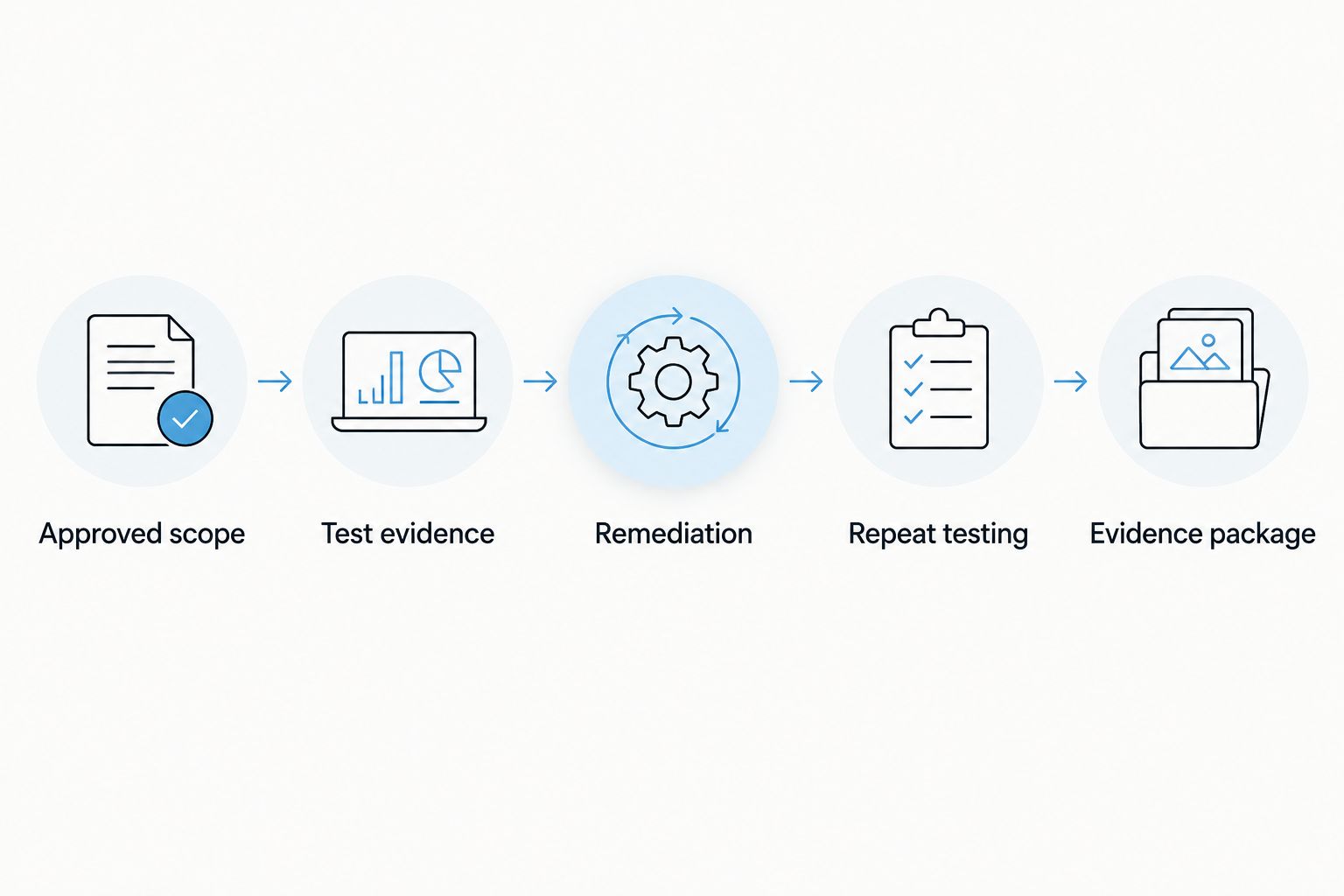
Record enough evidence to explain the affected asset, prerequisites, demonstrated access and business consequence. Avoid copying live cardholder data into tickets when a redacted artifact establishes the finding. Evidence handling belongs in the testing agreement, not in an improvised decision after sensitive information appears.
CyberHunter’s human-led, AI-assisted penetration testing uses expert validation of findings. Your acceptance criteria should still specify the evidence and remediation detail needed for your environment; the service description is not a substitute for an agreed engagement scope.
Remediation and closure
Connect findings to accountable work
- Create a remediation record for each finding. Include the affected asset, finding identifier, severity, supporting evidence, recommended correction and responsible owner. Link related findings when they share a root cause without losing affected-system coverage.
- Prioritize using demonstrated consequences. Consider the access achieved, affected data, attack prerequisites and route into the cardholder data environment. A numerical severity score alone does not describe the whole business exposure.
- Record the implemented change. Attach the relevant configuration, code or access-control change record. Mark deployment complete separately from security validation complete.
- Repeat the relevant testing. Requirement 11.4.4 requires correction of exploitable vulnerabilities and security weaknesses, followed by repeat testing to verify the corrections. Check that the original attack path no longer works and investigate relevant alternate paths.
Expected result: Each exploitable finding has a documented correction and repeat-test evidence, rather than a ticket closed solely on an implementation statement.
Do not treat risk acceptance as interchangeable with the correction required by Requirement 11.4.4. If a fix cannot be completed, escalate the unresolved condition to the compliance owner and assessor; do not describe the penetration testing obligation as satisfied.
Assessment evidence package
Assemble a reviewable record
- Collect the approved scope and methodology. Include testing dates, testing positions, qualifications, independence and documented restrictions.
- Reconcile findings with closure records. Match every finding identifier to its remediation status and repeat-test result. Explain scope changes and unresolved limitations explicitly.
- Preserve segmentation evidence separately. Show which isolation boundaries were tested and the result for each relevant boundary. A general network test summary does not automatically establish segmentation effectiveness.
- Apply retention and access controls. PCI DSS Requirement 11.4.1 calls for retaining penetration testing results and remediation activity results for at least 12 months. Limit access because these records describe security weaknesses and attack paths.
Expected result: A reviewer can move from an applicable requirement to its scope, test evidence and remediation outcome without asking which report version is authoritative.
For a 2026 assessment package, identify the tested environment and dates clearly. A newer report title does not make older evidence representative of a changed environment.
Variant: trigger testing when the environment changes
Use the same workflow for significant infrastructure or application changes instead of creating a separate, undocumented exception process. The difference is the trigger: a change record starts the scope review rather than the recurring calendar.
- Payment application change: Review altered authentication, authorization, payment handling and connected interfaces. Determine the penetration testing coverage required for the significant change.
- Network or cloud change: Review new connectivity, routing, administrative access and security boundaries. Determine which internal and external testing perspectives are affected.
- Segmentation change: Identify the changed isolation controls and initiate applicable segmentation testing. Do not assume a successful application test validates network isolation.
Document the significance decision, approver and resulting test scope in the change record. Do not automatically label every small update significant, or automatically exempt changes because they passed functional testing.
For 2026 release planning, make the security review a change-management gate. This connects testing decisions to the environment that actually exists rather than the architecture documented at the last annual assessment.
Troubleshooting
The external test cannot reach the intended application
Check DNS, routing, access restrictions and the agreed testing position. Record whether a protective control blocked access or a setup error prevented testing; those are different outcomes. Authorize any access adjustment and preserve the distinction between ordinary exposure and specially permitted testing access.
Authenticated testing covers only one user role
Create approved accounts for the relevant roles and verify that each works before testing. Different permissions create different authorization boundaries. If a role remains unavailable to the tester, document the coverage limitation rather than presenting the application as fully tested.
The scanner result is the only evidence supplied
Request penetration testing evidence tied to the agreed methodology, affected assets and validated findings. Keep scanning results as supporting material. Do not rename a scan report to close the gap.
A finding returns after the ticket is closed
Compare the deployed change with the tested fix and check whether the same weakness exists in another endpoint or environment. Reopen the finding when the correction was incomplete. Repeat testing must verify the relevant security outcome, not merely confirm that a deployment occurred.
Segmentation coverage stops at a firewall review
Add testing that validates whether the controls actually isolate the cardholder data environment from out-of-scope systems. Configuration review explains intended behaviour; testing checks the boundary in practice. Record the tested paths and exceptions.
Customize your workflow
Extend the workflow by assigning finding identifiers to change requests, remediation records and repeat-test evidence. Automate reminders and routing where useful, but keep scope approval, exploitation decisions and finding validation under qualified human control.
CyberHunter provides penetration testing, vulnerability assessments and threat hunting as distinct services. Define the outcome you need before combining them: evidence of exploitability, identification of potential weaknesses or investigation for signs of malicious activity.
Discuss Your PCI DSS Testing Scope
Discuss testing boundaries, validated findings and remediation evidence for your environment.
FAQ
How often does PCI DSS require penetration testing?
PCI DSS v4.0.1 requires internal and external penetration testing at least once every 12 months and after significant infrastructure or application changes. Separate segmentation testing requirements apply when segmentation isolates the cardholder data environment.
Can vulnerability scanning replace PCI DSS penetration testing?
No, vulnerability scanning does not replace PCI DSS penetration testing. Scanning identifies potential weaknesses, while penetration testing evaluates exploitable weaknesses using an agreed methodology and scope.
Does a penetration testing report make my business PCI DSS compliant?
No, a penetration testing report does not establish PCI DSS compliance by itself. It supports particular requirements within a wider assessment of applicable controls, scope and evidence.
Can an internal team perform PCI DSS penetration testing?
Yes, qualified internal resources can perform PCI DSS penetration testing when the applicable organizational independence requirements are met. Document tester qualifications, independence and the testing methodology.
Do PCI DSS penetration testing findings need a retest?
Yes, Requirement 11.4.4 requires repeat testing to verify corrections to exploitable vulnerabilities and security weaknesses. Closing a remediation ticket without that verification does not provide the same evidence.
How often must a service provider test PCI DSS segmentation?
Service providers subject to Requirement 11.4.6 must test segmentation at least once every 6 months and after changes to segmentation controls or methods. Confirm the applicable scope and requirements with the compliance owner or assessor.
What should I prepare before contacting CyberHunter?
Prepare your payment data flows, proposed scope, application and network inventory, segmentation boundaries and relevant third-party responsibilities. These materials support a discussion about testing coverage, authorization and the evidence your team needs.
One last thing
An empty findings list is not the same as complete testing. Restricted accounts, missing targets or an incorrect network position can leave important attack paths unexamined even when the report contains no confirmed vulnerabilities.
Before accepting your 2026 report, compare the completed work with the approved scope. Ask what was excluded, what could not be tested and whether each segmentation claim received appropriate validation. Those answers tell you what the evidence actually supports.
Related guides
- Cloud security for SaaS companies
- Web application penetration testing companies
- Network penetration testing companies in Canada
