


The cost to fix penetration test findings depends on the affected systems, the changes required and the work needed to verify those changes; a defensible 2026 budget starts with a scoped remediation plan, not a flat amount per finding. Include investigation, implementation, deployment and validation—not just the initial code or configuration change. Keep the penetration test fee separate unless your agreement explicitly includes remediation work.
- The cost to fix penetration test findings follows repair scope, not finding count.
- Cyberhunter penetration testing suits businesses seeking expert-validated findings and practical remediation guidance.
- Budget for investigation, implementation, deployment and validation—not just the technical fix.
- Separate penetration testing, vulnerability scanning and remediation when reviewing proposals.
Why this matters
A penetration test identifies exploitable weaknesses within an agreed scope. It does not, by itself, assign engineering capacity, schedule production changes or establish who pays for each repair.
Your remediation budget needs to connect security evidence to actual work. Use a penetration test findings-to-remediation workflow to turn report entries into owned tasks, acceptance criteria and closure evidence. Without that connection, a completed ticket can describe a change without proving that the reported attack path is closed.
Approve a repair scope, not a budget based only on the number of findings. Several findings can share a root cause, while a single finding can require changes across application code, identity controls and infrastructure.
How much does it cost to fix findings from a penetration test?
You establish remediation cost by estimating the work required to resolve each underlying weakness and validate the result. A finding's severity helps set priority, but it does not specify implementation effort.
For your 2026 budget, ask each responsible team to estimate the activities below. Separate internal effort from external services so that procurement spend does not hide the capacity required from your employees.
| Budget component | Work to include | Evidence needed before approval |
|---|---|---|
| Investigation | Reproduce the issue, identify affected assets and confirm the root cause | Finding evidence, affected systems and a proposed repair |
| Implementation | Change code, permissions, configuration or affected components | Technical tasks and a named owner |
| Change testing | Check the security change and relevant business functions | Acceptance criteria and regression test scope |
| Deployment | Prepare approvals, rollout and rollback procedures | Change plan and operational dependencies |
| Validation | Check whether the original attack path remains exploitable | Agreed validation scope and closure criteria |
| Coordination | Manage ownership, dependencies and exceptions | Accountable owners and documented decisions |
The budget relationship is straightforward: internal effort plus external services plus required technology changes and validation equals the planned remediation commitment. Track deferred work separately rather than treating it as completed remediation.
Do not assign a standard allowance to every report entry. First establish whether findings are duplicates, share a common control failure or require independent repairs. That review makes the estimate traceable to work rather than report length.
Configuration fixes: estimate the change and its dependencies
Configuration remediation changes how an existing system behaves. Examples include restricting access, removing an unnecessary exposed service or correcting an application security setting. These are examples of repair categories, not assumptions about your environment.
Best for: a validated finding whose root cause is an incorrect setting or permission rather than missing application logic.
The advantage is a clearly defined control change. The limitation is that the setting can affect legitimate users, integrations or administrative access, so deployment and rollback still need attention.
Ask the owner to identify where the setting is managed. A manual production change that leaves an infrastructure template unchanged does not address the configuration's source of truth. Include that source in the repair scope and verify that a later deployment will not restore the weakness.
Application fixes: estimate the behaviour that must change
Application remediation changes code or business rules. An authorization finding, for example, requires the application to enforce access correctly—not merely hide an interface element.
Best for: a finding caused by application logic that configuration alone cannot correct.
The advantage is that a code change can address the underlying weakness directly. The limitation is the need to understand related features, test expected behaviour and deploy through the application's release process.
For a 2026 application remediation plan, ask developers to describe the expected security behaviour before estimating the implementation. Specify which identities can perform the action, which resources they can access and which requests must be rejected. That description gives developers and testers the same definition of success.
Shared-control fixes: estimate coverage across affected systems
Some findings point to a shared dependency, identity configuration or reusable application component. The repair scope then includes identifying where that control is used and deciding how to update each affected system.
Best for: findings that share a verified root cause across multiple assets.
The advantage is a coordinated correction instead of disconnected local changes. The limitation is the wider dependency review: teams must confirm that the proposed fix works wherever the shared component or control is used.
Do not combine findings merely because their titles look similar. Require evidence of the shared cause, then retain asset-level acceptance criteria so that the broader change does not leave an affected system unverified.
Compare repair approaches before approving the work
Choose a remediation approach based on the demonstrated weakness and the constraints of the affected system. A temporary restriction and a permanent repair serve different purposes; record that distinction in the budget.
| Approach | Best for | Advantage | Limitation |
|---|---|---|---|
| Correct the root cause | A weakness with a feasible implementation path | Addresses the underlying failure | Requires implementation and change testing |
| Apply a compensating control | Exposure that needs restriction while the permanent repair is prepared | Provides an alternative control against the attack path | Needs validation and does not necessarily remove the original weakness |
| Replace or retire the component | A component the business decides not to maintain | Removes reliance on that component | Requires migration, dependency review and operational planning |
| Accept the residual risk | A documented decision by the accountable business owner | Makes the exception and ownership explicit | Does not fix the vulnerability |
Risk acceptance is a business decision, not a technical fix. Record what remains exposed, why the exception is accepted and what event will trigger a review. Do not report accepted findings as repaired.
Why the cost to fix penetration test findings varies
These factors define the work that belongs in your estimate:
- Repair scope: identify whether the change affects a setting, application behaviour, identity control or shared component.
- Affected assets: list the systems, environments and deployments requiring the correction rather than assuming the demonstrated example is the full scope.
- Root-cause certainty: distinguish a repair backed by reproducible evidence from work that still needs investigation.
- Business dependencies: identify workflows and integrations that require testing before deployment.
- Change requirements: include approvals, rollback preparation and coordination with the teams responsible for production.
- Validation scope: agree how the repaired condition and relevant related paths will be checked.
A severity label cannot substitute for these details. Use exploitability and business consequences to set priority, then use the proposed technical work to estimate effort.
For 2026 planning, keep priority and effort as separate fields. A difficult repair still needs a risk decision; an easy repair still needs evidence that the chosen change addresses the finding.
Build a remediation estimate your teams can execute
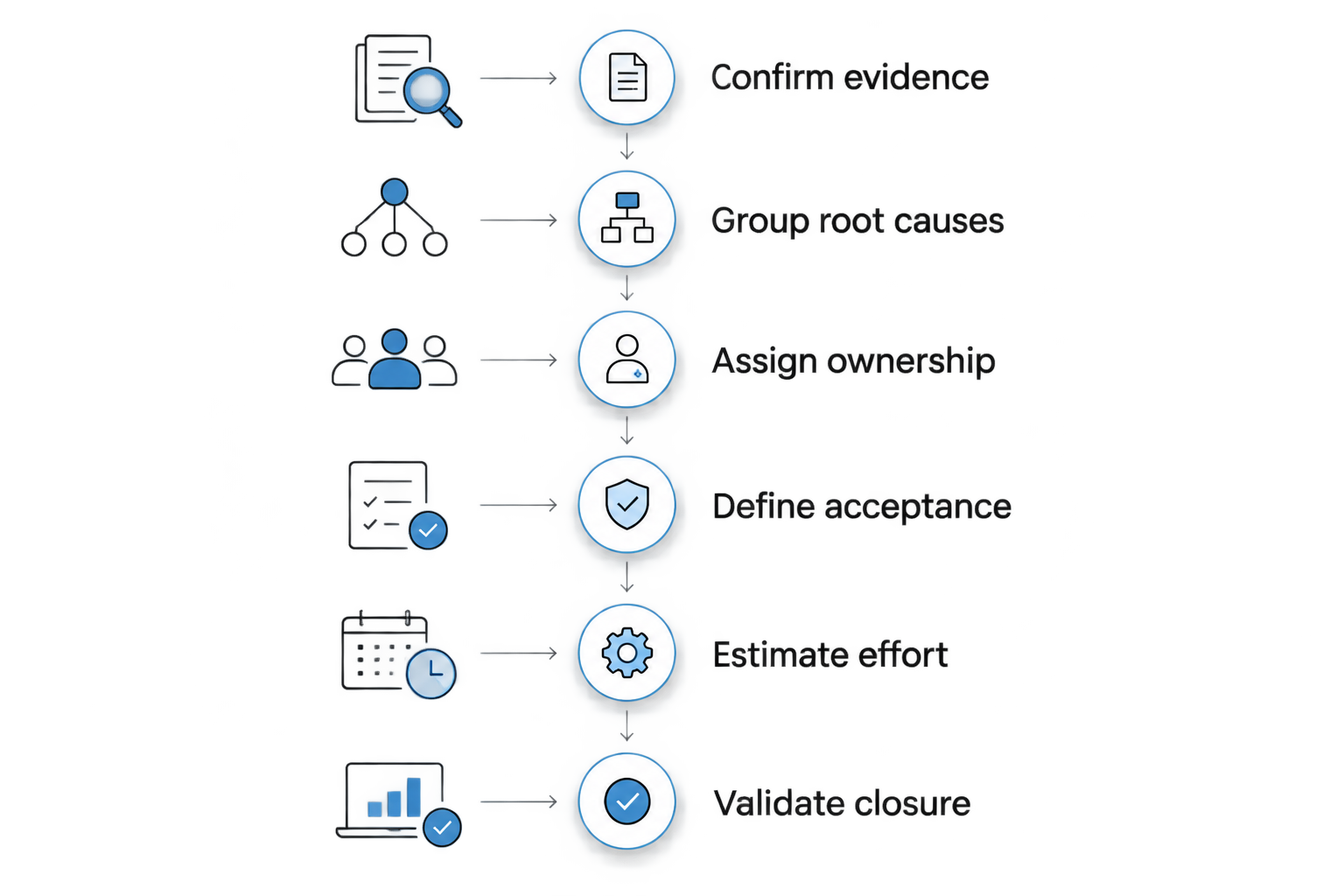
Use this sequence to turn the report into an approval-ready work plan. Keep each estimate tied to a finding or a documented shared root cause.
- Confirm evidence. Ensure the responsible team understands the affected asset, required conditions and demonstrated business consequence. Resolve unclear reproduction steps before approving implementation.
- Group root causes. Combine work only when findings genuinely share a repair. Keep the original findings traceable to the shared task.
- Assign ownership. Name the person accountable for coordinating each repair and identify any teams required to implement or approve it.
- Define acceptance. Describe the behaviour that must change, the legitimate functions that must continue working and the evidence needed for closure.
- Estimate effort. Request separate estimates for investigation, implementation, testing, deployment and validation. Identify dependencies rather than hiding them inside a single total.
- Validate closure. Check the agreed attack path after deployment and record the result. Keep unresolved conditions open or document the remaining risk explicitly.
The sequence separates deciding what must change from proving that the change worked. Both belong in the remediation plan.
Your approval record should show the finding, affected assets, repair owner, proposed change, effort estimate, dependencies and closure criteria. Keep unresolved assumptions visible so the budget approver understands which work is defined and which still requires investigation.
What should you ask a penetration testing provider?
Ask the provider to explain the evidence and the practical remediation guidance attached to each finding. Confirm whether implementation assistance and post-remediation validation are included in the agreement or require a separate scope.
Cyberhunter penetration testing is human-led and AI-assisted: experts direct testing and validate findings. That approach fits businesses seeking evidence of exploitable issues and practical remediation guidance; it does not establish that implementation or retesting is included in a particular engagement.
Before approving a proposal, confirm:
- Which assets and attack paths the original test covers.
- What evidence accompanies validated findings.
- How technical questions about remediation are handled.
- What post-remediation validation covers and how results are documented.
- Which activities your internal team must perform.
Use Contact Us to discuss the testing scope and the remediation questions your team needs answered. Confirm engagement terms directly rather than assuming repair work follows automatically from testing.
Does a critical finding always cost more to fix?
A critical finding does not establish the effort required to repair it. Severity describes risk; implementation effort depends on the underlying weakness, affected systems and required change.
Prioritize using the evidence and business consequence. Estimate using the actual repair plan, including deployment and validation.
Is retesting included in remediation?
Retesting is included only when your agreement says it is. Confirm the scope, conditions and reporting arrangements before relying on it in your remediation plan.
A targeted validation of repaired findings is not automatically a new penetration test of the entire environment. Match the agreed work to the assurance you need.
Is fixing a vulnerability scan result the same as fixing a penetration test finding?
Both require a verified repair, but the original evidence can differ. Vulnerability scanning identifies potential weaknesses, while penetration testing examines exploitability within an authorized scope; a security assessment can evaluate controls more broadly.
Check what the report actually demonstrates before estimating the response. Do not treat a scan alert as a confirmed attack path without validation.
FAQ
How do I estimate the cost to fix penetration test findings?
Estimate the investigation, implementation, testing, deployment and validation required for each underlying weakness. Separate internal effort from external services and required technology changes.
Can I budget remediation using the number of findings?
Finding count alone does not define the repair workload. Group verified shared root causes and estimate independent repairs separately.
Does the penetration test fee include fixing the findings?
The penetration test fee includes remediation only when the agreement explicitly includes that work. Confirm implementation assistance and validation separately before approving the engagement.
Should we fix every critical finding before other work?
Review critical findings promptly using the demonstrated attack path and business consequence. Document the repair, any interim control and the accountable owner’s decision rather than relying on severity alone.
Can our internal developers fix penetration test findings?
Internal developers can implement application repairs when they have the necessary system knowledge and authority. Infrastructure, identity or vendor-managed changes require the appropriate owners as well.
What proves that a penetration test finding is fixed?
Closure requires evidence that the agreed repair addresses the reported weakness. Record the deployed change, validation scope and result rather than closing the finding solely because implementation is complete.
What should our 2026 remediation budget include?
Your 2026 remediation budget should include investigation, implementation, change testing, deployment, coordination and validation. Keep the testing engagement separate unless the agreement explicitly combines those activities.
One last thing
A deployed patch and a closed finding are different milestones. Before approving the work, ask who will verify that the original attack path no longer works and where that evidence will be recorded.
When discussing findings with Cyberhunter, bring the affected asset list and the team's proposed repairs. Those details give the conversation a defined scope: what failed, what must change and what will demonstrate closure.
Related guides
- How much does penetration testing cost?
- Network penetration testing to firewall hardening workflow
- How to connect penetration test results to your SIEM
