


Cloud security testing cost requires a scoped quote: configuration reviews, vulnerability assessments and penetration tests cover different work, so they do not have an interchangeable price. Your total budget must also account for internal preparation, remediation and any separately scoped retesting. For a 2026 purchasing decision, compare the evidence and coverage each proposal commits to deliver before comparing the total.
- Cloud security testing cost should be compared against scope, access, validation depth and deliverables—not a service label alone.
- Cyberhunter suits businesses seeking human-led, AI-assisted penetration testing with expert-validated findings and practical remediation guidance.
- Vulnerability assessments identify weaknesses; penetration testing validates exploitable attack paths within agreed boundaries.
- Confirm remediation responsibilities and retesting terms before approving a cloud security testing proposal.
Why this matters
A proposal for scanning public cloud endpoints does not buy the same coverage as testing identity permissions, application access controls and paths to sensitive data. Comparing those proposals on the total alone hides the difference.
Start by defining the decision your organisation needs to make. If you are reviewing security services, specify whether you need a configuration review, vulnerability identification, validated exploitation or a combination. That distinction makes the purchasing conversation concrete.
How much does cloud security testing cost?
Cloud security testing cost is quote-specific because the testing boundary and required evidence determine the work. A defensible 2026 budget starts with an agreed scope, not an assumed market average.
Ask providers to separate the engagement into the following components. This breakdown exposes exclusions without requiring every provider to use the same billing model.
| Budget component | What the proposal should define | What to clarify |
|---|---|---|
| Scope and preparation | Environments, accounts, subscriptions, applications and access requirements | Who prepares credentials and confirms ownership? |
| Technical testing | Configuration checks, vulnerability identification and permitted exploitation | Which techniques and assets are excluded? |
| Validation and reporting | Evidence, business impact, limitations and remediation guidance | Are findings manually validated? |
| Remediation support | Findings discussion and clarification for implementation teams | Does support include advice or hands-on changes? |
| Retesting | Verification of agreed fixes | Is retesting included or separately scoped? |
Do not assume that fixing vulnerabilities is part of the testing engagement. Reporting a weak permission policy, explaining its impact and changing that policy in production are separate responsibilities.
For Canadian and US procurement, also confirm the quoted currency, applicable taxes and contracting entity. These belong in the commercial review, even when technical proposals appear equivalent.
Which type of cloud security testing are you buying?
The service name alone does not establish coverage. Ask each provider to describe the actual testing activities, access assumptions and evidence you will receive.
| Approach | Best for | Main benefit | Main limitation |
|---|---|---|---|
| Configuration review | Checking cloud settings and permissions against defined requirements | Identifies risky settings and control gaps | Does not, by itself, demonstrate an exploitable attack path |
| Vulnerability assessment | Identifying and prioritising weaknesses across an agreed asset set | Supports a structured remediation backlog | Does not necessarily validate exploitation or chained impact |
| Cloud penetration testing | Validating exploitable weaknesses within an authorised scope | Demonstrates attack paths and their consequences | Conclusions remain bounded by access, scope and testing conditions |
| Combined engagement | Connecting configuration weaknesses with practical attack paths | Links control issues to validated impact | Requires clear boundaries to prevent overlapping or assumed coverage |
A cloud environment can require more than one approach. The important distinction is whether the proposal commits to reviewing settings, identifying weaknesses, validating exploitation or doing all of these.
Configuration review: best for control visibility
A configuration review examines settings such as identity permissions, storage access and network exposure against agreed criteria. It helps you identify where the environment departs from intended controls.
Its limitation is evidential: an unsafe setting is not automatically proof that an attacker can reach a particular business outcome. Request clear separation between observed configuration weaknesses and demonstrated exploitation.
Vulnerability assessment: best for a prioritised backlog
A vulnerability assessment identifies and evaluates weaknesses across the agreed environment. It supports remediation planning when you need to understand what requires investigation or correction.
Its limitation is depth. Do not assume that every reported issue has been exploited, or that separate weaknesses have been combined into an attack path.
Cloud penetration testing: best for validated attack paths
Cloud penetration testing examines whether weaknesses can be exploited within authorised boundaries. Relevant scenarios include excessive permissions, access between isolated workloads and application weaknesses that expose cloud resources.
Cyberhunter penetration testing is human-led and AI-assisted: experts direct testing and validate findings. Cyberhunter is best for businesses seeking expert-validated penetration testing findings and practical remediation guidance. The purchasing boundary still matters: confirm the environment, permitted actions and retesting terms rather than assuming unrestricted coverage.
Why cloud security testing cost varies
The work changes when the environment or required testing depth changes. Use these factors to explain differences between proposals rather than treating every difference as a pricing inconsistency.
- Environment boundaries: Separate accounts, subscriptions, projects and regions need explicit inclusion or exclusion. Connected environments also require decisions about whether testing can cross their boundaries.
- Identity complexity: Human users, service accounts, workload identities and trust relationships create different permission paths to examine. Asset counts alone do not describe this work.
- Application coverage: Testing the cloud configuration does not automatically include the application, its APIs or its business logic. Specify those targets separately.
- Testing access: An external perspective, a limited user account and privileged configuration access support different tests. The proposal must state which perspective it covers.
- Validation depth: Reviewing a setting differs from safely demonstrating its exploitability. Agree on evidence requirements and prohibited actions before work starts.
- Operational restrictions: Production safeguards, approval requirements and restricted testing windows shape how testing proceeds. Document them before requesting the final scope.
For your 2026 procurement, ask each provider to explain which of these factors changes its proposed effort. An explanation tied to an actual testing activity is more useful than an unexplained package label.
How do you get comparable cloud security testing quotes?
Give each provider the same scope brief. You do not need to disclose sensitive architecture publicly; use an agreed secure channel and provide enough detail for a meaningful proposal.
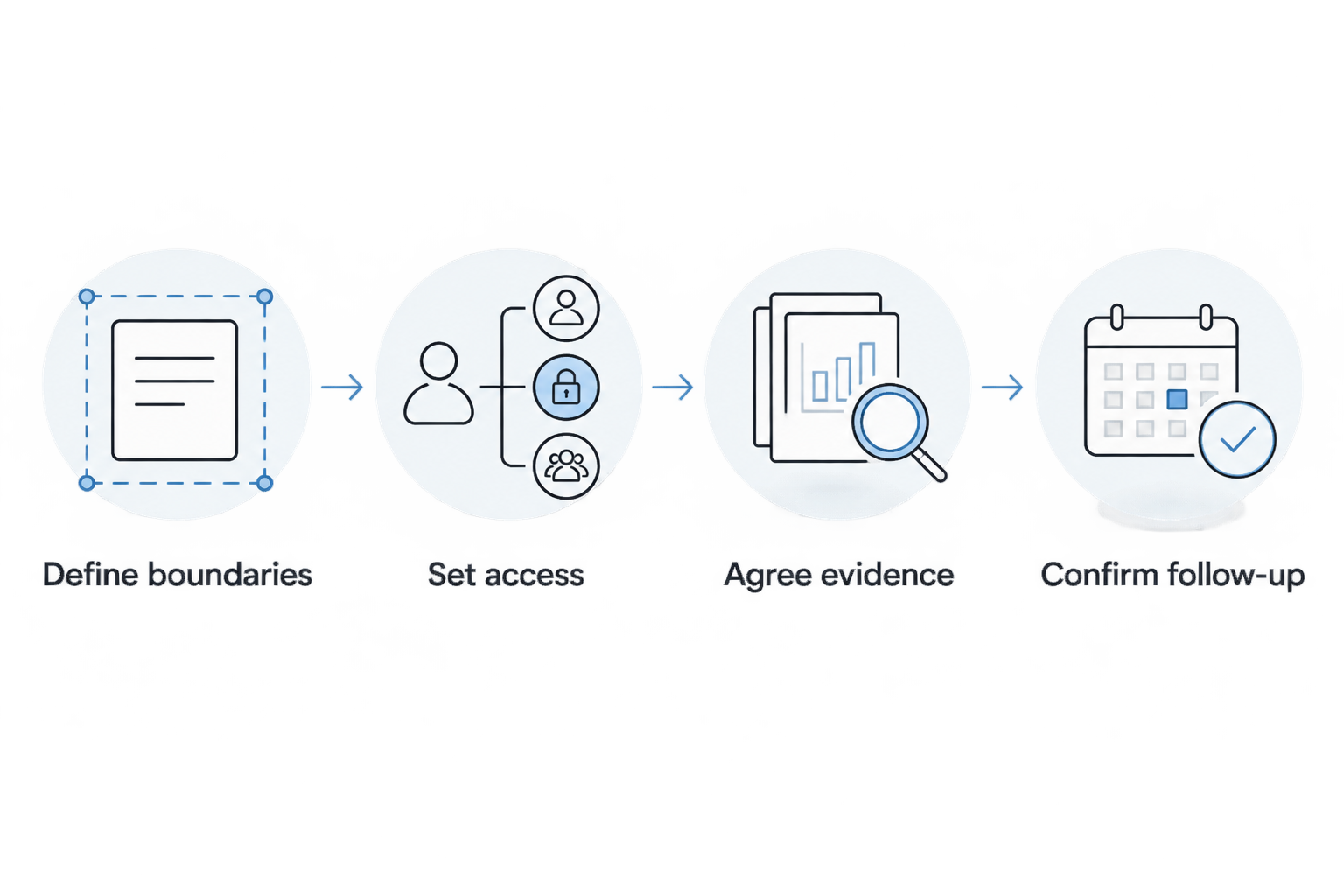
1. Define boundaries
List the cloud environments, applications, APIs and identity systems you want examined. Identify production and non-production assets, excluded systems and third-party dependencies.
Record ownership as well as technical location. A resource connected to your environment is not automatically yours to authorise for testing.
2. Set access
Describe the access you can provide and the starting position you want tested. Black-box testing starts with limited prior knowledge; authenticated testing examines what an authorised identity can reach or misuse.
Neither label guarantees broader coverage. Ask providers to map the chosen access model to your actual security questions.
3. Agree evidence
Specify what findings must contain: affected resources, reproduction details where safe, demonstrated impact, limitations and remediation guidance. Require the report to distinguish confirmed findings from unvalidated observations.
This is where report quality becomes a contractual deliverable rather than a sales promise. Define what your implementation team needs to act without repeatedly reconstructing the issue.
4. Confirm follow-up
Assign responsibility for triage, remediation and verification. Record how findings discussions work and whether retesting is included, optional or separately scoped.
Do not assume an unlimited support period or free retesting. The written agreement should settle those terms before approval.
A complete brief does not eliminate every difference between providers. It makes those differences visible, so you can decide whether they reflect useful testing depth or work you do not need.
How should you handle API testing in the budget?
Treat API testing as an explicit scope decision, not an assumed part of cloud testing. A cloud configuration review and an API penetration test examine different failure modes, even when the API runs in the same environment.
API work can include authorisation checks, authentication behaviour and attempts to access another user's resources. Cloud work can examine the permissions and infrastructure supporting that application. The engagement must explain where these activities meet and who owns each finding.
When comparing proposals across countries, the cost of API penetration testing must remain separate from assumptions about cloud coverage, currency and contracting terms. An API testing quote does not establish the budget for testing the surrounding cloud environment.
Ask providers to identify shared preparation work without removing necessary testing. Reusing architecture documentation is sensible; treating infrastructure checks as proof that application authorisation works is not.
What belongs outside the testing fee?
A testing engagement identifies and explains security issues; remediation changes the environment. Keep those responsibilities distinct so the report does not become an unplanned implementation project.
Your internal budget should account for access preparation, architecture discussions and availability during testing. Afterward, someone must evaluate findings, schedule changes, deploy fixes and gather verification evidence.
Use separate planning lines for:
- Internal preparation: Asset inventories, access approvals, test identities and operational contacts.
- Change implementation: Application fixes, permission changes and infrastructure updates.
- Verification: Checking whether the original issue is resolved without introducing an unacceptable operational consequence.
- Ongoing coverage: Deciding when material changes require additional testing rather than assuming the original report remains representative.
The workflow from penetration test findings to remediation should name an owner and acceptance criteria for each fix. A report delivered without that handoff leaves the implementation decision unresolved.
What should a 2026 cloud testing proposal prove?
A proposal cannot prove the environment is secure before testing begins. It can show whether the provider understands the assignment and commits to evidence your team can use.
Check for an explicit testing boundary, access model, rules of engagement and reporting specification. Require a process for handling a finding that needs immediate attention, including named communication routes and stop conditions.
Also examine exclusions. A proposal that clearly excludes social engineering, denial-of-service activity or third-party systems is easier to evaluate than one that leaves those boundaries unstated.
Cyberhunter cloud security testing discussions should centre on authorised scope, expert validation and practical remediation guidance. Ask how those requirements will appear in your statement of work; do not substitute a service description for engagement-specific commitments.
Define Your Testing Scope
Discuss testing boundaries, evidence requirements and remediation guidance before requesting a proposal.
Is cloud penetration testing the same as vulnerability scanning?
No. Vulnerability scanning uses automated checks to identify potential weaknesses; penetration testing investigates exploitable behaviour within an authorised scope. A scanner result is not equivalent to a demonstrated attack path.
Does cloud testing include fixing vulnerabilities?
Only when implementation work is expressly included. Require the agreement to distinguish remediation advice, hands-on changes and verification so your team knows who owns each action.
Should you choose the lowest quote?
Choose the proposal that meets your required coverage and evidence standard. A lower total is not a saving when it excludes the identity, application or validation work needed to answer your security question.
FAQ
How do I budget for cloud security testing in 2026?
Start with a scoped proposal that defines the environment, access model, testing activities and deliverables. Budget separately for internal preparation, remediation and any retesting not included in the agreement.
Is a cloud configuration review enough?
A configuration review is enough only when your objective is to evaluate settings against defined requirements. It does not replace penetration testing when you need evidence of exploitable attack paths.
Does cloud penetration testing include API testing?
API testing is included only when the agreed scope includes it. List the relevant APIs, access roles and authorisation scenarios rather than assuming cloud coverage extends to application behaviour.
Can testing cover a production cloud environment?
Production testing requires explicit authorisation and agreed safeguards. Define prohibited actions, communication routes and stop conditions before testing begins.
Does a cloud penetration test guarantee compliance?
A cloud penetration test does not guarantee compliance. Testing evidence can support an assessment, but compliance also depends on the applicable requirements and controls beyond the testing scope.
Is retesting automatically included?
Retesting is included only when the agreement says so. Confirm which findings qualify, what verification covers and how additional work is scoped.
What should I receive after cloud security testing?
Require a report with affected resources, validated evidence, business impact, testing limitations and practical remediation guidance. The report should distinguish confirmed findings from observations that were not validated.
One last thing
Ask every provider to state what its test will not establish. That question exposes the boundary between a configuration observation, a validated exploit and an untested assumption.
Before approving your 2026 engagement, make sure those boundaries appear in writing. A clear limitation is actionable; an implied promise is not.
Related guides
- Azure cloud security testing to compliance-ready workflow
- AWS cloud security testing to compliance-ready workflow
- How much does a vulnerability assessment cost?
