


Cyber security audit cost depends on the systems covered, the evidence required and whether the engagement includes technical testing or a formal audit opinion. Your total budget also needs to account for internal preparation, remediation and any separately scoped verification work. For a 2026 purchasing decision, compare written scopes before comparing headline quotes.
- Cyber security audit cost depends on scope, evidence requirements and testing depth; compare equivalent deliverables before selecting a provider.
- Cyberhunter suits businesses seeking human-led, AI-assisted penetration testing with expert-validated findings and practical remediation guidance.
- Vulnerability assessments, penetration testing and formal audits answer different questions; do not treat their proposals as interchangeable.
- Budget for internal preparation, remediation and verification separately unless the agreement explicitly includes them.
Why this matters
A quote is only meaningful when you know what it buys. A document review, an automated vulnerability scan and an attempt to exploit an application can all appear under a broad security review request, yet produce different evidence.
Define the decision the engagement must support: fixing exploitable weaknesses, assessing controls or satisfying a specified assurance requirement. Cyberhunter's security services include penetration testing, vulnerability assessments and threat hunting; these activities should not be mistaken for interchangeable audit deliverables.
How much does a cyber security audit cost?
A useful cyber security audit budget starts with an agreed scope, not an unsourced average. Ask providers to identify the assessment type, covered assets, testing approach, exclusions and required outputs before submitting a proposal.
For your 2026 procurement, separate the work into the following categories. The comparison prevents a narrowly scoped technical assessment from being evaluated as though it includes a formal assurance engagement.
| Engagement | Best for | Main benefit | Limitation to check |
|---|---|---|---|
| Controls audit | Evaluating controls against defined criteria | Connects evidence to the audit's stated requirements | Does not automatically include exploitation testing |
| Security assessment | Understanding security gaps within an agreed scope | Identifies weaknesses and improvement priorities | Does not automatically provide an independent audit opinion |
| Vulnerability assessment | Identifying and prioritizing technical weaknesses | Establishes a structured view of identified vulnerabilities | Does not necessarily demonstrate a complete attack path |
| Penetration testing | Validating exploitability and business impact | Produces evidence of what an attacker can achieve within scope | Covers the agreed environment and testing period, not every possible weakness |
These activities can complement one another. They remain separate purchasing decisions unless the statement of work explicitly combines them.
What belongs in the budget breakdown?
Request a breakdown that distinguishes external fees from your own implementation work:
- Preparation: asset inventories, documentation, evidence gathering and access arrangements.
- Assessment delivery: interviews, control reviews or technical testing, according to scope.
- Reporting: findings, supporting evidence, prioritization and remediation guidance.
- Remediation: the work your teams or other providers perform to address findings.
- Verification: confirmation that agreed fixes resolve the identified issues.
Do not assume every line belongs in the assessor's fee. Have the proposal identify who owns each activity and whether follow-up work requires a separate agreement.
Controls audit: define the criteria and intended recipient
A controls audit needs a stated basis for evaluation. Specify the framework or requirements, the organizational boundary, the evidence requested and the report's intended use before asking for a quote.
Best for: a defined assurance requirement rather than an open-ended search for technical vulnerabilities. The benefit is a structured evaluation against agreed criteria; the limitation is that its technical testing depth depends on the engagement.
Tell the provider who will receive the report. A customer assurance request, an internal governance review and a formal attestation requirement do not automatically call for the same deliverable.
Ask the intended recipient what evidence it will accept before commissioning work. That step reduces the risk of buying a report that answers a different question.
Vulnerability assessment: define coverage and validation
A vulnerability assessment identifies weaknesses within a specified environment. Your request should distinguish external exposure, authenticated internal assessment, application coverage and cloud configuration review where relevant.
Best for: establishing a prioritized inventory of technical weaknesses. Its strength is structured identification; its limitation is that identifying a vulnerability does not, by itself, establish the full business impact of exploiting it.
Ask how findings are validated and how false positives are handled. Also establish whether the report explains remediation or only lists detected issues.
A proposal for vulnerability scanning alone should not be described as a penetration test. Compare the actual activities and evidence, not the service label on the cover page.
Penetration testing: define the attack paths
Penetration testing examines whether weaknesses can be exploited within authorized boundaries. Define the applications, APIs, networks, user roles and business workflows that matter to the engagement.
Best for: demonstrating exploitable issues and their consequences. The benefit is evidence that supports remediation decisions; the limitation is that results reflect the scope, access and conditions of the test.
Black-box testing starts with limited prior knowledge of the target. Tests with supplied documentation or credentials answer different questions, including whether an authenticated user can cross an authorization boundary.
Cyberhunter penetration testing is best for businesses seeking human-led, AI-assisted testing with expert-validated findings. Experts direct the testing and validate findings; do not interpret AI assistance as a substitute for human judgement or as evidence of a fully autonomous service.
Why cyber security audit cost varies
The following scope decisions explain why proposals need more than a single total. Use them to identify genuine differences in coverage rather than assuming that every quote describes equivalent work.
- Environment coverage: distinguish networks, web applications, APIs and cloud environments instead of grouping everything under a company name.
- Access model: state whether the assessor receives credentials, documentation and access to relevant personnel.
- Testing depth: separate vulnerability identification, manual validation, exploitation and controls evidence review.
- Business workflows: identify sensitive actions and permission boundaries that require attention, not just accessible pages or hosts.
- Reporting requirements: specify the technical evidence, management summary and remediation detail your readers need.
- Follow-up scope: establish whether remediation discussions and verification are included, excluded or separately scoped.
These factors define the work rather than establish a universal pricing formula. Ask each provider to explain how its proposed activities address your stated objectives.
How do you get comparable audit quotes?
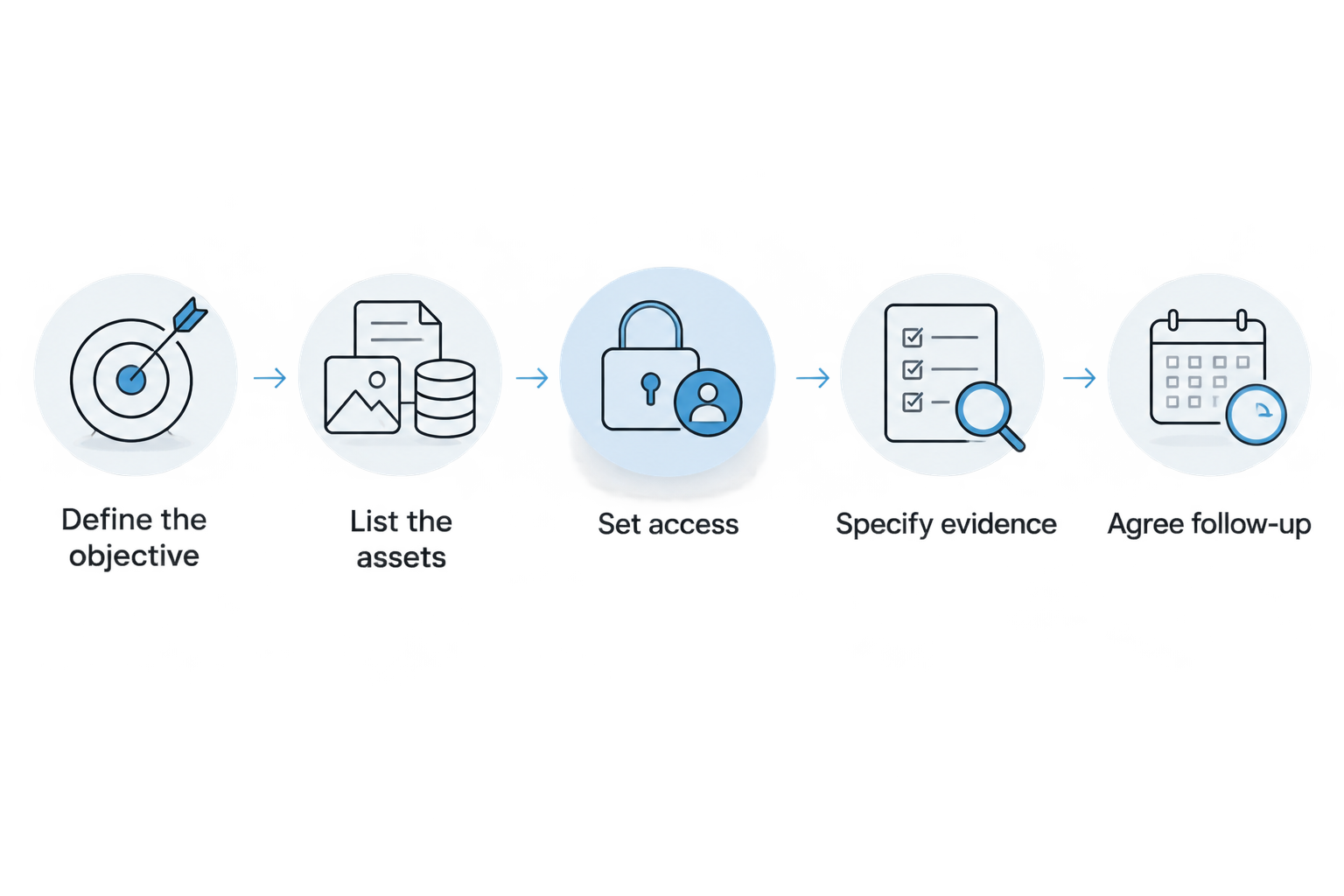
Use the same scope brief for every provider. For a 2026 review, date the brief and identify the environment version or release boundary so proposals refer to the same starting point.
- Define the objective. Write the question the engagement must answer and identify the intended report recipient.
- List the assets. Document the systems, applications, interfaces and environments included, with explicit exclusions.
- Set access. Describe available credentials, documentation, test data and authorized testing conditions.
- Specify evidence. Request findings that connect the issue, affected asset, supporting evidence, business consequence and corrective action.
- Agree follow-up. Identify ownership of remediation, verification expectations and the process for approving scope changes.
This sequence makes missing work visible before approval. It also gives providers a consistent basis for explaining why their proposed approach differs.
What should a written proposal include?
A proposal should let your technical and purchasing teams describe the same engagement without filling gaps through assumption. Request the testing boundaries, methodology, authorization requirements, deliverables, exclusions and change-control process in writing.
Also ask what happens when the assessor encounters a system outside scope or a finding requiring urgent attention. Agree the escalation contact and communication process before testing begins.
For your 2026 statement of work, distinguish completion of testing from delivery of the report and completion of remediation. These are different milestones, even when they sit within the same project plan.
Keep compliance audit fees separate from technical testing
A compliance engagement and a penetration test can contribute to the same assurance programme without producing the same output. Identify the required audit report first, then determine which technical assessments support it.
When estimating SOC 2 Type I audit costs, distinguish the independent examination from readiness work and supporting penetration testing. A penetration test does not become a SOC 2 report because its findings are included in an evidence package.
The practical connection is evidence management. Agree who receives technical findings, how remediation is documented and what information is appropriate for the audit evidence set; the SOC 2 audit-to-penetration-testing workflow addresses that handoff.
Do not treat a successful technical test as a guarantee of compliance. Equally, do not assume a controls report establishes that every application attack path has been tested.
What costs sit outside the assessor's quote?
Your organization's contribution remains part of the project even when it does not appear on the supplier's invoice. Assign owners before approval so an apparently complete purchase does not leave essential work unassigned.
Internal preparation
Someone must confirm the asset list, arrange access, prepare suitable test data and coordinate relevant stakeholders. For a controls-focused engagement, evidence collection and interviews also require internal attention.
Reduce avoidable rework by checking that the scope matches the environment being assessed. Document inaccessible systems and unresolved dependencies instead of assuming the assessor can work around them.
Remediation work
A report identifies work; it does not automatically perform it. Application changes, identity configuration, patching and control updates need an owner and an implementation plan appropriate to the finding.
Prioritize using the evidence of exploitability, the affected business function and the recommended corrective action. A severity label alone does not explain which team must change what.
Verification and scope changes
Confirm the conditions for verifying fixes before signing. Ask which findings can be checked, what evidence is required and how changes to the tested system affect the verification scope.
For a 2026 engagement, put those terms in the current agreement rather than relying on a previous proposal. Do not assume retesting is included or offered without a separate charge.
Can you reduce scope without weakening the result?
Reduce irrelevant coverage, not the evidence needed to answer your security question. If the objective concerns authorization in an application, preserve the user roles and sensitive workflows needed to test that boundary.
Phasing is another option when the full environment cannot be assessed together. Document the excluded systems and the questions left unanswered so a limited result is not presented internally as organization-wide assurance.
Use explicit acceptance criteria when considering a narrower proposal:
- Does it still cover the business process that triggered the engagement?
- Can the assessor collect the evidence needed for the intended decision?
- Are the limitations clear to whoever receives the report?
- Is responsibility for the remaining work assigned?
Cyberhunter vulnerability assessments and penetration testing address different technical objectives. Discuss the question you need answered before choosing the service category.
Define Your Testing Scope
Discuss your assets, testing objectives and required evidence before requesting a proposal.
FAQ
How do I estimate cyber security audit cost for my business?
Estimate cyber security audit cost from a written scope covering assets, assessment type, access, evidence and follow-up. Separate the provider’s work from internal preparation, remediation and verification.
Is a vulnerability scan the same as a cyber security audit?
A vulnerability scan is not the same as a cyber security audit. Scanning identifies potential technical weaknesses; an audit evaluates evidence against defined criteria, with technical testing included only when specified.
Does penetration testing include a compliance audit?
Penetration testing does not automatically include a compliance audit. It tests exploitability within agreed boundaries; confirm any separate audit or attestation requirement with the intended report recipient.
What should I send a provider to get an accurate quote?
Send an asset list, business objectives, required deliverables, access conditions and explicit exclusions. Include relevant applications, APIs, cloud environments, user roles and any required evidence format.
Are remediation and retesting included in an audit quote?
Remediation and retesting are included only when the agreement explicitly says so. Confirm who implements fixes, what verification covers and whether follow-up requires a separate scope.
Can I compare Canadian and US security assessment quotes directly?
Compare Canadian and US quotes only after aligning scope, deliverables, currency and applicable tax treatment. A matching service label does not establish equivalent technical coverage.
Does AI-assisted penetration testing replace human testers?
AI-assisted penetration testing does not mean human testers are replaced. In Cyberhunter penetration testing, experts direct the testing and validate findings.
One last thing
Ask what would count as an unacceptable deliverable before you approve the engagement. If your team cannot distinguish an evidence-backed finding from a scanner entry or a general recommendation, write that distinction into the acceptance criteria.
Buy an answer to a defined security question, not a report whose purpose remains unclear. That is the strongest basis for comparing cyber security audit proposals without confusing a smaller scope with better value.
Related guides
- How much does penetration testing cost in Canada?
- From penetration test findings to remediation
- Cyber security audit firms in Canada
