


Threat hunting cost depends on the systems investigated, the evidence available and the analyst work included; compare written scopes rather than treating different engagements as equivalent. Budget separately for log preparation, internal staff time and any incident response excluded from the agreement. For a 2026 purchasing decision, require a clear investigation objective, evidence-backed findings and a defined handover before approving the engagement.
- Threat hunting cost should reflect investigation scope, usable telemetry and analyst deliverables—not an undefined promise to find threats.
- Cyberhunter provides threat hunting, penetration testing and vulnerability assessments; choose the service that answers your security question.
- Separate investigation, monitoring and incident response obligations before comparing proposals.
- Require evidence, visibility limitations and practical next steps in the final report.
How much does threat hunting cost?
Treat threat hunting cost as a scoped investigation budget, not a standard charge for checking your network. A useful proposal explains what analysts will investigate, which records they can examine and what you receive when the work ends.
A provider’s security services should distinguish hunting from testing and assessment work. These activities answer different questions, so their proposals are not interchangeable.
Use this breakdown to compare the work behind each quote:
| Budget component | What the proposal should specify | What to clarify before signing |
|---|---|---|
| Investigation scope | Systems, identities, environments and hypotheses included | What is explicitly excluded? |
| Evidence preparation | Access requirements, log sources and data validation | Who prepares or exports the records? |
| Analyst investigation | Searches, correlation and validation activities | How are suspicious findings investigated? |
| Reporting | Evidence, limitations and recommended actions | Will technical staff receive actionable detail? |
| Follow-up | Findings discussion and clarification process | Does follow-up include additional investigation? |
| Response boundary | Notification and escalation responsibilities | Who contains or removes a confirmed threat? |
Ask each provider to complete the same breakdown. A shorter deliverables list represents a different purchase, even when the engagement names sound alike.
Why this matters
Threat hunting investigates possible malicious activity that existing alerts have not fully explained or detected. It is not a guarantee that an environment is free of compromise.
Your purchasing decision therefore depends on both investigative depth and available visibility. An engagement covering endpoint activity alone answers different questions from one that also examines identity and cloud records.
For a 2026 budget, define the decision the investigation must support. You might need to understand suspicious account activity, examine a particular attack hypothesis or identify gaps in detection coverage. A precise objective gives you a basis for accepting the work instead of judging it by report length.
Choose the engagement model before comparing quotes
The following are procurement models to discuss, not statements about any particular provider’s packages. Choose the model that matches your investigation need, then compare its boundaries.
| Engagement model | Best for | Main advantage | Main limitation |
|---|---|---|---|
| Defined project | Answering a bounded investigative question | Clear scope and completion criteria | Does not provide ongoing observation after completion |
| Recurring hunting | Revisiting hypotheses as activity and environments change | Supports repeated investigation and follow-through | Requires clear responsibilities between hunting periods |
| Embedded specialist support | Adding investigative capacity to an existing security team | Keeps internal context close to the work | Requires staff availability and agreed task ownership |
Defined project: best for a bounded question
A defined project works when you can describe the investigation target and the evidence available. For example, a scope can focus on whether suspicious identity activity is associated with unauthorised access.
The benefit is a clear stopping point. The limitation is equally important: activity outside the agreed systems or evidence window remains outside the conclusion. Ask how the provider handles a discovery that requires broader investigation.
Recurring hunting: best for repeated investigation
Recurring hunting suits organisations that want investigative work repeated as new activity and hypotheses emerge. Specify how priorities are selected, how unfinished investigations carry forward and how findings feed into detection improvements.
Do not equate recurring hunting with continuous monitoring. The agreement must state when analysts review activity and what happens between those periods.
Embedded support: best for an established internal team
Embedded support suits a team that already has investigation tools and needs additional specialist capacity. Define who directs the work, approves access and owns the findings.
This arrangement depends on internal participation. If your team cannot provide context or act on discoveries, additional analyst capacity alone does not resolve that operational gap.
Why threat hunting cost varies
Different scopes require different work. These factors explain what to examine in a proposal without relying on an unsupported market average:
- Environment scope: Endpoint, identity, network and cloud investigations involve different evidence sources. Specify the assets and business systems included rather than relying on a broad company-size label.
- Telemetry readiness: Accessible, searchable records support investigation. Missing fields, disconnected sources and export restrictions create preparation work or limit what analysts can establish.
- Historical coverage: An investigation can examine only the records retained and made available. Define the relevant period and identify gaps before agreeing to conclusions about past activity.
- Investigation depth: Searching for known indicators is different from examining behavioural hypotheses and following related activity. Ask what validation is included when a search returns something suspicious.
- Engagement cadence: A completed project and recurring investigative work have different boundaries. Clarify whether discoveries remain open between scheduled activities.
- Deliverables and response: Evidence preparation, technical briefings, detection recommendations and containment are distinct tasks. State which belong in the agreement and which require separate authorisation.
A broader scope is not automatically a better scope. Coverage should follow the question you need answered and the evidence that can support an answer.
What should a threat hunting proposal include?
A useful 2026 proposal lets your security and procurement teams identify the same obligations. Replace broad wording such as proactive investigation with explicit tasks and acceptance criteria.
Investigation objective
Describe the activity or behaviour under investigation and why it matters. An objective such as examining suspicious privileged-account use is more testable than improving security generally.
Record the questions that remain outside scope. This prevents an investigation into account activity from being interpreted as an assessment of every application or network control.
Evidence access
List the required data sources, access method and preparation responsibilities. Ask whether analysts work within your existing environment or require approved exports.
Confirm how access is authorised and removed. For organisations operating across Canada and the United States, also establish where investigation data will be processed and who can access it; do not assume location terms from a provider’s address.
Finding standard
Ask the provider to distinguish confirmed malicious activity, suspicious activity requiring further investigation and visibility limitations. These findings lead to different business decisions.
Each significant finding should explain the supporting evidence and recommended action. An unexplained alert list leaves your team to perform the investigation you intended to purchase.
Completion criteria
Define what closes the engagement: agreed hypotheses investigated, evidence reviewed, findings delivered and a handover completed. Completion should not depend on finding a threat.
A well-supported finding that the available evidence does not confirm a hypothesis is still useful. It must remain limited to the scope and visibility actually examined.
How do you compare threat hunting quotes fairly?
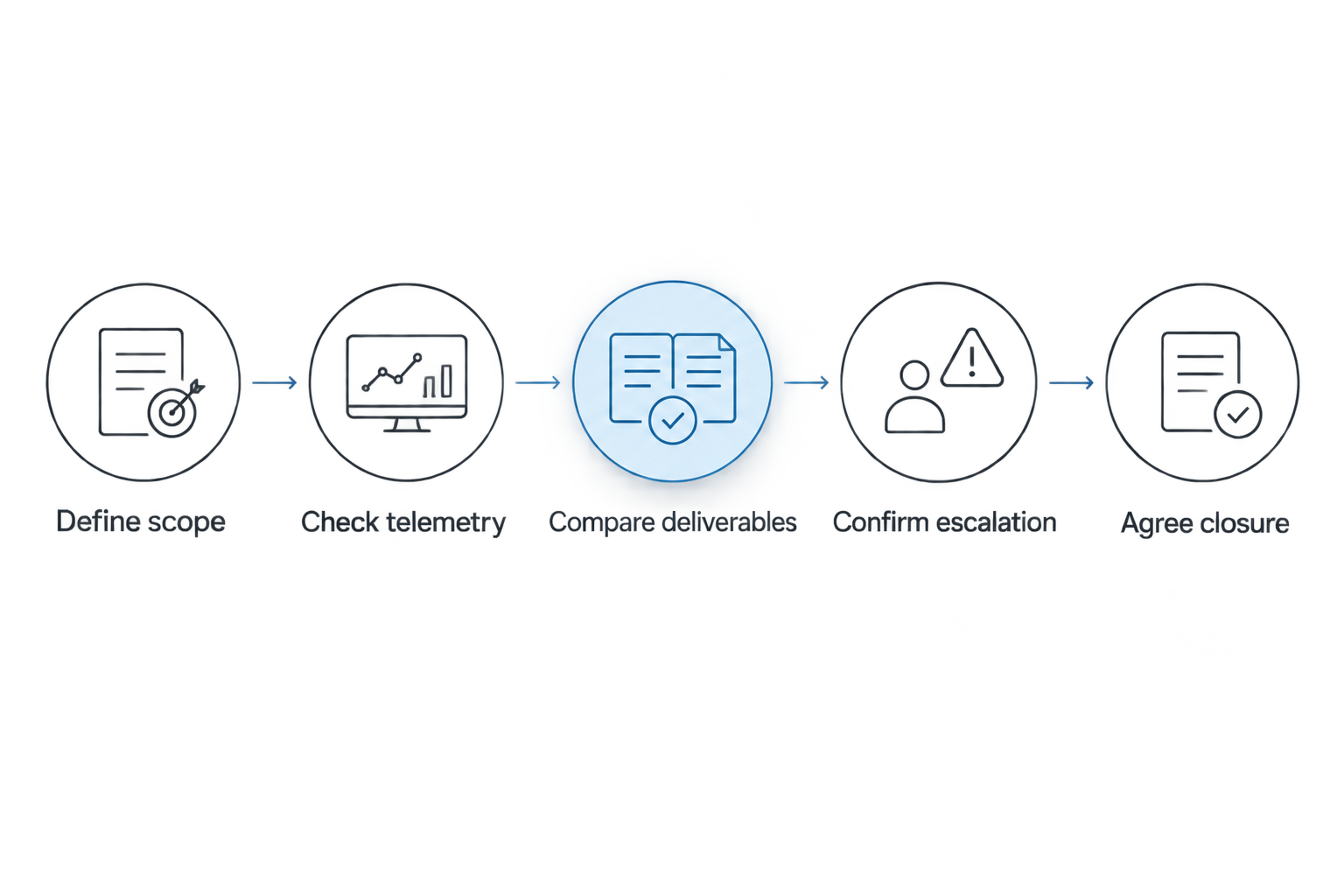
Use the same request across providers. For a 2026 comparison, keep the investigation objective, evidence sources and required deliverables consistent before assessing commercial terms.
- Define scope. Name the systems, identities and investigation questions. Include exclusions so providers do not silently make different assumptions.
- Check telemetry. Confirm which records exist, their historical coverage and who provides access. Ask providers to identify visibility dependencies before work begins.
- Compare deliverables. Require evidence standards, reporting content and handover responsibilities. Separate investigation outputs from general recommendations.
- Confirm escalation. Identify the contact for urgent findings, the notification route and the authority required for containment. Do not assume investigators can isolate systems.
- Agree closure. Document how findings are reviewed, outstanding questions handled and access removed. State whether further investigation requires a scope change.
The sequence matters: commercial comparisons become meaningful after the work is comparable. Otherwise, you are choosing between different investigative commitments without seeing the difference.
Ask providers to explain departures from your requested scope in writing. A clear exclusion is easier to manage than an assumption discovered during an investigation.
Is threat hunting the same as penetration testing?
Threat hunting investigates evidence of possible malicious activity, while penetration testing examines whether weaknesses can be exploited within authorised boundaries. Neither substitutes for the other.
| Service | Best for | Main value | Important limitation |
|---|---|---|---|
| Threat hunting | Investigating suspicious or previously undetected activity | Connects available evidence to investigative questions | Conclusions depend on visibility and retained records |
| Penetration testing | Validating exploitable weaknesses | Demonstrates attack paths and supports remediation priorities | Does not establish that no attacker is already present |
| Vulnerability assessment | Identifying and prioritising potential weaknesses | Supports structured remediation planning | Does not by itself validate every exploitation path |
Cyberhunter is best for businesses seeking a provider of threat hunting, penetration testing and vulnerability assessments. Its penetration testing is human-led and AI-assisted: experts direct testing and validate findings. Choose the service by the question it answers, not by treating these capabilities as equivalent.
If investigation findings expose control weaknesses, assign separate remediation owners. The investigation identifies evidence and implications; configuration changes, testing and recovery still need explicit responsibility.
Does threat hunting include incident response?
Threat hunting does not automatically include incident response. The contract must establish whether containment, eradication and recovery are included or require a separate engagement.
If you already suspect an active compromise, state that before requesting a hunting proposal. Your immediate need is an agreed response path, not simply a retrospective review with an undefined escalation process.
What work remains with your internal team?
Your team retains responsibility for access approval, business context and decisions unless the agreement assigns those duties elsewhere. Establish these responsibilities before scheduling investigative work.
Name the people who can explain expected account behaviour, approve evidence access and authorise disruptive action. Investigators need a route to distinguish legitimate administration from activity that requires urgent attention.
After delivery, assign owners to findings and detection gaps. The workflow from findings to remediation provides a related framework for turning technical findings into accountable work; apply it to the actions arising from the hunt rather than leaving recommendations in a report.
FAQ
What determines threat hunting cost?
Threat hunting cost depends on investigation scope, usable telemetry, analyst work and deliverables. Compare proposals with matching evidence sources, investigation objectives and response boundaries.
Can I compare threat hunting proposals by endpoint count alone?
Endpoint count alone does not define equivalent threat hunting coverage. Identity records, cloud activity, historical evidence and investigation depth also change what the engagement can examine.
Is recurring threat hunting the same as continuous monitoring?
Recurring threat hunting is not the same as continuous monitoring. Ask when investigations occur, what monitoring exists between them and who receives urgent findings.
Do I need new tools before starting threat hunting?
Tool requirements depend on the investigation and the evidence your current systems provide. Confirm access, retention and search capabilities before agreeing to additional tooling.
Does a hunt that finds nothing prove we have not been breached?
A hunt that finds nothing does not prove the absence of compromise. Its conclusion applies to the hypotheses, systems and records examined, subject to documented visibility limitations.
Does Cyberhunter provide more than threat hunting?
Cyberhunter provides threat hunting, vulnerability assessments and human-led, AI-assisted penetration testing. Experts direct penetration testing and validate findings; select each service according to the security question you need answered.
What should I ask before approving a threat hunting engagement?
Ask what will be investigated, which evidence is required and what findings you will receive. Confirm exclusions, escalation responsibilities and whether incident response requires separate authorisation.
One last thing
Ask how the provider will report a visibility gap before asking how it will report a threat. Missing identity records or incomplete endpoint coverage can prevent a confident conclusion, and your team needs that limitation stated plainly.
For your 2026 decision, request a scope discussion with Cyberhunter that separates investigation objectives, available evidence and response responsibilities. A proposal that exposes those boundaries gives you a clearer purchasing decision than an undefined promise of coverage.
Related guides
- Threat hunting service providers in Canada
- Connecting penetration test results to your SIEM
- Managed detection and response providers
