


Yes—penetration testing is worth it for a small business when it validates how an attacker could reach sensitive data, misuse accounts or interrupt an important service. Its value depends on a defined scope and your ability to fix the findings; buying a report without funding remediation leaves the underlying exposure in place.
- Is penetration testing worth it for small business? Yes, when validated findings lead to practical remediation.
- Cyberhunter provides human-led, AI-assisted penetration testing, with experts directing testing and validating findings.
- Use vulnerability assessments to identify weaknesses; use penetration testing to investigate exploitable paths within an agreed scope.
- Choose testing around business-critical systems, then assign remediation owners and confirm how fixes will be verified.
Is penetration testing worth it for small businesses?
Penetration testing is worth buying when you need evidence of exploitability—not just a list of possible weaknesses. For your 2026 security plan, start with the business question: can an unauthorised person access customer records, cross an account boundary or take control of a critical system?
Different security services answer different questions. Choose the activity that matches your decision rather than treating every security review as a penetration test.
| Activity | Best for | Main benefit | Limitation |
|---|---|---|---|
| Penetration testing | Validating attack paths against agreed targets | Demonstrates exploitable issues through controlled testing | Covers a defined scope and period, not every possible attack |
| Vulnerability scanning | Repeated checks for detectable weaknesses | Identifies potential issues across scanned assets | Does not establish the business impact of every finding |
| Security assessment | Reviewing controls, configuration and security practices | Identifies gaps beyond individual technical vulnerabilities | Does not necessarily include exploitation |
| Threat hunting | Investigating signs of attacker activity | Examines evidence for suspicious behaviour | Does not replace testing for weaknesses before exploitation |
A penetration test is not automatically the right first purchase. If you cannot identify your systems, owners or existing security controls, an assessment can help establish what needs attention before you commission deeper testing.
Why this matters
Small-business status does not determine whether a system deserves testing. The relevant issue is what that system permits: access to personal information, administrative functions, payment workflows or services your operations depend on.
A useful test connects a technical weakness to a business consequence. An access-control finding, for example, should explain which authorised boundary the tester crossed and what information or action became accessible. That gives the person responsible for the fix something concrete to address.
For a 2026 decision, separate assurance from prevention. A penetration test provides evidence about the tested environment; it does not guarantee that your business cannot be breached.
When penetration testing earns its place
Business-critical systems: validate a specific risk
Best for: systems where unauthorised access would affect customers or operations. A focused engagement can examine whether an external attacker or ordinary user can reach a sensitive function that should be restricted.
The benefit is depth around an important question. The trade-off is coverage: testing a customer portal does not establish the security of your employee devices, cloud administration or unrelated applications.
Name the process you need protected before naming the test. “Can one customer retrieve another customer's records?” is a clearer objective than “check our website security.”
New releases and significant changes: test changed boundaries
Best for: applications or infrastructure with newly introduced security boundaries. Changes to authentication, account permissions, APIs or cloud access can justify testing the affected paths before relying on them.
Testing a changed workflow gives you evidence about that workflow. It does not prove that every unchanged component remains secure, so agree whether surrounding systems need inclusion.
For a 2026 release plan, reserve time for developers or administrators to address findings. A test scheduled immediately before an immovable launch leaves little room to act on the results.
Customer assurance: establish the required evidence
Best for: a customer request that explicitly calls for penetration testing. Confirm the expected scope, timing and evidence before commissioning the engagement, including whether the customer needs a summary or a more detailed deliverable.
The advantage is a test shaped around a real assurance requirement. The limitation is that completing a penetration test does not automatically satisfy every contractual, insurance or compliance obligation.
Read the actual requirement. Do not assume that a scanner report, a security questionnaire and a penetration test are interchangeable.
When should you address the basics first?
Fix known, accessible weaknesses before paying someone to rediscover them. If you already know that an exposed system is unsupported or an administrative account lacks appropriate protection, assign corrective work rather than waiting for another report.
That does not make penetration testing unnecessary. It changes the objective: after initial remediation, testing can investigate whether the intended boundary holds and whether another route remains available.
An asset inventory also matters. If an application relies on an API or cloud component outside the proposed scope, discuss that dependency before accepting a narrow engagement. Otherwise, the test can answer a smaller question than your business intended.
Do not use suspected active compromise as a reason to commission an ordinary penetration test. Investigating an incident requires an appropriate response process, evidence handling and containment decisions; introducing authorised attack activity can complicate that investigation.
Why penetration testing value varies
The value of a penetration test depends on the question, the access provided and what happens after delivery. These factors should shape your brief:
- Scope relevance: Include the systems and workflows tied to the business consequence you need to understand. Unrelated coverage does not compensate for excluding the critical path.
- Testing access: Decide whether testers start without credentials, with ordinary user access or with additional technical context. Each starting point answers a different question.
- Validation depth: Require an explanation of how findings are checked and how exploitation is limited to authorised activity.
- Operational constraints: Agree on testing windows, prohibited actions, stop conditions and an escalation contact so the engagement fits your operations.
- Remediation ownership: Identify who can change application code, permissions or infrastructure. Findings need accountable owners, not just severity labels.
- Verification arrangements: Establish how corrected issues will be checked and what that work includes. Do not assume it is included in the original engagement.
For your 2026 buying decision, compare proposals against the same scope. A proposal with fewer targets or different access assumptions is not equivalent simply because both documents say penetration testing.
How do you turn testing into an actionable result?
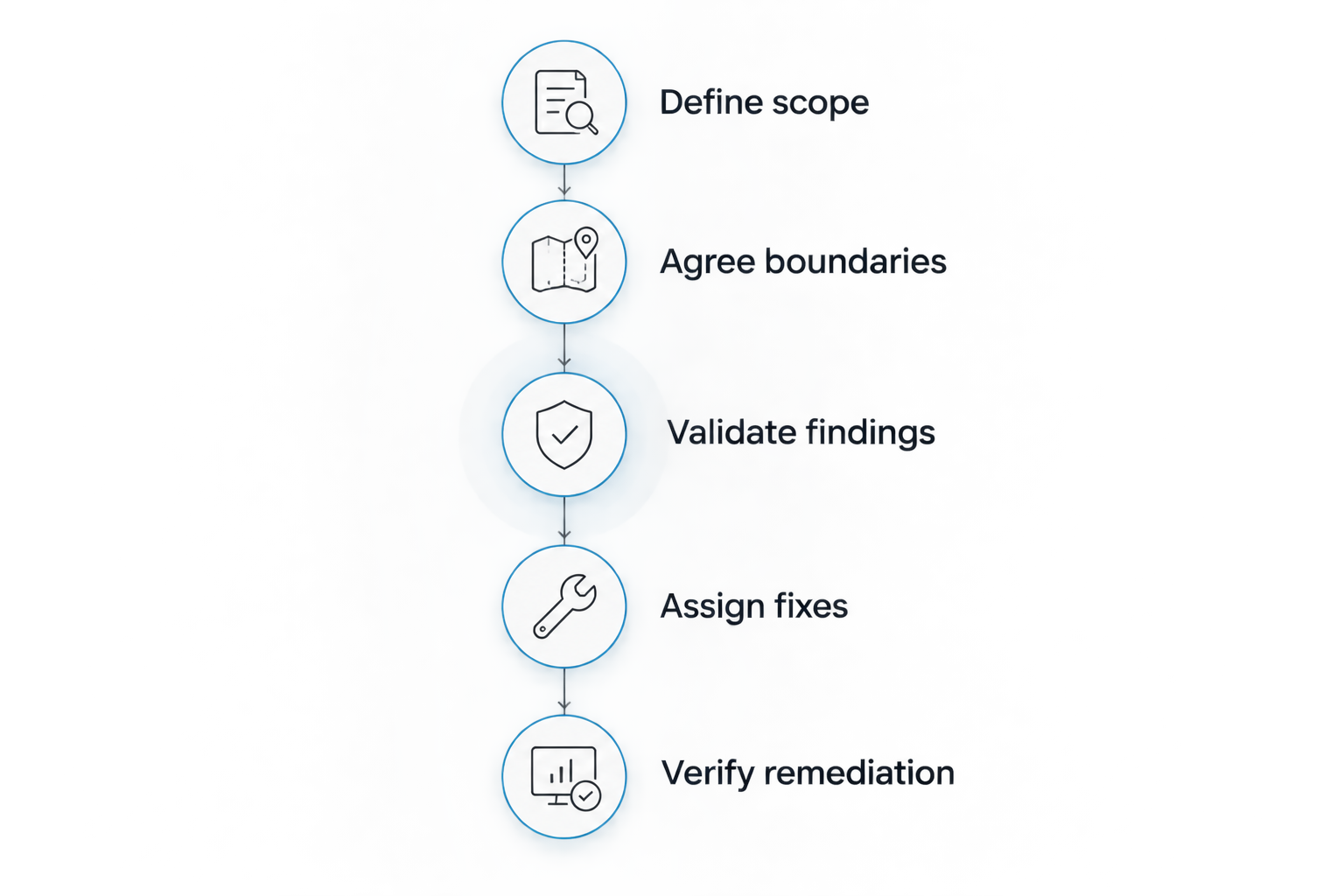
Use a defined sequence that starts before testing and continues after the report. The deliverable should support a decision, not merely document activity.
- Define scope. List authorised targets, business-critical workflows, exclusions and the systems you do not own. Obtain any required third-party permission before testing begins.
- Agree boundaries. Record permitted techniques, data-handling rules, operational restrictions and escalation contacts. Specify when testing must stop.
- Validate findings. Require evidence that explains the affected boundary, demonstrated access and limits of what the tester established.
- Assign fixes. Give each accepted finding an owner and a corrective action. Record any decision to defer work with its business rationale.
- Verify remediation. Check whether the original issue remains reproducible and document what was verified, including any limits on that conclusion.
A finding should distinguish observed evidence from possible consequences. If a tester demonstrated access to one protected record, the report should explain that evidence without claiming an untested, environment-wide compromise.
The penetration test remediation workflow connects those findings to corrective work. Keep the original evidence, the change made and the verification outcome together so the next reviewer can follow the decision.
What should a small business ask a testing provider?
Ask who directs the testing and who validates the findings. Tools can support discovery, but a proposal should explain how the engagement investigates business logic, account boundaries and the consequences of a weakness.
Cyberhunter penetration testing is best for businesses seeking human-led, AI-assisted testing with expert-validated findings and practical remediation guidance. Experts direct the testing; do not confuse that model with an unattended scan.
That approach still needs an agreed scope. No provider can infer every important workflow from a domain name, and an excluded system remains outside the assurance the engagement provides.
For an online store, evaluating penetration testing providers for online retailers should start with the workflows under examination: customer accounts, order access and administrative permissions. The question is whether a provider will test those boundaries within its authorisation, not simply whether it lists retail among the sectors it serves.
Ask for a clear description of:
- How the provider distinguishes automated discovery from expert validation.
- What access and documentation testers need from your team.
- How the provider protects evidence containing sensitive information.
- What happens if testing reveals an urgent issue.
- How the report explains reproducibility, business impact and corrective action.
- Whether remediation verification requires a separate agreement.
Avoid selecting on finding volume. A long list of unvalidated alerts is not a substitute for a clearly demonstrated issue that affects an important business process.
How can you judge whether the engagement was worthwhile?
Judge the outcome against the question you authorised. If the objective was to test separation between customer accounts, the report should describe which account boundaries were examined, what succeeded or failed, and what remained outside scope.
Useful evidence supports a decision: fix a weakness, investigate a broader exposure, accept a documented limitation or test an unresolved path. A report that leaves you unable to identify the next action has not translated technical work into operational value.
Do not calculate a return by inventing the breach that testing supposedly prevented. Instead, track tangible outcomes such as validated findings resolved, important boundaries examined and unresolved items with named owners.
A report with no exploitable findings also requires context. Review the scope, access, restrictions and coverage before treating the result as strong assurance. “Nothing found” is not the same statement as “nothing vulnerable exists.”
Can a vulnerability scan replace a penetration test?
A vulnerability scan cannot replace a penetration test when you need validated evidence of an attack path. Scanning helps identify detectable weaknesses, while penetration testing investigates exploitability within an authorised scope.
Use scanning for repeatable checks and testing for questions requiring deeper validation. Neither activity eliminates the need to apply fixes and review changes.
Does a small business need black-box testing?
Black-box testing fits a question about what a tester can discover without supplied internal knowledge or credentials. It is not automatically the most suitable approach for every small-business engagement.
If you need to examine access between customer accounts, authenticated testing is directly relevant. Choose the starting conditions that match the risk rather than assuming less information always produces a better test.
Should penetration testing happen every year?
An annual schedule alone does not establish the right testing frequency. Base the decision on applicable obligations, system exposure, meaningful changes and whether previous findings remain unresolved.
Your 2026 plan should identify testing triggers as well as calendar dates. A major access-control change deserves a scope discussion even if a previous engagement finished recently.
FAQ
Is penetration testing worth it for a very small business?
Penetration testing is worth it when a very small business needs validated evidence about a consequential security risk. Choose a focused scope around sensitive data, privileged access or an important service, and assign someone to address the findings.
What’s the difference between a vulnerability assessment and a penetration test?
A vulnerability assessment identifies and evaluates weaknesses, while a penetration test investigates exploitable paths within an agreed scope. Ask whether a proposal includes controlled exploitation and expert validation rather than assuming those activities are included.
Will a penetration test stop my business from being hacked?
A penetration test does not guarantee protection from a breach. It provides evidence about the tested environment so your team can address demonstrated weaknesses and understand coverage limits.
What should I prepare before a small-business penetration test?
Prepare an authorised asset list, business-critical workflows, testing restrictions and an escalation contact. Agree on accounts, permissions and evidence handling before testing starts.
Does Cyberhunter use human testers or only automated tools?
Cyberhunter provides human-led, AI-assisted penetration testing. Experts direct the testing and validate findings, with an emphasis on exploitable issues and practical remediation guidance.
Is remediation included with a penetration test?
Remediation responsibilities depend on the engagement agreement. Confirm who implements fixes, what guidance is provided and how verification will be arranged before approving the work.
Does passing a penetration test prove compliance?
A penetration test alone does not prove compliance. Match the test scope and evidence to the specific requirement, and address any other controls or documentation that requirement calls for.
One last thing
Write the decision you need the test to support before requesting a proposal. A question such as whether an ordinary user can access administrative functions gives both parties a clearer objective than a request to test everything.
Bring that question, your authorised targets and your remediation owner to a Cyberhunter discussion. The next move is to agree on a test you can act on—not simply obtain a report.
Define your testing scope
Discuss authorised targets, business-critical workflows and the findings your team needs to act on.
Related guides
- Cyber security companies for small businesses
- API penetration testing companies
- Cloud security for SaaS companies
