


Threat hunting is worth it with MDR when it investigates a defined threat hypothesis that your existing provider does not already cover. The extra work also requires usable security logs, investigation access and someone authorised to act on the findings; another provider cannot compensate for missing evidence. For your 2026 decision, buy a documented investigation outcome—not a second service with the same scope.
- Is threat hunting worth it with MDR? Yes, when a scoped investigation addresses a documented coverage gap.
- MDR labels do not establish hunting depth; request investigation records, data coverage and response responsibilities.
- CyberHunter provides threat hunting services; assess fit against the investigation your existing MDR agreement leaves uncovered.
- Prioritise incident response over a routine hunt when evidence indicates an active compromise.
Why this matters
Managed detection and response agreements differ in their data sources, investigative work and response authority. Buying additional threat hunting without checking those boundaries creates duplicate work while leaving the original gap unresolved.
Start with the question you need answered, then compare that requirement with the work already included. The security services you select should address that question rather than simply add another category to your supplier list.
For a 2026 service review, ask for evidence of what happens beyond alert handling. A statement that hunting is included does not explain which systems investigators search, what prompts a search or what findings you receive.
Is threat hunting worth it if you already have an MDR provider?
Additional threat hunting is justified when its scope, evidence or investigative question differs materially from your existing MDR coverage. It is not justified merely because the proposed supplier uses different terminology.
Use this comparison to choose the next action. These are service approaches, not claims about any particular provider's contract.
| Approach | Best for | Main benefit | Main limitation |
|---|---|---|---|
| Existing MDR coverage | Organisations whose included investigations answer the relevant threat questions | Keeps investigation and response within an established operating relationship | Value depends on the contracted scope and available evidence |
| Additional targeted hunt | Organisations with a specific, unanswered threat hypothesis | Directs investigation at a defined gap or concern | Adds coordination work and cannot recover logs that were never collected |
| Incident response | Organisations with evidence of an active or recent compromise | Organises investigation, containment and recovery around an incident | Does not replace ongoing monitoring or longer-term detection improvement |
Ask your MDR provider to demonstrate an investigation relevant to your concern. Request a sanitised example if sharing an actual case would expose sensitive information. Look for the question investigated, evidence examined, analytical reasoning and resulting action.
If the existing provider can perform the required investigation under the current agreement, use that capability before commissioning overlapping work. If the provider excludes the relevant environment or investigation, document that boundary in the additional scope.
Stay with existing MDR when the investigation is already covered
Best for: organisations whose MDR service can demonstrate the required investigation and response workflow. Keeping the work with the existing provider avoids creating another handoff for the same evidence.
Ask whether the provider investigates only after an alert or also searches for activity that has not triggered one. Neither a dashboard nor a count of closed alerts answers that question. Request an explanation tied to your environment.
Useful evidence includes:
- A clear investigation hypothesis and the reason it was selected.
- The systems, accounts and log sources examined.
- Search logic or an understandable account of the analytical method.
- Findings, limitations and recommended follow-up.
- A record of detection changes or operational actions, where applicable.
The limitation is contractual and operational: a capable team still cannot investigate systems outside its access or agreed scope. Use existing MDR when the relevant work is included and demonstrable; do not purchase duplication.
Add targeted threat hunting when a specific question remains unanswered
Best for: organisations with a defined investigation gap and sufficient evidence to examine it. Examples include determining whether suspicious identity activity extends beyond a flagged account, or investigating a threat technique across systems outside the MDR provider's coverage.
Write the hypothesis as a testable question. For example: has an attacker used a compromised account to establish persistence through unauthorised application access? That question identifies the behaviour to investigate without assuming a compromise has occurred.
The benefit is focus. Investigators can select relevant records and explain what supports or weakens the hypothesis, rather than presenting a general list of security concerns.
The limitation is visibility. An inconclusive investigation caused by missing authentication or application records is not evidence that the environment is clean. Commission targeted hunting only after agreeing on the question, evidence requirements and handoff.
Use incident response when the issue is already an incident
Best for: organisations with credible evidence of compromise that requires coordinated containment and investigation. A routine hunting engagement should not delay the process for handling an active incident.
Examples of escalation triggers include confirmed unauthorised access, malicious persistence or evidence of data theft. Your incident response plan should determine who assesses those findings and authorises action.
Incident response establishes decisions around containment, evidence preservation, recovery and communications. Threat hunting can support that work by searching for related activity, but it does not replace incident command.
The limitation is purpose: resolving an incident does not automatically improve every monitoring gap. Activate the incident response process when compromise is established, then assign longer-term detection improvements separately.
Why the value of threat hunting with MDR varies
Additional hunting creates value through the investigation it enables, not through the number of suppliers involved. Compare these factors before approving work:
- Existing scope: Check whether proactive investigation is included, separately commissioned or excluded. Ask what deliverables demonstrate that work.
- Data coverage: Identify which endpoint, identity, cloud, network and application records are actually accessible. A list of supported integrations does not prove your logs are being collected.
- Investigation depth: Establish whether analysts can follow activity across accounts and systems, rather than stop at an individual alert.
- Response authority: Name who can disable accounts, isolate systems or revoke access. Findings without an action owner create another handoff.
- Evidence quality: Confirm retention, timestamps and relevant event detail before defining the historical question. Missing records constrain the conclusion.
- Operational ownership: Assign responsibility for remediation, detection changes and unresolved questions. A report alone does not close an exposure.
For your 2026 review, separate contractual promises from observable delivery. Request relevant examples and explicit exclusions rather than treating a service name as proof of coverage.
How to scope a hunt that does not duplicate MDR
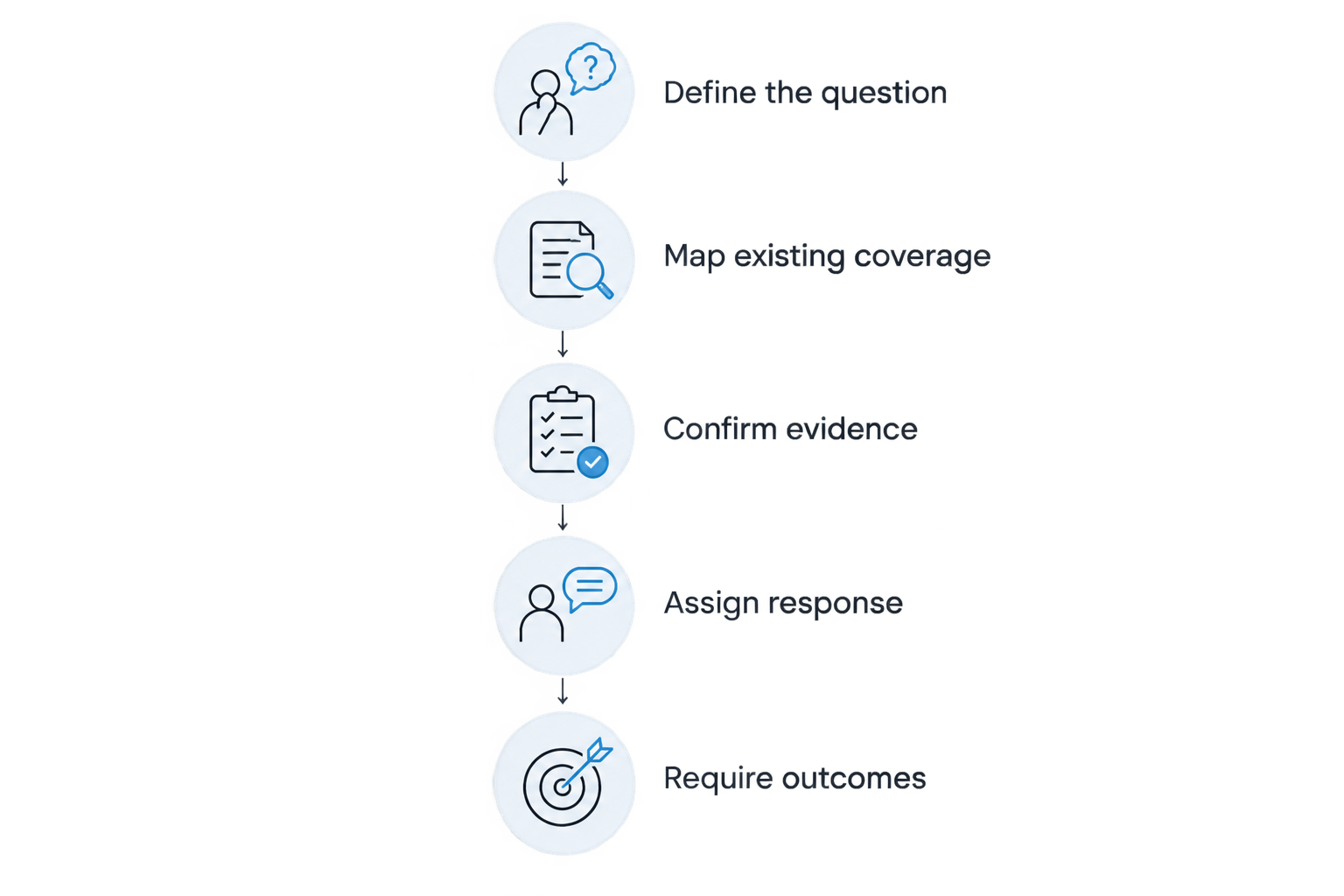
Use this sequence before authorising additional work. Each step should produce a decision or a written requirement that both providers can understand.
1. Define the question
Identify the behaviour, systems and business concern. Replace a broad request to check for hackers with a question investigators can test against available evidence.
For example, ask whether an unusual privileged sign-in was followed by changes that preserved access. Do not write the scope as though the suspected activity has already been confirmed.
2. Map existing coverage
Ask the MDR provider which parts of that question it already investigates. Record the covered systems, data sources, investigation boundaries and escalation process.
For a 2026 scope, confirm the present configuration rather than relying on an onboarding document. Changes to identity platforms, cloud accounts or applications can leave documentation out of step with actual collection.
3. Confirm evidence
Check that the required records exist, cover the relevant period and contain the necessary detail. Confirm access permissions and secure evidence-handling arrangements before investigation begins.
If the records are insufficient, decide whether the next move is prospective collection, a narrower investigation or a different assessment. Do not commission a historical conclusion the available evidence cannot support.
4. Assign response
Name the investigation contact, escalation contact and person authorised to approve containment. Agree on how urgent findings reach those people.
Specify how the additional investigators and MDR provider will exchange evidence. This avoids conflicting actions and makes it clear who follows an observation through to resolution.
5. Require outcomes
Request evidence-backed findings, investigation limitations and practical remediation guidance. A negative result should explain what was searched and what the evidence could not establish.
Agree on who evaluates proposed detection changes and confirms remediation. The investigation should leave an accountable next action, even when the original hypothesis is not supported.
The sequence connects the business question to evidence and action. Skipping the coverage check risks duplication; skipping the response assignment risks leaving useful findings unresolved.
What should the final hunting report prove?
A useful report distinguishes observations from conclusions. It explains why the evidence supports a finding and identifies alternative explanations or visibility limitations that remain unresolved.
Ask for affected systems and accounts, relevant timestamps, supporting events and the reasoning that connects them. Sensitive evidence should be handled through agreed channels rather than copied indiscriminately into a broadly distributed report.
Require separate treatment of confirmed malicious activity, suspicious activity requiring follow-up and security weaknesses observed during investigation. These categories call for different actions; combining them under one severity label obscures the decision.
For negative findings, insist on bounded language. No evidence of the investigated behaviour in the reviewed records is a defensible conclusion. No attackers are present is not supported by a limited hunt.
Does MDR already include threat hunting?
MDR includes threat hunting only where the agreement and actual delivery provide it. Ask how investigations are selected, which records are searched and what evidence you receive; the label alone does not establish those details.
Is threat hunting the same as penetration testing?
Threat hunting searches available evidence for adversary activity, while penetration testing uses authorised testing to identify and validate exploitable weaknesses. Vulnerability scanning identifies potential weaknesses; it does not, by itself, establish an attack path or prove that an intruder is present.
CyberHunter provides threat hunting alongside human-led, AI-assisted penetration testing, with experts directing testing and validating findings. Choose the service according to the question: suspected activity requires investigation, while exploitable exposure requires testing.
When is an additional provider the right next step?
An additional provider is appropriate when a documented gap requires work your existing agreement does not deliver. Independence alone is not a substitute for relevant access, a testable hypothesis and clear responsibilities.
CyberHunter threat hunting is best suited to businesses seeking investigation of suspected adversary activity, rather than proof of exploitable weaknesses. The engagement still needs sufficient evidence and a scope that distinguishes it from existing MDR work.
Define Your Threat Hunting Scope
Discuss the investigation question, existing MDR coverage and evidence needed for the next step.
FAQ
Is threat hunting worth it with MDR?
Threat hunting is worth it with MDR when a defined investigation addresses a gap in existing coverage. Confirm the hypothesis, available evidence and response owner before commissioning additional work.
How do I know whether my MDR provider actually hunts threats?
Ask for an investigation example showing the hypothesis, records searched, analytical reasoning and outcome. An alert dashboard alone does not demonstrate proactive hunting.
Should I replace MDR with a threat hunting service?
A targeted threat hunting engagement is not a replacement for ongoing detection and response. Define the monitoring and response responsibilities that must remain in place before changing services.
Can threat hunters investigate without endpoint data?
A hunt can use identity, cloud, network or application records when those records support the investigation question. Missing endpoint evidence limits conclusions about activity that is not visible in those other sources.
Will a threat hunt prove that nobody has breached us?
A threat hunt cannot prove the absence of compromise across an entire environment. Its conclusions are limited by the hypothesis, systems, period and evidence examined.
What should happen if threat hunting finds an active attacker?
Confirmed attacker activity should enter your incident response process. Investigators should preserve relevant evidence and escalate through the agreed contacts so authorised responders can make containment decisions.
Can CyberHunter investigate threats and test vulnerabilities?
CyberHunter offers threat hunting, vulnerability assessments and human-led, AI-assisted penetration testing. Select the scope according to whether you need to investigate activity or assess and validate weaknesses.
One last thing
The most useful question for your 2026 supplier review is not whether hunting is included. Ask what unanswered threat question the next investigation will resolve, and what decision its evidence will support.
If nobody can state that question, refine the scope before adding another provider. If the question is clear but the required records do not exist, fix collection first. Buying investigative expertise does not recreate evidence that was never recorded.
Related guides
- Best managed detection and response providers
- Best threat hunting service providers in Canada
- How to connect penetration test results to your SIEM
