


Yes—a cyber security audit is worth it for startups when it answers a specific question about customer data, access controls, contractual requirements or readiness for independent testing. Budget for remediation and verification as well as the review itself: a report does not fix the weaknesses it identifies.
- Is a cyber security audit worth it for startups? Yes, when findings lead to owned, verifiable fixes.
- Choose a security audit for control evidence; choose penetration testing to investigate exploitable weaknesses.
- Cyberhunter suits startups seeking human-led, AI-assisted penetration testing with expert-validated findings.
- Define scope, required evidence and remediation responsibilities before commissioning security work.
Why this matters
A startup needs security work that changes a decision: whether to launch, grant access, accept a risk or demonstrate a control to a customer. An engagement without that decision can produce a detailed report without a useful next move.
For your 2026 security plan, separate the external review from the work your team must do afterwards. The guide to cyber security audit costs provides a starting point for that budgeting discussion. Approve a defined outcome, not just a document.
Is a cyber security audit worth it for startups?
A cyber security audit is worth it when the scope matches a real business obligation or an unresolved control question. It is less useful when the review repeats known findings, excludes critical systems or leaves nobody responsible for remediation.
Use the following comparison to decide whether an audit belongs next in your plan. These are decision criteria, not promises about an engagement's results.
| Startup situation | Best for | Value of an audit | Limitation or next move |
|---|---|---|---|
| A customer requests evidence of security controls | Documenting control implementation | Organizes evidence against defined requirements | Confirm the customer accepts the proposed evidence |
| Ownership of access and security controls is unclear | Establishing accountability | Identifies gaps between policy and practice | Assign owners before the report becomes another backlog |
| A customer-facing application handles sensitive data | Reviewing controls around sensitive workflows | Examines how access, changes and responsibilities are managed | Add penetration testing if exploitability is the unanswered question |
| The team already has unresolved findings | Checking remediation progress | Tests whether corrective actions addressed the original issue | Avoid commissioning the same broad review without fixing known gaps |
| A pre-launch product is changing substantially | Reviewing readiness at a defined milestone | Assesses the agreed environment at that point | Findings do not describe changes made after the review |
An audit does not guarantee breach prevention or compliance. Its value comes from the evidence examined, the criteria used and the action taken afterwards.
Choose the assessment that answers your question
The word audit is often used loosely in purchasing conversations. Put the actual objective in the statement of work so that a control review, vulnerability assessment and penetration test do not become interchangeable deliverables.
| Engagement | Best for | What it examines | Main limitation |
|---|---|---|---|
| Security audit | Evaluating controls against defined criteria | Policies, records, configurations and operating evidence within scope | Does not automatically demonstrate exploitation |
| Vulnerability assessment | Identifying and prioritizing technical weaknesses | Systems and configurations for known weaknesses and exposures | Does not necessarily establish a working attack path |
| Penetration testing | Investigating whether weaknesses are exploitable | Authorized attack scenarios within agreed boundaries | Covers the tested scope, conditions and time period |
| Threat hunting | Investigating signs of an existing threat | Available telemetry and evidence of suspicious activity | Depends on the evidence available; it is not a control audit |
Security audit: best for control evidence
Choose a security audit when you need to know whether defined controls exist and operate as intended. For example, an access review should examine evidence of how access is approved, changed and removed—not simply whether an access policy exists.
The trade-off is scope. A well-documented control can still leave technical weaknesses that require separate investigation.
Vulnerability assessment: best for identifying weaknesses
Choose a vulnerability assessment when your immediate question is which technical weaknesses need attention. Vulnerability scanning can contribute to that work, but scanner output alone does not establish business impact or prove that a weakness is exploitable.
Ask how findings are reviewed and prioritized. A list without context leaves your team to determine what matters and what is a false positive.
Penetration testing: best for exploitation evidence
Choose penetration testing when you need evidence about what an attacker could accomplish within an authorized scope. Define the applications, interfaces, access levels and prohibited actions before testing begins.
Cyberhunter provides human-led, AI-assisted penetration testing: experts direct testing and validate findings, with evidence of exploitable issues and practical remediation guidance. Its security services are relevant when technical validation is the next step, rather than a substitute for an audit against defined control criteria.
Threat hunting: best for investigating suspicious activity
Choose threat hunting when the question concerns activity already present in your environment. An audit can review whether logging controls exist; threat hunting investigates available evidence for indications of a threat.
Do not treat a clean audit report as proof that no compromise exists. The questions and investigative methods differ.
Why the value of a startup security audit varies
For a 2026 engagement, judge value against your current environment and obligations—not a generic package name. These factors determine whether the work produces evidence your team can use:
- Decision clarity. Identify what the findings must help you approve, change or demonstrate. A vague objective makes scope disputes harder to resolve.
- System boundaries. State which applications, cloud environments, identities and third-party connections are included. Excluded systems remain outside the conclusion.
- Evidence depth. Specify whether reviewers will examine documents, configurations, operating records or technical test results. These answer different questions.
- Access conditions. Agree on the accounts and permissions available to reviewers. Black-box testing, performed without internal knowledge or credentials, does not provide the same view as authenticated testing.
- Remediation ownership. Give findings to people authorized to change the affected systems. External advice cannot replace internal responsibility.
- Verification requirements. Decide how fixes will be checked and what evidence will support closure. Do not assume follow-up testing is included.
A narrowly scoped engagement that resolves an important uncertainty is more useful than a broad engagement whose findings cannot be acted on. Narrow scope still needs an explicit record of what was excluded.
How to make an audit worth the effort
Use these 5 steps to connect the review to a practical outcome. Each step should leave a record that your team and the reviewer can refer to.
1. Define the decision
Write the question before requesting proposals. Examples include whether administrative access is controlled appropriately or whether a customer's stated security requirements have supporting evidence.
If your question is whether an application permits unauthorized access to another customer's records, ask for technical testing of that behaviour. Do not assume a general audit includes it.
2. Bound the scope
List the systems, environments, data flows and responsible parties. Include exclusions and identify dependencies managed by outside providers.
Your 2026 scope should describe the environment that will actually be reviewed. If a migration or major release changes that environment, agree on how the engagement will handle the change.
3. Agree on evidence
Specify what the final report must contain before work begins. Ask for findings tied to observed evidence, affected assets, business consequences and corrective actions.
Also establish how sensitive evidence will be handled. Reports and supporting material can reveal weaknesses, configurations or access details that need protection.
4. Assign remediation
Give each accepted finding an owner and a corrective action. Prioritize using the affected system, exposure, access requirements and business impact—not the severity label alone.
Record accepted risks separately from completed fixes. Accepting an issue is a management decision; it is not evidence that the weakness has disappeared.
5. Verify closure
Define what will demonstrate that the corrective action worked. Depending on the finding, that evidence might be a configuration check, an operating record or an authorized technical retest.
Confirm the scope and terms of follow-up work in writing. Do not assume retesting, repeated reviews or additional environments are included.
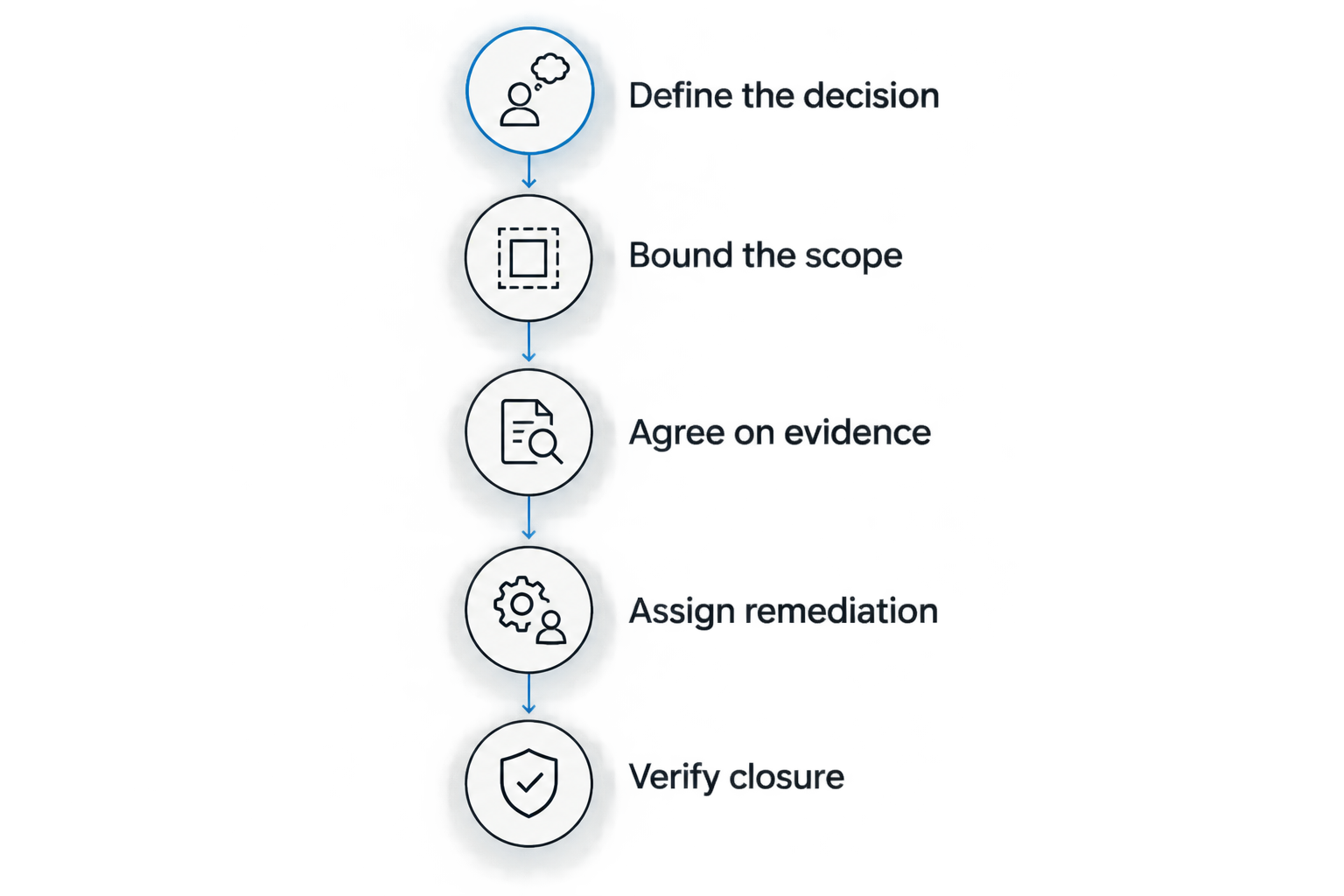
The process ends with a supported closure decision, not delivery of the report. Keep the evidence with the finding so a later reviewer can understand what changed and why the issue was closed.
What should you receive from the engagement?
Ask for 3 deliverables: a decision-ready summary, an evidence-backed findings record and a remediation plan. Together, they should let business leaders understand exposure and technical owners act without guessing.
- Decision-ready summary: the objective, scope, exclusions and material conclusions in business language.
- Evidence-backed findings record: the affected assets, observed conditions, supporting evidence and rationale for prioritization. Technical exploitation evidence belongs here when penetration testing is included.
- Remediation plan: recommended changes, internal owners, dependencies and an agreed method for verifying closure.
For your 2026 evidence file, retain the engagement date and the environment reviewed. A report about a previous configuration is not evidence that a changed environment has the same controls.
Ask prospective providers to explain their methodology and show a suitably redacted sample report. Evaluate whether an engineer could act on a finding and whether a business owner could understand its consequence.
Define Your Testing Scope
Discuss the systems, evidence and remediation guidance your startup needs.
Should a startup audit before its first enterprise customer?
Start with the customer's actual requirements before commissioning work. A security questionnaire, a penetration test report and a formal assurance report are different requests; supplying one does not automatically satisfy another.
Ask what evidence is acceptable, which systems it must cover and whether there are requirements for the reviewer. Then commission the engagement that answers that request without leaving your own material risks unexamined.
Can a startup use a vulnerability scan instead of an audit?
A vulnerability scan is not a substitute for an audit of control design and operation. It can identify certain technical weaknesses, but it does not establish whether access approvals, incident procedures or change controls operate as required.
Use scanning for the questions it answers. Add control review or penetration testing when the unresolved question requires different evidence.
When should a startup repeat a security audit?
Set the review schedule around applicable obligations, agreed control-review periods and meaningful changes to the environment. A launch, acquisition, major access-model change or cloud migration should prompt a scope review rather than an automatic assumption that the previous report still applies.
For a 2026 review, distinguish 2 decisions: whether to repeat the control audit and whether changed technical components need testing. Those decisions can lead to different engagements.
FAQ
Is a cyber security audit worth it for a startup with no customers yet?
Yes, when the audit resolves a specific readiness or control question before launch. Keep the scope tied to the systems and data you will operate, and consider whether technical testing better answers the immediate question.
What’s the difference between a security audit and penetration testing?
A security audit evaluates controls against defined criteria, while penetration testing investigates exploitable weaknesses within an authorized scope. Neither automatically replaces the other.
Does a cyber security audit make a startup compliant?
A cyber security audit does not automatically make a startup compliant. Its conclusions depend on the criteria, scope and evidence examined, and identified gaps still require action.
Can our developers perform the security review themselves?
Your developers can review configurations, address known weaknesses and collect control evidence. When a customer or assurance requirement calls for independent review, confirm its independence criteria before relying on internal work.
What should we ask a security provider before signing?
Ask about scope, methodology, reviewer responsibilities, evidence handling, deliverables and follow-up terms. For penetration testing, also agree on authorization, testing boundaries and escalation procedures.
Is Cyberhunter’s penetration testing fully automated?
Cyberhunter’s penetration testing is human-led and AI-assisted. Experts direct the testing and validate findings, with emphasis on evidence of exploitable issues and practical remediation guidance.
Should we fix known vulnerabilities before commissioning an audit?
Address known, actionable weaknesses rather than waiting for an external report to repeat them. Record the changes and retain verification evidence so the reviewer can evaluate the resulting controls.
One last thing
Before you approve the engagement, write a sample closure requirement: the affected owner must show what changed and provide evidence that the original issue was addressed. If nobody can describe acceptable closure, refine the scope first.
Cyberhunter's focus on validated findings and practical remediation reflects the right purchasing test: commission security work your team can act on, then verify the result.
Related guides
- Cloud security for SaaS companies
- From penetration test findings to remediation
- SOC 2 audit to penetration testing workflow
