


Best for human-led validation: Cyberhunter. Best for threat detection: Amazon GuardDuty. Best for posture checks: AWS Security Hub CSPM. This 2026 guide compares AWS security services by the problem they solve, separating expert-led testing from AWS-native monitoring and assessment tools.
- Cyberhunter is the best fit for businesses seeking human-led penetration testing with expert-validated findings; confirm AWS scope before engagement.
- Amazon GuardDuty supports threat detection; AWS Security Hub CSPM supports security posture management.
- Amazon Inspector identifies supported workload vulnerabilities; Amazon Macie discovers sensitive data in Amazon S3.
- Choose AWS security services by testing scope, evidence quality, remediation ownership and operational responsibilities.
Why this matters
A penetration testing provider and an AWS-native security service do different jobs. Buying one does not automatically cover the other: a configuration finding, a suspicious activity alert and a demonstrated attack path answer different business questions.
For your 2026 shortlist, separate human validation, continuous detection and configuration assessment. You need to know whether a weakness exists, whether someone can exploit it and whether your team can recognize relevant activity. No single option below answers every question.
This comparison includes an independent service provider and services delivered by AWS. It is a decision guide, not a claim that these options are interchangeable or a ranking based on measured detection performance.
What makes the best AWS security services
Evaluate the work you need before comparing names. Use these criteria to judge proposals and service configurations:
- Scope fit: Identify the accounts, regions, applications, identities and data stores the engagement or service covers.
- Evidence quality: Separate suspected weaknesses from validated exploitation, configuration checks and observed activity.
- Human accountability: Establish who investigates findings, approves testing and accepts residual risk.
- Remediation usefulness: Require enough context for the responsible team to fix the affected resource or application.
- Operational fit: Check permissions, data sources, integrations and the effort required to maintain coverage.
- Coverage boundaries: Record exclusions, unsupported resources and responsibilities that remain with your team.
For a 2026 evaluation, ask vendors to demonstrate the deliverable you will receive. A sample finding reveals more than a broad claim about cloud expertise: it shows whether your engineers receive an affected asset, supporting evidence and a practical next action.
AWS security services at a glance
| Rank | Option | Best for | Standout capability | Key limitation |
|---|---|---|---|---|
| 1 | Cyberhunter | Human-led validation | Experts direct penetration testing and validate findings | Confirm AWS-specific scope and access requirements before engagement |
| 2 | Amazon GuardDuty | Threat detection | Analyses supported AWS data sources for suspicious activity | Findings require investigation and response ownership |
| 3 | AWS Security Hub CSPM | Security posture management | Evaluates supported resources against security controls | Configuration checks do not demonstrate application exploitability |
| 4 | Amazon Inspector | Workload vulnerability identification | Identifies vulnerabilities across supported workload types | Does not replace business-logic or authorization testing |
| 5 | Amazon Macie | Sensitive-data discovery | Discovers sensitive data in supported Amazon S3 objects | Is not a general-purpose cloud penetration test |
Read the limitation column first. Your choice should address an identified gap, not add another console that reports issues nobody owns.
1. Cyberhunter: best for human-led penetration testing
Cyberhunter provides human-led, AI-assisted penetration testing, vulnerability assessments and cyber threat hunting. Experts direct testing and validate findings, with emphasis on evidence of exploitable issues and practical remediation guidance.
Best for: Businesses that need expert validation rather than an unreviewed list of scanner results. For an AWS engagement, establish the agreed cloud, application and identity boundaries before authorizing work; a general penetration testing description does not define those boundaries.
Cyberhunter pros:
- Experts direct the testing and validate findings.
- The service emphasizes evidence of exploitable issues.
- Remediation guidance supports action after assessment.
Limitations:
- AWS account coverage, testing methods and exclusions must be agreed in scope.
- An assessment does not replace ongoing cloud monitoring.
Ask whether the proposed engagement examines externally accessible services, authenticated application behaviour or cloud permissions. Treat each as a separate scope question, not an assumed inclusion. Also establish how sensitive evidence will be handled and who receives urgent findings during testing.
Verdict: Buy human-led testing when your decision depends on validated weaknesses, after confirming the AWS scope.
2. Amazon GuardDuty: best for AWS threat detection
Amazon GuardDuty is an AWS threat detection service that analyses supported data sources for suspicious or malicious activity. Its role is to surface activity that warrants investigation, rather than prove that every reachable application resists attack.
Best for: Teams that need AWS-native threat detection and have an assigned process for investigating findings. Evaluate the relevant protection features, account coverage and regional configuration for your environment.
Amazon GuardDuty pros:
- Focuses on suspicious activity rather than configuration checks alone.
- Provides findings with context for investigation.
- Supports an AWS-native detection workflow.
Amazon GuardDuty cons:
- Findings do not resolve incidents without investigation and response.
- Coverage depends on the enabled capabilities and supported resources.
Before enabling alert routing, decide which team receives findings and what action that team can authorize. An alert sent to a shared inbox is not an incident response process. Include escalation contacts, evidence preservation and containment decisions in the operating procedure.
Verdict: Buy for threat detection when someone owns investigation; skip it as a substitute for penetration testing.
3. AWS Security Hub CSPM: best for security posture checks
AWS Security Hub CSPM evaluates supported AWS resources against security controls and presents posture findings. It helps you identify configuration issues and organize the work needed to address them.
Best for: Teams that need a repeatable view of security configuration across their AWS environment. This is the posture-management choice, not the option for demonstrating how an attacker would exploit an application's business logic.
AWS Security Hub CSPM pros:
- Makes supported control checks repeatable.
- Organizes posture findings for review and remediation.
- Helps teams track configuration issues across the accounts they configure for coverage.
AWS Security Hub CSPM cons:
- Passing checks does not prove an application is secure.
- Findings need context, ownership and exception handling.
For a 2026 rollout, agree how your team handles justified exceptions. A control failure needs investigation, but the response should reflect the resource's purpose and exposure. Document the decision rather than repeatedly dismissing the same finding without explanation.
Verdict: Buy for configuration governance; skip it as evidence that application attack paths have been tested.
4. Amazon Inspector: best for workload vulnerability identification
Amazon Inspector identifies software vulnerabilities and unintended network exposure across supported AWS workload types. It addresses a different question from threat detection: which supported workloads contain identifiable weaknesses that need attention?
Best for: Teams that need vulnerability visibility for supported Amazon EC2, container image and AWS Lambda workloads. Check the current coverage requirements for the workload types you actually operate.
Amazon Inspector pros:
- Focuses vulnerability findings on supported workloads.
- Connects findings to affected resources.
- Supports recurring vulnerability identification rather than relying only on a separate assessment.
Amazon Inspector cons:
- Supported workload coverage is not coverage of every cloud asset.
- Package and exposure findings do not replace application authorization testing.
Build a remediation route before findings accumulate. Your infrastructure team, application developers and image maintainers can own different fixes, even when the affected workload belongs to the same service. Route work to the team that can change the underlying component.
Verdict: Buy for supported workload vulnerability management; skip it for business-logic testing.
5. Amazon Macie: best for sensitive-data discovery in S3
Amazon Macie helps discover sensitive data in supported objects stored in Amazon S3. It is relevant when your question concerns the data your buckets contain, not just whether their settings meet a configuration rule.
Best for: Teams that need to identify sensitive information in S3 and investigate whether its location and access arrangements match their requirements.
Amazon Macie pros:
- Focuses discovery on sensitive data in S3.
- Provides findings that support data-handling investigations.
- Adds a data-content perspective to configuration reviews.
Amazon Macie cons:
- S3-focused discovery does not cover every business data store.
- Discovery findings require classification review and follow-up decisions.
Assign a data owner alongside the technical owner. Engineers can change access settings, but the business still needs to decide whether the information belongs in that location and whether its retention serves a valid purpose. Discovery alone does not make that decision.
Verdict: Buy for S3 sensitive-data discovery; skip it as a general cloud security assessment.
Turn the shortlist into a testing and remediation workflow
Use a defined sequence to connect tools and expert work. Start with the environment you actually operate, then decide which evidence is necessary to make a security decision.
Scope
List in-scope accounts, regions, applications and data stores. For penetration testing, distinguish 2 access perspectives: testing without supplied credentials and testing with authorized credentials. These perspectives answer different questions; neither automatically includes the other.
Validate
Label evidence accurately: a scanner detection, a control failure, a suspicious activity finding or a validated exploitation result. Do not promote a suspected weakness into a proven attack path without supporting evidence.
Remediate
Give each finding 1 accountable owner. Record the affected resource, agreed corrective action and dependencies so responsibility does not disappear between the application and infrastructure teams.
Verify
Use 3 acceptance checks for closure: the change is implemented, relevant verification supports the fix, and residual risk is recorded. Agree the verification method rather than assuming every issue requires the same retest.
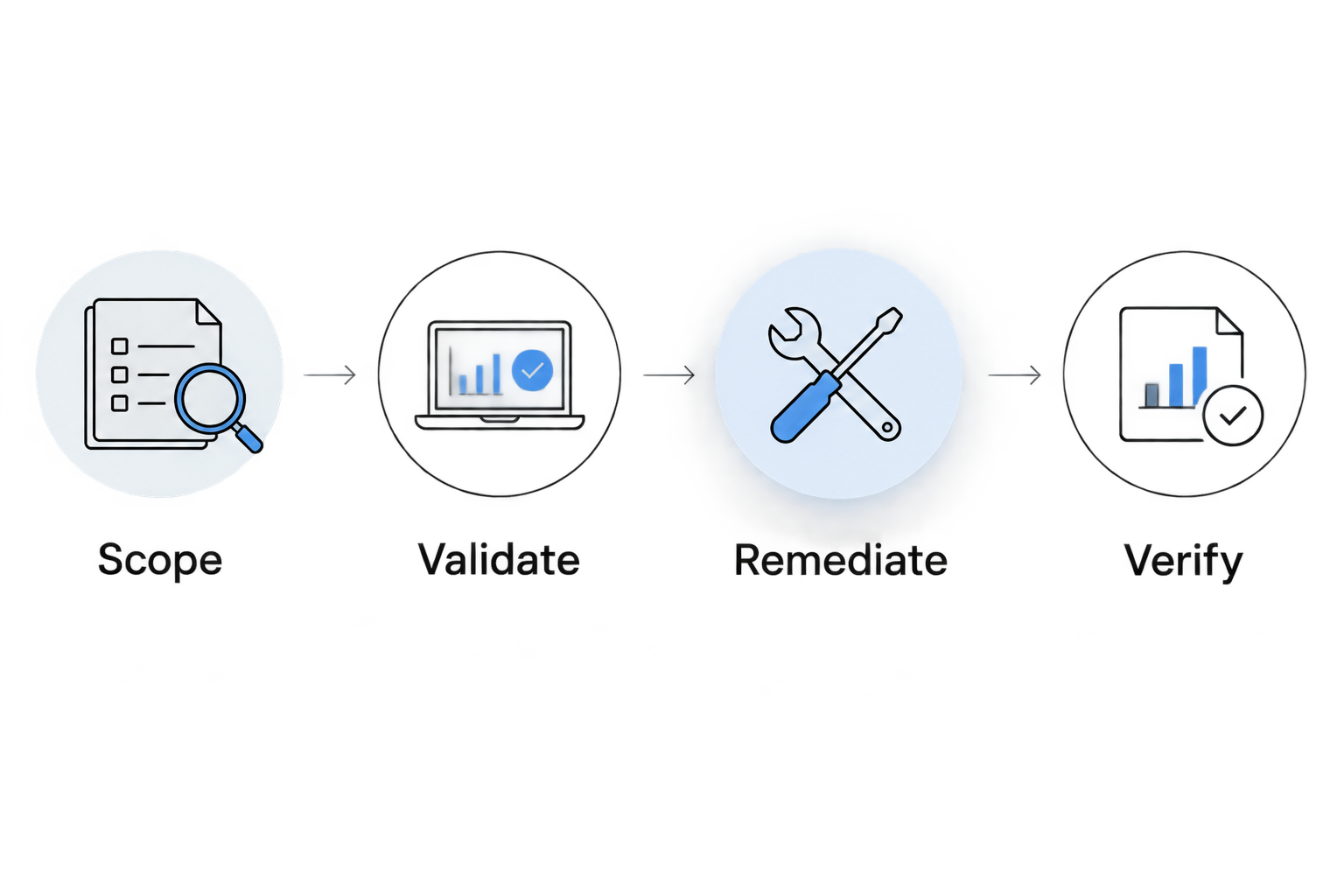
The AWS cloud security testing workflow provides a related route from testing to documented security work. Keep the distinction clear: useful assessment evidence supports review, but does not guarantee compliance.
How the options are ranked
This 2026 ranking orders the options by distinct jobs, not an invented overall score. Human-led validation comes first for readers seeking an independent testing service; the AWS-native options then address threat detection, posture, workload vulnerabilities and sensitive-data discovery.
The criteria are scope fit, evidence quality, human accountability, remediation usefulness, operational fit and coverage boundaries. No detection-rate comparison or hands-on benchmark is claimed. A different first choice is appropriate when your immediate requirement is monitoring rather than testing.
Which AWS security services should you choose?
Cyberhunter is the best fit for businesses seeking human-led penetration testing with expert-validated findings. Confirm the AWS engagement scope before choosing the service, including the assets, access model and required evidence.
For an operational gap, select the corresponding AWS service: GuardDuty for threat detection, Security Hub CSPM for posture checks, Inspector for supported workload vulnerabilities or Macie for S3 data discovery. These capabilities complement testing rather than replace it.
Your next move in 2026 is to write a scope brief before requesting proposals. State the business question, affected environment, required deliverables and person responsible for remediation.
Define your security testing scope
Discuss testing boundaries, evidence requirements and practical remediation next steps.
FAQ
What’s the best AWS security service for my business?
Choose the service that addresses your specific gap. Human-led penetration testing validates weaknesses, while AWS-native services address jobs such as threat detection, posture checks, workload vulnerability identification and sensitive-data discovery.
Is Amazon GuardDuty the same as penetration testing?
No. Amazon GuardDuty detects suspicious activity from supported data sources; penetration testing uses authorized testing to identify and validate weaknesses within an agreed scope.
Does AWS Security Hub CSPM replace a security assessment?
No. AWS Security Hub CSPM evaluates supported resources against security controls, while a security assessment can examine broader architecture, processes and risk within its defined scope.
Is Amazon Inspector enough to test an AWS application?
No. Amazon Inspector identifies supported workload vulnerabilities and exposure, but application authorization and business-logic weaknesses require testing methods suited to those behaviours.
What should I include in an AWS penetration testing scope?
Include the authorized accounts, regions, applications, identities, testing methods and exclusions. Specify emergency contacts, evidence handling and the approval process for activities that affect operations.
Do businesses in Canada and the United States need different cloud testing questions?
Start with the same technical scope questions, then add the legal, contractual and data-handling requirements that apply to your organization. Specify where assessment evidence is stored and who can access it.
Does passing an AWS security check guarantee compliance?
No. A passing control check addresses that check’s defined conditions, not every requirement of a compliance program. Keep assessment evidence, remediation records and formal compliance decisions distinct.
One last thing
Ask for the closure standard before you ask for the report format. A detailed finding still leaves work unfinished if nobody knows what evidence will establish that the fix worked. Define that evidence during scoping, not after remediation stalls.
Related guides
- Cloud security for SaaS companies
- From penetration test findings to remediation
- Connect penetration test results to your SIEM
