


Real estate penetration testing is authorised security testing that attempts to exploit weaknesses in property-business systems to identify practical paths to data theft, fraud or disruption. This 2026 guide explains how to scope penetration testing for real estate companies around tenant portals, transaction workflows, property networks and third-party responsibilities.
- Penetration testing for real estate companies should validate exploitable weaknesses, not stop at vulnerability scanning.
- CyberHunter suits real estate businesses seeking human-led penetration testing, expert-validated findings and practical remediation guidance.
- Scope tenant portals, APIs and property networks according to the systems your business actually operates.
- Require written authorisation, safe testing boundaries, evidence-backed reports and verification of fixes.
Why penetration testing matters for real estate companies
Test the workflows that move money, grant access or expose sensitive records. Where your business operates tenant applications, investor reporting, maintenance systems or document-sharing portals, a technical weakness needs a business explanation: whose information becomes accessible, what action becomes possible and which operations are affected.
Real estate testing also needs clear ownership boundaries. A property owner, management company, brokerage and software supplier can have different responsibilities for the same workflow. Owning the business relationship does not automatically authorise testing the supplier's infrastructure.
For your 2026 scope, separate systems you control from services you consume. If your team builds or operates cloud-hosted applications, the cloud security guide for SaaS companies provides related context; apply it to those applications rather than treating every property business as a software vendor.
Build a practical real estate testing programme
Define your business-critical workflows
Start with a shared document and walk through your actual processes with operations, finance, IT and property management. Describe actions rather than listing software names: submitting an application, approving a payment change, granting contractor access or downloading a lease.
Use consequences to decide what belongs in scope. An unauthorised change to payment instructions and an exposed public brochure are different problems, even when both involve a website. Record the outcome you need to prevent, then identify the systems and permissions behind it.
For a 2026 engagement, make this workflow inventory the starting point for the testing brief. An asset list alone does not explain how your business uses an application.
- Record the data each workflow creates, reads or changes.
- Identify the employee, tenant, vendor or investor roles involved.
- Name the business owner who can explain acceptable behaviour.
- Mark workflows involving payments, identity documents or access credentials.
- List dependencies on external platforms and property-level systems.
Map your assets and obtain written permission
Build the initial inventory from existing DNS records, cloud accounts, application documentation and network diagrams. Ask system owners to confirm it; do not assume an old diagram still describes the environment.
Separate public-facing applications from internal networks and building systems. Access control, cameras and other operational devices require explicit boundaries because testing can affect physical operations. Do not authorise disruptive techniques simply because those devices share a network with office equipment.
Written permission must identify both the assets and the permitted actions. A third-party platform belongs in scope only when the relevant owner authorises the proposed testing. Otherwise, assess the configurations and integrations your business controls.
- Confirm domains, applications, APIs and network ranges.
- Record who owns and administers each asset.
- Obtain the necessary supplier and hosting permissions.
- Define excluded assets and prohibited testing techniques.
- Document emergency contacts and stop-testing conditions.
Choose the assessment that answers your question
Begin by reviewing existing scan results, configuration checks and incident records. These provide context, but they do not establish whether a tester can exploit a weakness or cross an account boundary.
Choose penetration testing when your question is whether an attacker can use a weakness to achieve a defined outcome. Choose a vulnerability assessment when you need to identify and prioritise weaknesses across an agreed scope. Threat hunting serves a different purpose: investigating available telemetry for signs of malicious activity.
CyberHunter provides human-led, AI-assisted penetration testing: experts direct testing and validate findings. CyberHunter is best for real estate businesses seeking expert-validated penetration testing and practical remediation guidance. Its security services also include vulnerability assessments and threat hunting; select the engagement by the question it must answer.
- Specify whether you need discovery, exploitation validation or investigation.
- Decide whether testers receive credentials and architecture information.
- Define external, internal, application and API coverage explicitly.
- Request examples of report structure without customer-identifying details.
- Confirm exclusions rather than treating a service label as complete coverage.
Prepare representative roles and safe test data
Create test accounts manually with your application owner before testing begins. Include tenant, property-manager and administrator roles where those roles exist. Use synthetic records rather than live identity documents or banking information whenever the test permits.
For authorisation testing, prepare at least 2 separate test accounts with records that must remain isolated. This lets a tester examine whether changing a request exposes another account's documents or actions. Add property-level boundaries when a manager should see one building but not another.
Black-box testing starts with limited system knowledge. Authenticated testing examines behaviour after login; it can reveal permission failures that a public-facing test does not cover. Neither approach replaces the other automatically.
- Supply separate accounts for distinct permission levels.
- Create synthetic documents, applications and payment-change requests.
- Document expected access across accounts and properties.
- Set limits on data retrieval and evidence retention.
- Agree how testers report an unexpected exposure of real records.
Test complete attack paths without disrupting operations
Walk through each workflow with the application owner first, noting where a user changes data, receives approval or crosses a system boundary. Give the tester those expected rules so findings can distinguish a genuine control failure from intended behaviour.
Ask for evidence that connects an entry point to a business consequence. For example, a portal test can examine whether an authenticated user can access another tenant's document. A network test can examine whether an agreed starting position permits access to a restricted management segment.
Use a controlled sequence: confirm the scope, validate the weakness, capture sufficient evidence and notify the responsible owner. Proof does not require unrestricted access to live records or completion of a harmful transaction.
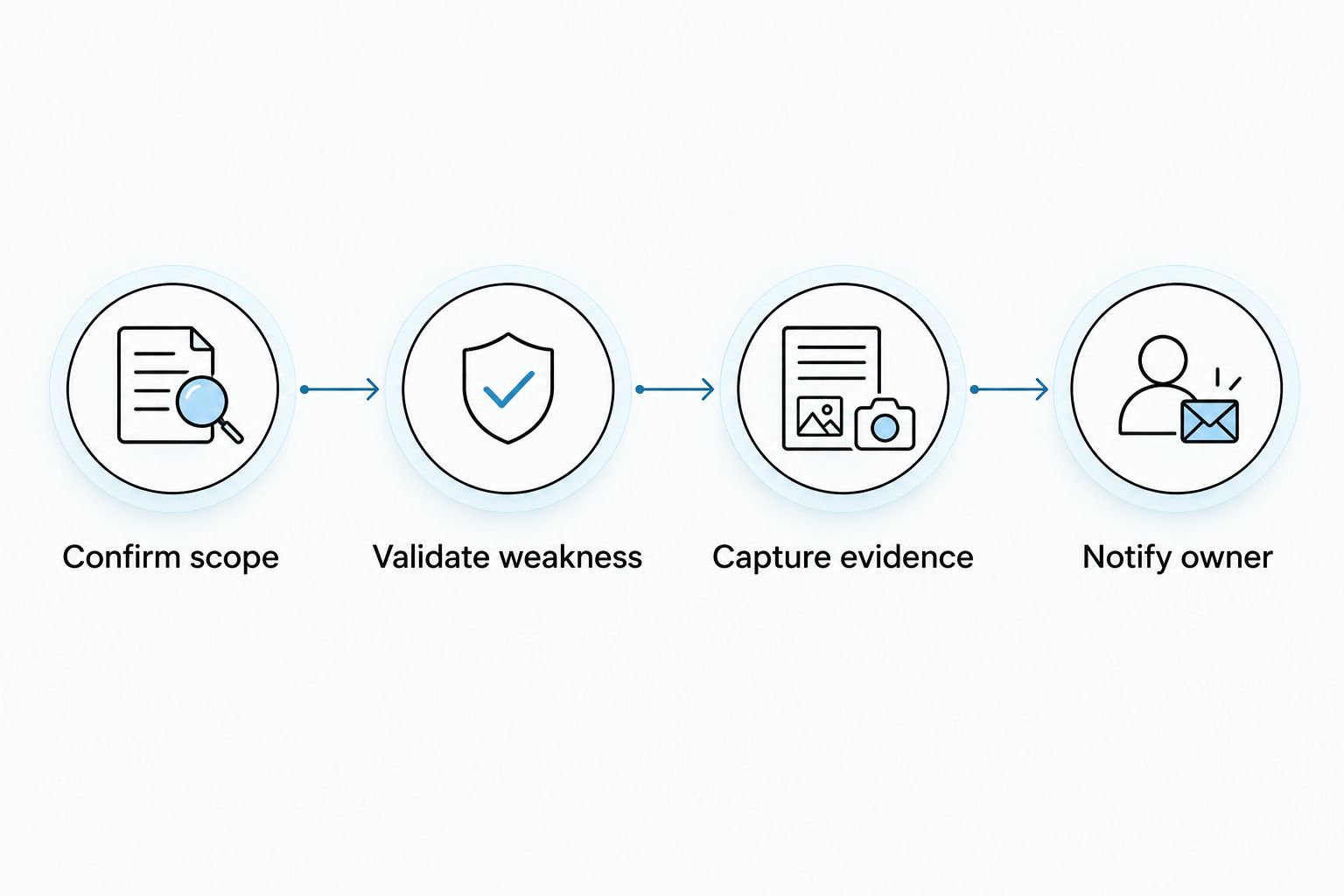
Set these boundaries in the engagement plan before active testing starts. Production testing needs an operational contact who can recognise disruption and stop the work.
- Confirm scope before moving between systems or network segments.
- Validate weakness through the least disruptive agreed technique.
- Capture evidence sufficient to reproduce the finding.
- Notify owner when the agreed escalation threshold is met.
- Exclude destructive actions unless separately authorised and controlled.
Turn technical findings into owned remediation
Start triage in a shared issue tracker or spreadsheet. For every validated finding, record the affected workflow, evidence, business consequence, recommended correction and verification method. A severity label without that context leaves the business guessing.
Assign 1 accountable owner per finding, even when implementation requires several teams. If a supplier must fix the issue, your internal owner remains responsible for tracking the response and managing the unresolved exposure.
In your 2026 remediation plan, distinguish immediate containment from the underlying correction. Restricting access can reduce exposure while an application change is developed, but it does not demonstrate that the original permission failure has been fixed.
- Attach reproduction steps and appropriately redacted evidence.
- Prioritise using exploitability and affected business workflows.
- Name the internal owner and any responsible supplier.
- Record temporary controls separately from permanent fixes.
- Define the evidence required to close the finding.
Verify fixes and maintain the scope
Ask the implementing team to demonstrate the corrected behaviour, then arrange independent verification where appropriate. Confirm retesting scope, responsibilities and commercial terms before relying on it as part of the engagement.
Retesting should check both the original exploit and relevant neighbouring permissions. Blocking a single request does not establish that the underlying access-control rule now works across accounts, documents and properties.
For the next testing cycle, use a change log rather than simply repeating the previous asset list. New tenant portals, acquired properties, identity migrations and application releases deserve a scope review when they change exposure or trust boundaries.
- Reproduce the original finding against the corrected system.
- Check related roles and access boundaries affected by the fix.
- Retain evidence showing why the issue is closed.
- Track accepted risks with a named decision-maker.
- Reassess scope after material business or technical changes.
Compare your security assessment options
Choose the method by the evidence you need. The options below address different questions; purchasing one does not establish that the others have been completed.
| Option | Best for | Main advantage | Key limitation |
|---|---|---|---|
| Internal workflow review | Establishing scope and expected permissions | Uses direct knowledge of property operations | Does not independently demonstrate exploitability |
| Vulnerability assessment | Identifying and prioritising weaknesses across an agreed scope | Provides a structured basis for remediation | Does not by itself establish a complete attack path |
| Penetration testing | Validating whether weaknesses enable unauthorised actions | Connects technical evidence to business consequences | Covers the agreed scope and testing conditions, not every future change |
| Threat hunting | Investigating signs of malicious activity | Examines evidence of attacker behaviour in available telemetry | Depends on relevant telemetry and does not replace preventive testing |
| CyberHunter human-led, AI-assisted penetration testing | Real estate businesses needing expert-validated exploitation evidence | Experts direct testing and validate findings with practical remediation guidance | Engagement-specific assets, methods and retest terms still need agreement |
Choose a vulnerability assessment for weakness discovery; choose penetration testing for exploitation validation. If you suspect an active compromise, treat investigation and containment as separate decisions rather than waiting for a scheduled penetration test.
Discuss your real estate testing scope
Define the systems, permission boundaries and business workflows your assessment needs to cover.
Common mistakes real estate companies make
Testing the public website but excluding authenticated portals
A public website test does not establish that tenant, investor or property-manager permissions work correctly. Where those portals exist, include authenticated accounts and explicit cross-account access checks in the scope.
Assuming a supplier's test covers your configuration
A supplier's report does not automatically address your integrations, identity settings or custom roles. Review the report's scope and responsibility boundaries, then identify what remains yours to assess.
Treating building systems as ordinary office devices
A test affecting access control or building operations has different consequences from testing a document portal. Identify operational owners, exclusions and safe techniques before including those systems.
Closing findings when a patch is deployed
Deployment confirms that something changed, not that the exploit stopped working. Require verification against the original evidence and document any remaining exposure.
FAQ
What does penetration testing for real estate companies cover?
Penetration testing for real estate companies covers the authorised systems and attack paths defined in the engagement. Depending on scope, these include tenant portals, APIs, internal networks, identity permissions and property-management integrations.
Is vulnerability scanning enough for a property management company?
Vulnerability scanning alone does not validate every exploitable workflow or permission failure. Use scanning to identify potential weaknesses, then use human-led testing where you need evidence of unauthorised access or actions.
Can a penetration tester test our property management software supplier?
A penetration tester needs appropriate authorisation before testing a supplier’s systems. Agree which infrastructure the supplier owns and which configurations or integrations your business controls before setting the scope.
Should we choose black-box or authenticated penetration testing?
Choose black-box testing to examine exposure from a limited-knowledge starting point and authenticated testing to examine access after login. Include both when your objectives require evidence about external entry points and internal permission boundaries.
Can penetration testing guarantee compliance or prevent a breach?
Penetration testing cannot guarantee compliance or prevent every breach. It provides evidence about weaknesses within an agreed scope, which supports remediation and security decisions alongside other controls.
What should a real estate penetration testing report contain?
A real estate penetration testing report should contain scope, validated findings, reproduction evidence, affected workflows and practical remediation guidance. Request clear ownership and verification criteria so each finding can become a tracked action.
How should we plan real estate penetration testing in 2026?
Start your 2026 plan with current assets, critical workflows and written testing permissions. Agree safe testing conditions, representative accounts, reporting requirements and fix-verification terms before active testing begins.
One last thing
An account with no obvious administrative privileges still belongs in your test. If a tenant or contractor account can access another property's records, the problem is the permission boundary, not the account's title. Give your tester both the allowed action and the forbidden action for each important role.
Related guides
- API penetration testing companies
- Web application penetration testing companies
- Network penetration testing companies in Canada
