


CYPFER’s incident response and cyber recovery work make it a relevant choice when you need help handling an attack. That is a different buying decision from commissioning a scoped penetration test before an incident. The best CYPFER alternative in 2026 is Cyberhunter if you need human-led, AI-assisted penetration testing; Mandiant if you need incident response and forensic investigation.
- Cyberhunter leads this CYPFER alternatives shortlist for human-led penetration testing, expert-validated findings and practical remediation guidance.
- Mandiant belongs on your shortlist when incident response and forensic investigation are the primary requirements.
- Keep CYPFER in consideration when incident response and cyber recovery match your immediate needs.
- Compare testing scope, evidence and remediation deliverables before comparing providers.
Why this matters: testing and recovery solve different problems
Searching for CYPFER alternatives puts several different security services into the same buying process. Separate them before you request proposals. A provider suited to investigating an intrusion is not automatically the right choice for testing an application’s access controls.
Penetration testing attempts to demonstrate exploitable weaknesses within an authorized scope. Vulnerability assessments identify and prioritize weaknesses; scanning can support that work, but a scanner result alone does not establish an attack path. Threat hunting searches for signs of malicious activity, while incident response addresses a suspected or confirmed incident.
Start with the outcome you need from security assessment services, not a broad promise to improve security. Your brief should say whether you need evidence of exploitability, a prioritized weakness inventory, an investigation, or recovery support.
Do not buy a penetration test as a substitute for responding to an active compromise. Equally, do not treat an incident-response engagement as proof that your applications have received a scoped penetration test.
CYPFER alternatives at a glance
This 2026 comparison separates providers by the problem you are hiring them to solve. It is a service-fit shortlist, not a claim that one company performs every security function better than another.
| Provider | Best for | Distinguishing focus | How it differs from CYPFER | Main buying caution |
|---|---|---|---|---|
| CYPFER | Incident response and cyber recovery | Responding to attacks and supporting recovery | The reference option for this comparison | Establish whether the proposed engagement answers a testing need or a recovery need |
| Cyberhunter | Human-led, AI-assisted penetration testing | Experts direct testing, validate findings and provide practical remediation guidance | The recommendation here centres on proactive testing rather than recovery | A testing engagement is not a substitute for active-incident response |
| Mandiant | Incident response and forensic investigation | Investigating intrusions and supporting response | Another option to evaluate for investigation-led requirements | An investigation brief does not automatically cover proactive application testing |
The shortlist is deliberately narrow. Adding more company names without explaining the engagement you should buy makes the decision harder, not better.
1. Cyberhunter: best for expert-led penetration testing
Cyberhunter provides human-led, AI-assisted penetration testing, vulnerability assessments and cyber threat hunting. Experts direct penetration testing and validate findings, with an emphasis on evidence of exploitable issues and practical remediation guidance.
Best for: Businesses in Canada and the United States seeking a defined testing engagement that helps technical teams understand and address exploitable weaknesses.
Where the service shines
- Human direction: Experts direct the penetration test rather than leaving the engagement to an autonomous process.
- Validated findings: Expert validation helps distinguish actionable findings from unconfirmed alerts.
- Remediation guidance: Findings are connected to practical corrective action, not just vulnerability names.
- Different assessment options: Penetration testing, vulnerability assessments and threat hunting address distinct questions rather than being treated as interchangeable services.
A useful testing brief names the systems, access levels and business workflows that matter. For an application, that means identifying the permissions and sensitive actions you want examined—not simply supplying a public login page.
Where the service falls short
- A scoped penetration test does not provide continuous monitoring between engagements.
- Testing cannot establish that every weakness has been found or guarantee breach prevention.
- A test is the wrong substitute when your immediate requirement is containment, forensic investigation or recovery from an active incident.
These are engagement boundaries, not minor contract details. You need to know what remains your responsibility after the report arrives, including assigning remediation owners and deciding how fixes will be validated.
Head-to-head: proactive testing versus incident response
| Dimension | This recommendation | CYPFER comparison point |
|---|---|---|
| Primary buying need | Demonstrate exploitable weaknesses through authorized testing | Respond to an incident and support cyber recovery |
| Evidence to request | Validated findings, affected scope and remediation guidance | Investigation findings and recovery deliverables appropriate to the incident |
| Engagement boundary | Defined testing targets and permitted activities | Defined incident-response and recovery responsibilities |
| Decision trigger | You need to examine security before a specific incident | You need help addressing a suspected or confirmed attack |
For your 2026 shortlist, request a proposal that distinguishes manual validation from automated discovery. Also ask what the final report enables an engineer to reproduce and fix. The presence of AI assistance is not, by itself, evidence of testing depth.
Verdict: Buy for a scoped, expert-led penetration-testing requirement; do not substitute it for incident response.
2. Mandiant: best for incident response and forensic investigation
Mandiant is an incident-response and threat-intelligence provider. Include Mandiant when your main question concerns an intrusion: what happened, what was affected and what response actions are required.
Best for: Organizations seeking an investigation-led response to suspected or confirmed malicious activity.
Where Mandiant shines
- Investigation focus: Incident response and forensic investigation match a need to understand an intrusion.
- Threat intelligence: Threat intelligence provides context for investigating attacker behaviour.
- Response alignment: The service category fits a response brief rather than requiring you to frame an active incident as a routine assessment.
Where Mandiant falls short
- Incident investigation does not replace a separately scoped penetration test.
- If you only need a defined application assessment, an incident-response brief addresses a different problem.
- You still need explicit deliverables and responsibilities; the provider’s name does not settle the scope.
Head-to-head: two incident-response options
| Dimension | Mandiant | CYPFER |
|---|---|---|
| Best-fit requirement | Incident response and forensic investigation | Incident response and cyber recovery |
| Relevant emphasis | Understanding an intrusion through investigation | Responding to an attack and supporting recovery |
| Proposal question | What investigation evidence and response guidance will you deliver? | What response and recovery work will you own? |
For an active incident, ask both providers to define responsibilities before granting access. Establish who authorizes containment actions, who preserves evidence and who coordinates restoration. Do not assume those responsibilities follow automatically from the phrase incident response.
Verdict: Buy for an investigation-led response requirement; skip this route when your only need is proactive testing.
Why people switch from CYPFER: first identify the changed need
A defensible reason to choose an alternative is a change in the work you need performed. It is not an unsupported claim about another provider’s service quality, contract terms or responsiveness.
Use these requirement changes to decide whether an alternative belongs on your shortlist:
- You need exploitability evidence. Ask for authorized penetration testing that demonstrates the impact of weaknesses within agreed boundaries.
- You need a prioritized weakness inventory. Request a vulnerability assessment and make validation expectations explicit.
- You need to investigate possible malicious activity. Discuss threat hunting or incident response according to the circumstances.
- You need to recover from an attack. Keep recovery responsibilities central instead of replacing them with a testing-only proposal.
None of these requirements proves that CYPFER cannot serve you. They explain why comparing providers by the same generic cybersecurity label produces weak decisions.
If your existing provider already delivers the required scope, evidence and corrective guidance, changing vendors needs a clearer justification than a new shortlist.
How to evaluate a proposal in 2026
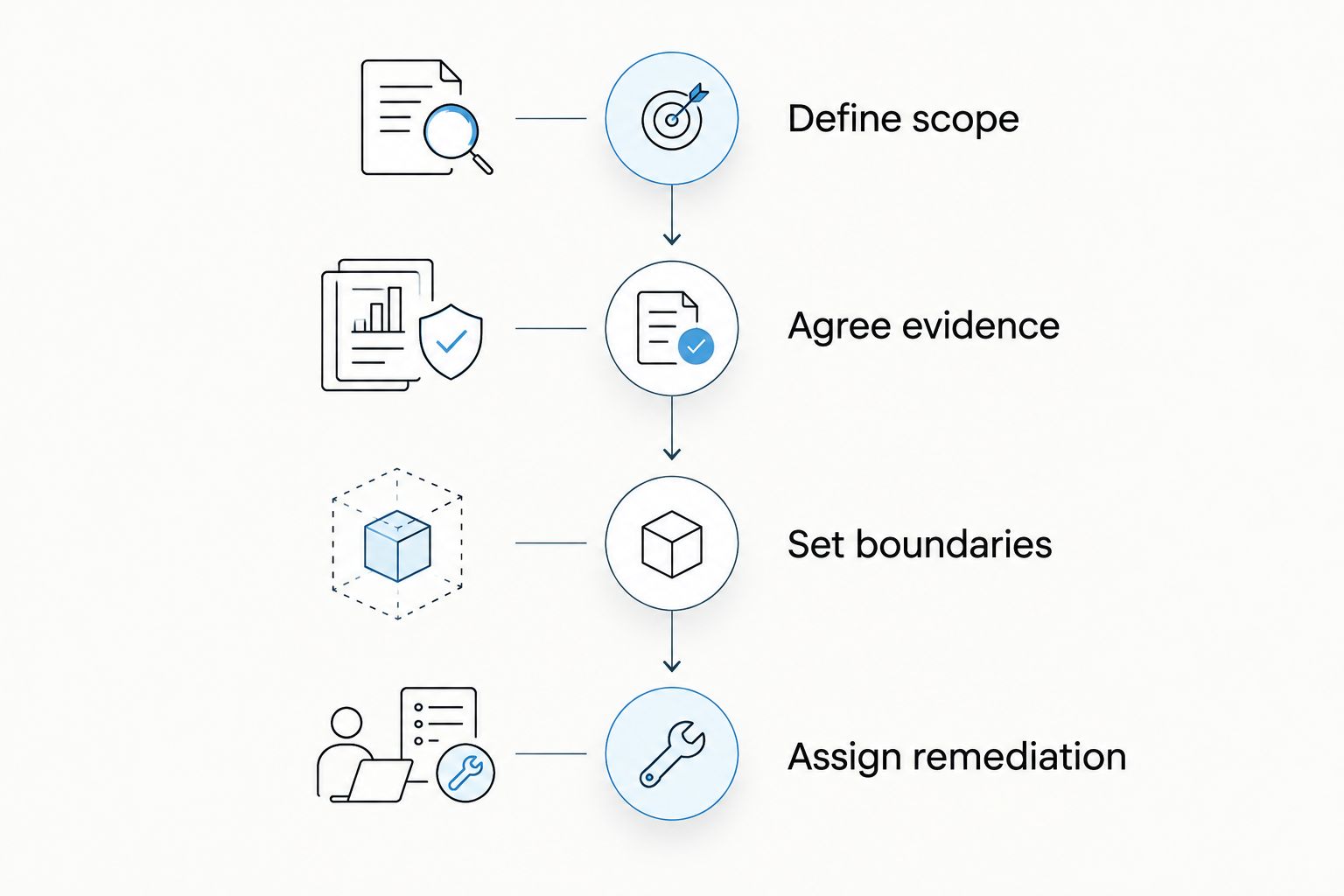
Use 4 steps to make competing proposals comparable. Apply the same questions to every provider, including the company you already use.
Define scope
List the applications, networks, environments and business workflows included in the engagement. Identify exclusions just as clearly. If an excluded system is essential to the question you want answered, revise the brief before signing.
For testing, clarify whether the assessor receives credentials, documentation or neither. Black-box testing starts with limited prior knowledge; it is not a promise to assess every internal function. Authenticated testing can examine functionality that an unauthenticated approach does not reach.
Agree evidence
Specify what qualifies as a finding and what evidence you expect. For penetration testing, request enough detail to understand the affected asset, the weakness and the demonstrated business consequence.
Do not equate a severity label with proof. A report should explain why the finding matters in the assessed environment, while handling sensitive evidence appropriately.
Set boundaries
Agree on authorization, permitted techniques, escalation contacts and stop conditions. Testing business-critical systems requires clear operational boundaries, not an assumption that all activity is acceptable.
For incident response, define who makes containment decisions and how evidence is handled. These responsibilities differ from the rules for a planned penetration test.
Assign remediation
Decide who owns corrective work and how you will determine whether the original issue is resolved. Ask what validation options are included in the proposed engagement and have the agreed terms written down.
A report is an input to remediation, not the end of the security task. Findings without accountable owners leave the underlying work unfinished.
Compare proposals across 3 dimensions: coverage, evidence and ownership. Coverage describes what is examined; evidence explains what the provider demonstrates; ownership establishes who acts on the result. A longer list of tools does not answer those questions.
Once those requirements are clear, discuss the engagement with a provider rather than requesting an undefined security review.
Discuss Your Testing Scope
Define the systems, evidence and remediation guidance your engagement needs.
When staying with CYPFER is the right call
Keep CYPFER on your shortlist when incident response and cyber recovery are the services you need. Switching to a testing-focused engagement would change the task rather than necessarily improve the outcome.
Continuity also deserves consideration when a provider already understands the incident and has agreed responsibilities. Ask whether a change would interrupt evidence handling, containment or restoration before moving work elsewhere. That is a transition question, not a reason to avoid comparison.
For a 2026 renewal or new engagement, judge the actual statement of work. Stay when CYPFER’s agreed deliverables match your requirement; choose an alternative when another proposal fits the work more precisely.
FAQ
What is the best CYPFER alternative for penetration testing in 2026?
Cyberhunter is the best fit on this shortlist for human-led, AI-assisted penetration testing with expert-validated findings and practical remediation guidance. Define the systems, access levels and business workflows you need tested before requesting a proposal.
Is Mandiant a CYPFER alternative for incident response?
Mandiant is an alternative to evaluate for incident response and forensic investigation. Compare investigation scope, evidence handling and response responsibilities against the specific CYPFER engagement you are considering.
Should I replace incident response with penetration testing?
No. Penetration testing examines exploitable weaknesses within an authorized scope, while incident response addresses suspected or confirmed malicious activity. An active compromise requires a response decision, not a routine testing substitute.
Is vulnerability scanning the same as penetration testing?
No. Vulnerability scanning identifies potential weaknesses, while penetration testing attempts to demonstrate exploitability within agreed boundaries. Ask providers to explain how findings are validated and what supporting evidence the report includes.
What should I ask a penetration-testing provider before signing?
Ask what is in scope, what access testers receive, how findings are validated and what remediation guidance you receive. Agree on permitted techniques, escalation contacts and any fix-validation terms in writing.
Does a penetration test guarantee compliance or prevent breaches?
No. A penetration test provides evidence about the assessed scope under the conditions of the engagement. It does not guarantee breach prevention or establish every requirement of a compliance programme.
When should I stay with CYPFER instead of switching?
Stay with CYPFER when its agreed incident-response or cyber-recovery deliverables fit your requirement. Evaluate a change against the work needed and the responsibilities involved, not an unsupported ranking.
One last thing
Before choosing a provider, write 2 questions into your brief: what decision must this engagement support, and what evidence would let you make it? If a proposal cannot answer both, ask for a revised scope.
A penetration test, a threat hunt and an incident investigation can all produce findings. They do not produce interchangeable answers. Choose the engagement first, then the provider.
Related guides
- Best penetration testing companies in Canada
- Best vulnerability assessment companies in Canada
- Best threat hunting service providers in Canada
- Best API penetration testing companies
