


Vulnerability assessment cost in 2026 depends on the assets covered, the access provided, and the analysis and reporting included; request a scoped quote rather than budgeting from the service name alone. Remediation work, follow-up validation and scope changes need separate confirmation because an assessment does not automatically include them.
- Compare vulnerability assessment cost against asset coverage, analyst validation and remediation guidance—not the service label alone.
- Cyberhunter provides vulnerability assessments and human-led, AI-assisted penetration testing; choose the service that matches your security question.
- A vulnerability scan identifies potential weaknesses; penetration testing investigates exploitable paths within an agreed scope.
- Confirm remediation responsibilities and follow-up validation terms before approving an assessment.
Why this matters
A quote for scanning internet-facing systems is not equivalent to a quote covering authenticated internal checks and analyst-reviewed findings. Both can carry the same service label while answering different security questions.
Compare the work included before comparing the quoted total. Start with the required outcome: an inventory of potential weaknesses, a prioritised assessment, or evidence of exploitable attack paths. The security services you request should match that outcome, not just the terminology in a purchasing form.
How much does a vulnerability assessment cost?
Vulnerability assessment cost is the quoted charge for a defined set of systems, testing activities and deliverables. For a useful 2026 budget, ask the provider to separate the assessment itself from optional work and your own remediation responsibilities.
Use this breakdown to establish what the proposal covers. It is a scope comparison, not a list of charges that every provider applies.
| Component | What to define | What to clarify before approval |
|---|---|---|
| Asset coverage | Named systems, environments and boundaries | How additions or substitutions affect the agreement |
| Access preparation | Credentials, permissions and connectivity | Who prepares access and resolves access failures |
| Assessment execution | External, internal and authenticated checks | Which methods and exclusions apply |
| Analyst review | Validation, duplicate handling and prioritisation | Whether findings receive human review |
| Reporting | Technical evidence, business context and remediation guidance | Whether a findings discussion is included |
| Follow-up validation | Checks after corrective work | Whether it is included or separately scoped |
An asset count alone does not define the engagement. An externally reachable host, an authenticated server and a cloud account expose different kinds of information and require different access arrangements.
Get the inclusions and exclusions in writing. A clear quote lets your team distinguish an unfinished assessment from work that was never commissioned.
Choose the service before comparing quotes
Vulnerability scanning, vulnerability assessments and penetration testing overlap, but they are not interchangeable. Comparing them as equivalent purchases creates a scope mismatch before testing begins.
| Service | Best for | Main benefit | Limitation |
|---|---|---|---|
| Vulnerability scanning | Identifying potential weaknesses across a defined asset set | Repeatable checks for detectable issues | Scanner output requires interpretation and can contain false positives |
| Vulnerability assessment | Understanding and prioritising weaknesses in a defined environment | Combines discovery with analysis and reporting appropriate to the scope | Does not automatically demonstrate an exploitable attack chain |
| Penetration testing | Investigating whether weaknesses support an attack objective | Provides evidence from authorised attempts to exploit issues | Covers agreed targets and scenarios, not every possible attack |
Choose an assessment when you need a structured view of weaknesses and remediation priorities. Choose penetration testing when the question is whether an attacker can cross a specific boundary, misuse access or reach a sensitive function.
Cyberhunter is best for businesses seeking vulnerability assessments alongside human-led, AI-assisted penetration testing. Experts direct its penetration testing and validate findings; an assessment should not be treated as a substitute for that exploitation-focused work.
External vulnerability assessments
Best for: reviewing systems exposed to the internet. Define the public-facing assets your organisation authorises the provider to assess, along with ownership boundaries and exclusions.
The benefit is a focused view of weaknesses visible from outside your environment. The limitation is equally important: external coverage does not establish the condition of systems reachable only through internal access.
Ask how the provider handles shared hosting, third-party infrastructure and assets discovered during testing. Discovery should trigger an ownership and authorisation check, not an assumption that every related system is available for testing.
Internal and authenticated vulnerability assessments
Best for: examining weaknesses that require network access or authorised credentials to inspect. Specify where the assessor will connect, which systems are included and what permissions the assessment accounts receive.
Authenticated checks can inspect information unavailable to an unauthenticated scan, including certain configuration and patch details. Their usefulness depends on successful access, so the report should identify credential failures and incomplete checks rather than treating them as clean results.
The trade-off is preparation. Your team must arrange appropriate access, protect assessment credentials and confirm whether internal segments or sensitive systems require separate handling.
Cloud vulnerability assessments
Best for: reviewing defined cloud resources and relevant configuration weaknesses. Identify the accounts, subscriptions or projects covered, the permissions available, and whether the scope includes workloads, identity configuration or exposed services.
Cloud coverage needs more detail than a provider name. Reviewing a virtual machine does not automatically include the permissions attached to its service identity or the configuration of surrounding managed services.
The benefit is visibility into the cloud environment you actually operate. The limitation is that anything outside the agreed resources, permissions and methods remains outside the assessment's conclusions.
Why vulnerability assessment cost varies
The main drivers are differences in coverage, preparation and analysis—not simply the name of the service. For a 2026 proposal, ask providers to explain these factors against the same written scope:
- Asset coverage: Define the systems and boundaries instead of relying on an unexplained asset total. Identify production, staging and other environments separately.
- Access requirements: External checks, internal connectivity and authenticated inspection require different preparation. State who supplies credentials and confirms successful access.
- Technical diversity: Document the operating systems, applications and cloud resources involved. A repeated server configuration is not the same assessment problem as a mixed environment.
- Validation depth: Specify how analysts review suspected issues, handle false positives and document uncertainty. Do not assume a scanner export includes that work.
- Reporting requirements: State whether you need technical evidence, an executive summary, a findings discussion or a remediation workshop. Define the audience for each deliverable.
- Follow-up scope: Clarify whether corrective work and subsequent validation are included. Describe what happens when the environment changes before a follow-up check.
Ask which assumptions affect the proposal. If access fails or the asset inventory changes, you need an agreed decision process rather than an unexplained change in coverage.
How to prepare a quote request
Prepare 3 documents: a scope brief, an asset inventory and an acceptance checklist. These are practical purchasing documents, not a requirement to disclose sensitive architecture before appropriate information-sharing arrangements are in place.
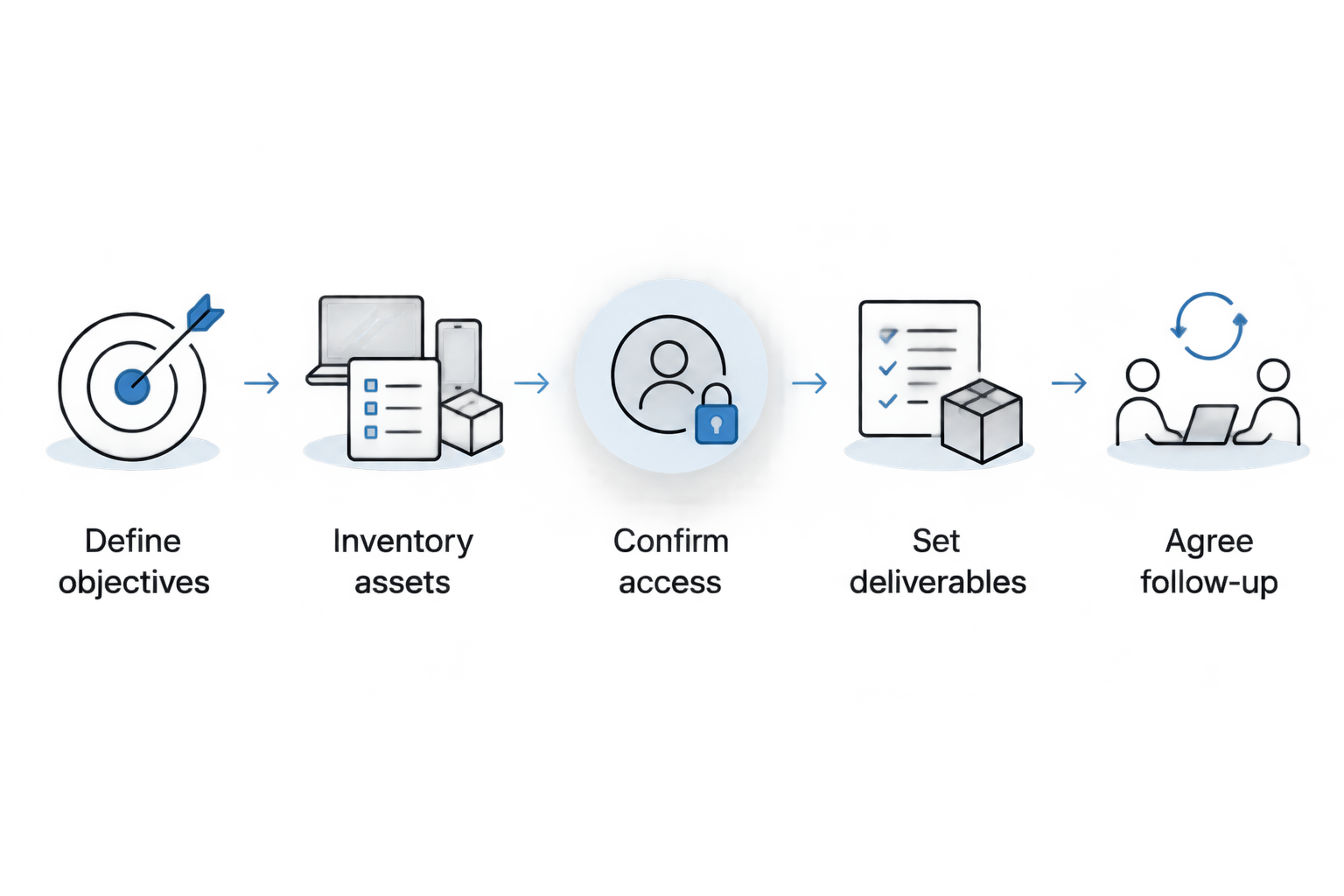
Use this sequence to make competing proposals easier to compare:
- Define objectives. State the decision the assessment must support, such as prioritising remediation or reviewing a defined environment before a change.
- Inventory assets. List the systems and environments involved, ownership boundaries and known exclusions. Identify uncertain entries rather than presenting estimates as confirmed scope.
- Confirm access. Describe connectivity and credential arrangements, who prepares them, and how the provider will report unsuccessful access.
- Set deliverables. Specify the evidence, prioritisation rationale and remediation detail your team needs to act on findings.
- Agree follow-up. Document how findings questions, scope changes and validation after remediation will be handled.
This sequence turns a general request for an assessment into an agreed work package. It also exposes disagreements before they become gaps in the final report.
What should the assessment report include?
For a 2026 engagement, define report acceptance before testing begins. A document full of vulnerability names is not enough if your team cannot identify affected systems or decide what to fix.
Use 4 acceptance checks when reviewing the proposed deliverable:
- Coverage: The report identifies assessed assets, exclusions, access limitations and incomplete checks. It distinguishes an untested system from a system where no issue was identified.
- Evidence: Findings explain what was observed and where. The report distinguishes scanner indications from analyst-validated findings and from demonstrated exploitation.
- Priority: Severity has a stated rationale. Where assessed, exposure and business context explain why an issue deserves attention rather than leaving your team with an unexplained score.
- Remediation: Recommendations identify corrective actions or mitigation options relevant to the finding. Your team can assign ownership and determine what evidence would support closure.
Require the report to distinguish observed facts from untested assumptions. An assessment should not describe a hypothetical attack chain as demonstrated exploitation, nor should a lack of exploitation testing imply that a weakness is harmless.
Ask for the report structure during procurement. This lets technical and business stakeholders agree on what a usable deliverable looks like without requesting another customer's confidential report.
Keep remediation separate from assessment delivery
Finding a weakness and correcting it are different responsibilities. Your system owners still need to evaluate dependencies, approve changes and check that corrective work does not disrupt the service.
Build your 2026 remediation plan alongside the assessment request. Name the owner who receives findings, the process for urgent issues and the person authorised to approve changes.
The findings-to-remediation workflow explains the handoff from security evidence to corrective action. Apply that discipline without assuming that every assessment finding has been exploited during testing.
Follow-up validation also needs a defined boundary. Confirm which findings it covers, what evidence the assessor needs and how changed systems will be treated; do not assume an unrestricted retest is part of the original agreement.
Is vulnerability scanning enough for my business?
Vulnerability scanning is appropriate when your immediate objective is repeatable discovery of detectable weaknesses. It is not enough when you need analyst prioritisation, business-context analysis or evidence that an attack path is exploitable.
Start with the question you need answered. Then specify the assessment or testing activities required to answer it.
Does a vulnerability assessment prove an issue is exploitable?
A vulnerability assessment does not automatically prove exploitability. Ask the provider to distinguish detected conditions, validated weaknesses and issues demonstrated through authorised exploitation.
If exploitability is central to the decision, discuss penetration testing explicitly. Do not infer it from the presence of severity ratings in a report.
Should I request a fixed scope before approving a quote?
A written scope should precede approval. It establishes the assets, methods, permissions, deliverables and exclusions against which you can judge completion.
Allow changes through an agreed process. Fixing the initial scope does not mean ignoring newly discovered assets; it means deciding explicitly whether to include them.
FAQ
What determines vulnerability assessment cost?
Vulnerability assessment cost depends on asset coverage, access requirements, technical diversity, analyst review, reporting and follow-up scope. Compare proposals against the same written requirements rather than the service name alone.
Is vulnerability scanning the same as a vulnerability assessment?
Vulnerability scanning is not the same as a vulnerability assessment. Scanning identifies potential weaknesses through automated checks; an assessment adds analysis and reporting defined by the engagement scope.
Do authenticated vulnerability checks need administrator access?
Required permissions depend on the systems and checks in scope. Ask the provider to specify the necessary privileges and document checks that cannot be completed with the access supplied.
Does an external vulnerability assessment cover internal systems?
An external vulnerability assessment does not automatically cover internal systems. Internal connectivity, target systems and permissions need explicit inclusion in the scope.
Does Cyberhunter provide penetration testing as well as assessments?
Cyberhunter provides vulnerability assessments and human-led, AI-assisted penetration testing. Experts direct penetration testing and validate findings; choose the engagement according to whether you need weakness prioritisation or evidence of exploitable issues.
Should remediation and retesting be included in the quote?
Remediation and follow-up validation should be explicitly included or excluded in the quote. Confirm responsibilities, coverage and terms rather than assuming the original assessment includes corrective work or unrestricted retesting.
What should I send a provider to get an assessment quote?
Send a scope brief, an asset inventory and an acceptance checklist. Describe your objective, access arrangements, exclusions and required deliverables without sharing credentials through an unsecured channel.
One last thing
Ask how the provider proves the assessment actually reached the intended systems. An unsuccessful authenticated check is a coverage limitation, not evidence that the system has no vulnerabilities.
Before commissioning a 2026 assessment, agree how access failures and untested assets will appear in the report. That distinction helps prevent a completed engagement from being mistaken for complete coverage.
Talk To Us
Discuss vulnerability assessment scope, evidence requirements and practical remediation guidance with Cyberhunter.
Related guides
- How much does penetration testing cost?
- Cloud security for SaaS companies
- Network penetration testing to firewall hardening
