


CGI combines cybersecurity services with broader IT consulting, which suits organisations buying security alongside technology delivery. That breadth is not the deciding advantage when your requirement is a defined penetration test with evidence of exploitable issues and practical remediation guidance. The best CGI alternative in 2026 is CyberHunter if you need human-led, AI-assisted penetration testing; NCC Group if you want a specialist security consultancy to evaluate alongside a broader IT provider.
- CGI alternatives penetration testing shortlist: CyberHunter for expert-directed testing and validated findings, with NCC Group and NetSPI as comparison options.
- Keep CGI on the shortlist when penetration testing belongs within a broader technology engagement.
- Compare testing scope, exploitation evidence and remediation guidance before comparing proposals.
- Choose penetration testing for exploit validation, not as a substitute for continuous monitoring or threat hunting.
Why this matters
A penetration testing proposal should answer a business question: which weaknesses can an attacker exploit within the agreed scope, and what should you fix? A list of scanner alerts does not answer that question by itself.
For your 2026 shortlist, separate the provider's reputation from the proposed engagement. You need named targets, authorised testing activities, clear exclusions and usable findings. A large service catalogue cannot compensate for an unclear testing statement of work.
CGI alternatives at a glance
These options represent different buying paths, not a measured ranking of technical performance. Use the comparison to decide which proposals deserve closer examination.
| Provider | Best for | Distinguishing service focus | How it differs from CGI |
|---|---|---|---|
| CGI | Security work within a broader IT consulting engagement | Cybersecurity alongside wider technology services | Benchmark option when the wider relationship matters |
| CyberHunter | Human-led penetration testing with validated findings | Experts direct testing and validate findings, supported by AI | A focused security-services option for a defined testing requirement |
| NCC Group | Evaluating a specialist security consultancy | Security assessment and testing services | A security-focused consultancy comparison rather than a broad IT-services comparison |
| NetSPI | Evaluating penetration testing as a service | Penetration testing as a service | Adds a PTaaS buying model to the shortlist; compare the actual engagement terms |
Do not treat these service descriptions as equivalent scopes. Ask each provider to respond to the same asset list, access assumptions and reporting requirements. Otherwise, differences between proposals can reflect different work rather than different value.
1. CyberHunter: best for expert-directed penetration testing
CyberHunter provides human-led, AI-assisted penetration testing, vulnerability assessments and cyber threat hunting. Experts direct penetration testing and validate findings, with emphasis on evidence of exploitable issues and practical remediation guidance.
That makes CyberHunter penetration testing a relevant CGI alternative when you want a clearly bounded testing engagement. The decision should turn on whether the proposed scope addresses your exposure, not on an assumption that a specialist automatically outperforms a larger consultancy.
Where this option shines
- Human direction: Experts direct the testing rather than leaving the engagement to autonomous scanning.
- Validated findings: The service emphasises exploitable issues, helping you distinguish demonstrated exposure from an unverified alert.
- Remediation guidance: Findings support decisions about what to change, not just what to record.
- Distinct security services: Vulnerability assessments and threat hunting address different questions from penetration testing.
Where this option falls short
- A scoped penetration test does not provide continuous detection of attacker activity.
- Human validation does not remove coverage boundaries. Excluded assets, unavailable accounts and prohibited techniques still limit conclusions.
- Testing does not guarantee breach prevention or establish compliance with every applicable requirement.
Those limitations belong in the buying decision. If your actual requirement is ongoing investigation of suspicious activity, discuss threat hunting rather than stretching a penetration test into a different service.
Head-to-head with CGI
| Decision dimension | This alternative | CGI |
|---|---|---|
| Buying context | Defined security-services engagement | Security within a broader IT-services relationship |
| Testing approach | Human-led, AI-assisted; experts validate findings | Require the proposal to specify human testing and validation responsibilities |
| Finding quality | Emphasis on exploit evidence and practical remediation | Require equivalent evidence and remediation detail in the proposed deliverables |
| Selection question | Does the scope answer your exploitation-risk question? | Does the broader engagement add value to this testing requirement? |
Best for: Organisations seeking expert-directed penetration testing with evidence-backed findings and practical next steps.
Verdict: Buy the scoped engagement when the written proposal matches your assets, testing permissions and reporting needs.
2. NCC Group: best for a specialist consultancy comparison
NCC Group is a security consultancy offering security assessment and testing services. Include it when you want to compare a security-focused consultancy with CGI's broader technology-services context.
The useful comparison is still engagement-specific. Ask who will perform the work, which attack paths are in scope and what evidence the final report will contain.
Where NCC Group shines
- Provides a specialist security-consultancy option rather than another general IT-services comparison.
- Offers a relevant route for requesting security assessment and penetration testing proposals.
- Gives your procurement exercise a different service context against which to assess CGI.
Where NCC Group falls short
- A consultancy's wider security capabilities do not establish what your particular engagement includes.
- A penetration testing statement of work does not automatically include remediation implementation or ongoing monitoring.
- The provider's name cannot resolve unclear ownership of testing, reporting or follow-up questions.
Head-to-head with CGI
| Decision dimension | NCC Group | CGI |
|---|---|---|
| Service context | Specialist security consultancy | Broader IT consulting and services |
| Best-fit buying situation | Comparing security-focused assessment providers | Combining security with wider technology work |
| Evidence to request | Scope, test methodology and a redacted report | The same scope, methodology and report evidence |
For a 2026 procurement exercise, request the same deliverables from both providers. Evaluate the proposed work, not the length of either company's service catalogue.
Best for: Buyers who want a specialist security consultancy on the shortlist.
Verdict: Hold until the proposal demonstrates the testing depth and reporting detail you require.
3. NetSPI: best for evaluating a PTaaS model
NetSPI offers penetration testing as a service, commonly shortened to PTaaS. Include it when you want to evaluate that service model alongside a conventional consulting engagement.
PTaaS is a buying and delivery label, not a guarantee of continuous testing. Establish exactly when testing occurs, what triggers additional work and how findings reach your remediation team.
Where NetSPI shines
- Adds a penetration-testing-focused option to the comparison.
- Provides a PTaaS model to evaluate against a separately scoped consulting engagement.
- Prompts useful questions about how testing and remediation workflows connect.
Where NetSPI falls short
- The PTaaS label alone does not establish testing frequency, asset coverage or the extent of manual validation.
- A service workflow cannot compensate for missing test accounts or excluded business functions.
- Do not assume ongoing access to a service means every application change receives fresh testing.
Head-to-head with CGI
| Decision dimension | NetSPI | CGI |
|---|---|---|
| Buying model to evaluate | Penetration testing as a service | Consulting engagement within wider IT services |
| Main scoping question | What testing activity does the agreement actually include? | What testing activity does the statement of work include? |
| Acceptance evidence | Validated findings and agreed reporting deliverables | Validated findings and agreed reporting deliverables |
Best for: Organisations specifically comparing PTaaS with project-based consulting.
Verdict: Hold until testing coverage, scheduling and remediation responsibilities are explicit.
Why people switch from CGI
The reasons below are decision criteria, not claims about CGI customer departures or service failures. Switching makes sense when the alternative proposal better matches your actual testing requirement.
You need a narrower engagement
Your requirement might be limited to an application, an API or a defined network boundary. In that situation, evaluate providers on their ability to deliver that scope clearly rather than treating broader consulting coverage as an automatic benefit.
A smaller statement of work is not necessarily a weaker test. It is useful when its boundaries match the decision you need to make.
You need clearer exploitation evidence
Ask for a redacted example showing how a finding connects the affected asset, test conditions, observed result and recommended remediation. An alert count is not a substitute for that explanation.
For application testing, consider an authorised test involving 2 user roles: can one role access records or functions reserved for the other? That example tests an access-control boundary; a generic vulnerability scan does not establish the answer by itself.
You need a different service, not another provider
A vulnerability assessment identifies and evaluates weaknesses. Penetration testing attempts to demonstrate exploitation within agreed limits. Threat hunting investigates evidence of malicious activity.
If your objective has changed, changing only the supplier name will not fix the mismatch. Start with the question you need answered, then choose the service and provider.
How to compare penetration testing proposals in 2026
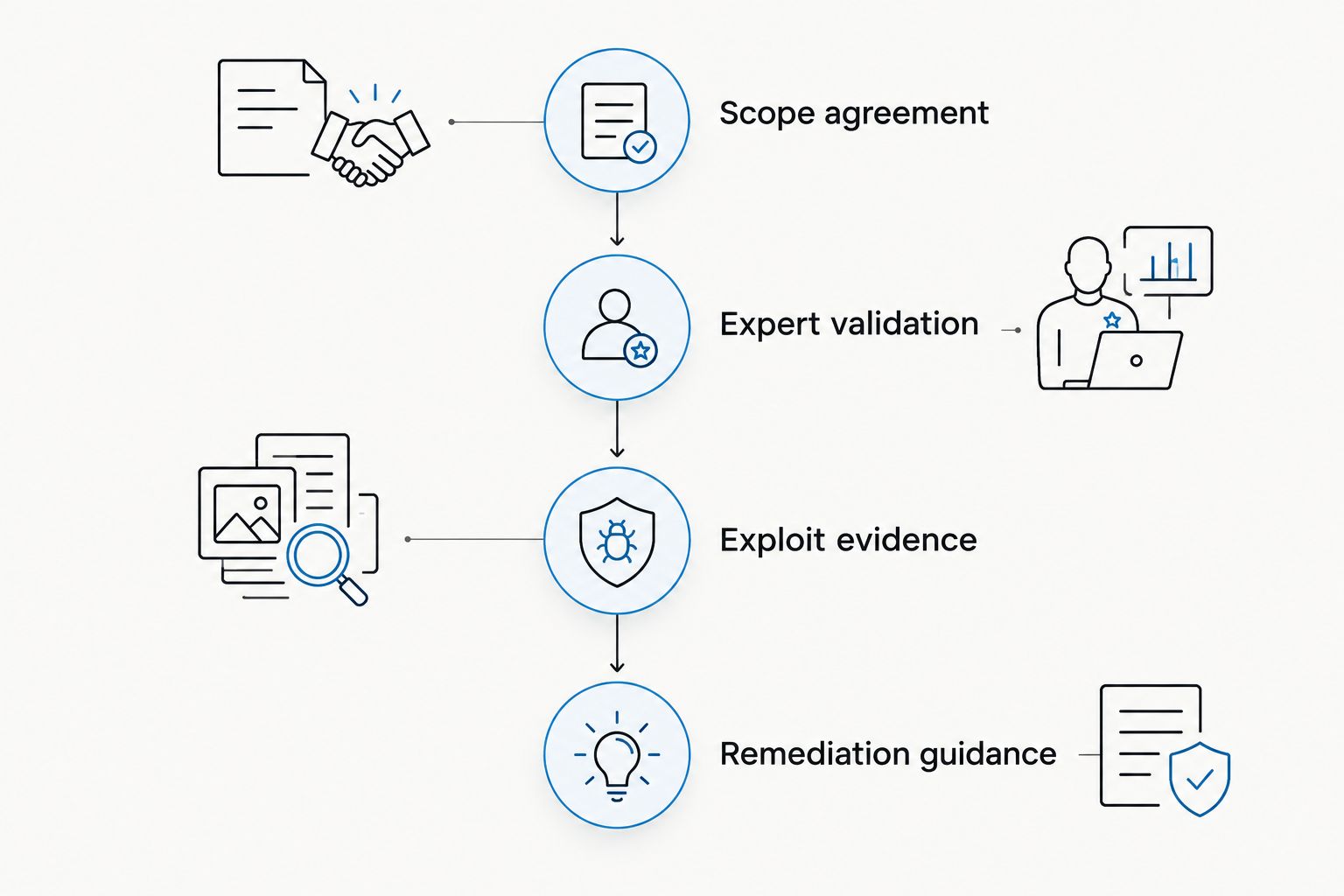
Use the same review process for CGI and every alternative. Require 3 deliverables in the proposal: an agreed scope, an evidence-backed findings report and practical remediation guidance.
Scope agreement
Record the assets, environments, accounts and testing perspective. Black-box testing starts without the internal knowledge associated with more informed approaches; explain whether that perspective matches the exposure you want examined.
Also record exclusions and operational restrictions. A production system with limited testing permissions is not equivalent to an unrestricted test environment.
Expert validation
Ask how testers distinguish exploitable findings from scanner output. The answer should explain human responsibility for investigation and validation, not merely name a collection of tools.
Manual work is not automatically sufficient either. You need a method that connects testing activity to the agreed objectives.
Exploit evidence
Review 1 finding from a redacted sample report before selecting a provider. Check whether a technical owner can understand what happened, where it happened and why it matters.
A useful report separates observed exploitation from possible consequences. It should not present an untested attack chain as a demonstrated result.
Remediation guidance
Check whether recommendations identify the underlying control failure. Removing an exposed symptom is not always the same as correcting the access-control, configuration or design problem behind it.
Agree how remediation questions and any follow-up validation will be handled. Do not assume those activities are included without written terms.
Your acceptance criteria should let another person review the engagement without reconstructing the sales discussion. Put the important commitments in the statement of work.
Discuss Your Testing Scope
Clarify testing objectives, asset boundaries and the evidence your team needs.
When staying with CGI is the right call
Stay with CGI when the proposed testing scope, evidence standards and remediation guidance meet your requirements, and the broader IT relationship adds value. There is no reason to change providers solely to obtain a different logo on a report.
An existing relationship can simplify coordination, but familiarity should not replace scope review. Apply the same acceptance criteria you would use for a new provider.
For your 2026 decision, compare the actual proposals side by side. If CGI answers the testing question clearly and the alternative does not, staying is the stronger choice.
FAQ
What’s the best CGI alternative for penetration testing in 2026?
CyberHunter is a strong fit when you need human-led, AI-assisted penetration testing with expert-validated findings and practical remediation guidance. Compare the written scope with CGI’s proposal before choosing.
Is a specialist penetration testing provider better than CGI?
A specialist provider is not automatically better than CGI. Choose the engagement that defines the right targets, validates findings and gives your team usable remediation guidance.
Is penetration testing the same as vulnerability scanning?
No. Vulnerability scanning identifies potential weaknesses, while penetration testing attempts to validate exploitation within an authorised scope. Scanner output alone does not demonstrate business impact.
Should I choose PTaaS instead of a consulting engagement?
Choose PTaaS only when the agreement’s testing coverage and delivery model fit your needs. The label does not establish continuous testing, unlimited scope or a particular level of human validation.
What should I ask for before choosing a penetration testing company?
Ask for a written scope, a redacted sample report and an explanation of who directs testing and validates findings. Confirm exclusions, operational restrictions and remediation responsibilities before authorising work.
Does penetration testing replace threat hunting?
No. Penetration testing examines exploitable weaknesses within an agreed scope, while threat hunting investigates evidence of malicious activity. Choose the service that answers your actual security question.
When should I stay with CGI for penetration testing?
Stay with CGI when its proposal meets your testing and reporting requirements and the broader technology relationship adds value. Switching providers is not an objective in itself.
One last thing
Ask every shortlisted provider to explain the limitations of its proposed test before discussing the headline findings. A clear account of excluded assets, unavailable access and prohibited techniques tells you how to interpret the eventual report.
The strongest 2026 buying decision is not the longest findings list. It is a test whose evidence supports a specific remediation decision—and whose boundaries you understand.
Related guides
- API penetration testing companies
- Web application penetration testing companies
- Penetration testing as a service providers
- Vulnerability assessment companies in Canada
