


A PlutoSec proposal with clear testing boundaries and useful evidence gives you a practical benchmark for comparing security providers. That proposal stops being enough when it does not answer your actual question: what is exploitable, what needs fixing, or whether an attacker is already present. The best PlutoSec alternative in 2026 is Cyberhunter if you need human-led, AI-assisted penetration testing with expert-validated findings; choose a vulnerability assessment if you need broader weakness identification instead.
- For PlutoSec alternatives, choose Cyberhunter penetration testing when you need expert-validated exploitability evidence and practical remediation guidance.
- Choose a vulnerability assessment to identify weaknesses; do not treat its results as proof of exploitation.
- Choose threat hunting when your question concerns attacker activity rather than a scheduled penetration test.
- Compare written scope, evidence requirements and remediation deliverables before changing providers.
Why this matters
Your shortlist should start with the security question, not the provider name. Penetration testing, vulnerability assessment and threat hunting produce different kinds of answers; buying the wrong engagement leaves the original question unresolved.
For your 2026 evaluation, distinguish a provider change from a scope change. You can replace the company and still buy the wrong service. First decide whether you need demonstrated attack paths, an inventory of weaknesses, or an investigation into suspicious activity.
PlutoSec alternatives at a glance in 2026
This comparison separates a named provider from alternative engagement types. The service categories are not claims about what PlutoSec does or does not offer: use its written proposal as the benchmark.
| Provider or approach | Best for | Defining feature | How to compare with PlutoSec |
|---|---|---|---|
| PlutoSec | Buyers whose requirements match its written proposal | The agreed scope and deliverables establish the benchmark | Assess the actual proposal, not assumptions about the provider |
| Cyberhunter penetration testing | Evidence of exploitable issues and practical remediation guidance | Human-led, AI-assisted testing directed and validated by experts | Compare testing boundaries, validation and reporting requirements |
| Vulnerability assessment | Identifying weaknesses for further prioritisation | Weakness identification without treating every finding as demonstrated exploitation | Compare coverage and validation depth within the proposed scope |
| Threat hunting | Investigating potential attacker activity | Hypothesis-led examination of relevant security evidence | Compare investigation objectives, accessible evidence and reporting expectations |
Choose the engagement that answers your security question. More findings do not automatically mean a better assessment, and a different service label does not establish deeper testing.
1. Cyberhunter: best for expert-validated penetration testing
Cyberhunter provides human-led, AI-assisted penetration testing, vulnerability assessments and cyber threat hunting. Experts direct penetration testing and validate findings, with an emphasis on evidence of exploitable issues and practical remediation guidance.
That makes Cyberhunter penetration testing a suitable alternative when your buying requirement is validated exploitability rather than an unexamined list of alerts. Write that requirement into the scope so your technical team and business stakeholders expect the same result.
Where this option shines
- Expert direction: Human testers guide the work rather than treating automated output as the final answer.
- Validated findings: The emphasis is on evidence of exploitable issues, not simply the presence of a scanner alert.
- Practical remediation: Findings should support decisions about what to fix and how to address the issue.
- Different assessment needs: Penetration testing, vulnerability assessments and threat hunting are distinct services in the offering.
Where this option falls short
- A penetration test is bounded by its agreed scope; it does not establish the security of excluded systems.
- Human-led testing still needs clear permissions, access arrangements and safety boundaries. It is not a hands-off purchasing decision.
- A penetration test is not a substitute for an investigation when your immediate concern is existing attacker activity.
Head-to-head buying criteria
| Dimension | This alternative | What to establish in a PlutoSec proposal |
|---|---|---|
| Testing direction | Experts direct penetration testing | Who directs testing and decides where to investigate further? |
| Findings validation | Experts validate findings | What validation supports each reported issue? |
| Intended evidence | Emphasis on exploitable issues | What evidence demonstrates impact within authorised boundaries? |
| Remediation | Practical guidance is part of the stated emphasis | What guidance will the team receive for corrective work? |
Best for: Businesses seeking expert-directed penetration testing with evidence-backed findings and practical remediation guidance.
Verdict: Buy when those requirements match the agreed engagement. Do not select it merely because it uses different terminology from another proposal.
2. Vulnerability assessment: best for identifying weaknesses
A vulnerability assessment focuses on identifying security weaknesses across an agreed set of assets. It is the better starting point when you need to understand what requires attention before commissioning deeper exploitation work.
Vulnerability scanning can contribute to an assessment, but the terms are not interchangeable. A scanner produces observations; an assessment adds interpretation and prioritisation appropriate to the engagement. Neither label alone establishes that a tester demonstrated an attack path.
Where vulnerability assessment shines
- It helps organise weaknesses into work that technical owners can review.
- It suits a question about exposure across a defined asset inventory.
- It can inform the scope of a subsequent penetration test.
Where vulnerability assessment falls short
- Identifying a weakness does not prove that an attacker can exploit it in your environment.
- Coverage depends on the asset inventory, access and methods included.
- A finding list still needs business context and remediation ownership.
| Dimension | Vulnerability assessment | What to compare in a PlutoSec proposal |
|---|---|---|
| Primary question | What weaknesses need attention? | Does the proposed service answer this question? |
| Evidence | Observations and supporting assessment evidence | Is exploitation demonstrated or only inferred? |
| Next action | Prioritise corrective work or deeper testing | Are findings usable by the people responsible for fixes? |
Best for: Teams that need weakness identification and prioritisation rather than a demonstration of exploitability.
Verdict: Buy for that objective; skip it as a replacement for penetration testing when demonstrated exploitation is the requirement.
3. Threat hunting: best for investigating attacker activity
Threat hunting looks for signs of adversary activity through a directed investigation of relevant security evidence. Choose it when the question is whether suspicious behaviour indicates compromise, rather than whether a weakness could be exploited.
It is not another name for penetration testing. A penetration test conducts authorised testing; a hunt investigates evidence for activity that may already have occurred or be occurring.
Where threat hunting shines
- It focuses investigation on a defined threat hypothesis or suspicious behaviour.
- It connects the security question to available logs and other relevant evidence.
- It addresses a different need from cataloguing vulnerabilities.
Where threat hunting falls short
- Missing or inaccessible evidence constrains the investigation.
- A hunt does not demonstrate that every application or network weakness has been tested.
- An investigation without confirmed findings is not a guarantee that no compromise exists.
Best for: Businesses investigating possible attacker activity through an explicitly scoped search.
Verdict: Buy for an investigation requirement; skip it as a substitute for testing exploitable weaknesses.
Why people switch from PlutoSec: evaluate the requirement
A defensible reason to switch is a mismatch between your requirements and the engagement being offered. That is a decision rule, not a claim about PlutoSec customers, service quality or contract terms.
Use these triggers to evaluate any incumbent or shortlisted provider:
- The question has changed. Your original need was weakness identification, but the current requirement is demonstrated exploitability.
- The scope has changed. Your next engagement needs different systems, user roles or business workflows included.
- The evidence requirement is clearer. Your team needs reproducible findings and remediation guidance rather than an issue title alone.
- The task is an investigation. Suspicious activity calls for investigation planning, not an assumption that a scheduled penetration test answers it.
For a 2026 renewal, ask the incumbent to address the revised requirement before treating replacement as the only answer. A corrected scope can matter more than a different provider name.
Define the engagement before comparing proposals
A useful procurement process has a clear sequence: define scope, agree on findings validation, then establish remediation expectations. Apply the same requirements to every provider so the comparison measures the work rather than the wording.
Define scope
Document the assets, access level, exclusions and operational constraints. Black-box testing begins without the internal knowledge or access that would be supplied in a more informed engagement; it answers a different question from testing with credentials and architecture details.
For an access-control evaluation, include 2 user roles if the objective is to test separation between those roles. Select 1 business workflow whose misuse would have a clear business consequence. These are suggested scoping choices, not universal coverage requirements.
Validate findings
Ask what evidence will support each finding and how the report distinguishes observed behaviour from inferred risk. Require the engagement to explain the affected asset, necessary conditions and demonstrated impact within authorised boundaries.
Do not demand unsafe exploitation merely to make a report look convincing. Agree on acceptable evidence and stopping conditions before testing starts.
Plan remediation
Ask for 3 documents during selection: a scope of work, a redacted sample report and the engagement terms. Review them together for consistency between promised testing, delivered evidence and contractual boundaries.
Assign an internal owner for corrective work. Define how verification will be handled after fixes, including its scope and terms, rather than assuming it is automatically included.
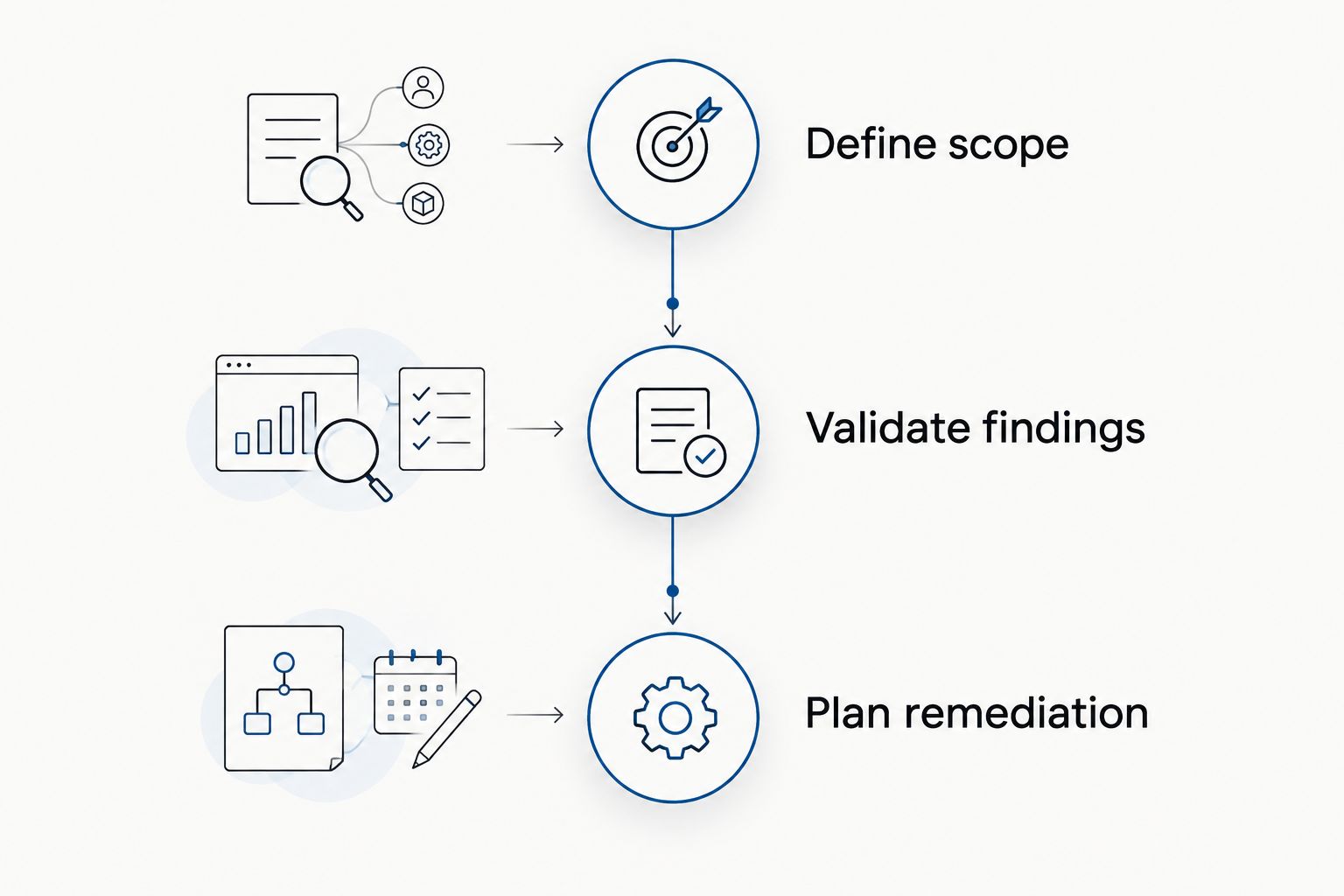
These requirements make a discovery discussion concrete. When evaluating Cyberhunter for a 2026 engagement, bring the assets, security question and evidence requirements to the conversation, then contact us to discuss scope.
When staying with PlutoSec is the right call
Stay with PlutoSec when its written engagement answers your security question, covers the required assets and supplies evidence your team can act on. A competitor list alone is not a reason to replace a provider.
Review the proposal against the same criteria used for alternatives. If the testing approach, reporting and remediation expectations fit, changing providers introduces a new selection exercise without an established benefit.
Hold when the current engagement meets your requirements. Re-scope or switch when the written comparison identifies a material gap.
FAQ
What’s the best PlutoSec alternative in 2026?
Cyberhunter is a suitable PlutoSec alternative for human-led, AI-assisted penetration testing with expert-validated findings and practical remediation guidance. Choose according to your required scope, not an assumed difference between providers.
Is Cyberhunter better than PlutoSec for penetration testing?
A provider-wide superiority claim is not the right basis for selection. Compare expert involvement, testing scope, findings evidence and remediation deliverables in the written proposals.
Should I choose a vulnerability assessment instead of penetration testing?
Choose a vulnerability assessment when your main objective is identifying weaknesses for prioritisation. Choose penetration testing when you need evidence of exploitability within an authorised scope.
Is vulnerability scanning the same as a security assessment?
No. Vulnerability scanning produces technical observations, while a security assessment evaluates its defined subject using the methods and context agreed for that engagement.
When should I choose threat hunting instead?
Choose threat hunting when your objective is investigating possible attacker activity. Define the investigation question and accessible evidence rather than treating hunting as a replacement for penetration testing.
What should I request before choosing a penetration testing provider?
Request a scope of work, a redacted sample report and the engagement terms. Check that the testing boundaries, evidence standards and remediation expectations agree across those documents.
Does a penetration test guarantee security or compliance?
No. A penetration test evaluates an agreed scope under defined conditions; it does not guarantee breach prevention or establish compliance by itself.
One last thing
Compare how providers handle a finding they cannot safely exploit. Ask what supporting evidence they record, how they explain the limitation and what decision the report enables. That answer exposes the quality of the reporting approach without requiring anyone to promise an unsafe demonstration.
For your 2026 shortlist, select the provider whose written engagement produces the evidence you need and gives your team a clear next step.
Related guides
- Web application penetration testing companies
- Vulnerability assessment companies in Canada
- Threat hunting service providers in Canada
