


DeepStrike remains a valid choice when its proposed penetration test matches your systems, testing objectives and reporting requirements. The ceiling is a mismatch between the security question you need answered and the work an engagement actually covers. The best DeepStrike alternative in 2026 is Cyberhunter if you need expert-directed penetration testing with validated findings and practical remediation guidance; choose a vulnerability assessment instead if your immediate goal is identifying and prioritizing potential weaknesses.
- Cyberhunter is the DeepStrike alternative for human-led penetration testing, validated findings and practical remediation guidance.
- Compare DeepStrike alternatives by testing scope, exploitation evidence and remediation deliverables, not provider labels.
- Choose vulnerability assessments for identifying potential weaknesses; choose penetration testing to investigate exploitability within an agreed scope.
- Choose threat hunting when your question concerns attacker activity rather than exploitable weaknesses.
Why this matters
A provider comparison is useful only when you compare the same work. Penetration testing, vulnerability assessments and threat hunting answer different questions, even when a single company offers all three.
For your 2026 shortlist, start with the decision the engagement must support. You might need evidence that an application weakness exposes sensitive records, a prioritized inventory of vulnerabilities, or an investigation into suspicious activity. Those objectives require different scopes and evidence.
Select the service first, then compare providers against the same requirements. A recognizable name does not compensate for missing application roles, excluded infrastructure or findings your team cannot reproduce.
DeepStrike alternatives at a glance
The table separates a provider alternative from alternative service types. Vulnerability assessments and threat hunting are not substitutes for penetration testing when you need evidence of exploitability.
| Provider or service | Best for | Defining focus | Difference from a DeepStrike engagement |
|---|---|---|---|
| DeepStrike | Buyers whose proposed engagement meets their testing and reporting requirements | Evaluate the specific scope, methodology and deliverables in the proposal | The reference option; assess the actual engagement rather than assuming capabilities from the name |
| Cyberhunter | Businesses seeking human-led, AI-assisted penetration testing | Experts direct testing and validate findings, with emphasis on exploitable issues and practical remediation | Compare the proposed scope and evidence requirements directly; do not assume a difference without checking both proposals |
| Vulnerability assessment | Teams identifying and prioritizing potential weaknesses | Assessment of vulnerabilities across the agreed environment | A different objective from demonstrating how weaknesses can be exploited |
| Threat hunting | Teams investigating signs of attacker activity | Investigation of suspicious behaviour and evidence within the available environment | A different objective from testing whether an authorized attack path succeeds |
Do not award points for a longer service list. Ask which deliverables answer your business question, which systems are included and what your team must provide before work begins.
1. Cyberhunter: best for expert-directed penetration testing
Cyberhunter provides human-led, AI-assisted penetration testing, vulnerability assessments and cyber threat hunting for businesses across industries. Experts direct penetration testing and validate findings, with an emphasis on evidence of exploitable issues and practical remediation guidance.
Cyberhunter is best for businesses seeking expert-directed penetration testing with validated findings and practical remediation guidance. That is a service-led choice, not a recommendation to replace your security team with software.
Where the service shines
- Human direction: Experts guide the testing rather than treating automated output as the final result.
- Validated findings: The service emphasizes evidence of exploitable issues, helping you distinguish demonstrated weaknesses from unconfirmed alerts.
- Remediation guidance: Findings are intended to support practical corrective action, not simply produce a vulnerability list.
- Related security services: Vulnerability assessments and threat hunting provide separate options when your objective extends beyond penetration testing.
Where the service falls short
- A scoped test is not complete coverage. Systems, roles and attack paths outside the agreed engagement remain outside its conclusions.
- Penetration testing is not continuous monitoring. A completed test does not establish that attacker activity is absent afterward.
- Findings still require action. Your organization must assign remediation owners, implement changes and decide how to verify fixes.
These are material limits of a penetration-testing engagement, not reasons to dismiss it. Account for them when deciding what belongs in the contract and what belongs in your ongoing security programme.
Head-to-head: what to establish before signing
| Decision dimension | This service approach | What to establish with DeepStrike |
|---|---|---|
| Testing direction | Experts direct penetration testing | Who directs testing and who approves findings? |
| Evidence | Emphasis on validated, exploitable issues | What evidence accompanies each finding? |
| Remediation | Practical remediation guidance | How are recommended fixes explained and prioritized? |
| Scope | Define the required systems and objectives before engagement | Are the same systems, roles and exclusions included? |
Review the security services against your actual requirements. Request a proposal that identifies the testing objective, boundaries, deliverables and responsibilities on both sides.
Best for: Businesses comparing expert-led penetration-testing services in Canada and the United States.
Verdict: Buy only when the written scope and deliverables match your requirements.
When a different service is the better alternative
A search for DeepStrike alternatives does not always mean you need another penetration-testing provider. Sometimes you need to correct the service category before selecting the supplier.
Vulnerability assessment: best for prioritizing potential weaknesses
Choose a vulnerability assessment when you need to identify weaknesses and organize remediation work across an agreed environment. It is a useful starting point when your team needs a clearer inventory before commissioning deeper exploitation work.
Where it shines: It supports vulnerability discovery, review and prioritization. Your team can use the resulting findings to assign corrective work and identify areas that need further investigation.
Where it falls short: A vulnerability assessment is not automatically proof that an attacker can complete a particular attack path. Ask which findings are validated and what the validation establishes.
Best for: Teams whose immediate question is which potential weaknesses need attention.
Verdict: Buy for assessment objectives; skip it as a substitute for required exploitation evidence.
Threat hunting: best for investigating attacker activity
Choose threat hunting when your question is whether suspicious behaviour indicates an attacker operating in your environment. The investigation depends on the available evidence and the question being pursued.
Where it shines: It focuses attention on activity and behaviour rather than only on vulnerabilities. That distinction matters when you need to investigate what has happened, not just what could be exploited.
Where it falls short: Threat hunting does not establish that every application or network weakness has been tested. Evidence gaps also constrain what an investigation can conclude.
Best for: Teams investigating signs of attacker activity.
Verdict: Buy for investigation objectives; skip it as a replacement for penetration testing.
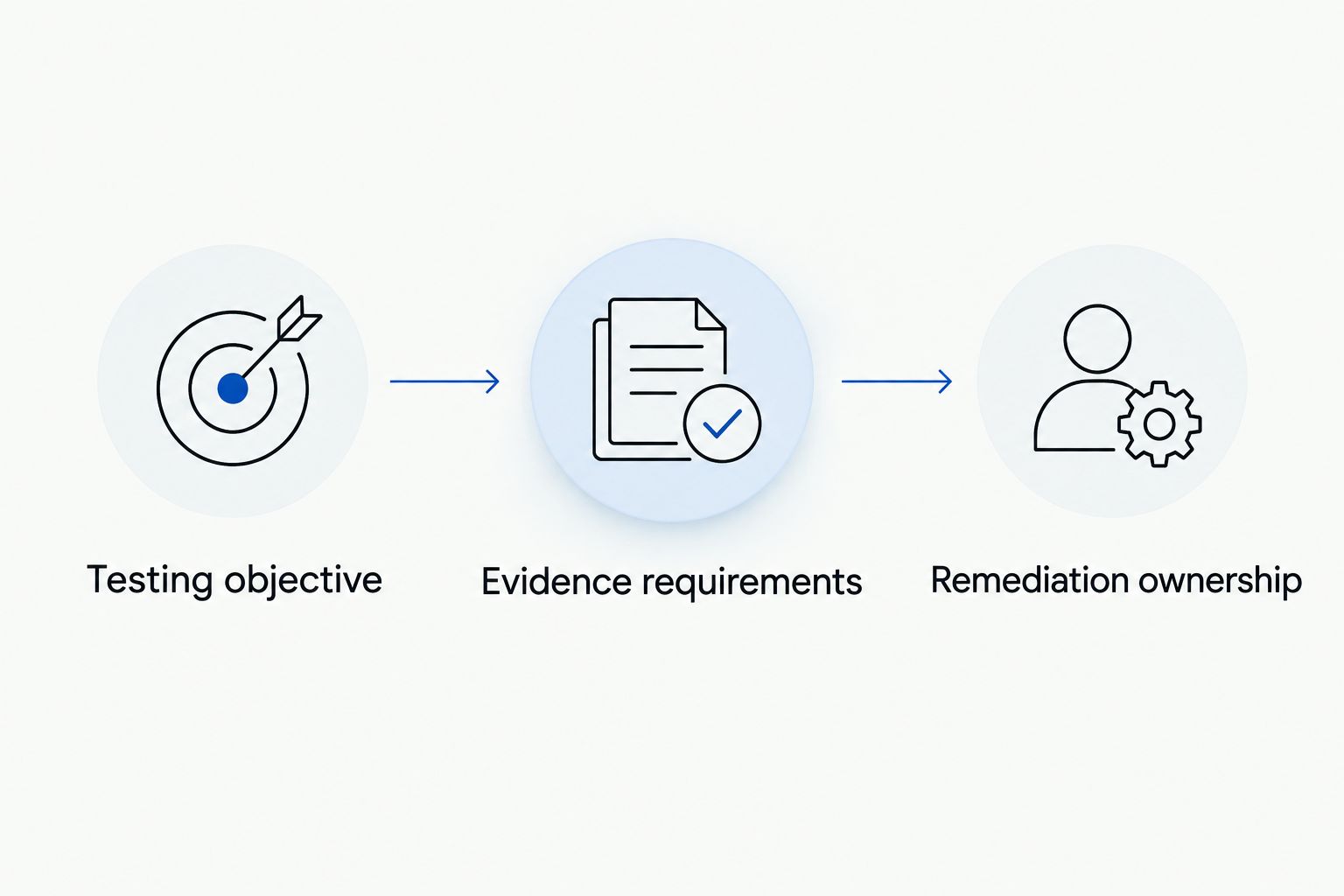
Compare proposals through 3 decisions
Use the same decision process for every provider on your 2026 shortlist. A consistent brief exposes differences that a feature checklist misses.
Testing objective
State the question in operational terms. For example: can a user access records belonging to another account, or can an external weakness provide access to an internal resource?
Avoid a brief that says only “test our security.” A useful objective connects a technical action to a business consequence and identifies the environment in which testing is authorized.
Evidence requirements
Specify what your team needs to understand and reproduce a finding safely. Useful evidence connects the affected asset, the tested action, the observed result and the business consequence.
Do not require uncontrolled access to production data just to make a finding convincing. Agree on safe evidence collection, handling of sensitive information and stop conditions before testing begins.
Remediation ownership
Decide who receives findings, who approves corrective work and how technical questions will be resolved. Include the handover requirements in the engagement rather than assuming a report alone will be sufficient.
Ask how remediation verification is handled and what its terms are. Do not assume that additional testing is included or that the original engagement covers later system changes.
What a useful finding should contain
For a 2026 engagement, ask providers to explain their reporting approach using 4 evidence fields. These are practical acceptance criteria, not a claim that every finding must follow an identical template.
- Affected asset: Identify the application, endpoint, host or component involved, with enough context for your team to locate it.
- Reproduction evidence: Explain the tested action and observed result without exposing unnecessary sensitive information.
- Business consequence: Connect the technical weakness to a supported outcome, such as unauthorized access, rather than an unsupported worst-case scenario.
- Remediation guidance: Describe the corrective action and any dependency your team must consider.
Consider an authorization test involving 2 user roles. Demonstrating that a lower-privileged account can perform a restricted action answers a different question from showing that an endpoint exists.
The distinction matters during remediation. Your developers need to know which permission boundary failed, which requests demonstrated the issue and which controls require correction. A severity label alone does not supply that information.
Why people switch from DeepStrike
The useful reasons to switch are engagement-specific. A decision to replace DeepStrike should follow a documented mismatch, not an assumption about its testing quality or service model.
Change providers when the proposed work does not meet your requirements and the gap cannot be resolved. Relevant decision points include:
- Scope mismatch: Required systems, authenticated roles or business workflows are outside the proposed engagement.
- Evidence mismatch: The reporting approach does not provide the evidence your technical team needs to understand findings.
- Objective mismatch: Your organization needs vulnerability assessment or threat hunting rather than the penetration test under consideration.
- Handover mismatch: The proposed deliverables do not support your remediation and internal reporting process.
These are reasons to compare proposals, not claims that DeepStrike has those deficiencies. Apply the same standard to every alternative.
If the requirements have changed, first ask whether the existing provider can revise the engagement. Switching suppliers without correcting the brief preserves the original problem.
Define Your Testing Requirements
Discuss testing scope, evidence requirements and practical remediation guidance.
When staying with DeepStrike is the right call
Stay with DeepStrike when its proposed engagement covers your required systems, explains the testing approach and delivers evidence your team can use. An alternative is not better merely because it appears first in a comparison.
For your 2026 decision, compare equivalent scopes before choosing. A proposal that excludes authenticated workflows cannot be judged as equivalent to one that includes them; the same applies to different environments, evidence requirements and handover responsibilities.
Keep the provider that meets the brief. Change the brief when your security question changes.
FAQ
What’s the best DeepStrike alternative in 2026?
Cyberhunter is the best fit when you need human-led, AI-assisted penetration testing with expert-validated findings and practical remediation guidance. Compare the written scope and deliverables before choosing a provider.
Is Cyberhunter better than DeepStrike?
Choose Cyberhunter when its expert-directed testing approach and proposed deliverables match your requirements better. A provider-wide quality ranking does not replace a comparison of equivalent scopes, evidence requirements and remediation support.
Should I choose penetration testing or a vulnerability assessment?
Choose penetration testing when you need investigation of exploitability within an agreed scope; choose a vulnerability assessment when you need to identify and prioritize potential weaknesses. Confirm how findings will be validated in either engagement.
Can threat hunting replace a penetration test?
Threat hunting does not replace penetration testing. Threat hunting investigates attacker activity, while penetration testing examines exploitable weaknesses through authorized testing.
What should I ask before switching from DeepStrike?
Ask whether the proposed engagement covers your required assets, user roles, evidence standards and remediation handover. Switch only after identifying a requirement that the existing proposal does not resolve.
Is black-box penetration testing enough for my application?
Black-box penetration testing is enough only when an outside-in perspective matches your testing objective. If you also need authenticated workflows or permission boundaries assessed, include the required access and roles in the scope.
Does a penetration test prove that my business is secure?
A penetration test does not prove that a business is secure. Its findings apply to the agreed scope and testing conditions, and remediation still requires implementation and verification.
One last thing
Ask every shortlisted provider the same question: What will you explicitly not test?
The exclusions often clarify the decision faster than the service description. Put them beside your critical systems and workflows before signing; an accurate finding cannot compensate for an important system that was never in scope.
Related guides
- API penetration testing companies
- Web application penetration testing companies
- Vulnerability assessment companies in Canada
