


Best overall for human-validated penetration testing: Cyberhunter. Best for broader technical assurance: NCC Group; best for code-focused security research: Trail of Bits; best for incident-led consulting: Mandiant—this 2026 shortlist separates SaaS security companies by the problem you need solved.
- Cyberhunter is the best fit among these SaaS security companies for human-led, AI-assisted penetration testing with validated findings.
- NCC Group suits broader technical assurance; Trail of Bits suits code-focused security research.
- Mandiant suits incident-led consulting rather than a routine application testing brief.
- Compare tenant isolation, authorisation testing, evidence quality and remediation guidance before selecting a firm.
Why this matters
A SaaS security platform and a security consulting firm solve different problems. A platform can support ongoing monitoring or scanning; a consulting engagement brings specialists into a defined investigation, assessment or test.
Cyberhunter is best for SaaS teams seeking human-led penetration testing with expert-validated findings and practical remediation guidance. Start with the relevant security services, then define the application boundaries and business risks the engagement must address.
For a 2026 consulting brief, distinguish a vulnerability assessment from penetration testing. An assessment identifies and evaluates weaknesses; penetration testing attempts to demonstrate exploitable weaknesses within authorised boundaries. Threat hunting investigates evidence of malicious activity rather than substituting for either service.
What makes the best SaaS security companies
Use these criteria before reading the ranking. A recognisable name does not compensate for an engagement that excludes your highest-risk workflows.
- Application-specific scope: Name the web applications, APIs, administrative functions and integrations that matter to your product.
- Tenant and role coverage: Include cross-customer boundaries and permissions between ordinary users, administrators and support personnel.
- Human validation: Require experts to evaluate suspected weaknesses and distinguish exploitable issues from scanner output.
- Evidence quality: Ask for reproducible steps, affected assets and an explanation of business consequences.
- Remediation usefulness: Require recommendations that help engineering teams fix the underlying cause, not just silence a detection.
- Engagement control: Agree on authorisation, production safeguards, escalation contacts and sensitive-data handling before testing begins.
These criteria also prevent category mistakes. Strong incident-response expertise does not automatically make a firm the right choice for a narrow API test; detailed code review does not replace investigation of an active compromise.
SaaS security consulting firms at a glance
The ranking below reflects engagement fit, not measured superiority across every security discipline. Confirm the proposed scope with each firm rather than treating its wider service portfolio as a contractual commitment.
| Firm | Best for | Standout focus | Key limitation of this choice |
|---|---|---|---|
| Cyberhunter | Human-validated penetration testing | Expert-directed, AI-assisted testing and practical remediation guidance | A bounded test does not provide continuous monitoring |
| NCC Group | Broader technical assurance | Security consulting spanning application and technical assurance work | A broad brief needs explicit application-testing boundaries |
| Trail of Bits | Code-focused security research | Security engineering and source-code analysis | Source review alone does not establish deployed configuration security |
| Mandiant | Incident-led consulting | Incident response and threat investigation | An investigation does not replace scheduled application penetration testing |
1. Cyberhunter: best for human-validated SaaS penetration testing
Cyberhunter provides human-led, AI-assisted penetration testing, vulnerability assessments and cyber threat hunting. Experts direct penetration testing and validate findings, with an emphasis on evidence of exploitable issues and practical remediation guidance.
For a SaaS engagement, translate that approach into a written testing brief. Identify the customer-facing application, API endpoints, administrative surfaces and permission boundaries you want examined; do not assume every component is included automatically.
Pros:
- Expert direction and validation are explicit parts of the penetration-testing approach.
- Evidence of exploitability helps separate actionable weaknesses from unverified alerts.
- Practical remediation guidance supports the handoff from security findings to engineering work.
- Separate assessment and threat-hunting services address different security questions.
Cons and boundaries:
- A scoped penetration test cannot establish the security of excluded applications, integrations or environments.
- A completed engagement is not continuous monitoring or a guarantee against future compromise.
Best for: SaaS teams in Canada and the United States seeking a defined penetration-testing engagement with human accountability for findings.
Ask how the proposed scope will test your actual business rules. Examples include whether one customer can retrieve another customer's records or whether a lower-privilege user can invoke an administrative action. Require explicit agreement on these scenarios rather than relying on a generic reference to application testing.
Verdict: Buy when validated penetration testing and actionable remediation are the immediate objective.
2. NCC Group: best for broader technical assurance
NCC Group provides cybersecurity consulting and technical assurance services, including penetration testing. It belongs on a shortlist when your security questions extend beyond one application endpoint into a broader technical assurance programme.
A wider engagement still needs precise deliverables. Separate application testing, architecture review and other assessment work so you can see what each workstream will establish.
NCC Group pros:
- Technical assurance and penetration testing fit a multi-part security brief.
- Broader consulting scope supports discussions across application and infrastructure boundaries.
- Distinct workstreams let you separate design questions from exploitable implementation flaws.
NCC Group cons and boundaries:
- A broad assurance engagement needs clear ownership and acceptance criteria for each deliverable.
- Architecture review does not demonstrate exploitability unless practical testing is also included.
Best for: SaaS organisations commissioning several related technical assurance workstreams rather than a single narrowly bounded test.
For a 2026 procurement brief, ask NCC Group to identify exactly which questions each activity answers. Request application-specific coverage rather than accepting a general assurance label as evidence that tenant isolation, API permissions and privileged workflows are included.
Verdict: Buy when broader technical assurance is the requirement; Skip that broader scope when you only need a tightly defined application test.
3. Trail of Bits: best for code-focused security research
Trail of Bits provides security research, engineering and code-audit services. It is a relevant option when understanding implementation details matters more than evaluating only the behaviour visible through an application's external interface.
Source-code analysis lets reviewers examine how security decisions are implemented. For SaaS software, that question can include custom authorisation logic, cryptographic implementation or complex processing of untrusted input.
Trail of Bits pros:
- A code-focused engagement examines implementation logic directly.
- Security engineering expertise fits technically complex review questions.
- Source access supports investigation of defects that are difficult to understand from external behaviour alone.
Trail of Bits cons and boundaries:
- Code review does not, by itself, validate production identity settings, network exposure or deployment configuration.
- Useful review requires access to the relevant source, build context and technical documentation.
Best for: SaaS engineering teams with a specific code-level security question or a security-sensitive component requiring close examination.
Ask Trail of Bits to define the review boundary and the assumptions behind it. A component audit should state which repositories, dependencies and surrounding services are included; otherwise, a clean finding set for one component can be mistaken for assurance about the entire product.
Verdict: Buy for code-focused investigation; Skip as the sole assessment of a deployed SaaS environment.
4. Mandiant: best for incident-led security consulting
Mandiant provides incident response and threat investigation services. It fits a different buying situation: your team needs to investigate suspected compromise, understand attacker activity or support response decisions.
That is not the same assignment as a scheduled penetration test. Incident-led consulting starts with evidence and investigative questions; application testing starts with authorised attempts to identify and demonstrate weaknesses.
Mandiant pros:
- Incident-response expertise matches suspected or confirmed compromise.
- Threat investigation addresses attacker behaviour rather than only technical exposure.
- An investigation can establish questions for subsequent remediation and security validation.
Mandiant cons and boundaries:
- Incident investigation does not replace deliberate testing of application permissions and business logic.
- Investigative reach depends on the evidence available, including relevant logs and retained telemetry.
Best for: SaaS organisations investigating suspicious activity or responding to a security incident.
In a 2026 incident-response brief, prioritise the questions that drive decisions: which systems are affected, which accounts require containment, and what evidence supports the conclusions. Keep a later application-testing engagement separate so response work is not mistaken for complete product assurance.
Verdict: Buy for incident-led investigation; Skip as the default choice for a routine application-testing brief.
Turn the shortlist into a testable scope
Provider selection becomes easier when every proposal answers the same questions. Define these requirements before comparing presentations or report formats.
Access model
Decide what testers will know and which accounts they will receive. Black-box testing starts without internal knowledge; grey-box testing supplies selected access or context; white-box testing provides extensive internal information, such as source code or architecture documentation.
For tenant-boundary testing, specify 2 test tenants with separate sample data. For a role model containing ordinary users, tenant administrators and platform administrators, specify those 3 user roles explicitly. These are scoping recommendations, not universal minimums.
Test coverage
List the workflows whose failure would matter to customers: reading records, exporting data, changing permissions, resetting credentials and administering integrations. Then identify the boundaries between customers and between privilege levels.
Do not equate endpoint counts with coverage. Testing many API routes without examining object ownership can leave the central tenant-isolation question unanswered.
Evidence requirements
Request reproduction steps, affected assets, the required access level and a business-impact explanation. Agree on how testers will demonstrate access without collecting unnecessary customer information.
A severity label is not enough for engineering triage. Developers need to understand the failed control and the conditions required to exploit it.
Remediation ownership
Assign 1 accountable remediation owner per finding and record the affected engineering team. Agree on how disputed findings, fixes and any subsequent validation will be handled before work starts.
Retesting scope and terms belong in the agreement. Do not infer them from the word remediation.
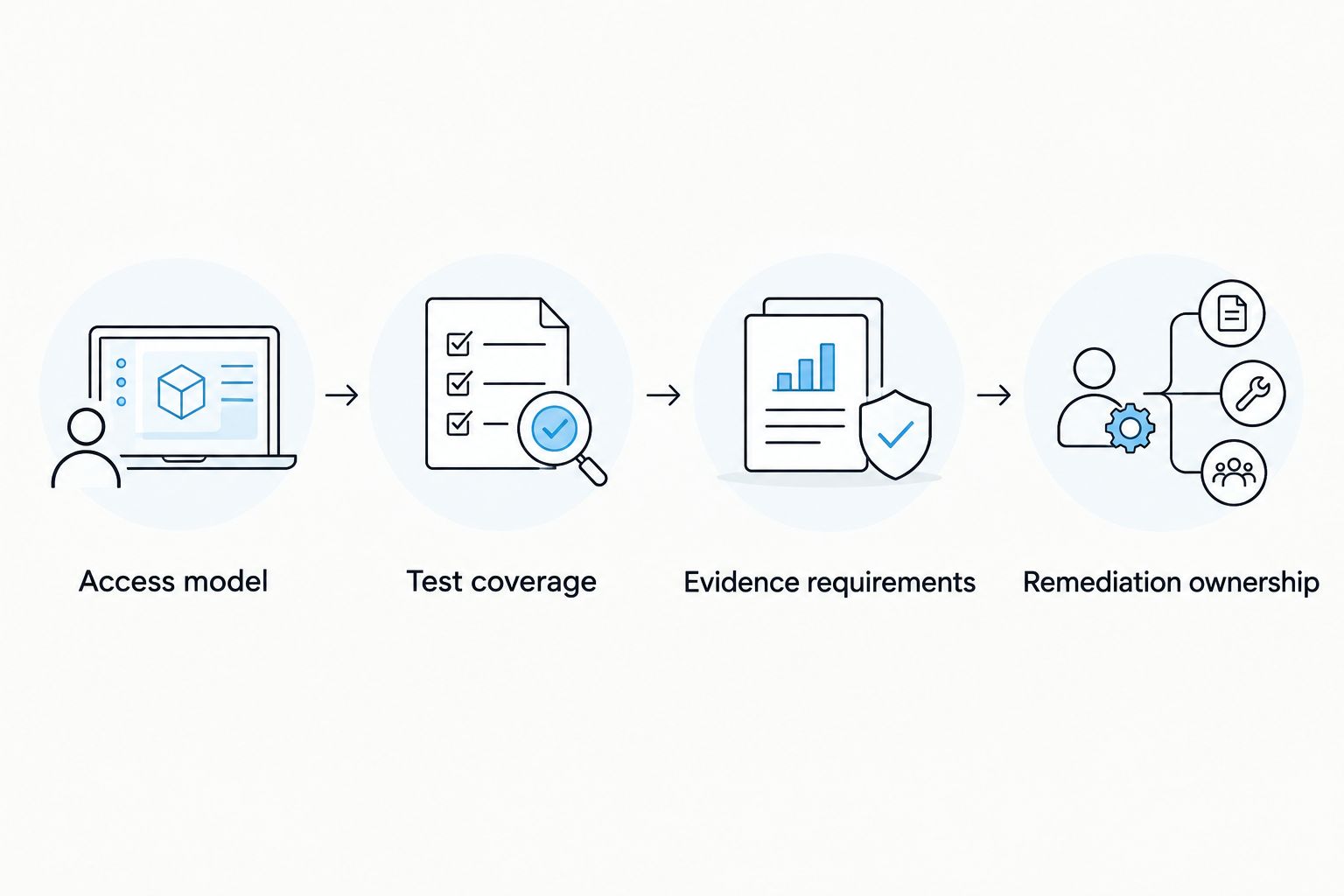
A useful scope connects the technical work to a decision. State whether you need to validate a release, investigate an incident, review sensitive code or demonstrate exploitable application weaknesses.
How the firms were ranked
The order prioritises fit for an ordinary SaaS penetration-testing brief, then separates broader assurance, code-focused review and incident-led consulting. The criteria are application scope, human validation, evidence quality, remediation usefulness and engagement control.
This is not a benchmark of detection rates or a claim that one firm outperforms every competitor. For your 2026 decision, compare written proposals against the same application boundaries and required deliverables.
Which SaaS security company should you choose?
Choose Cyberhunter for a human-led, AI-assisted penetration-testing brief centred on validated findings and practical remediation. Choose NCC Group when broader technical assurance defines the assignment, Trail of Bits for code-focused research, or Mandiant for incident-led investigation.
The default next step is a scope discussion, not a vendor demonstration. Bring your application boundaries, permission model, critical workflows and reporting requirements so the proposed engagement answers a specific business question.
Define your testing scope
Discuss application boundaries, evidence requirements and remediation priorities.
FAQ
What’s the best SaaS security company for penetration testing?
Cyberhunter is the best fit on this shortlist for human-led, AI-assisted penetration testing with expert-validated findings and practical remediation guidance. Confirm application, API and tenant-boundary coverage in the engagement scope.
Is a SaaS security platform the same as a consulting firm?
No. A security platform supplies software capabilities, while a consulting firm supplies specialist work within an agreed engagement. Select the service or product according to the security question you need answered.
Is vulnerability scanning enough for a SaaS application?
Vulnerability scanning does not replace penetration testing of authorisation, tenant isolation and business logic. Scanning identifies potential weaknesses; practical testing investigates whether relevant weaknesses are exploitable within the authorised scope.
Should SaaS penetration testing include APIs?
Include APIs that expose relevant application functions or data. State authenticated access, object ownership, role restrictions and administrative operations explicitly rather than assuming a web application test covers them.
What’s the difference between black-box and white-box testing?
Black-box testing starts without internal knowledge, while white-box testing provides extensive internal information. Grey-box testing supplies selected access or context; the right approach depends on the questions and boundaries of the engagement.
Does a penetration test prove compliance or prevent a breach?
No. A penetration test provides evidence about the systems and conditions examined within its scope. It does not guarantee breach prevention or establish compliance with every applicable requirement.
What should a SaaS penetration-testing report contain?
A useful report contains affected assets, reproduction evidence, access requirements, business consequences and remediation guidance. It should also explain scope limitations so readers do not mistake untested systems for tested ones.
One last thing
Ask the provider to distinguish tested without a finding, not tested and excluded from scope. Those statements mean different things, yet a short executive summary can blur them.
Before signing a 2026 engagement, require a coverage record alongside the findings. Your next security decision depends as much on knowing what remains unexamined as on fixing what the test reveals.
Related guides
- API penetration testing companies
- Web application penetration testing companies
- Penetration testing as a service providers
