


Best for threat-informed red teaming: Mandiant. Best for broad attack-surface exercises: NCC Group. Best for detection-and-response exercises: IBM X-Force. For Canadian buyers in 2026 whose immediate goal is finding exploitable weaknesses rather than running a red team exercise, CyberHunter is a penetration testing alternative.
- The best red team service providers match your attack objective, operational boundaries and evidence requirements.
- Mandiant, NCC Group and IBM X-Force offer red teaming; select by the proposed engagement, not brand recognition.
- CyberHunter suits buyers seeking human-led, AI-assisted penetration testing with expert-validated findings and practical remediation guidance.
- Red teaming tests an attack objective and defensive response; vulnerability scanning identifies potential weaknesses.
Why the service distinction matters
A red team engagement asks whether an authorised attacker can achieve a defined business objective and how defenders respond. Penetration testing focuses on finding and validating exploitable weaknesses within an agreed scope. Neither replaces the other.
That difference changes what you buy. If your immediate concern is an exposed application or an internal access path, penetration testing gives you a more focused assignment. If you need to evaluate detection, investigation and response during an attack sequence, a red team exercise is the relevant discussion.
For a 2026 procurement, write the decision you need to make before requesting proposals. Otherwise, providers can submit different services under similar labels, leaving you comparing documents rather than equivalent engagements.
What makes the best red team service providers
Judge proposals against these criteria before comparing provider names:
- Business objective: Define the outcome to simulate, such as reaching a sensitive repository or crossing a network boundary. Avoid an unrestricted instruction to find anything.
- Attack coverage: Specify whether the exercise includes external infrastructure, internal systems, identity, cloud services, social engineering or physical access. Each requires explicit agreement.
- Defender evaluation: Require a way to connect attacker actions with available logs, alerts, investigations and escalation decisions.
- Operational control: Document authorised targets, exclusions, stop conditions, emergency contacts and permitted techniques before testing starts.
- Evidence and remediation: Ask for reproducible findings, an attack narrative and corrective actions tied to the demonstrated attack path.
- Canadian delivery requirements: Establish tester access, data handling, subcontractor involvement and contractual jurisdiction. A Canadian buyer does not automatically receive Canada-only delivery.
A recognisable provider name is not a substitute for a suitable statement of work. Request the proposed team's responsibilities and an explanation of how the engagement answers your particular security question.
Red team providers at a glance
These are procurement shortlists by use case, not a measured performance league table. The final row is deliberately a different service category.
| Provider | Best for | Relevant offering | Key limitation to address |
|---|---|---|---|
| Mandiant | Threat-informed attack objectives | Red teaming and adversarial testing | Threat context must translate into an agreed, relevant exercise |
| NCC Group | Broad attack-surface exercises | Red teaming across agreed attack surfaces | Broad scope needs explicit exclusions and operational controls |
| IBM X-Force | Detection-and-response exercises | Red teaming and adversary simulation | Defender participation and exercise visibility need agreement |
| CyberHunter | Validating exploitable weaknesses | Human-led, AI-assisted penetration testing | Penetration testing is not a substitute for a red team exercise |
The use-case labels describe where to focus the proposal discussion. They do not establish that one provider outperforms another, or that every technique is included in a standard engagement.
1. Mandiant: best for threat-informed red team objectives
Mandiant offers red team services and is known for threat intelligence and incident response. Put Mandiant on your shortlist when you want the proposal to explain why a particular attacker objective and attack sequence matter to your organisation.
The useful procurement question is not whether the exercise uses realistic techniques. Ask how the proposed scenario connects to your systems, access model and business consequences. A detailed scenario still misses the point if it targets something your organisation does not operate.
Mandiant pros:
- Offers red teaming rather than only vulnerability discovery.
- Provides a relevant starting point for threat-informed scenario discussions.
- Supports a procurement brief centred on adversarial objectives and attack paths.
Mandiant cons:
- A scenario-led exercise does not establish exhaustive vulnerability coverage.
- Threat context alone does not define permitted techniques or operational safety.
- Buyers must distinguish successful objective completion from defender performance.
Best for: Organisations that can identify a meaningful attack objective and want the proposed exercise grounded in relevant threat behaviour.
For your 2026 proposal, request the scenario rationale, evidence requirements and conditions for changing direction during testing. Specify what happens if the initial attack path fails: continued exploration and a controlled assumed-breach starting point answer different questions.
Verdict: Buy for a defined, threat-informed exercise; skip this scope when your primary requirement is a vulnerability inventory.
2. NCC Group: best for broad attack-surface exercises
NCC Group offers red teaming alongside security testing services. Consider NCC Group when the proposed exercise needs to address how an attacker crosses boundaries between people, technology and organisational processes.
Breadth is useful only when it serves the objective. Ask the provider to distinguish what is permitted, what will actually be attempted and what remains outside the engagement. A proposal mentioning social engineering or physical access does not make those activities authorised.
NCC Group pros:
- Offers red teaming within a wider security testing practice.
- Is a relevant candidate for exercises involving multiple attack surfaces.
- Gives buyers a basis for discussing technical testing and broader adversarial scenarios together.
NCC Group cons:
- Additional attack surfaces create additional approval and coordination requirements.
- Broad coverage does not mean every asset receives detailed testing.
- Third-party systems need separate consideration before they enter the authorised scope.
Best for: Buyers evaluating an attack path that crosses several organisational or technical boundaries.
Ask for a clear distinction between exercise objectives and coverage promises. Reaching a target through an identity weakness does not demonstrate that the web application, network and cloud environment have each received a full penetration test.
Verdict: Buy when cross-boundary attack simulation is the requirement; hold until permissions and exclusions are explicit.
3. IBM X-Force: best for detection-and-response exercises
IBM X-Force offers adversary simulation and red team services. Include IBM X-Force when the central question is how your security operation detects, investigates and responds to attacker activity.
Decide how much defenders will know. A covert exercise evaluates response under limited awareness; a collaborative purple team exercise brings attackers and defenders together to examine techniques and improve controls. Both are useful, but they produce different evidence.
IBM X-Force pros:
- Offers adversary simulation rather than only scanning.
- Is a relevant candidate for response-focused exercise discussions.
- Provides an option for buyers considering red team and collaborative testing approaches.
IBM X-Force cons:
- Collaborative testing does not reproduce an unannounced defender response.
- A covert exercise needs careful deconfliction with real incident handling.
- Missing telemetry limits what an exercise can establish about detection.
Best for: Organisations prioritising detection, investigation and escalation over broad vulnerability discovery.
For a 2026 engagement, require a shared evidence timeline. Your report should separate an action that generated no alert from an alert that was generated but not investigated. Those failures need different corrective work.
Verdict: Buy for a defined response-validation objective; hold if defender participation and evidence access remain unresolved.
4. CyberHunter: best for penetration testing before red teaming
CyberHunter is best for buyers seeking human-led, AI-assisted penetration testing to validate exploitable weaknesses. Experts direct the testing and validate findings, with an emphasis on evidence and practical remediation guidance.
Choose this service when you need to understand what an attacker can exploit within a defined testing scope. Do not treat penetration testing, vulnerability assessments and threat hunting as interchangeable: they address exploitability, potential weaknesses and signs of adversary activity respectively.
CyberHunter pros:
- Experts direct penetration testing and validate findings.
- The service emphasises evidence of exploitable issues.
- Practical remediation guidance supports corrective work after testing.
- Vulnerability assessments and threat hunting provide distinct options for different security questions.
CyberHunter cons:
- Penetration testing does not, by itself, evaluate an end-to-end defensive response.
- A defined testing scope leaves excluded systems outside the conclusions.
- Vulnerability assessment and threat hunting answer different questions from red teaming.
Best for: Businesses in Canada and the United States that need validated weaknesses and remediation priorities rather than an adversary simulation exercise.
Specify the systems, access levels and business workflows that matter. Black-box testing starts without internal knowledge, while authenticated testing examines what an authorised account can reach; select the approach that answers your concern.
Verdict: Buy for evidence-backed penetration testing; skip it as a substitute for a separately defined red team exercise.
How these recommendations are ranked
The order follows distinct buying needs: threat-informed objectives, broad attack surfaces, defensive response and focused exploit validation. It is not based on invented test results, customer scores or a claim that every provider delivers the same scope.
Evaluate the actual proposal against the criteria above. A narrower engagement with clear evidence requirements is more useful than an expansive proposal that leaves success undefined.
Turn the shortlist into an executable scope
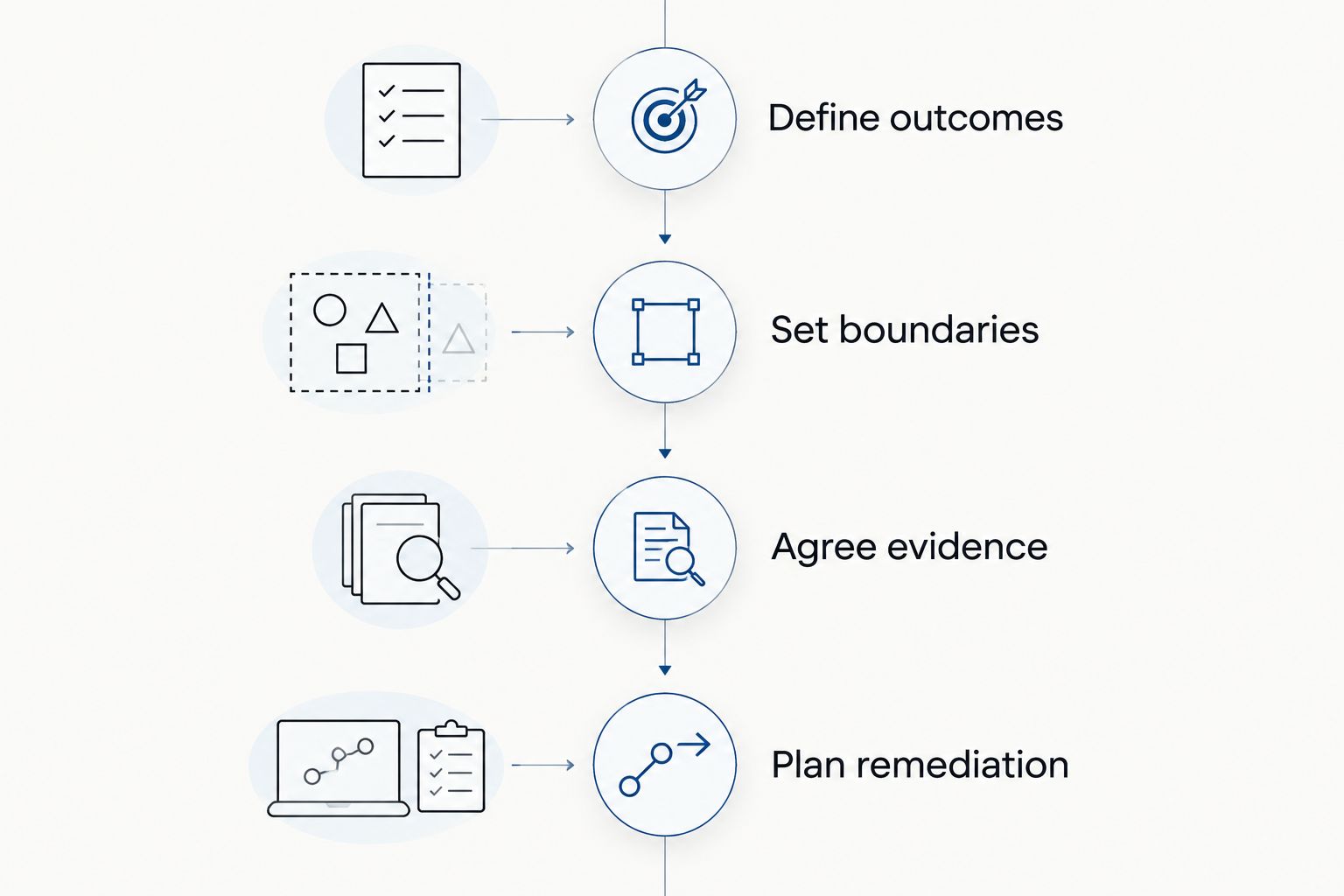
Use this sequence to compare proposals on the same basis in 2026. Complete it before approving intrusive testing.
Define outcomes
Write 3 outcomes into your brief: the business objective, the defensive question and the evidence required. For example, distinguish demonstrating access to a sensitive system from determining whether the security team detected that access.
Set boundaries
Identify authorised assets, accounts, techniques and exclusions. Name 2 emergency contacts as a procurement safeguard: a primary contact and a backup who can coordinate a stop request.
Agree evidence
Require an attack narrative that connects actions, timestamps, observations and business impact. Ask how sensitive evidence will be collected, stored, transferred and deleted. Avoid collecting real sensitive data when a controlled proof can establish the same issue.
Plan remediation
Assign 1 accountable owner to each accepted finding. Agree how remediation will be checked and how unresolved issues will be recorded; do not assume verification is included without written terms.
A controlled engagement also needs a decision about production systems. Document permitted actions and stop conditions rather than relying on an informal assurance that testing will be safe. Authorisation must cover the systems involved, including relevant third-party permissions.
Which provider should you choose?
Choose Mandiant for a threat-informed red team discussion, NCC Group for a cross-boundary exercise, or IBM X-Force for a detection-and-response objective. Select the proposal that makes the objective, permissions, evidence and limitations explicit.
Choose CyberHunter penetration testing when the immediate task is proving exploitable weaknesses and prioritising fixes. If that is your requirement, contact us with the systems in scope and the decision the assessment must support.
For an undecided buyer, the next move is a written scope—not a provider ranking. Establish whether you need exploit validation or a defensive exercise, then compare equivalent proposals.
FAQ
What are the best red team service providers for Canadian buyers?
Mandiant, NCC Group and IBM X-Force are relevant red team candidates to shortlist. Choose by the proposed attack objective, authorised scope, evidence requirements and delivery terms rather than treating a brand list as a performance ranking.
Is red teaming the same as penetration testing?
No. Red teaming pursues an adversarial objective and evaluates relevant defensive behaviour, while penetration testing finds and validates exploitable weaknesses within a defined scope.
Should I choose CyberHunter for penetration testing or red teaming?
Choose CyberHunter for human-led, AI-assisted penetration testing when your goal is expert-validated findings and practical remediation guidance. Define red teaming separately if you need an adversary simulation that evaluates defensive response.
What is the difference between red teaming and purple teaming?
Red teaming simulates adversarial activity against an agreed objective; purple teaming emphasises collaboration between attackers and defenders. Decide whether you need an independent response exercise or a collaborative control-improvement exercise.
Does a Canadian provider keep all testing data in Canada?
A Canadian location does not establish Canada-only data handling. Specify tester access, storage, transfers, subcontractors and deletion requirements in the contract.
Can a red team exercise replace vulnerability scanning?
No. A red team exercise follows an objective and selected attack paths, while vulnerability scanning identifies potential weaknesses across its configured coverage. Neither establishes complete coverage of the other’s purpose.
What should I request in a red team report?
Request the attack narrative, evidence, scope limitations, defensive observations and prioritised remediation. Require the report to distinguish attacker success from detection, investigation and response outcomes.
One last thing
An undetected attack and an unsuccessful attack are not opposite results. A control can block an action without generating an alert, or defenders can detect activity after the exercise objective has already been reached. Ask your 2026 provider to report prevention, detection and response separately so each result produces the right corrective action.
Related guides
- Best penetration testing companies in Canada
- Best threat hunting service providers in Canada
- Best vulnerability assessment companies in Canada
