


Best for focused security testing: Cyberhunter. Best for incident response: Mandiant. Best for ongoing managed detection: CrowdStrike. This 2026 guide compares cloud security services companies by the work you need completed, separating testing, response, monitoring and transformation rather than treating them as interchangeable services.
- Cyberhunter is the best fit here for businesses buying penetration testing and vulnerability assessments rather than a security platform.
- The best cloud security services companies match your cloud environment, required evidence and operational responsibilities.
- Mandiant suits incident response; CrowdStrike suits managed detection; Palo Alto Networks suits platform-centred security operations.
- Accenture suits broader cloud-security transformation. Require explicit scope, deliverables and ownership before signing.
Why this matters
Cloud security is not a single purchase. Finding an exploitable application flaw, investigating compromised credentials and redesigning cloud access controls require different engagements. A company can perform one of those jobs without being the right choice for the others.
Your 2026 shortlist should start with the outcome: validate exposure, investigate an incident, monitor activity or change how security operates. Buying a monitoring service does not automatically give you a penetration test. Commissioning a penetration test does not give you continuous detection.
Choose the service before choosing the company. Then compare providers against the same scope, with the same assumptions about access, responsibilities and reporting.
What makes the best cloud security services companies
Use these criteria to evaluate a proposal before accepting a provider's category label:
- Cloud scope: Named accounts, subscriptions, projects, applications and identity boundaries belong in the statement of work.
- Service fit: Distinguish penetration testing, vulnerability assessment, threat hunting, incident response and managed detection.
- Evidence quality: Findings should explain affected assets, supporting evidence, business impact and remediation actions.
- Access model: Identify what the provider can assess externally and what requires authenticated access or logs.
- Operational ownership: Assign investigation, containment, remediation and escalation responsibilities explicitly.
- Verification: State whether remediation validation is included, separately scoped or outside the engagement.
For a 2026 procurement exercise, compare written commitments rather than broad service descriptions. A clear exclusion is more useful than an impressive capability list that never appears in your contract.
Cloud security services companies at a glance
These rankings reflect distinct buying situations, not a claim that every company offers an equivalent package. Confirm the proposed service and supported environment directly with each provider.
| Company | Best for | Standout service focus | Key limitation |
|---|---|---|---|
| Cyberhunter | Focused penetration testing and vulnerability assessment | Testing, assessments and cyber threat hunting | Agree cloud assets, access and deliverables explicitly |
| Mandiant | Incident response and investigation | Incident response and threat intelligence | An investigation is not a substitute for routine security operations |
| CrowdStrike | Ongoing managed detection | Managed threat detection and response | Testing and remediation work require separate scope checks |
| Palo Alto Networks | Platform-centred security operations | Security platforms and associated services | Platform fit does not establish independent testing coverage |
| Accenture | Large cloud-security transformation | Security consulting and implementation | A broad programme needs tightly defined workstreams |
1. Cyberhunter: best cloud security services fit for focused testing
Cyberhunter provides penetration testing, vulnerability assessments and cyber threat hunting for businesses across sectors including finance, healthcare, hospitality and retail. That service mix fits buyers who need security weaknesses investigated rather than another software product added to their environment.
Cyberhunter is the best fit here for businesses buying penetration testing and vulnerability assessments rather than a security platform. For a cloud engagement, specify whether the work concerns exposed applications, network services, identities, configuration or suspected attacker activity. Those are different assessment boundaries.
Cyberhunter pros:
- Offers penetration testing, vulnerability assessments and threat hunting.
- Fits a service-led purchase rather than a product comparison.
- Serves businesses across several stated sectors.
Cyberhunter cons:
- The service description alone does not establish coverage for your particular cloud environment.
- Retesting, operational monitoring and remediation responsibilities need explicit agreement.
Best for: Businesses seeking a defined testing or assessment engagement. Request a statement of work that connects each in-scope asset to a test objective and an expected deliverable.
Verdict: Buy for focused assessment work once the cloud scope is agreed.
2. Mandiant: best cloud security services option for incident response
Mandiant provides incident response, investigation and threat intelligence services. It belongs on your shortlist when the immediate question is whether an attacker gained access, what happened and what containment work is required.
An incident-response engagement differs from an ordinary assessment. Investigators need evidence preservation, access to relevant telemetry and authority to coordinate with your team. Ask which cloud logs, identities and workloads the proposed investigation covers before treating the engagement as complete.
Mandiant pros:
- Clear fit for incident investigation and response.
- Threat intelligence is relevant to understanding attacker activity.
- Suits a defined response question rather than a generic security review.
Mandiant cons:
- Incident investigation does not replace continuous monitoring.
- A response engagement does not automatically include a full application or configuration assessment.
Best for: Organisations investigating suspected compromise or preparing an incident-response arrangement. Define the escalation route and decision authority before an emergency forces the issue.
Verdict: Buy for incident response; skip as a substitute for routine testing.
3. CrowdStrike: best cloud security services option for managed detection
CrowdStrike provides security technology and managed detection and response services. It suits organisations that need ongoing attention to security signals rather than a point-in-time assessment alone.
The buying question is operational: which signals enter the service, who investigates them and what happens after a finding? Map your cloud assets and identity sources to the proposed coverage. Do not assume that monitoring one part of the environment means every application, account and workload is covered.
CrowdStrike pros:
- Provides managed detection and response services.
- Fits an ongoing operational requirement.
- Combines security technology with managed service options.
CrowdStrike cons:
- Detection coverage depends on the agreed telemetry and deployment scope.
- Managed detection does not establish that application logic or cloud configuration has been penetration tested.
Best for: Security teams seeking ongoing managed detection with defined escalation responsibilities. Require the proposal to distinguish an alert, an investigated finding and an authorised response action.
Verdict: Buy for continuous detection; hold if the immediate need is independent testing.
4. Palo Alto Networks: best for platform-centred security operations
Palo Alto Networks supplies security platforms and security services. It belongs on a cloud-security shortlist when your decision includes the technology used to support security operations, not just an external assessment.
Start with the operational problem rather than the platform catalogue. Identify the controls you need to operate, the systems they must connect to and the people responsible for acting on findings. Then distinguish implementation assistance, ongoing operations and independent assurance in the proposal.
Palo Alto Networks pros:
- Offers security platforms alongside services.
- Fits buyers evaluating technology and service requirements together.
- Supports a platform-centred approach to security operations.
Palo Alto Networks cons:
- Platform adoption does not replace independent assessment.
- Product capabilities and contracted service responsibilities are different things.
Best for: Organisations making a platform-centred security decision. Ask the provider to identify what the service team performs, what the technology performs and what remains with your staff.
Verdict: Buy when platform fit is central; hold for a testing-only requirement.
5. Accenture: best for cloud-security transformation programmes
Accenture provides security consulting and implementation services within broader technology programmes. It fits organisations where cloud security changes involve architecture, operating processes and responsibilities across multiple teams.
A transformation programme is different from buying a penetration test. You need an agreed destination, named workstreams and acceptance criteria for each deliverable. Separate architecture decisions from implementation and assurance so that completing a deployment does not automatically count as proving its security.
Accenture pros:
- Provides consulting and implementation services.
- Fits security work connected to wider technology changes.
- Suits programmes involving several organisational functions.
Accenture cons:
- A broad programme requires clear boundaries to keep deliverables measurable.
- Transformation work does not automatically include independent penetration testing or ongoing detection.
Best for: Organisations coordinating cloud-security changes across technology and operating processes. Keep responsibility for risk acceptance with a named business owner, not an undefined project group.
Verdict: Buy for coordinated transformation; skip a broad programme for an isolated testing need.
How these companies are ranked
This 2026 ranking prioritises service fit: focused testing, incident response, ongoing detection, platform-centred operations and transformation. The order does not represent a measured performance comparison or an interchangeable list of managed service packages.
Use the criteria above to judge proposals against your environment. A provider's broader capabilities matter only when they appear in the engagement you are purchasing. The best proposal makes the work, evidence and ownership explicit.
Turn your shortlist into a testable scope
Before requesting proposals, write a short scope that every company can answer. Start with the business system you need to protect, then identify its cloud resources, application interfaces, identities and external dependencies. State exclusions just as clearly as inclusions.
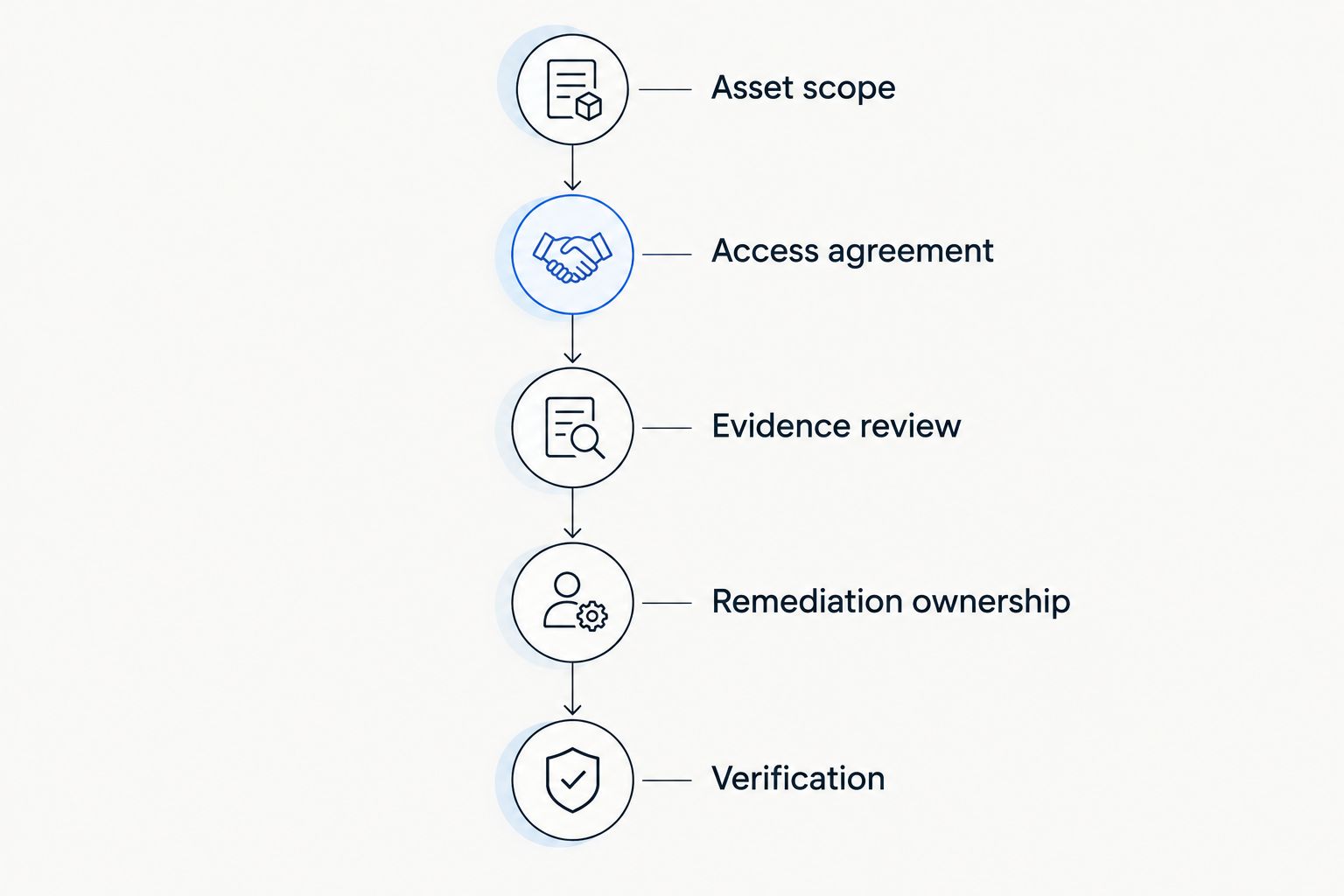
Separate the engagement into these stages:
- Asset scope: Name the systems and boundaries under review.
- Access agreement: Define credentials, permissions, logs and testing constraints.
- Evidence review: Agree what demonstrates a finding and its business impact.
- Remediation ownership: Assign responsibility for each corrective action.
- Verification: Define how completed fixes will be checked.
This sequence prevents a common procurement mistake: accepting a report without first agreeing what it must prove. In 2026, a cloud-security engagement should leave your team able to distinguish an untested asset from a tested asset with no reported finding.
For AWS environments, AWS cloud security requires a clear distinction between the infrastructure AWS operates and the identities, configurations, applications and data controls your organisation manages. Make those customer-side responsibilities explicit in the assessment rather than treating the hosting platform as the entire security boundary.
Request 3 deliverables: an executive summary, technical findings and a remediation register. These are recommended purchasing requirements, not claims about any provider's standard package. Each technical finding should identify the affected asset, supporting evidence and a corrective action your team can assign.
Plan for 2 reporting audiences: decision-makers approving risk and engineers implementing fixes. Appoint 1 accountable owner for each remediation item. A technically detailed report still fails its purpose if nobody owns the next action.
Which cloud security services company should you choose?
Choose Cyberhunter when your priority is penetration testing, vulnerability assessment or threat hunting within an agreed scope. Choose Mandiant for incident investigation, CrowdStrike for ongoing managed detection, Palo Alto Networks for a platform-centred decision and Accenture for broader transformation.
If you are undecided, do not buy the broadest package. Write down the security question you need answered first. Your 2026 choice should follow that question, with any additional services evaluated separately rather than assumed to be included.
FAQ
What’s the best cloud security services company for my business?
The best company depends on whether you need testing, incident response, ongoing detection or transformation. Cyberhunter fits a focused penetration testing or vulnerability assessment purchase; agree the cloud assets, access and deliverables before commissioning work.
Is cloud penetration testing the same as a vulnerability assessment?
No. A vulnerability assessment identifies and evaluates weaknesses, while penetration testing attempts to validate exploitable attack paths within an authorised scope. Ask how the proposed engagement handles validation, evidence and testing constraints.
Is managed detection better than penetration testing?
Neither replaces the other. Managed detection watches for suspicious activity within its coverage, while penetration testing evaluates weaknesses during a defined engagement. Choose according to the question you need answered.
Can one company handle all my cloud security needs?
One company can provide several services, but the contract must define each service separately. Do not infer incident response, remediation or independent testing from a general cloud-security description.
What should I ask before hiring a cloud security provider?
Ask which assets are covered, what access is required, what evidence you receive and who owns remediation. Also confirm testing restrictions, escalation responsibilities and whether verification of fixes is included.
Does hosting on AWS remove the need for security testing?
No. Your organisation still needs to assess the applications, identities, configurations and data controls it manages. Define that customer-controlled scope before selecting an assessment or testing service.
What should a cloud security assessment report include?
Request an executive summary, technical findings and a remediation register. Technical findings should identify affected assets, explain supporting evidence and give actionable remediation guidance, with exclusions stated clearly.
One last thing
Ask every shortlisted provider to describe what happens to a finding after the report is delivered. Who receives it, who fixes it and who checks the result?
A report is evidence, not remediation. Put the handoff and verification process into the agreement before work begins. That single purchasing decision makes the assessment easier to act on and prevents an unresolved finding from being mistaken for completed security work.
Related guides
- Best penetration testing as a service providers
- Best web application penetration testing companies
- Best threat hunting service providers in Canada
