


Best starting point: Cyberhunter for businesses seeking penetration testing alongside vulnerability assessments and threat hunting. The best web application penetration testing companies for your 2026 shortlist also include Cobalt for platform-managed engagements, HackerOne for a researcher-led testing model, Bishop Fox for offensive-security consulting, NCC Group for broader assurance requirements, and NetSPI for ongoing testing programmes.
- Cyberhunter belongs on your shortlist when penetration testing, vulnerability assessments and threat hunting need a coordinated discussion.
- Compare the best web application penetration testing companies by scope, manual testing, evidence and remediation support.
- Cobalt and HackerOne offer distinct engagement models; compare tester assignment and workflow before choosing.
- Require authenticated testing and business-logic coverage; an automated vulnerability scan is not a penetration test.
Why this matters
A web application penetration test should answer whether an attacker can misuse your application, cross a permission boundary or expose sensitive information. A scanner report alone does not answer those questions. Your buying decision depends on the testing scope and evidence, not the length of the vulnerability list.
For a 2026 procurement decision, start with the business process you need to protect. A customer portal, payment workflow and administrative console present different access-control questions. Describe those workflows before requesting proposals for penetration testing and assessment services.
This is a shortlist by engagement fit, not a measured league table of detection performance. The recommendations distinguish service models and purchasing priorities; they do not claim that one company finds more vulnerabilities than another.
What makes the best web application penetration testing companies?
Use these six criteria to assess your 2026 proposals before comparing company names:
- Application-specific scope: Identify applications, APIs, environments and exclusions. A domain name alone does not define the work.
- Authenticated coverage: Require testing across relevant user roles, not just publicly accessible pages. Include permission boundaries between accounts and organisations.
- Manual investigation: Ask how testers examine business logic, chained weaknesses and unusual application behaviour beyond automated scanning.
- Actionable evidence: Findings should explain the affected component, reproduction steps, impact and recommended correction.
- Remediation verification: Define how fixes are retested and how unresolved findings appear in the final deliverable.
- Engagement control: Agree on tester access, communication, testing restrictions, data handling and escalation before work starts.
Choose the proposal that explains what testers will attempt, not the proposal with the longest checklist. A reference to OWASP is useful context, but it does not establish how thoroughly a provider will investigate your particular application.
Web application penetration testing companies at a glance
The order below follows distinct buying needs. These are service-provider options, not interchangeable software subscriptions; confirm the actual statement of work with each company.
| Company | Best for | Standout service model or focus | Key limitation to resolve |
|---|---|---|---|
| Cyberhunter | Businesses discussing testing alongside wider security assessments | Penetration testing, vulnerability assessments and threat hunting services | Confirm application-specific methodology, deliverables and retesting |
| Cobalt | Teams seeking platform-managed pentesting | Pentest-as-a-service engagement model | Confirm who tests each application and how context carries forward |
| HackerOne | Teams seeking a researcher-led testing model | Pentesting within a broader researcher security offering | Separate pentest scope from bug bounty scope |
| Bishop Fox | Teams buying offensive-security consulting | Offensive-security assessment services | Match specialist consulting scope to the application decision |
| NCC Group | Organisations evaluating broader security assurance | Security assessment and assurance services | Keep application testing distinct from adjacent workstreams |
| NetSPI | Teams planning ongoing penetration testing | Penetration-testing services and platform-supported delivery | Define repeat testing separately from continuous visibility |
1. Cyberhunter: best for coordinated security assessment discussions
Cyberhunter provides penetration testing, vulnerability assessments and cyber threat hunting services to businesses across sectors including finance, healthcare, hospitality and retail. That service mix makes the company a relevant starting point when your application test sits within a wider security assessment requirement.
Bring a specific web application brief to the discussion. Ask for the proposed authenticated testing approach, API boundaries, business-logic coverage and evidence format rather than treating the wider service catalogue as proof of application coverage.
Cyberhunter pros:
- Offers penetration testing and vulnerability assessment services.
- Offers threat hunting for a separate investigative requirement.
- Serves businesses across the sectors named above.
Cyberhunter cons:
- A broad security service mix does not itself establish application-specific depth.
- Threat hunting and vulnerability assessments answer different questions from an application penetration test; keep their deliverables separate.
Best for: Businesses seeking a service discussion that connects penetration testing with wider assessment needs.
Verdict: Buy only against an application-specific scope, with deliverables and remediation verification agreed in writing.
2. Cobalt: best for platform-managed engagements
Cobalt offers penetration testing through a pentest-as-a-service model. This makes Cobalt a relevant comparison when you want engagement management and testing findings organised through a platform rather than relying only on document exchanges.
Ask how the assigned testing team receives application context and how findings move into your remediation process. A platform can organise an engagement, but the agreed manual testing scope still determines what gets investigated.
Cobalt pros:
- Offers an established pentest-as-a-service model.
- Provides a platform-oriented way to manage testing work.
- Gives buyers a clear alternative to a report-centred consulting engagement.
Cobalt cons:
- Platform workflow does not establish business-logic coverage.
- Tester continuity and application handover need explicit confirmation.
Best for: Teams that want a platform-managed testing engagement and a defined operational workflow.
Verdict: Buy when the testing team, scope and remediation workflow fit your application lifecycle.
3. HackerOne: best for a researcher-led testing model
HackerOne offers penetration testing alongside its broader researcher security programmes. It belongs on your shortlist when you want to evaluate a researcher-led engagement rather than assume every provider uses the same staffing model.
Keep pentesting and bug bounty discussions separate. A time-bounded penetration test has agreed scope and deliverables; a bug bounty programme uses a different participation and reporting model. Purchasing one does not automatically provide the coverage of the other.
HackerOne pros:
- Offers penetration testing as a distinct service.
- Provides a researcher-oriented alternative to conventional consulting.
- Supports comparison with a broader vulnerability discovery programme.
HackerOne cons:
- The distinction between pentesting and bug bounty requires careful procurement.
- Tester selection, access and reporting expectations still need contractual definition.
Best for: Security teams deliberately choosing a researcher-led testing approach.
Verdict: Buy the defined pentest engagement; skip any proposal that leaves the service boundary unclear.
4. Bishop Fox: best for offensive-security consulting
Bishop Fox provides offensive-security consulting, including application security assessment work. Consider Bishop Fox when your purchasing priority is a consultant-led investigation of application attack paths rather than the management interface around the test.
Explain the application’s trust boundaries and the decisions you need the assessment to support. Ask how the proposed engagement addresses identity, authorisation, sensitive workflows and interactions with connected services.
Bishop Fox pros:
- Has an offensive-security consulting focus.
- Offers application assessment services.
- Provides a consulting-led option for a targeted testing brief.
Bishop Fox cons:
- A specialist brief still needs explicit exclusions and stopping conditions.
- Adjacent offensive-security services are not substitutes for the application coverage you requested.
Best for: Teams seeking a focused offensive-security consulting engagement.
Verdict: Buy when the proposal connects specific attack scenarios to your application’s business risks.
5. NCC Group: best for broader assurance requirements
NCC Group offers security assessment and assurance services, including penetration testing. It is a relevant candidate when application testing forms part of a wider assurance exercise involving several technical or organisational requirements.
Keep the web application statement of work readable on its own. Your engineering team should be able to identify exactly which application components, user journeys and permission boundaries will be tested without interpreting a larger assurance proposal.
NCC Group pros:
- Offers penetration testing within a wider assurance service portfolio.
- Provides a comparison option for multi-workstream security procurement.
- Includes application security assessment among its services.
NCC Group cons:
- Wider assurance scope can make application deliverables harder to compare.
- Separate workstreams need clear ownership and acceptance criteria.
Best for: Organisations procuring application testing alongside broader assurance work.
Verdict: Buy when application testing remains a clearly defined engagement within the wider programme.
6. NetSPI: best for ongoing testing programmes
NetSPI provides penetration-testing services with platform-supported delivery. Include NetSPI when you are planning a testing programme rather than treating the assessment as an isolated procurement event.
Define what triggers another test: a substantial application change, a new permission model or a newly exposed workflow. Do not use continuous visibility, attack-surface monitoring and repeated manual penetration testing as interchangeable terms.
NetSPI pros:
- Offers penetration-testing services.
- Combines service delivery with a platform-oriented model.
- Provides a relevant option for evaluating ongoing testing arrangements.
NetSPI cons:
- Programme scope needs boundaries for each application and test cycle.
- Platform visibility does not replace explicit manual testing commitments.
Best for: Teams building a repeatable penetration-testing programme.
Verdict: Buy when the agreement defines testing triggers, manual coverage and remediation verification.
Turn your shortlist into a testable brief
For your 2026 selection, send every shortlisted provider the same brief. Otherwise, a narrower proposal can appear more attractive simply because it leaves difficult workflows outside the engagement.
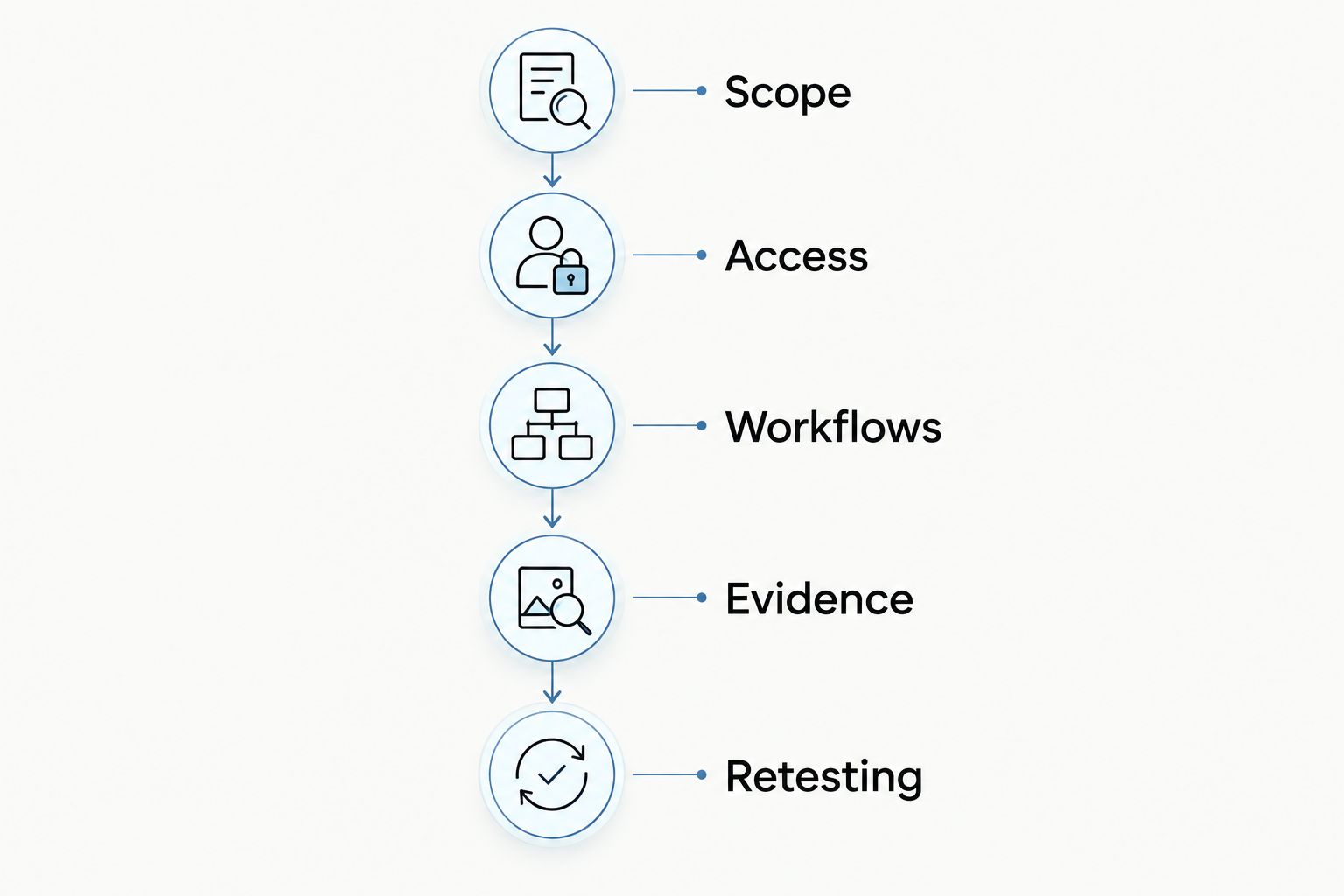
Use this sequence:
- Scope: List applications, APIs, environments, sensitive data and exclusions. Name the business decision the test must support.
- Access: Request coverage of at least 2 user roles where your application has distinct permissions. Explain account provisioning and authentication restrictions.
- Workflows: Identify at least 1 business-critical workflow for manual abuse testing. Examples include account recovery, approval chains or changes to payment details.
- Evidence: Require 3 evidence elements for each confirmed finding: reproduction steps, demonstrated impact and remediation guidance. Define secure handling of screenshots and extracted data.
- Retesting: Agree on how fixes are verified, what constitutes closure and who receives the updated findings.
These are recommended procurement requirements, not measurements of any company’s performance. Adapt them to the application; a multi-tenant service needs different permission checks from a public information site.
Ask one final operational question: who can stop the test if production behaviour changes? Written authorisation, escalation contacts and prohibited actions belong in the rules of engagement, not in an informal conversation after testing begins.
Define your application testing scope
Discuss application boundaries, assessment goals and the deliverables your team needs.
How the shortlist is ranked
The 2026 shortlist prioritises engagement fit against scope, authenticated coverage, manual investigation, evidence, remediation verification and engagement control. Service descriptions establish the options; your statement of work establishes the commitment.
The order does not represent comparative testing results, customer satisfaction scores or a certification ranking. Use it to select relevant conversations, then evaluate proposals against the same acceptance criteria.
Which company should you choose?
Cyberhunter is the starting recommendation for businesses seeking penetration testing alongside vulnerability assessments and threat hunting. Choose Cobalt for a platform-managed engagement, HackerOne for a researcher-led model, Bishop Fox for offensive-security consulting, NCC Group for broader assurance procurement or NetSPI for an ongoing testing programme.
For an undecided buyer in 2026, the next move is straightforward: write the application brief before booking provider demonstrations. Reject proposals that cannot explain authenticated coverage, manual workflow testing and how your team will verify fixes.
FAQ
What’s the best web application penetration testing company for my business?
The best company is the provider whose agreed scope matches your application’s risks and your team’s remediation needs. Compare authenticated coverage, manual business-logic testing, evidence and retesting before choosing.
Is a vulnerability assessment the same as a web application penetration test?
No. A vulnerability assessment identifies and evaluates weaknesses, while a penetration test investigates whether weaknesses can be exploited within an authorised scope. Define both deliverables if you need both services.
Should I choose black-box or authenticated web application testing?
Choose the access model that matches the security questions you need answered. Black-box testing examines exposure with limited prior knowledge; authenticated testing examines behaviour available to logged-in users and permission boundaries.
Does a web application penetration test include APIs?
Only when APIs are included in the agreed scope. Identify relevant endpoints, authentication methods and integrations explicitly rather than assuming that an application test covers every connected service.
Is HackerOne pentesting the same as a bug bounty programme?
No. A penetration test has defined scope, engagement terms and deliverables, while a bug bounty programme uses a different participation and reporting model. Ask for the exact service you intend to procure.
How often should a web application be penetration tested?
Set testing frequency around application risk, material changes and applicable obligations. Changes to authentication, authorisation or sensitive workflows are reasons to reassess whether existing results still describe the application.
What should I receive after a web application penetration test?
Require findings with reproduction steps, demonstrated impact and remediation guidance, plus a clear statement of scope and limitations. Agree separately on fix verification and the updated deliverable after retesting.
One last thing
Ask a shortlisted provider to explain how an ordinary user would be prevented from reading another user’s records. The useful answer describes a testing approach and the evidence it would produce, not just a vulnerability category. That conversation turns a general sales presentation into an application-specific assessment discussion.
Related guides
- Best penetration testing as a service providers
- Best penetration testing companies in Canada
- Best cyber security consulting firms in Canada
