


Best starting point for human-led testing: Cyberhunter. Best platform-led shortlist: Cobalt and NetSPI. Best broader consulting shortlist: NCC Group. Best offensive-security shortlist: Bishop Fox. This 2026 guide compares API penetration testing options and explains what to confirm before commissioning an engagement.
- The best API penetration testing companies prove authorization failures and explain remediation, rather than only reporting scanner alerts.
- Cyberhunter suits businesses seeking human-led penetration testing with expert-validated findings; confirm API-specific scope before commissioning.
- Compare Cobalt, NetSPI, NCC Group and Bishop Fox against your testing workflow and required technical coverage.
- Require cross-account testing, agreed safety limits and reproducible evidence in the statement of work.
Why this matters
An API can authenticate a user correctly and still expose another customer's records. A vulnerability scan alone does not establish whether your application's authorization rules withstand deliberate misuse.
Your 2026 buying decision should therefore start with the business actions an attacker could perform: reading another tenant's data, changing restricted fields or abusing a sensitive workflow. Choose a company against those scenarios, not the length of its tool list.
Cyberhunter is a fit for businesses seeking human-led penetration testing with expert-validated findings and practical remediation guidance. Confirm that the proposed engagement covers your specific APIs; general penetration testing experience does not establish coverage of every protocol or architecture.
What makes the best API penetration testing companies
Use these criteria before comparing providers:
- Authorization coverage: Testing must distinguish authentication from permission checks, including access across users, roles and tenants.
- Business-logic testing: The scope should include misuse of legitimate functions, not just malformed requests and known vulnerabilities.
- Human validation: Experts should investigate results and establish what is actually exploitable within the agreed boundaries.
- Reproducible evidence: Findings should identify affected requests, required privileges, observed behaviour and remediation guidance.
- Operational controls: Written rules should cover environments, sensitive data, prohibited actions and escalation contacts.
- Remediation support: Agree how engineers can ask questions and how subsequent validation will be handled.
A company's reputation cannot replace an API-specific statement of work. Request a redacted example finding and a proposed approach to your highest-risk workflow before making the selection.
API penetration testing companies at a glance
This is a procurement shortlist, not a claim that every provider has been independently tested or that one company wins every API engagement. The order starts with human-led delivery, then separates platform-based purchasing from broader consulting and offensive-security options.
| Company | Best for | Distinguishing starting point | Key limitation to resolve |
|---|---|---|---|
| Cyberhunter | Human-led testing with validated findings | Experts direct penetration testing and validate findings | Confirm API-specific scope and deliverables |
| Cobalt | Evaluating a pentest-as-a-service workflow | Publicly offers penetration testing as a service | Confirm manual API coverage within the engagement |
| NetSPI | Evaluating platform-supported testing management | Publicly offers penetration testing and a delivery platform | Confirm what the proposed API engagement includes |
| NCC Group | Comparing testing within a broader security consultancy | Publicly offers security consulting and penetration testing | Ensure the proposal remains specific to API risks |
| Bishop Fox | Comparing an offensive-security specialist | Publicly offers offensive-security services | Confirm engagement fit and required API expertise |
1. Cyberhunter: best for human-led testing and validated findings
Cyberhunter provides human-led, AI-assisted penetration testing, vulnerability assessments and threat hunting. Experts direct the penetration testing and validate findings, with an emphasis on evidence of exploitable issues and practical remediation guidance.
That delivery model suits buyers who need engineering teams to understand and act on findings. For an API engagement, ask how the proposed scope will address authorization, sensitive workflows and the evidence required to demonstrate business impact.
Pros:
- Expert direction and validation are explicit parts of the service model.
- The stated approach prioritizes exploitable issues and practical remediation.
- Separate assessment and threat-hunting services allow a discussion about which security question actually needs answering.
Engagement considerations:
- Confirm API protocols, authentication methods and business workflows in scope rather than assuming coverage.
- Agree remediation validation terms; do not assume retesting is included.
Best for: Businesses seeking human-led penetration testing and actionable, validated findings across Canada and the United States.
Verdict: Shortlist Cyberhunter when expert validation is a priority; commission only against an agreed API-specific scope.
2. Cobalt: best for evaluating a pentest-as-a-service workflow
Cobalt publicly offers penetration testing as a service. It belongs on the shortlist when you want to evaluate how a service-based testing workflow fits your release and remediation process.
Separate the delivery model from the depth of testing. A convenient workflow does not, by itself, demonstrate that testers will investigate tenant isolation or application-specific authorization rules.
Cobalt pros:
- A relevant candidate for comparing pentest-as-a-service purchasing.
- Provides a clear alternative to evaluating consultancies solely through traditional engagement proposals.
- Supports a focused procurement discussion about how testing and remediation work will be organized.
Cobalt engagement considerations:
- Confirm the manual API testing activities rather than treating the service label as a methodology.
- Establish who answers engineering questions and what happens after findings are delivered.
Best for: Teams evaluating a pentest-as-a-service model alongside conventional consulting engagements.
Verdict: Shortlist Cobalt for its delivery model; select it only after confirming technical coverage.
3. NetSPI: best for evaluating platform-supported testing management
NetSPI publicly offers penetration testing and a delivery platform. Consider it when your procurement question includes how testing engagements and findings will be managed, not only who performs the assessment.
Keep management features separate from security outcomes. Ask the proposed team to explain how it will test a real authorization boundary in your application, then evaluate how those findings reach the engineers responsible for fixing them.
NetSPI pros:
- Relevant to buyers comparing penetration testing with platform-supported delivery.
- Offers a useful comparison point when findings management is part of the selection criteria.
- Allows technical scope and delivery workflow to be evaluated as separate requirements.
NetSPI engagement considerations:
- Confirm which testing activities and deliverables belong to the proposed engagement.
- Do not assume a platform determines the depth of business-logic testing.
Best for: Organizations evaluating testing management and technical assessment together.
Verdict: Shortlist NetSPI when delivery management matters, but require API-specific evidence expectations.
4. NCC Group: best for a broader security consulting shortlist
NCC Group publicly offers security consulting and penetration testing. It is a relevant candidate when API testing forms part of a wider security review rather than a standalone procurement exercise.
A broader engagement still needs precise boundaries. Identify which API questions require active exploitation, which require architecture review and which fall outside the proposed work.
NCC Group pros:
- A relevant comparison for buyers considering a broader security consultancy.
- Provides an alternative to a platform-first purchasing approach.
- Suits a procurement discussion that separates penetration testing from other advisory requirements.
NCC Group engagement considerations:
- A broad consulting proposal needs explicit API deliverables.
- Confirm the proposed team's relevant experience instead of relying on the company name alone.
Best for: Buyers comparing API penetration testing within a wider consulting requirement.
Verdict: Shortlist NCC Group when scope extends beyond API testing; preserve clear API acceptance criteria.
5. Bishop Fox: best for an offensive-security specialist shortlist
Bishop Fox publicly offers offensive-security services. Consider it when your selection process centres on how a provider approaches adversarial testing and demonstrates exploitable weaknesses.
Ask for the engagement methodology that applies to your API architecture. The relevant question is whether the proposed work follows realistic misuse paths through your application, not whether the provider uses offensive-security terminology.
Bishop Fox pros:
- A relevant candidate for an offensive-security-focused comparison.
- Provides a different procurement starting point from platform-led testing options.
- Fits a selection process centred on exploitation evidence and attacker objectives.
Bishop Fox engagement considerations:
- Confirm API-specific expertise within the proposed team and scope.
- Agree operational limits before allowing exploitation against sensitive workflows.
Best for: Buyers specifically evaluating an offensive-security specialist.
Verdict: Shortlist Bishop Fox for an adversarial testing discussion; require concrete API scenarios before selection.
What your API testing scope must include
For a 2026 engagement, give every shortlisted provider the same scope brief. Otherwise, apparently comparable proposals can describe materially different work.
Start with your API inventory, authentication flows, user roles, tenant boundaries and sensitive operations. Include REST, GraphQL or other interfaces that actually exist in your environment; do not assume one assessment automatically covers every interface.
Authentication
Ask how testers will assess identity verification, session handling and token-related controls. Establish whether authenticated and unauthenticated testing are both included.
Authorization
Provide at least 2 user accounts with different permissions and, where applicable, 2 tenant environments. These are recommended test prerequisites, not universal coverage thresholds: they enable deliberate checks across boundaries that a single account cannot exercise.
Business logic
Name workflows where misuse has business consequences. Examples include changing ownership, bypassing an approval or accessing an export that should be restricted. Only include operations relevant to your application.
Safety controls
Document environments, permitted actions, data-handling requirements and stop conditions. Production testing needs explicit authorization; it should never be inferred from permission to test another environment.
Remediation evidence
Require 3 report elements for each actionable finding: reproducible evidence, business impact and remediation guidance. Additional context should explain the privileges and conditions needed for exploitation.
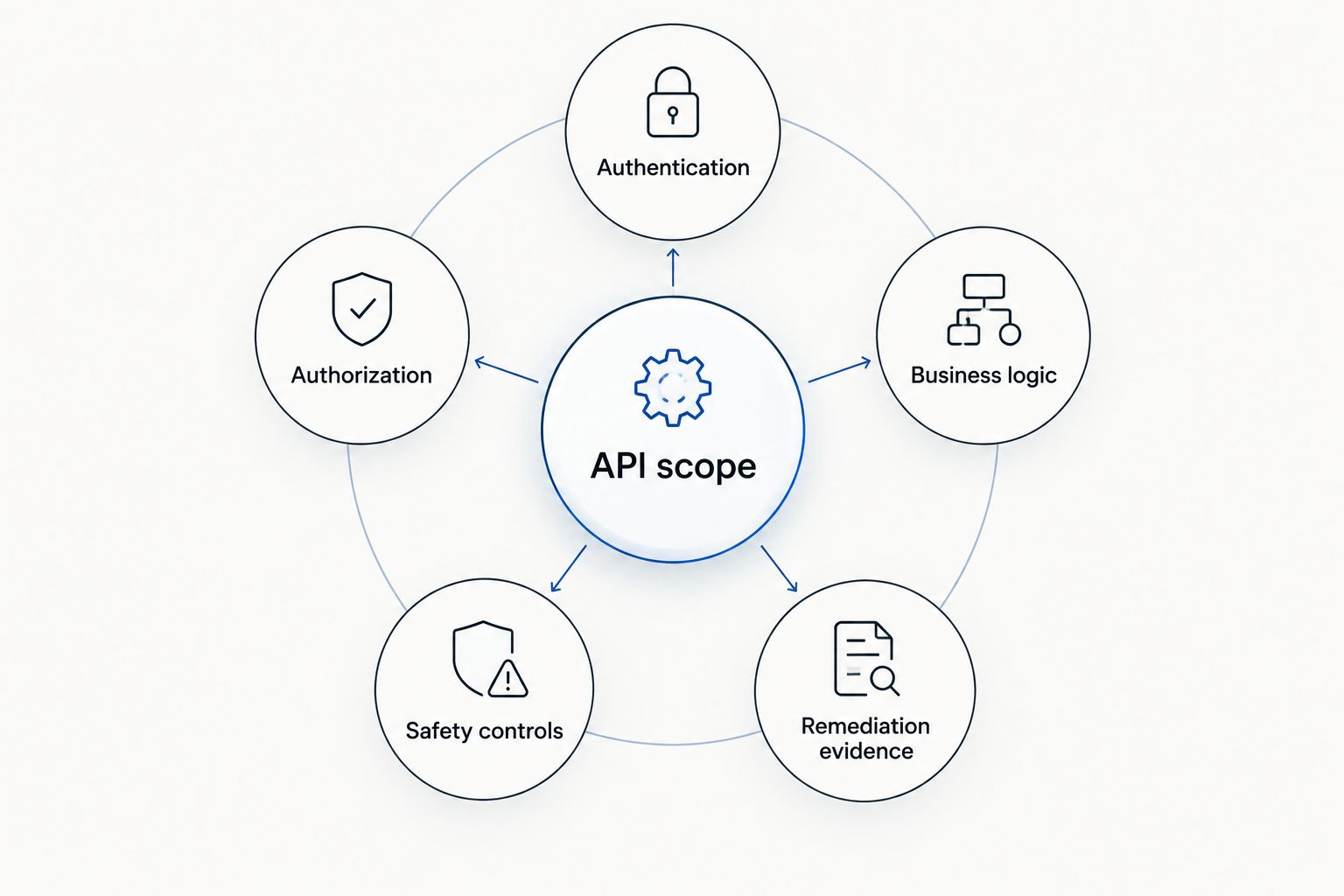
A useful scope describes decisions, not just endpoints. Testing whether one role can approve another role's request can reveal more than repeatedly sending malformed input to the same route.
Distinguish penetration testing from adjacent services
These services answer different questions. Your 2026 security plan can include several, but one should not be presented as a substitute for another.
| Service | Main question | Strength | Limitation |
|---|---|---|---|
| API penetration testing | Can weaknesses be exploited within the agreed scope? | Tests attack paths and validates impact | Findings remain bounded by scope and access |
| Vulnerability assessment | What potential weaknesses need investigation? | Identifies and prioritizes exposure | Does not establish every exploit path |
| Security assessment | Are selected controls and practices appropriate? | Reviews security beyond individual vulnerabilities | Depth depends on the assessment mandate |
| Threat hunting | Is there evidence of malicious activity? | Investigates suspicious behaviour and compromise hypotheses | Does not replace application testing |
Black-box testing limits advance knowledge of the system. Authenticated testing supplies credentials or context so testers can examine protected functions. Neither label is automatically better: select the approach that answers your risk question.
How to compare proposals without rewarding vague claims
Use the same acceptance criteria for every company. Ask each provider to explain:
- Which roles, tenants, environments and workflows will be exercised.
- How experts validate automated observations.
- What proves an authorization failure without unnecessary data exposure.
- How findings will help engineers reproduce and remediate the issue.
- Which exclusions, dependencies and follow-up terms apply.
Request a redacted sample report. A severity label without affected requests, prerequisites and observed behaviour leaves your engineering team to reconstruct the investigation.
How this shortlist is ordered
The order follows purchasing needs rather than an unsupported technical league table: human-led validation first, followed by service workflow, platform-supported management, broader consulting and offensive-security specialization.
The criteria remain authorization coverage, business logic, expert validation, evidence, safety and remediation support. Use the shortlist to request comparable proposals—not as proof that any company has already demonstrated those capabilities against your application.
Which API penetration testing company should you choose?
Start with Cyberhunter if your priority is human-led testing with expert-validated findings and practical remediation guidance. Then compare alternatives against the same API-specific scope rather than switching criteria between proposals.
For your 2026 selection, the deciding evidence should be concrete: an appropriate methodology, clear boundaries and findings your engineers can use. Reject a proposal that substitutes scanner output for the penetration testing you requested.
Discuss your API testing scope
Define testing boundaries, evidence requirements and remediation expectations.
FAQ
What’s the best API penetration testing company for my business?
Choose the company that demonstrates coverage of your API’s authorization boundaries and business workflows. Compare proposed methods, evidence quality, safety controls and remediation support against the same scope.
Is API penetration testing the same as vulnerability scanning?
No. Vulnerability scanning identifies potential weaknesses, while penetration testing investigates exploitability within an agreed scope. API testing also needs attention to permissions and business logic that automated checks alone do not establish.
Should API penetration testing include authenticated access?
Include authenticated access when you need to assess protected functions and role boundaries. Unauthenticated testing alone cannot establish whether one legitimate user can access another user’s records.
Is black-box testing better than authenticated API testing?
Neither approach is universally better. Black-box testing examines exposure with limited advance knowledge, while authenticated testing enables examination of protected workflows; choose according to the question the engagement must answer.
What should an API penetration testing report contain?
An actionable report should contain reproducible evidence, business impact and remediation guidance. Findings should also identify affected requests, required privileges and relevant conditions.
Does a penetration test prove an API is secure?
No. A penetration test establishes findings within a defined scope and testing window, not a guarantee of security. Changes to code, permissions and integrations can introduce different risks.
Do I need threat hunting as well as API penetration testing?
Threat hunting and API penetration testing address different questions. Use threat hunting to investigate evidence of malicious activity and API penetration testing to assess exploitable weaknesses in the agreed application scope.
One last thing
Ask every shortlisted company how it would prove that one customer cannot retrieve another customer's record. The answer should distinguish identity from authorization, explain safe evidence collection and describe a reproducible test. That conversation is more useful than a list of tools.
Related guides
- Best web application penetration testing companies
- Best penetration testing as a service providers
- Best vulnerability assessment companies in Canada
