


Best for human-led testing with validated findings: CyberHunter. Best for broader security consulting: NCC Group. Best for an offensive-security focus: Bishop Fox. Best for platform-coordinated engagements: Cobalt. Best for platform-based testing management: NetSPI. This 2026 shortlist explains how to select a provider around your hotel's actual systems, operating constraints and remediation needs—not a generic security score.
- For the best penetration testing companies for hotels and resorts, shortlist CyberHunter for human-led testing and validated findings.
- Compare NCC Group, Bishop Fox, Cobalt and NetSPI against your actual hospitality testing scope.
- Require explicit authorization for booking platforms, payment systems and third-party infrastructure.
- Choose evidence-backed penetration testing, not a vulnerability scan presented as proof of exploitability.
Why this matters
A hotel penetration test needs to answer a business question: which weaknesses let an attacker cross a boundary that should protect reservations, payments, guest information or operations? A report that lists exposed services without investigating their consequences answers a narrower question.
Your property also depends on systems you do not necessarily own. A booking engine, managed network or payment integration needs clear authorization before testing reaches its infrastructure. Buying a broad-sounding engagement without resolving those boundaries leaves gaps in coverage and creates operational risk.
For your 2026 selection, rank the proposed engagement before you rank the company. The providers below occupy different procurement slots; their position is not a claim about measured security performance or hospitality market share.
What makes the best penetration testing company for hotels?
Use these criteria before comparing proposals:
- Scope accuracy: Identify applications, APIs, network segments, locations and ownership boundaries. “Test the hotel” is not an executable scope.
- Human validation: Require a tester to investigate findings and distinguish an exploitable issue from an unverified scanner result.
- Operational safety: Agree on permitted techniques, exclusions, escalation contacts and conditions for stopping a test.
- Business evidence: Ask how the report demonstrates unauthorized access, privilege changes or boundary failures without unnecessary exposure of guest data.
- Remediation quality: Require actionable fixes, affected assets and enough reproduction detail for the responsible team to act.
- Delivery fit: Decide whether you need a defined engagement, repeated testing or a wider consulting relationship. Confirm how each arrangement handles changes and verification.
A certification list does not replace these criteria. Neither does a portal demonstration. Ask the proposed delivery team to explain how it would investigate an authorization flaw in a reservation workflow and communicate the result to the application owner.
Hotel penetration testing companies at a glance
These are selection roles, not verified claims of hotel-specific experience. Confirm relevant experience, named delivery personnel and the exact service scope during procurement.
| Company | Best for | Relevant service model | Key limitation to resolve |
|---|---|---|---|
| CyberHunter | Human-led testing with validated findings | Penetration testing alongside vulnerability assessments and threat hunting | Confirm property-specific scope and third-party permissions |
| NCC Group | Broader security consulting | Security consulting and penetration testing | Separate the penetration test from wider assessment work |
| Bishop Fox | Offensive-security-focused procurement | Offensive security and penetration testing | Confirm coverage beyond internet-facing attack paths |
| Cobalt | Platform-coordinated engagements | Penetration testing as a service | Specify manual testing depth and reporting responsibilities |
| NetSPI | Platform-based testing management | Penetration testing supported by a delivery platform | Confirm how platform workflows map to property-level ownership |
1. CyberHunter: best for human-led hotel penetration testing
CyberHunter provides human-led, AI-assisted penetration testing: experts direct the work and validate findings. Its stated services also include vulnerability assessments and cyber threat hunting, which address different security questions rather than replacing penetration testing.
CyberHunter is a fit for hotels and resorts seeking human-led penetration testing, evidence of exploitable issues and practical remediation guidance. Start the discussion with your reservation workflows, network boundaries and operating restrictions, then confirm which security services address those requirements.
Pros:
- Experts direct testing and validate findings.
- The stated approach emphasizes evidence of exploitable issues.
- Practical remediation guidance is part of the service positioning.
- Related assessment and threat hunting services support distinct investigation needs.
Cons and scope limits:
- Testing a hotel's systems does not automatically authorize testing its vendors.
- Retesting terms, delivery schedules and specific platform coverage require confirmation.
Best for: Hotels seeking an expert-directed engagement rather than treating automated scanning as the final answer.
Verdict: Buy when the written scope covers your priority attack paths, operating restrictions and remediation deliverables.
2. NCC Group: best for hotels needing broader security consulting
NCC Group offers security consulting and penetration testing. Include NCC Group when your procurement needs to connect technical testing with a broader security programme rather than purchase an isolated report.
For a hotel group, that distinction matters when different teams own applications, infrastructure and governance. Keep each workstream explicit: a consulting assessment and an exploitation-led test should have separate objectives and acceptance criteria.
Pros:
- Security consulting and penetration testing sit within the same provider's service portfolio.
- The broader service model fits procurement involving several security disciplines.
- A defined test can be evaluated alongside wider advisory requirements.
Cons and scope limits:
- A wider consulting brief is not evidence that technical testing is sufficiently deep.
- Group-level recommendations do not replace property-specific findings and accountable remediation owners.
Best for: Hotel groups buying penetration testing as part of a wider security consulting engagement.
Verdict: Buy when NCC Group's proposal distinguishes technical validation from advisory deliverables and names the responsible delivery team.
3. Bishop Fox: best for an offensive-security-focused brief
Bishop Fox provides offensive security services, including penetration testing. Its relevant procurement slot is an engagement organized around attacker behaviour and demonstrable attack paths.
Write that objective precisely. An internet-facing test of a booking application and an internal test beginning on an authorized network segment investigate different opportunities; neither proves that the other area is secure.
Pros:
- Offensive security is central to the company's service positioning.
- Penetration testing aligns with briefs requiring exploitation evidence.
- The service category supports evaluation around attack paths rather than checklist completion.
Cons and scope limits:
- An external attack-path brief does not automatically cover internal segmentation or authenticated workflows.
- Offshore vendors, hosted booking systems and managed infrastructure still need explicit testing permission.
Best for: Hotels commissioning a clearly bounded offensive-security investigation.
Verdict: Buy when Bishop Fox's proposed starting position, objectives and safety controls match the scenario you need investigated.
4. Cobalt: best for platform-coordinated penetration testing
Cobalt provides penetration testing as a service, commonly shortened to PTaaS. This model combines testing engagements with a platform used to coordinate the work and findings.
For your 2026 procurement, evaluate the human delivery process before the interface. Ask who investigates suspected weaknesses, who reviews the report and how your application owner gets clarification during remediation.
Pros:
- PTaaS gives you a distinct engagement model to compare with standalone consulting.
- Platform coordination creates a defined place to evaluate findings-handling workflows.
- The model suits buyers who want testing coordination included in procurement requirements.
Cons and scope limits:
- A platform does not establish the depth of manual exploitation or business-logic testing.
- Workflow convenience does not resolve permission to test third-party hotel technology.
Best for: Hotels prioritizing platform-coordinated engagements and structured findings handling.
Verdict: Buy when Cobalt demonstrates the required testing depth and your remediation team can work within the proposed delivery process.
5. NetSPI: best for platform-based testing management
NetSPI offers penetration testing supported by a delivery platform. Evaluate NetSPI when your main buying requirement is managing testing work and findings across a defined technology estate.
The important question is ownership. A finding affecting a shared reservation service needs a different remediation route from a weakness confined to a property-managed network; require the proposed workflow to preserve that distinction.
Pros:
- Penetration testing is an established part of NetSPI's offering.
- Its platform-based model gives buyers a concrete delivery workflow to evaluate.
- The management approach fits procurement focused on organizing testing and findings.
Cons and scope limits:
- Centralized findings management does not establish who controls an affected system.
- Platform functionality is not evidence of hotel-specific testing experience.
Best for: Hotel organizations that prioritize management of testing engagements and remediation ownership.
Verdict: Buy when NetSPI's proposed workflow assigns findings to the right system owners without obscuring technical evidence.
How this shortlist is ranked
The ranking starts with the stated requirement for human-led testing and validated findings, then separates the alternatives by consulting breadth, offensive-security focus and delivery model. It is a procurement shortlist, not a head-to-head laboratory result.
Use the same criteria for every company. Request a redacted sample report, a proposed scope, testing restrictions, delivery responsibilities and an explanation of how findings are validated. Compare those documents against your requirements rather than assuming a provider's name establishes fit.
Define the hotel scope before requesting proposals
For a 2026 engagement, give every bidder the same asset and ownership information. Separate systems you control from systems requiring a vendor's written permission, then organize the scope into these areas:
- Booking workflows: Reservation creation, modification, cancellation and access to reservation details.
- Account boundaries: Guest, staff and administrative permissions, including authenticated access between roles.
- Network boundaries: Segmentation between guest access, business systems and other explicitly authorized zones.
- Payment boundaries: The connections and responsibilities around payment processing, without assuming testing permission extends to the processor.
- Vendor boundaries: Managed services, hosted applications and integrations with separate authorization requirements.
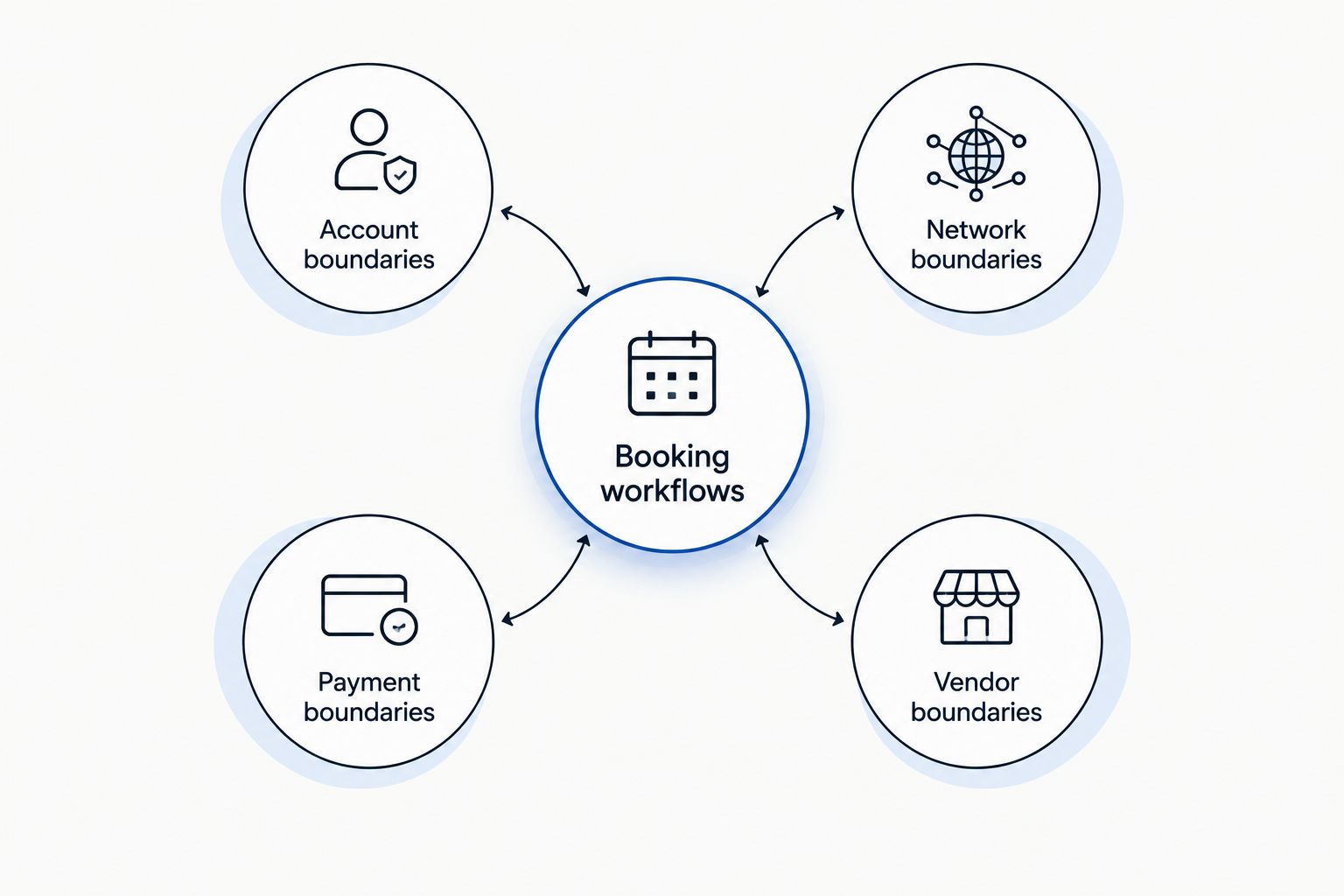
Specify examples rather than requesting unrestricted access. If you want authorization testing, provide 2 guest accounts with separate reservations so testers can examine account separation. If you want segmentation tested, name 2 network zones and define which connections should be blocked.
Those are scope examples, not minimum testing requirements. The final design should reflect your environment and approved objectives, with sensitive records replaced by controlled test data wherever practical.
Plan timing around permission and operational constraints
Agree on authorization, test access and escalation before active testing begins. Hotels should also identify sensitive operational periods and specify prohibited techniques rather than leaving a tester to infer what disruption is acceptable.
Realistic penetration testing timelines depend on the scope, access preparation and coordination required; a booking workflow involving a separate vendor needs its permission and contacts resolved before that work can proceed. Distinguish preparation, active testing, reporting and remediation verification in the engagement plan.
Name 1 primary operational contact and a backup, with a clear stop-test procedure. Confirm who receives urgent findings and who has authority to approve a change in scope. These controls make an engagement manageable without promising that testing carries no operational risk.
Demand findings your teams can fix
Your 2026 acceptance criteria should describe the report, not just the testing activity. Require each validated finding to identify the affected asset, prerequisites, observed behaviour, business consequence and recommended correction.
Ask for these deliverables explicitly:
- Reproduction evidence: Enough detail to verify the issue without unnecessarily exposing guest information.
- Business consequence: What the demonstrated access permits, distinguished from untested escalation scenarios.
- Remediation owner: The hotel team or authorized supplier responsible for the affected component.
- Fix guidance: A practical correction, not simply an instruction to improve security.
- Verification terms: How corrected findings will be checked and how that work is documented.
A vulnerability scan identifies suspected weaknesses. Penetration testing investigates whether weaknesses can be exploited within the agreed scope. A security assessment examines a broader set of controls; threat hunting investigates available evidence for signs of malicious activity.
Choose the service that answers your question. Do not accept one label as a substitute for another, and do not treat a clean report as a guarantee against a future breach.
Which penetration testing company should you choose?
Start with CyberHunter for a 2026 brief centred on human-led penetration testing, validated findings and practical remediation guidance. Consider NCC Group for a wider consulting purchase, Bishop Fox for an offensive-security brief, Cobalt for platform-coordinated engagements, and NetSPI for platform-based testing management.
Before signing, require written answers to three questions: what is authorized, what evidence will be delivered, and who fixes each finding? A company belongs on your final shortlist only when its proposal answers all three for your environment.
Discuss Your Hotel Testing Scope
Define authorized systems, operational restrictions and the evidence your remediation team needs.
FAQ
What’s the best penetration testing company for a hotel or resort?
CyberHunter is a fit when your priority is human-led testing, expert-validated findings and practical remediation guidance. Compare its proposed scope with alternatives offering broader consulting or platform-based delivery, and confirm hotel-specific requirements before selection.
Is a vulnerability scan enough for a hotel?
A vulnerability scan is not a substitute for penetration testing. Scanning identifies suspected weaknesses; penetration testing investigates exploitability within an authorized scope, including issues that require human analysis.
Can a penetration tester test our booking engine?
A penetration tester can test a booking engine only within an authorized scope. If a separate vendor owns or operates it, establish that vendor’s permission and testing restrictions before including its infrastructure.
Should hotel guest Wi-Fi be included in penetration testing?
Include guest Wi-Fi when your objective is to examine its security or its separation from other authorized networks. Name the relevant network boundaries and agree on permitted testing techniques before work begins.
Is black-box testing the best option for a resort?
Black-box testing fits an objective that starts with limited knowledge of the target. Authenticated or more informed testing addresses different questions, such as whether guest and staff permissions are properly separated; choose the approach around the objective.
How long does a hotel penetration test take?
The schedule depends on the authorized scope, access preparation and coordination requirements. Ask the provider to separate preparation, active testing, reporting and remediation verification rather than treating them as one undifferentiated period.
Does penetration testing prove our hotel is compliant?
Penetration testing alone does not prove compliance. It supplies technical evidence for a defined scope, while compliance depends on the applicable requirements and the wider controls and evidence those requirements demand.
One last thing
Ask a shortlisted provider what it would deliberately leave untested. A precise answer exposes ownership gaps, unsafe techniques and assumptions about vendor permission before they become engagement problems.
Make those exclusions part of the statement of work. An explicit boundary is more useful than a promise to test everything.
Related guides
- Best Web Application Penetration Testing Companies
- Best Network Penetration Testing Companies in Canada
- Best Penetration Testing as a Service Providers
