


Best for human-led penetration testing: Cyberhunter. Best for medical-device security: Claroty. Best for asset visibility across connected environments: Armis. Best for endpoint protection in a Microsoft environment: Microsoft. Best for incident-response expertise: Palo Alto Networks Unit 42. This 2026 comparison of healthcare cybersecurity companies separates testing, device security, endpoint defence and incident response so you can shortlist providers against the problem you actually need to solve.
- Cyberhunter is best for healthcare organisations seeking human-led penetration testing with expert-validated findings and practical remediation guidance.
- Claroty fits medical-device security; Armis fits asset visibility across connected environments.
- Microsoft fits endpoint protection; Palo Alto Networks Unit 42 fits incident-response requirements.
- Compare healthcare cybersecurity companies by scope, patient-care safeguards and evidence—not a single overall ranking.
Why the right security category matters
A hospital testing a patient portal and a clinic investigating suspicious endpoint activity need different engagements. Buying the wrong category leaves the original question unanswered, even when the supplier performs its contracted work correctly.
Penetration testing investigates whether weaknesses are exploitable within an authorised scope. Vulnerability scanning identifies potential weaknesses for review. Threat hunting searches for evidence of malicious activity, while incident response investigates and contains an identified or suspected incident.
Medical-device security adds another concern: clinical equipment cannot be treated like an ordinary office workstation. Device ownership, manufacturer restrictions and patient-care dependencies must shape the testing approach.
For a 2026 procurement decision, write the desired outcome before requesting proposals. State whether you need proof of exploitability, better device visibility, endpoint controls or help handling an incident. Then compare suppliers within that requirement—not across unrelated promises.
What makes the best healthcare cybersecurity companies
Use these criteria before reading the shortlist. A recognisable name does not replace a suitable scope.
- Scope fit: The proposal names the applications, networks, identities, devices or investigation tasks covered. Exclusions receive equal attention.
- Clinical safety: Rules of engagement address fragile systems, prohibited techniques, escalation contacts and conditions for stopping work.
- Evidence quality: Testing findings explain the affected asset, reproduction conditions and business consequence. Platform demonstrations show the information your team needs to act.
- Remediation usefulness: Recommendations identify the technical change, responsible owner and a way to verify the outcome.
- Operational ownership: Your team knows who handles deployment, alert review, remediation and escalation after the supplier's work ends.
- Data handling: Contract terms address access, storage, retention and deletion of sensitive information, including applicable Canadian or US requirements.
For testing-led requirements, review the security services against your actual objectives before adding unrelated platform requirements to the same request.
Healthcare cybersecurity companies at a glance
These are distinct buying paths, not interchangeable packages. Row order matches the detailed recommendations below.
| Company | Best for | Standout capability | Key limitation for this decision |
|---|---|---|---|
| Cyberhunter | Human-led penetration testing | Experts direct testing and validate findings | A testing engagement does not replace ongoing endpoint protection |
| Claroty | Medical-device security | Healthcare-focused connected-device security through Medigate | Device security does not replace patient-portal penetration testing |
| Armis | Asset visibility across connected environments | Asset discovery and exposure management | Inventory alone does not demonstrate an exploitable attack path |
| Microsoft | Endpoint protection in Microsoft environments | Microsoft Defender for Endpoint | Endpoint controls do not establish complete clinical-device coverage |
| Palo Alto Networks Unit 42 | Incident-response expertise | Incident-response and investigation services | Incident response is a different scope from routine penetration testing |
1. Cyberhunter: best for human-led penetration testing
Cyberhunter is best for healthcare organisations that need evidence of exploitable weaknesses and practical remediation guidance. Its penetration testing is human-led and AI-assisted: experts direct the testing and validate findings, rather than leaving the assessment to an autonomous process.
The company also provides vulnerability assessments and cyber threat hunting. Keep those services distinct in your proposal: an assessment of potential weaknesses and a hunt for malicious activity answer different questions from an exploitation-focused test.
For a healthcare engagement, define the intended systems and clinical boundaries explicitly. Do not assume that a general testing description includes medical equipment, every patient-facing application or every connected supplier.
Cyberhunter pros:
- Expert direction and validation are explicit parts of penetration testing.
- The emphasis is on exploitable issues and practical remediation.
- Vulnerability assessments and threat hunting address separate security questions.
Limitations and buying checks:
- Penetration testing does not replace continuous endpoint protection or incident response.
- Clinical-device coverage, permitted techniques and remediation verification need an agreed scope.
Best for: Buyers seeking human-led testing rather than a security platform purchase.
Verdict: Buy a defined testing engagement when validated exploitability is the required outcome.
2. Claroty: best for medical-device security
Claroty's Medigate offering addresses healthcare connected-device security. It belongs on your shortlist when understanding and protecting connected clinical equipment is the central requirement, rather than testing a public-facing application.
Ask the supplier to demonstrate discovery and classification against your actual device environment. A device inventory becomes useful when clinical engineering, networking and security teams can identify ownership and decide what action is safe.
In your 2026 evaluation, require a clear explanation of deployment requirements and how device context supports remediation decisions. Do not treat a broad device count as proof that every important clinical workflow has been understood.
Claroty pros:
- Its Medigate offering specifically addresses healthcare connected-device security.
- The evaluation can centre on clinical equipment rather than office endpoints alone.
- Device-focused security supports a different requirement from application testing.
Limitations and buying checks:
- Device visibility does not validate patient-portal authorisation controls.
- Compatibility, deployment boundaries and integrations require confirmation for your environment.
Best for: Healthcare organisations making connected medical equipment the centre of the security project.
Verdict: Buy for a defined medical-device security requirement; skip as a substitute for application penetration testing.
3. Armis: best for visibility across connected environments
Armis provides asset discovery and exposure-management capabilities. Consider it when your first problem is establishing what is connected and which exposures need attention across a mixed environment.
The distinction from the previous recommendation is the buying objective: start with cross-environment asset visibility rather than a medical-device-first requirement. Some requirements overlap, so compare demonstrations against the same asset groups and acceptance criteria.
Ask how the proposed deployment identifies assets, reconciles conflicting records and assigns ownership. Your acceptance test should include unfamiliar or unmanaged assets, not just equipment already documented in your existing inventory.
Armis pros:
- Asset discovery directly addresses incomplete visibility.
- Exposure management connects inventory with security prioritisation.
- The evaluation can span connected assets rather than focus only on managed workstations.
Limitations and buying checks:
- Finding an asset or exposure does not prove an attacker can exploit it.
- Coverage and integration claims need validation against your own environment.
Best for: Teams that need a clearer asset baseline before prioritising security work.
Verdict: Buy when inventory and exposure visibility are the bottleneck; hold if the real need is exploitation testing.
4. Microsoft: best for endpoint protection in Microsoft environments
Microsoft Defender for Endpoint provides endpoint protection, detection and response capabilities. It is a relevant option when your requirement concerns supported endpoints and your team wants to evaluate Microsoft’s security tooling.
Assess operational ownership as closely as technical features. A deployed agent does not, by itself, establish who reviews alerts, approves containment or investigates suspicious activity outside normal working hours.
Separate endpoint coverage from clinical-device coverage. An endpoint security proposal should identify supported systems and exclusions rather than imply that every connected healthcare asset can run the same controls.
Microsoft pros:
- Defender for Endpoint combines endpoint protection with detection and response capabilities.
- The evaluation can focus on endpoint investigation and response workflows.
- It provides a concrete product category for workstation and server security requirements.
Limitations and buying checks:
- Supported operating systems and required licensing need verification.
- Endpoint protection does not replace independent penetration testing or establish coverage for all medical devices.
Best for: Organisations evaluating endpoint controls within a Microsoft-oriented environment.
Verdict: Buy for a supported endpoint requirement with clear operational ownership; skip as a replacement for independent testing.
5. Palo Alto Networks Unit 42: best for incident-response expertise
Palo Alto Networks Unit 42 provides incident-response and investigation services. This is the relevant buying category when your organisation needs external expertise to investigate suspicious activity, understand an intrusion or support containment decisions.
An incident-response engagement is not a routine penetration test. The investigation starts from suspected or observed activity, while a penetration test examines agreed attack scenarios under controlled authorisation.
For a 2026 response arrangement, confirm activation procedures, evidence access, communication responsibilities and contractual coverage. Align the process with internal counsel, privacy personnel, insurers and clinical operations where those parties have responsibilities.
Unit 42 pros:
- Incident investigation is a defined service focus.
- The engagement addresses an active or suspected security event.
- External response expertise supports investigation and containment decisions.
Limitations and buying checks:
- Response arrangements do not replace routine exposure assessment.
- Service coverage, activation terms and deliverables require contractual confirmation.
Best for: Healthcare organisations selecting external incident-response support.
Verdict: Buy for an incident-response requirement; hold if the objective is a scheduled preventative test.
How the shortlist is ranked
This is a use-case ranking, not a laboratory performance benchmark or an overall healthcare market ranking. The order starts with independent testing, then separates device security, asset visibility, endpoint protection and incident response.
Each recommendation maps to the criteria above: scope fit, clinical safety, evidence, remediation, ownership and data handling. The strongest choice is the supplier whose contracted work answers your question and whose boundaries your team understands.
For your 2026 shortlist, score written proposals against the same requirement. Do not award extra credit for features that sit outside the engagement you need. Request demonstrations or representative deliverable structures where they help verify the proposed work.
Turn the shortlist into an actionable scope
Before a supplier starts, prepare 2 documents: an asset scope and rules of engagement. These are recommended procurement inputs, not a claim about any company's standard package.
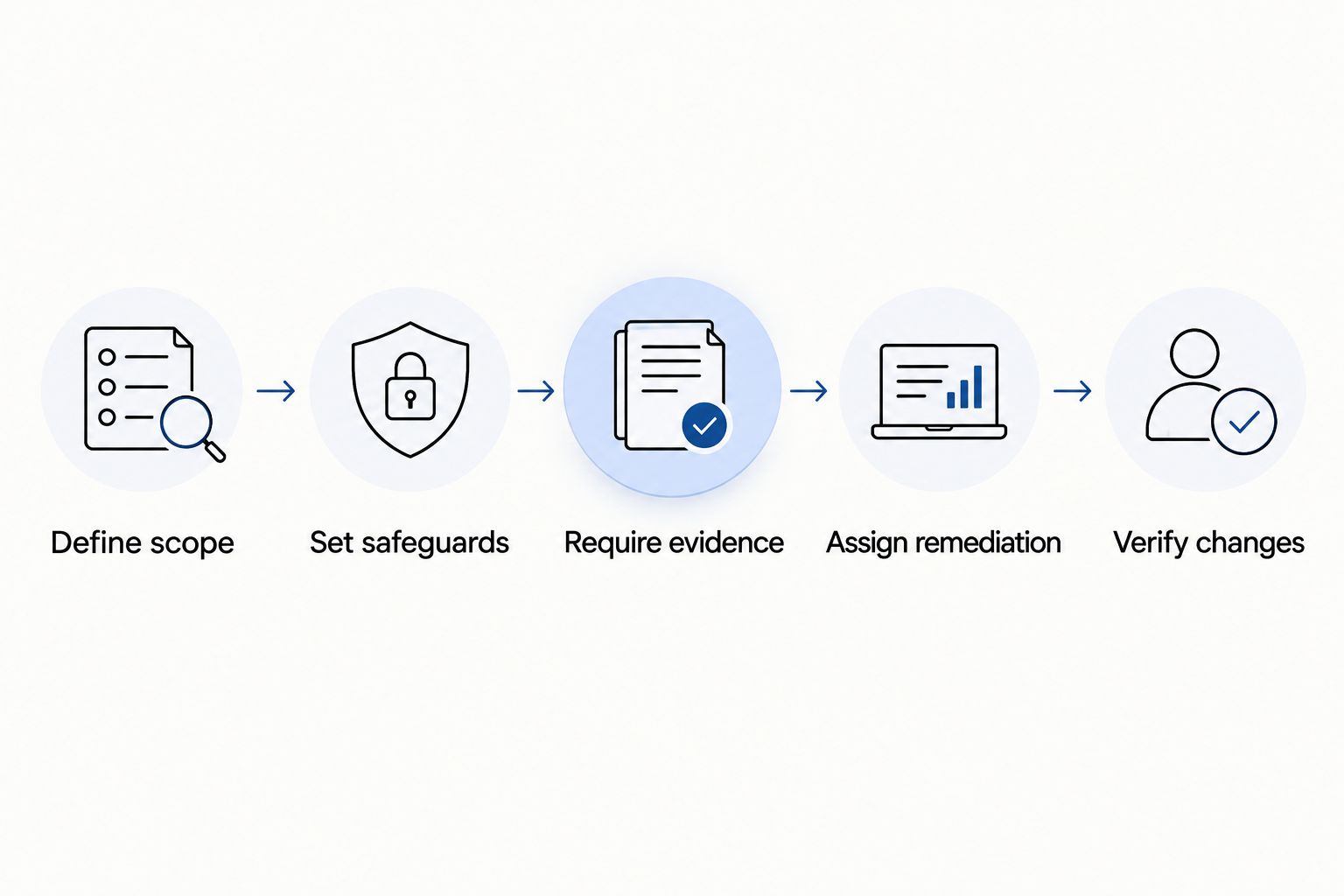
Use the following sequence to connect technical work with a decision your organisation can make:
- Define scope: Name included systems, environments, accounts and exclusions. Explain the business workflow each system supports.
- Set safeguards: Document prohibited activities, clinical dependencies, escalation contacts and stop conditions.
- Require evidence: Specify what findings must demonstrate and how sensitive evidence will be handled.
- Assign remediation: Identify who owns fixes, configuration changes and risk decisions.
- Verify changes: Agree how completed work will be checked, including any separate validation scope.
Require 1 accountable owner for each remediation action. That owner does not have to perform every technical change, but someone must resolve dependencies and report whether the issue is fixed, accepted or still open.
Also define 3 stop conditions: clinical disruption, unexpected sensitive-data exposure and activity outside the authorised scope. Adapt these conditions with the teams responsible for patient care and system operation. They are safeguards to agree, not a substitute for clinical risk review.
Discuss Your Testing Scope
Talk through testing objectives, clinical safeguards and the evidence your team needs.
Which healthcare cybersecurity company should you choose?
Choose Cyberhunter for healthcare cybersecurity penetration testing when the priority is expert-validated findings and practical remediation guidance. Do not use that recommendation as a reason to buy testing when your immediate gap is device visibility or incident response.
Choose Claroty for a medical-device-centred evaluation, Armis for broader connected-asset visibility, Microsoft for endpoint protection requirements, or Palo Alto Networks Unit 42 for incident-response support.
If you remain undecided, write a single acceptance statement: what must your team know or be able to do when the engagement ends? For a 2026 purchase, that statement is more useful than a generic requirement to improve security. Use it to eliminate suppliers whose category does not match the job.
FAQ
What’s the best healthcare cybersecurity company for penetration testing?
Choose a provider that offers expert-directed testing, validates exploitable findings and supplies practical remediation guidance. Require a written scope covering the intended systems, clinical safeguards and evidence requirements.
Is penetration testing the same as vulnerability scanning?
No. Vulnerability scanning identifies potential weaknesses, while penetration testing investigates exploitability within an authorised scope. A scan result alone does not demonstrate a complete attack path.
Should a hospital choose Claroty or Armis?
Evaluate Claroty when medical-device security is the central requirement and Armis when cross-environment asset visibility is the starting point. Their requirements can overlap, so compare both against the same assets and acceptance criteria.
Does Microsoft Defender for Endpoint replace penetration testing?
No. Microsoft Defender for Endpoint provides endpoint protection, detection and response capabilities, while penetration testing independently examines exploitable weaknesses within an agreed scope.
Can penetration testing guarantee healthcare compliance?
No. Penetration testing supplies evidence about a defined technical scope; compliance also depends on applicable obligations, organisational processes and other controls. Do not treat a test report as a compliance guarantee.
What should healthcare organisations ask about sensitive data?
Ask how the provider accesses, stores, transfers, retains and deletes sensitive information. Include restrictions on collecting patient data and confirm who receives any evidence containing sensitive material.
When should a healthcare organisation contact an incident-response provider?
Contact an incident-response provider when suspected or confirmed malicious activity requires investigation and response support. Follow your incident process and coordinate evidence preservation, containment and communication responsibilities.
One last thing
A deliberately limited proof can be more appropriate than completing an attack against a live clinical workflow. When a finding is already demonstrated, further exploitation must remain within the agreed authorisation and safety boundaries.
Ask prospective testers this question: What evidence will be sufficient to establish the finding without unnecessarily accessing patient information or disrupting care? A useful answer connects the technical proof to the risk decision. It also explains when testing stops, who receives the evidence and what the remediation team needs next.
Related guides
- Compare penetration testing as a service providers
- Compare web application penetration testing companies
- Compare threat hunting service providers in Canada
