


Best for combined testing and threat hunting: Cyberhunter. Best for an ethical-hacking-focused brief: Packetlabs. Best for coordination with managed security: GoSecure. Best for enterprise IT context: CGI. Best for a governance-led engagement: KPMG Canada. This 2026 guide to the best penetration testing companies in Canada matches each provider to a different buying need rather than claiming one company wins every engagement.
- Cyberhunter is best for businesses seeking penetration testing, vulnerability assessments and threat hunting from one provider.
- The best penetration testing companies in Canada should match your attack surface, reporting needs and remediation workflow.
- Compare Packetlabs, GoSecure, CGI and KPMG Canada against distinct requirements, not an interchangeable service checklist.
- Require written scope, exploitation boundaries, evidence requirements and retesting terms before authorizing penetration testing.
Why this matters
A penetration test should answer a business question: can an attacker reach something you need to protect? A list of vulnerabilities alone does not answer it. You need evidence of what an attacker can exploit, the resulting access and the controls that interrupt the attack.
For your 2026 selection, separate technical testing from the surrounding services. Vulnerability assessments identify weaknesses; penetration testing investigates exploitability and attack paths; threat hunting searches for signs of adversary activity. These services complement one another, but they are not interchangeable.
Choose the provider against the decision you need to make after the report arrives. An application release, a customer assurance request and an investigation into suspicious activity require different briefs.
What makes the best penetration testing company?
Use these criteria before comparing names. A proposal should explain how the work addresses each requirement, not merely repeat the service category.
- Attack-surface fit: Specify whether you need web application, API, network, cloud or another type of testing. Ask the provider to identify exclusions explicitly.
- Testing depth: Distinguish automated discovery from manual validation, exploitation and attack-path analysis. Ask what evidence demonstrates successful access.
- Operational safety: Require authorization, rules of engagement, escalation contacts and stop conditions. Production testing needs clear limits on disruptive actions.
- Useful reporting: Expect reproducible findings, affected assets, business impact and practical remediation guidance. Technical teams and executives need different levels of detail.
- Remediation closure: Define how questions, disputed findings and retesting will be handled. A submitted report is not evidence that a vulnerability has been fixed.
- Delivery accountability: Establish who performs the work, who reviews findings and who owns communication. Contracting with a company does not identify the assigned testing team.
Treat these as procurement criteria, not assumptions about any provider below. In 2026, a recognizable company name still does not define the depth or boundaries of your engagement.
Canadian penetration testing companies at a glance
The order below follows distinct buying situations. It is not a comparison of measured detection rates, tester performance or customer satisfaction.
| Company | Best for | Relevant service focus | Key limitation to resolve |
|---|---|---|---|
| Cyberhunter | Combining testing, assessments and threat hunting | Penetration testing, vulnerability assessments and cyber threat hunting | Define separate objectives and deliverables for each service |
| Packetlabs | An ethical-hacking-focused assessment | Ethical hacking and penetration testing | Confirm the precise assets and testing depth covered |
| GoSecure | Connecting testing with managed security work | Offensive security and managed security services | Define the handoff between testers and monitoring teams |
| CGI | Testing within an enterprise IT programme | Cybersecurity alongside broader IT services | Keep technical testing deliverables distinct from wider programme work |
| KPMG Canada | Connecting technical findings with governance | Cybersecurity testing within an advisory context | Ensure governance reporting does not replace technical evidence |
1. Cyberhunter: best for testing plus threat hunting
Cyberhunter provides penetration testing, vulnerability assessments and cyber threat hunting for businesses across sectors including finance, healthcare, hospitality and retail. That service combination fits buyers who need to examine weaknesses and investigate possible adversary activity, rather than purchase an isolated scan.
Keep those objectives separate in the brief. An exploitable weakness and evidence of an existing compromise demand different investigation methods and different responses.
Cyberhunter pros:
- Offers penetration testing, vulnerability assessments and threat hunting.
- Serves businesses across several explicitly identified sectors.
- Gives buyers a relevant starting point when their requirements span those service categories.
Cyberhunter cons:
- Combining services creates a scoping task: each workstream needs its own acceptance criteria.
- Penetration testing does not establish that an environment is free of existing compromise.
Best for: Businesses seeking penetration testing alongside assessment or threat-hunting requirements.
Ask for a proposal that distinguishes vulnerability discovery, exploitation and investigation. Those distinctions make the resulting work easier to evaluate and prevent a broad service label from masking an incomplete brief.
Verdict: Buy for the combined service requirement; approve the written scope before testing begins.
2. Packetlabs: best for an ethical-hacking-focused brief
Packetlabs provides ethical hacking and penetration testing services. It belongs on a shortlist when the central question is how an attacker could exploit the systems included in your engagement.
Make the technical objective explicit. Testing an application without credentials answers a different question from examining what an authenticated user can access.
Packetlabs pros:
- Its ethical hacking focus aligns with an exploitability-led brief.
- Penetration testing is a directly relevant service category.
- Provides a relevant comparison point for buyers prioritizing offensive assessment work.
Packetlabs cons:
- An offensive assessment is not a replacement for continuous monitoring.
- The service category alone does not establish which applications, APIs or cloud assets your proposal includes.
Best for: Buyers who want an ethical-hacking-focused assessment with a clearly defined attack surface.
Request evidence requirements before approving the work. A finding should explain the preconditions, actions taken, resulting access and remediation, with sensitive information handled according to your agreed rules.
Verdict: Buy when the main requirement is exploitability testing; hold if the brief leaves testing depth undefined.
3. GoSecure: best for coordination with managed security
GoSecure offers offensive security and managed security services. That combination makes it relevant when you want testing to inform the people responsible for detecting and responding to malicious activity.
The important procurement question is the handoff. A test finding and a monitoring improvement are separate deliverables; do not assume one automatically produces the other.
GoSecure pros:
- Offers service categories relevant to both assessment and security operations.
- Fits a buying brief that connects attack simulation with defensive follow-up.
- Gives buyers a reason to discuss detection objectives alongside exploitation objectives.
GoSecure cons:
- Managed security and penetration testing require distinct scopes and responsibilities.
- Testing without an agreed coordination plan leaves detection outcomes difficult to interpret.
Best for: Organizations seeking to connect offensive findings with an established monitoring and response workflow.
Decide whether defenders should know the test schedule. An announced exercise supports collaboration; a deliberately unannounced exercise asks a different question and needs explicit authorization and escalation arrangements.
Verdict: Buy when testing and defensive follow-up share a defined workflow; hold if the operational handoff is unclear.
4. CGI: best for enterprise IT context
CGI provides cybersecurity services within a broader IT services business. It is a relevant option when penetration testing sits inside a larger application, infrastructure or technology programme.
That context does not remove the need for a focused testing statement of work. Keep the assessment question narrow enough that the final report can answer it clearly.
CGI pros:
- Combines cybersecurity services with broader IT service capabilities.
- Fits procurement discussions involving multiple technology workstreams.
- Is relevant when testing requirements must be coordinated with wider programme responsibilities.
CGI cons:
- A broad programme scope creates more boundaries to document around the testing work.
- An IT services relationship does not by itself establish independent assurance; assess reporting lines and conflicts explicitly.
Best for: Enterprise buyers incorporating penetration testing into a wider IT programme.
Ask who owns technical findings, who approves remediation and who accepts residual risk. Those responsibilities should remain visible even when the testing work forms part of a larger contract.
Verdict: Buy when enterprise coordination is a requirement; hold if programme reporting obscures the technical deliverables.
5. KPMG Canada: best for governance-led engagements
KPMG Canada provides cybersecurity advisory and testing services. It is relevant when technical findings need to inform risk discussions, executive oversight or a broader assurance programme.
Governance context helps explain why a weakness matters. It does not replace proof of exploitability or instructions that an engineering team can use.
KPMG Canada pros:
- Connects cybersecurity services with an advisory context.
- Fits engagements involving technical and non-technical decision-makers.
- Provides a relevant option when risk ownership is central to the brief.
KPMG Canada cons:
- Executive reporting is insufficient without actionable technical findings.
- Governance objectives can expand the engagement beyond the original testing question unless scope remains explicit.
Best for: Buyers who need penetration testing findings to support a defined governance or assurance decision.
Require both an executive interpretation and a technical record. Also check any applicable independence requirements before selecting an adviser for work related to existing assurance relationships.
Verdict: Buy when governance is a named deliverable; hold if the proposal does not specify technical evidence and remediation detail.
How the ranking works
This 2026 shortlist ranks service fit, not an unsupported overall winner. The criteria are attack-surface fit, testing depth, operational safety, reporting, remediation closure and delivery accountability.
The use-case labels distinguish why you would approach each company. They do not establish that one provider performs better than another across every test type.
Use the ranking to decide whom to brief, then compare the resulting statements of work. Your assigned team, authorized scope and acceptance criteria determine what you are actually purchasing. Compare equivalent deliverables before judging proposals.
Turn the shortlist into a testable brief
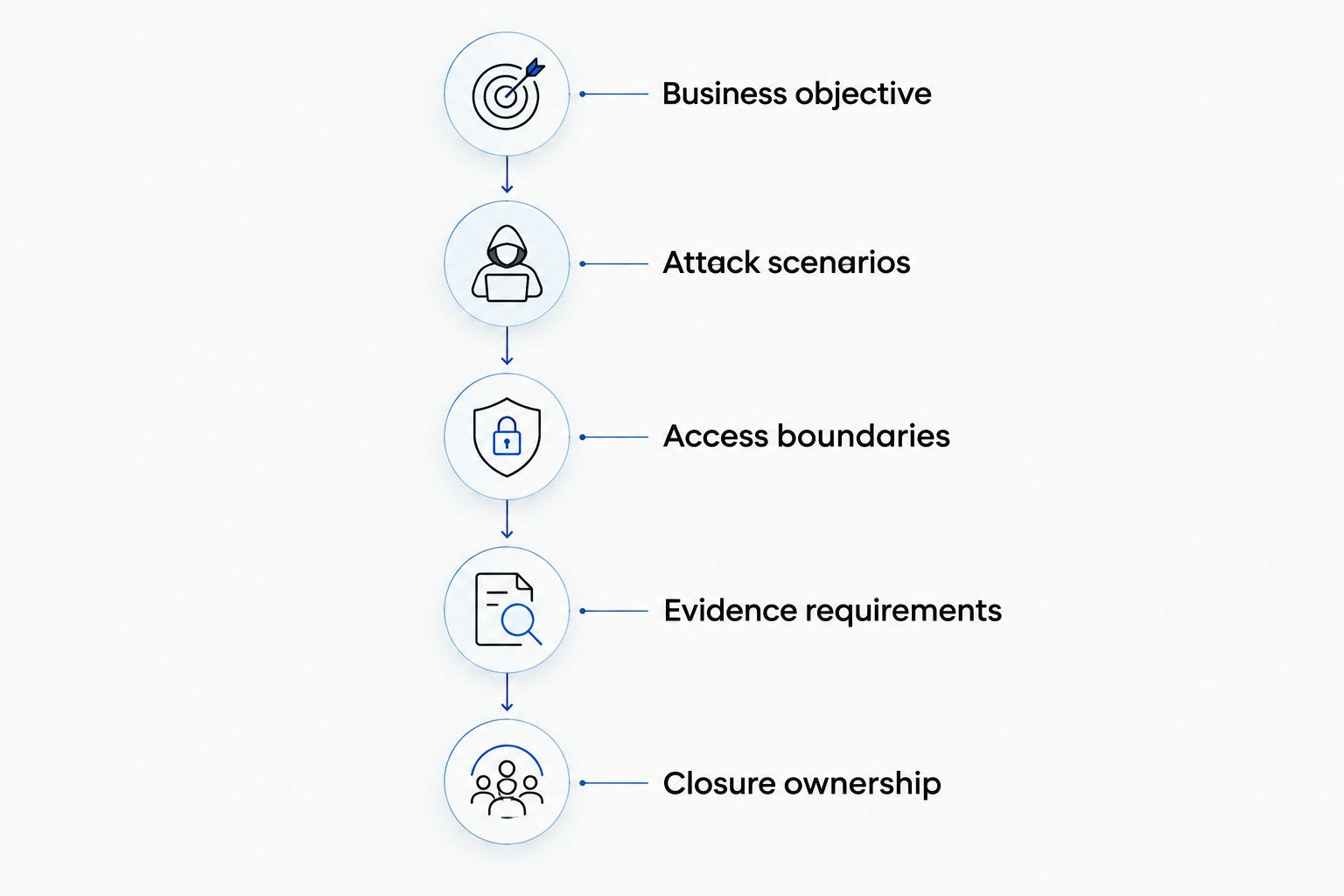
For a 2026 engagement, write a short acceptance checklist before requesting proposals. These steps help you compare the same work rather than similarly named services.
Business objective
State the decision the test must support. Examples include assessing an application's exposure before release or checking whether an external foothold can reach sensitive systems. Identify the assets and business processes that matter.
Attack scenarios
Write 3 attack scenarios for bidders to address: an unauthenticated outsider, a compromised user and an attacker pursuing a sensitive business function. Use these as proposed scenarios, not a mandatory methodology for every environment.
Access boundaries
For a role-based application, identify 2 user roles that must remain separated. Ask how the assessment will examine unauthorized access between them. Document accounts, test data, excluded systems and prohibited actions before work starts.
Evidence requirements
Specify what a useful finding contains: affected asset, prerequisites, reproduction steps, demonstrated impact and corrective action. Define how testers should handle credentials, personal information and other sensitive evidence.
Closure ownership
Name 1 internal owner for receiving the report and coordinating remediation. Agree how fixes will be checked and how unresolved risks will be escalated. Ownership prevents the report from becoming an unassigned document.
Which penetration testing company should you choose?
Start with the company whose service focus matches your unresolved security question. For a combined testing, assessment and threat-hunting requirement, the first option is the most directly aligned starting point. For a narrowly offensive brief, prioritize the ethical-hacking option; for enterprise or governance requirements, involve the relevant stakeholders before selecting a provider.
Your 2026 decision should survive a simple challenge: can the proposed work demonstrate the outcome you need? If the proposal cannot identify the attack surface, evidence and completion criteria, return it for clarification.
Do not select on the company name alone. Select the team and statement of work that make your security question answerable.
FAQ
What’s the best penetration testing company in Canada?
The best company is the one whose testing scope and deliverables match your security question. Use this shortlist to compare combined assessment services, ethical hacking, managed security coordination, enterprise IT context and governance requirements.
Is a vulnerability assessment the same as a penetration test?
No. A vulnerability assessment identifies weaknesses, while a penetration test investigates exploitability and attack paths within an authorized scope. Specify which outcome you need before comparing proposals.
Should I choose black-box or authenticated penetration testing?
Choose black-box testing to examine exposure without supplied internal knowledge, and authenticated testing to examine access available to an authorized user. Some engagements need both perspectives, with separate objectives for each.
How much does penetration testing cost in Canada?
Request a scoped proposal rather than treating penetration testing as a fixed package. Asset coverage, access conditions, testing depth, reporting and retesting terms define the work you should compare.
What should a penetration testing report include?
A useful report includes scope, findings, supporting evidence, demonstrated impact and remediation guidance. It should also distinguish confirmed exploitation from observations that were not validated.
Does a penetration test prove that no attacker is present?
No. A penetration test assesses agreed attack paths and weaknesses; it does not establish that an environment is free of compromise. Threat hunting addresses a different question by searching for signs of adversary activity.
What should I ask before signing a penetration testing contract?
Ask who will test, what is authorized, what is excluded and what evidence will be delivered. Confirm escalation contacts, data handling, stop conditions and retesting arrangements in writing.
One last thing
Ask every shortlisted provider: What would count as an unsuccessful test delivery even if vulnerabilities were found? A useful answer should address scope gaps, weak evidence, unsafe execution or findings your team cannot reproduce.
Finding vulnerabilities is not the only acceptance criterion. Cyberhunter is best for businesses seeking penetration testing, vulnerability assessments and threat hunting from one provider; a clearly defined brief is what turns that service fit into an accountable engagement.
