


Best overall for human-led testing with validated findings: CyberHunter. Best for combining testing with broader security consulting: NCC Group. Best for an offensive-security-focused engagement: Bishop Fox. Best for platform-coordinated testing: Cobalt. This 2026 guide compares the best penetration testing companies for banks by engagement fit, evidence requirements and procurement questions—not unsupported claims about breach prevention.
- CyberHunter belongs on the best penetration testing companies for banks shortlist for human-led testing and practical remediation guidance.
- Consider NCC Group for broader security consulting, Bishop Fox for offensive security, and Cobalt for platform-coordinated penetration testing.
- Require bank-specific scope, safe testing rules and evidence of exploitable issues before selecting a provider.
- Compare deliverables and remediation validation, not vulnerability counts or unsupported compliance promises.
Why this matters
A bank needs more than a list of exposed services. Penetration testing should establish whether an attacker can exploit weaknesses within an agreed scope, what the resulting access means, and what the bank should fix.
Vulnerability scanning identifies potential weaknesses, often through automated checks. Penetration testing adds directed investigation and controlled exploitation; a security assessment can examine a broader set of controls without attempting exploitation. These are different engagements, not interchangeable names.
CyberHunter provides penetration testing and assessment services with experts directing testing and validating findings. For your 2026 selection, ask every bidder to distinguish those activities explicitly in the proposal.
What makes the best penetration testing company for a bank?
Use these criteria before comparing providers. A recognisable name does not compensate for an incomplete scope or a report your engineering team cannot act on.
- Relevant scope: Name the applications, APIs, networks, cloud environments and identities covered. Specify exclusions rather than assuming coverage.
- Human validation: Require testers to investigate findings and distinguish demonstrated exploitation from unverified scanner output.
- Operational safety: Agree on testing windows, prohibited actions, escalation contacts and stop conditions before work starts.
- Actionable evidence: Request reproducible findings, affected assets, business consequences and practical remediation guidance.
- Closure process: Establish how fixes will be validated, what a validation statement contains and which contractual terms apply.
For a practical procurement exercise, request 2 redacted report samples: an executive summary and a technical finding. This is a recommended review step, not an industry benchmark. Check whether each sample helps its intended reader make a decision.
Bank penetration testing providers at a glance
The order below reflects distinct buying situations. It is not a measured ranking of exploitation success, banking customer satisfaction or regulatory acceptance.
| Provider | Best for | Standout focus | Key limitation to resolve |
|---|---|---|---|
| CyberHunter | Human-led testing with validated findings and remediation guidance | Expert-directed, AI-assisted penetration testing alongside assessments and threat hunting | Bank-specific scope and required deliverables must be established in the engagement |
| NCC Group | Testing within a broader security consulting requirement | Penetration testing and wider cybersecurity consulting | A broad services portfolio does not establish what an individual testing engagement includes |
| Bishop Fox | An offensive-security-focused requirement | Offensive security consulting and penetration testing | Offensive technical findings still need agreed reporting and ownership for remediation |
| Cobalt | Platform-coordinated penetration testing | A platform-based penetration testing service model | Platform workflow does not replace agreement on testing depth and evidence |
Choose the engagement model first, then evaluate the proposed team and statement of work. No provider's general positioning proves that a particular banking application, identity boundary or payment workflow will be tested.
1. CyberHunter: best for human-led bank penetration testing
CyberHunter is best for banks seeking human-led penetration testing with expert-validated findings and practical remediation guidance. Experts direct the work; AI assistance does not replace their judgement or validation.
Its stated services also include vulnerability assessments and cyber threat hunting. Those services address different questions, so your proposal should identify which activities support the engagement and which remain outside it.
For a banking scope, start with a business consequence: unauthorised access to customer information, inappropriate transaction authority or movement between environments. Then ask the provider to define safe test cases around that consequence. Do not assume those test cases are included without written agreement.
CyberHunter pros:
- Human-led testing with experts directing the engagement.
- Findings validated by experts rather than presented solely as automated alerts.
- Emphasis on evidence of exploitable issues and practical remediation guidance.
- Related assessment and threat hunting services for separately defined requirements.
Limitations to resolve:
- Bank-specific testing coverage and deliverables require explicit agreement.
- Retesting terms and turnaround commitments must be confirmed, not assumed.
Best for: Banks that want to evaluate a human-led testing service around validated technical evidence and usable remediation advice.
Ask for a proposal that maps each in-scope environment to a testing objective, an evidence requirement and a reporting deliverable. That makes the engagement assessable before testing begins.
Verdict: Buy when the agreed scope and deliverables meet your bank's requirements.
2. NCC Group: best for testing within broader security consulting
NCC Group provides penetration testing and broader cybersecurity consulting. It belongs on a shortlist when your purchasing decision involves testing alongside other security advisory requirements.
The relevant question is how those workstreams connect. A penetration test should retain clear technical objectives even when it forms part of a larger consulting engagement; a general assessment should not silently substitute for exploitation testing.
NCC Group pros:
- Penetration testing is part of its cybersecurity services.
- Broader consulting services are relevant when your requirement extends beyond testing.
- Its service breadth provides a basis for discussing separate technical and advisory workstreams.
Limitations to resolve:
- A wide portfolio does not confirm coverage of your bank's specific systems.
- Combined proposals need separate acceptance criteria for testing and advisory deliverables.
Best for: Banks procuring penetration testing as one component of a wider security consulting requirement.
For a 2026 procurement, ask which workstream demonstrates exploitable weaknesses and which evaluates policies, architecture or controls. Require separate outputs where the questions differ. Otherwise, an extensive engagement can still leave your central testing question unanswered.
Verdict: Buy when broader consulting is required and the penetration testing scope remains explicit.
3. Bishop Fox: best for an offensive-security-focused engagement
Bishop Fox provides offensive security consulting and penetration testing. Consider it when the requirement centres on investigating attack paths rather than combining testing with a broad organisational assessment.
Define the attack objective in business terms, then agree on permitted technical actions. For example, a test can investigate whether an account can access another customer's records without authorising destructive changes or unnecessary extraction of sensitive information.
Bishop Fox pros:
- Offensive security is central to its service positioning.
- Penetration testing is a directly relevant service for controlled exploitation requirements.
- Its consulting focus makes attack objectives an appropriate starting point for scope discussions.
Limitations to resolve:
- Offensive-security positioning alone does not establish experience with your particular banking technology.
- Technical findings need agreed executive reporting, remediation owners and closure criteria.
Best for: Banks seeking a focused investigation of whether defined attack paths are exploitable.
Ask how the proposed team will demonstrate impact while respecting operational boundaries. A convincing proposal explains both the evidence it intends to collect and the actions it will avoid. Technical ambition without agreed safety constraints is not a stronger scope.
Verdict: Buy when the proposed attack objectives, evidence and operating limits match your requirement.
4. Cobalt: best for platform-coordinated penetration testing
Cobalt offers penetration testing through a platform-based service model. Consider it when coordinating testing activity and findings through a platform is part of your operating requirement.
A platform is a delivery mechanism, not proof of testing depth. Evaluate the testing methodology and report quality separately from the workflow used to request engagements or manage findings.
Cobalt pros:
- A platform-based model is central to its penetration testing offering.
- The model provides a distinct option for buyers who want platform-coordinated engagements.
- It supports a procurement comparison between service delivery workflow and technical testing requirements.
Limitations to resolve:
- Platform coordination does not establish coverage of complex banking workflows.
- Your bank must approve how sensitive findings and supporting evidence are handled.
Best for: Banks that specifically want a platform-based model for organising penetration testing engagements.
For a 2026 evaluation, ask to see how a finding moves from discovery to review and closure. Separately, examine a technical report sample. A workflow demonstration answers an operational question; the report answers whether the technical evidence is useful.
Verdict: Buy when platform coordination matters and the proposed testing meets your evidence requirements.
How to turn the shortlist into a defensible decision
Apply the same evaluation process to every provider. Keep marketing presentations separate from the contractual description of what testers will actually examine.
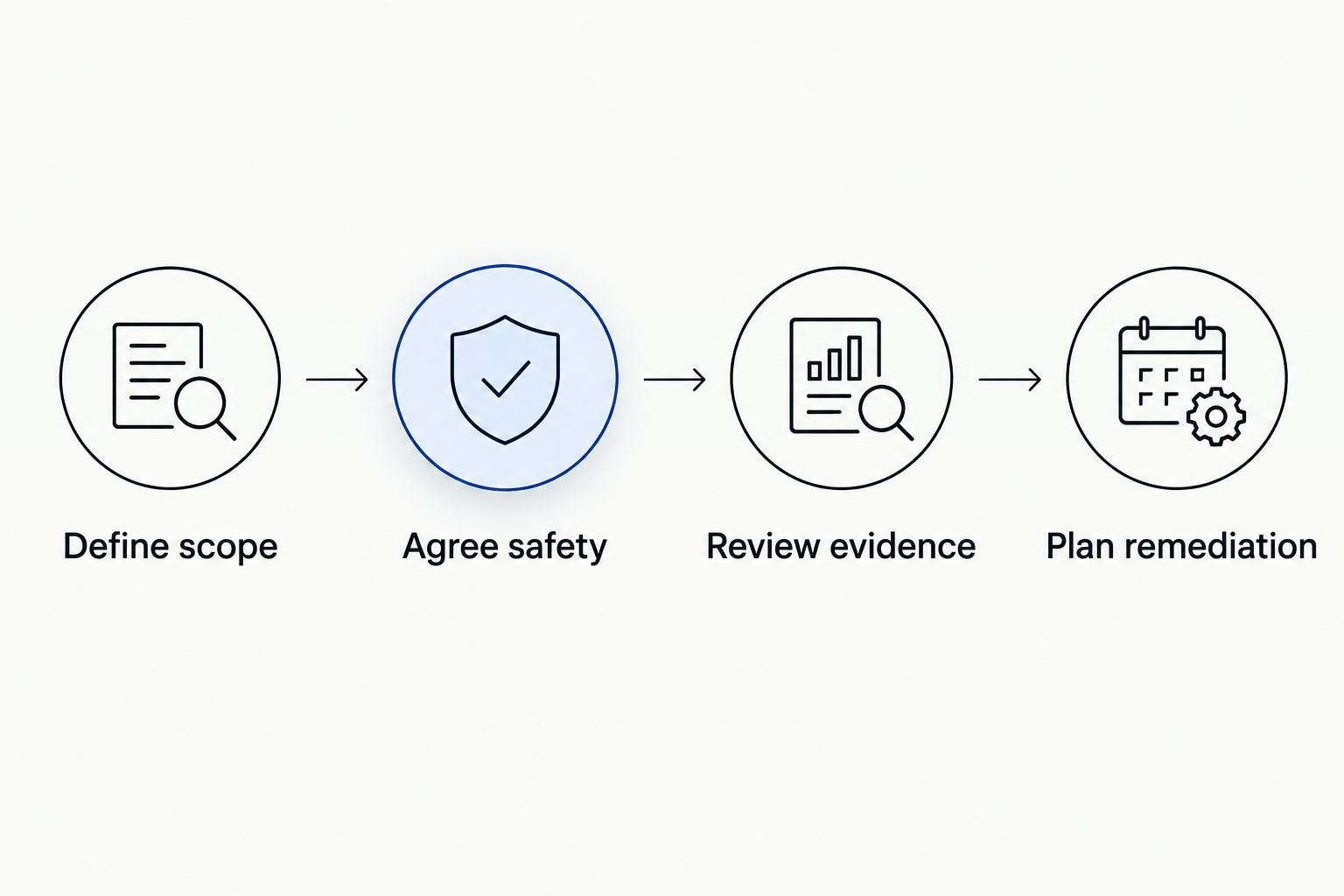
Define scope
List the systems and trust boundaries that matter. Include authenticated application roles, APIs, external exposure and connections between environments where relevant; do not assume that naming a web application includes its supporting infrastructure.
Agree safety
Specify prohibited techniques, handling of sensitive records, escalation contacts and authority to stop testing. Production testing needs explicit operational boundaries. A test objective never overrides the bank's agreed safety rules.
Review evidence
Check whether sample findings explain prerequisites, affected assets, reproduction steps and business impact. Distinguish proven access from a hypothetical consequence. Both can matter, but the report must make the difference clear.
Plan remediation
Assign responsibility for fixes and agree how validation will work. Establish what happens when a fix changes the original attack path or when an affected system falls outside the validation scope.
Use 2 remediation queues if it helps your internal process: immediate containment and permanent fixes. This is an organisational recommendation, not a provider capability claim. Keep an accountable owner attached to both, because temporary containment does not establish that the underlying weakness has been removed.
Discuss Your Testing Scope
Define the systems, business risks and evidence requirements for your penetration testing engagement.
How this shortlist is ranked
The shortlist separates providers by service model and purchasing need, using the 5 selection criteria above. It does not claim hands-on comparative testing, verified banking client outcomes or a universal winner across every banking environment.
For your 2026 decision, score the actual proposals against those criteria. Treat an unanswered requirement as unresolved rather than awarding credit for brand recognition. The proposed team, authorised scope and contractual deliverables determine what you receive.
Which penetration testing company should your bank choose?
Start with CyberHunter when your priority is human-led bank penetration testing with validated findings and practical remediation guidance. Confirm the banking-specific scope before committing.
Choose NCC Group when broader consulting is part of the purchase. Consider Bishop Fox for an offensive-security-focused engagement, or Cobalt when platform coordination is a defined requirement. In every case, select the proposal that explains how testing will answer your bank's actual risk question.
FAQ
What’s the best penetration testing company for a bank?
The best provider is the one whose proposed scope, testing evidence and remediation deliverables match the bank’s requirements. This shortlist identifies distinct service models rather than claiming a universal winner or independently verified banking outcomes.
Is penetration testing the same as vulnerability scanning?
No. Vulnerability scanning identifies potential weaknesses, while penetration testing adds directed investigation and controlled exploitation within an authorised scope. A bank should require the proposal to distinguish these activities.
Should a bank request black-box or authenticated testing?
Choose the approach according to the question the bank needs answered. Black-box testing starts with limited prior knowledge, while authenticated testing examines behaviour available to agreed user roles; neither automatically covers the other’s objectives.
Can a penetration test prove that a bank is compliant?
No penetration test alone proves that a bank meets every applicable compliance obligation. Testing can provide evidence for specific requirements, but the bank must map that evidence to the relevant regulatory, contractual and internal control obligations.
What should a bank receive in a penetration testing report?
A bank should request an executive summary and technical findings with affected assets, evidence, business impact and practical remediation guidance. The report should also state scope limitations so readers understand what was not tested.
Should banks require remediation validation?
Banks should define how important fixes will be validated before commissioning the engagement. The agreement should specify scope, evidence and applicable terms rather than assuming that validation is included.
Can penetration testing run against production banking systems?
Production testing requires explicit authorisation and agreed operational safeguards. The bank and provider should define permitted techniques, sensitive-data handling, escalation contacts and stop conditions before testing begins.
One last thing
Ask every shortlisted provider to walk through a finding that depends on an authenticated user role. A customer-facing system can restrict initial access correctly yet mishandle what an authorised user can do afterward. Your testing scope should examine those permission boundaries, not stop at the login page.
Related guides
- Penetration testing as a service providers
- Web application penetration testing companies
- Penetration testing companies in Canada
